






Before participating in SpaceX’s trillion-dollar IPO, you need to understand these key numbers first


- Core View: SpaceX will list on Nasdaq at a fixed price of $135, raising approximately $75 billion, with a valuation between $1.75 and $1.8 trillion. Market controversy centers on its high valuation of 94 times price-to-sales, the selling pressure from a staggered early unlock structure, and the risk of passive funds being forced to buy in after Nasdaq changed its rules to accommodate the listing.
- Key Elements:
- SpaceX's 2025 revenue is approximately $18.7 billion, with a net loss of about $4.9 billion, corresponding to a price-to-sales ratio of roughly 94x. Its business includes rocket launches, Starlink, and the not-yet-commercialized Starship and AI.
- The retail allocation ratio is 30% of newly issued shares (approximately $22.5 billion), far exceeding the 5%-10% typical for large traditional IPOs, potentially drawing liquidity from other markets (such as crypto assets).
- Insiders are subject to a 180-day lock-up period but with a staggered early unlock structure. The earliest unlock allows selling 20% of shares after the first earnings report (July-September), meaning selling pressure may arrive earlier than expected.
- Nasdaq modified its "fast inclusion" rules for SpaceX, allowing it to enter the Nasdaq-100 index within 15 trading days. Its low free float (4.3%) will force passive funds to buy at a high weight.
- There is a huge divergence in underwriter valuations: Goldman Sachs predicts AI division revenue of $322 billion by 2030, while Morningstar's fair value estimate is only $780 billion, less than half of the IPO target.
- On-chain pricing is aggressive. Binance's SPCXUSDT perpetual contract implies a valuation exceeding $2 trillion, and Polymarket markets show over 70% probability of the valuation surpassing $2 trillion.
SpaceX is set to land on the Nasdaq at tomorrow's opening bell.
With an IPO price of $135 per share, the company plans to issue approximately 556 million shares, aiming to raise about $75 billion. This corresponds to a valuation between approximately $1.75 trillion and $1.8 trillion. Market sources indicate that subscription demand has exceeded $250 billion, representing nearly 4x oversubscription.
Goldman Sachs and Morgan Stanley are acting as the two lead bookrunners, with a total of 23 investment banks forming the entire underwriting syndicate. Goldman Sachs secured the coveted "lead left" position, with its name printed in the top left corner of the S-1 filing's front page, and is also the bank managing the books. This arrangement is somewhat delicate: Morgan Stanley has had a partnership with Elon Musk for over 15 years, following him from the Tesla IPO to the financing for the Twitter acquisition, yet this time it has taken the second seat.
In terms of regional distribution, Barclays is handling the UK, Deutsche Bank and UBS cover continental Europe, the Royal Bank of Canada is managing Canada, and Mizuho is responsible for Asia.
Based on this all-star lineup and the fundraising scale, the total underwriting fee pool for Wall Street from this transaction is estimated to be between $800 million and over $1 billion.
There is no "price range" this time. SpaceX has skipped the traditional IPO roadshow and price discovery process, opening subscriptions directly at a fixed price of $135. The order book is expected to close between June 8 and 10, with pricing on June 11.
Regarding the stock structure, SpaceX had previously received approval for a 5-for-1 stock split. Post-IPO, Musk will still maintain extremely high voting power. Common shareholders will receive economic exposure, not control. As for the lock-up period, insiders face a 180-day lock-up, with the timing precisely scheduled around the Nasdaq's mid-December index rebalancing window. At that point, passive funds will be forced to buy heavily according to the rules.
This IPO involves the issuance of approximately 556 million new shares, all of which will enter the public float upon listing, accounting for about 4.3% of the company's total share capital. Of these, 30% are allocated to retail investors, equivalent to roughly $22.5 billion. This is three times the typical 5% to 10% allocation for large US IPOs. Morgan Stanley's E*Trade platform will serve small and mid-sized retail investors, while Bank of America handles US high-net-worth clients. Fidelity, Robinhood, Charles Schwab, and SoFi have all opened their subscription channels.
Will SpaceX Drain Liquidity from the Broader Market?
Intuitively, an IPO raising $75 billion with a retail share allocation of 30% of new shares must inevitably drain liquidity from elsewhere.
Retail investors need to come up with this cash from somewhere, and the easiest way is to sell the stocks and crypto assets they already hold. The pressure on Bitcoin in recent weeks may partly stem from this source.
So, does a large tech company IPO necessarily mean draining liquidity from the broader market? Let's first look at some background data.
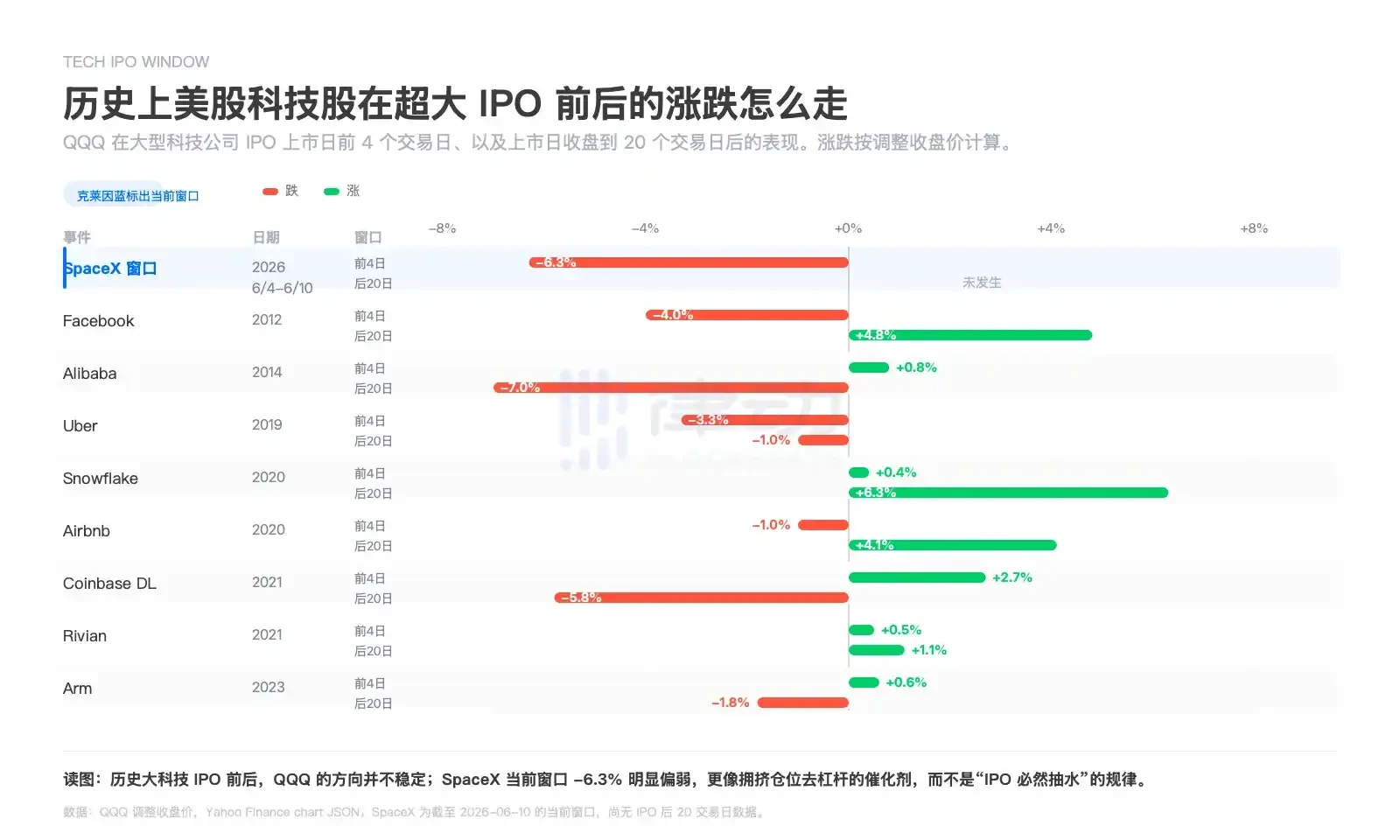
According to data, the performance of the Nasdaq ETF (QQQ) around historical large-cap tech IPOs shows a clear divergence in the 4 trading days before and after the IPO, as well as in the 20 trading days post-listing.
IPOs like Facebook, Snowflake, Airbnb, and Coinbase mostly recorded positive returns 20 days after listing, while Uber, some phases of Alibaba, and Arm showed weakness or significant volatility.
Current simulated data for the SpaceX IPO window shows a cumulative return of approximately -6.3% in the four days prior, weaker than most historical samples.
This data leads us more towards the conclusion: a large tech company IPO does not necessarily mean draining liquidity from the broader market.
But this does not mean all assets are safe. SpaceX is likely to compress the marginal capital most reliant on forward risk appetite, such as long-tail assets and high-beta positions.
Andri Fauzan Adziima, Head of Research at Bitrue Research Institute, calls this pressure the "IPO tax."
Do the Financials Not Support the Valuation?
This is also the most contentious issue surrounding the SpaceX IPO.
Public filings show that SpaceX's 2025 revenue was approximately $18.7 billion, with a net loss of about $4.9 billion. At a $1.75 trillion valuation, this equates to roughly 94 times the 2025 price-to-sales ratio for a company that is still loss-making.
In terms of business structure, the segment closest to a mature publicly-traded company is the connectivity service provided by Starlink. Rocket launches provide deployment capabilities and a technical moat. However, what truly pushes the valuation ceiling higher is AI. After SpaceX acquired xAI in February 2026 at a combined valuation of $1.25 trillion, it is no longer just an aerospace company.
The story Musk wants to tell is a longer chain: rockets reduce the cost of reaching orbit, Starlink lays down global connectivity, Starship delivers heavier equipment into orbit, the AI business creates demand for computing power, and data centers are eventually placed in space.
It's a grand narrative. But Musk is packaging all these businesses together for investors. This includes not only the proven Starlink and the validated Falcon 9, but also the uncommercialized Starship, the unproven economics of orbital data centers, and the yet-to-be-profitable, somewhat stalled AI business.
Consequently, analysts and different markets have widely varying estimates for SpaceX's revenue and fair valuation.
On the most conservative end is Morningstar, which estimates fair value at around $780 billion, less than half the IPO target. It doesn't deny SpaceX's technical capabilities, acknowledging the company has a "narrow moat" and that SpaceX alone accounted for over half of global rocket launches last year. However, it views the feasibility, timeline, and financial outcomes of orbital computing and the AI business as highly uncertain.
NYU Finance Professor Aswath Damodaran's model gives a valuation range of $1.22 trillion to $1.29 trillion. He acknowledges the engineering advantages but believes the upside above $1.75 trillion has thinned. Long-term holder Scottish Mortgage's anchor position is around $1.25 trillion, also not directly aligning with the IPO target price.
The underwriting side, however, is pushing the price skyward. Goldman Sachs predicts SpaceX's AI division alone could contribute annual revenue of $322 billion by 2030, with total company revenue exceeding $470 billion. Morgan Stanley goes further, forecasting revenue of $3.4 trillion by 2040 and adjusted EBITDA exceeding $2.7 trillion.
The most aggressive pricing comes from on-chain. The SPCXUSDT perpetual contract launched by Binance in May reflects an expected valuation range between $1.75 trillion and $2 trillion. Polymarket shows over a 70% probability betting the final IPO valuation will exceed $2 trillion. As the listing nears, Binance has adjusted the estimated number of SpaceX shares underlying the SPCXUSDT contract from 11.87 billion to 13.08 billion, implying a valuation exceeding $2 trillion at current prices.
Currently, the next Starship test flight is scheduled for June. If it can achieve stable, high-frequency, and low-cost commercial operations, Musk may once again successfully tell a perfect story. However, if it fails during the roadshow period, or progress falls short of expectations, many long-term narratives could be impacted, thereby shaking the market cap and stock price.
Will the Unlock Come Too Soon?
The issue of unlocking is another point of investor discontent with the SpaceX IPO.
Typically, new listings have a 180-day lock-up period during which insiders cannot sell, aiming to give the market time to establish a true price.
SpaceX nominally also has a 180-day period, but many are unaware that it uses a staggered early unlock structure, dividing the 180 days into several segments.
The first unlocking date arrives just after the Q2 earnings report, allowing eligible insiders to sell up to 20% of their shares, likely between mid-July and September.
In other words, just over a month after listing, the first batch of unlocked shares could appear. Other insiders can start selling as early as the second trading day following the first quarterly earnings report, which is likely in August.
Further arrangements follow. If the stock price is more than 30% above the IPO price for at least five of ten consecutive trading days before the first earnings report, an additional early unlock of up to 10% is permitted. This is supplemented by five scheduled tranches releasing at days 70, 90, 105, 120, and 135, with up to another 28% unlocking after the Q3 earnings report. All shares are unlocked by day 180 (mid-December).
Although Musk himself has pledged not to sell for 366 days, all other early employees, venture capitalists, and banking syndicates – the truly exiting early capital – can begin to depart after the first earnings report.
For those who just bought at $135, the first wave of selling pressure they must absorb may arrive sooner than expected.
Index Funds Overnight Change Rules for SpaceX
The three points above can be considered SpaceX's own issues and controversies. This point, however, might be a problem with the entire market mechanism.
The Nasdaq changed its rules for this listing. Normally, a new company must wait about a year before being eligible for major indices. This waiting period is meant to allow the market to complete true price discovery first.
Nasdaq's "fast entry" mechanism compressed the window for SpaceX to enter the Nasdaq-100 to 15 trading days. FTSE Russell is even shorter, requiring just 5 trading days. MSCI has also confirmed a fast track for large IPOs. The S&P 500 is one of the few that hasn't followed suit, as it still requires sustained profitability, which SpaceX currently lacks, preventing its entry.
Another issue lies with the public float. The new shares issued by SpaceX represent about 4.3% of the total share capital. The remaining over 95% is held by Musk, early employees, and institutional investors, all under lock-up and unavailable for secondary market trading. In comparison, Microsoft's float ratio is 99.97%, Nvidia's is 95.8%, and Amazon's is 90.5%.
Nasdaq also allows stocks with a low public float to have their weighting calculated using up to three times the actual free float. This essentially takes a tightly held, tens-of-billions-dollar actual free float, applies a hundreds-of-billions-dollar fictional weight, and then forces a large amount of price-insensitive passive capital to buy according to the rules.
Some institutions estimate that passive funds could absorb approximately 30% of the free float within 15 trading days post-listing. The total assets tracking the Nasdaq-100 amount to roughly $1.4 trillion. What's more problematic is that since no existing constituent stock is removed to make room, every single Nasdaq-100 fund must sell a proportional amount of all its other holdings to buy this new stock. This is a forced sale of all other stocks, all for the sake of one.
"The Big Short" Michael Burry shared criticism of this rule. Some Wall Street veterans have directly called it "shameless" index manipulation. A Wall Street Journal columnist described Nasdaq's fast entry rule as "arbitrary, unfair, and potentially dangerous." A Financial Times reporter called it "the biggest bag-holding game in history."
In essence, the core of the market criticism is: low-fee index funds were originally tools for ordinary people to gain market exposure at minimal cost. Now, due to rewritten rules, they risk becoming channels for early capital exit and risk transfer. Force-feeding money from retirement accounts, as per the rules and regardless of price, into a new stock with a 94x price-to-sales ratio is the exact opposite of what index investing was originally designed to achieve.
The bigger the tree, the more wind it catches, and naturally, the more controversy it attracts. SpaceX represents the grandest IPO of this era, as well as the most controversial one.


