






Starlink makes money, AI burns money. Can you buy a $1.7 trillion SpaceX?


- Core Thesis: SpaceX's proposed IPO at a $1.75 trillion valuation is generating market FUD. The core controversy lies in the valuation having already priced in high-risk, unproven future businesses like AI and orbital data centers, while its profitable division (Starlink) continuously subsidizes the heavily loss-making AI business. Furthermore, related-party transactions and governance structures exacerbate risk concentration.
- Key Factors:
- Overvaluation vs. Financial Structure Conflict: The $1.75 trillion valuation corresponds to a 94x revenue multiple, yet the company is still projected to have a net loss of $49.4 billion in 2025. Profit primarily comes from Starlink (Q1 profit of $1.19 billion), while the AI division posted a Q1 loss of $2.47 billion, with 76% of capital expenditure flowing to AI.
- Related-Party Transactions & Risk Transfer: After acquiring xAI, SpaceX assumed over $20 billion in AI infrastructure lease agreements from its subsidiary. Some transactions were classified as "failed sale-leasebacks," with debt directly entering SpaceX's balance sheet, and a financing party is an entity affiliated with the company's directors.
- Governance Structure Weakens Shareholder Rights: The company employs a dual-class share structure, giving Musk absolute control. Furthermore, being incorporated in Texas, the laws there raise the bar for shareholders to file derivative lawsuits, making it difficult for ordinary investors to constrain management's high-risk decisions.
- Core Infrastructure Dependent on Starship: Future growth engines like AI and orbital data centers all rely on Starship achieving low-cost, high-frequency commercial launches. The progress of Starship's scaling is the key variable determining whether the valuation can be realized.
- Market FUD Essence: The concern is not about questioning the company's technological prowess, but rather that the public market must pay an excessive premium for AI and space infrastructure that have yet to form a viable business model, while having no influence over capital allocation and risk decisions.
TL;DR
- SpaceX plans to issue shares at $135 each, raising approximately $75 billion, corresponding to a valuation of about $1.75 trillion. The controversy is not about the company's technological capabilities, but that this valuation already prices in AI, orbital data centers, and the Mars vision.
- The market's FUD mainly stems from three points: the valuation far exceeds current revenue scale, Starlink profits are subsidizing the high-investment AI business, and related-party financing and internal mergers are gradually concentrating risks onto the same balance sheet.
- Related Asset: SPCX (Proposed Listing)
SpaceX is preparing for an IPO that could rewrite capital market records.
The company plans to issue approximately 556 million shares at $135 per share, raising about $75 billion, corresponding to an overall valuation of roughly $1.75 trillion. If the listing proceeds smoothly, it would become one of the largest IPOs in history and would place SpaceX among the most valuable companies in the US on its first day of trading.
Given SpaceX's achievements over the past two decades, this market attention is not hard to understand.
The company has significantly reduced commercial launch costs through reusable rockets, built the world's largest satellite internet network, and transformed Starlink from a technical experiment into a genuine source of revenue and profit. In the global commercial aerospace sector, SpaceX has virtually no true comparable company.
However, the closer this IPO gets to fruition, the more intense the market skepticism becomes.
These doubts do not mean investors deny SpaceX's technical capabilities, nor do they suggest the market believes Starlink has no value. What truly triggers the FUD is the company's expectation that the public market will accept an extremely aggressive pricing logic all at once:
Today's investors are not only paying for rockets and satellite networks; they are also required to pay a premium upfront for AI infrastructure, orbital data centers, next-generation Starship, and the longer-term space economy.
The market is not afraid that SpaceX has no future, but that the future has already been priced in too much, too early.
The $1.75 Trillion Valuation Can No Longer Be Explained by Starlink Alone
The most direct controversy surrounding SpaceX's IPO stems from its valuation.
In 2025, the company's revenue was approximately $18.67 billion, a 33% year-over-year increase, but its net loss was still about $4.94 billion. Based on a $1.75 trillion valuation, SpaceX's market cap is nearly 94 times the prior year's revenue.
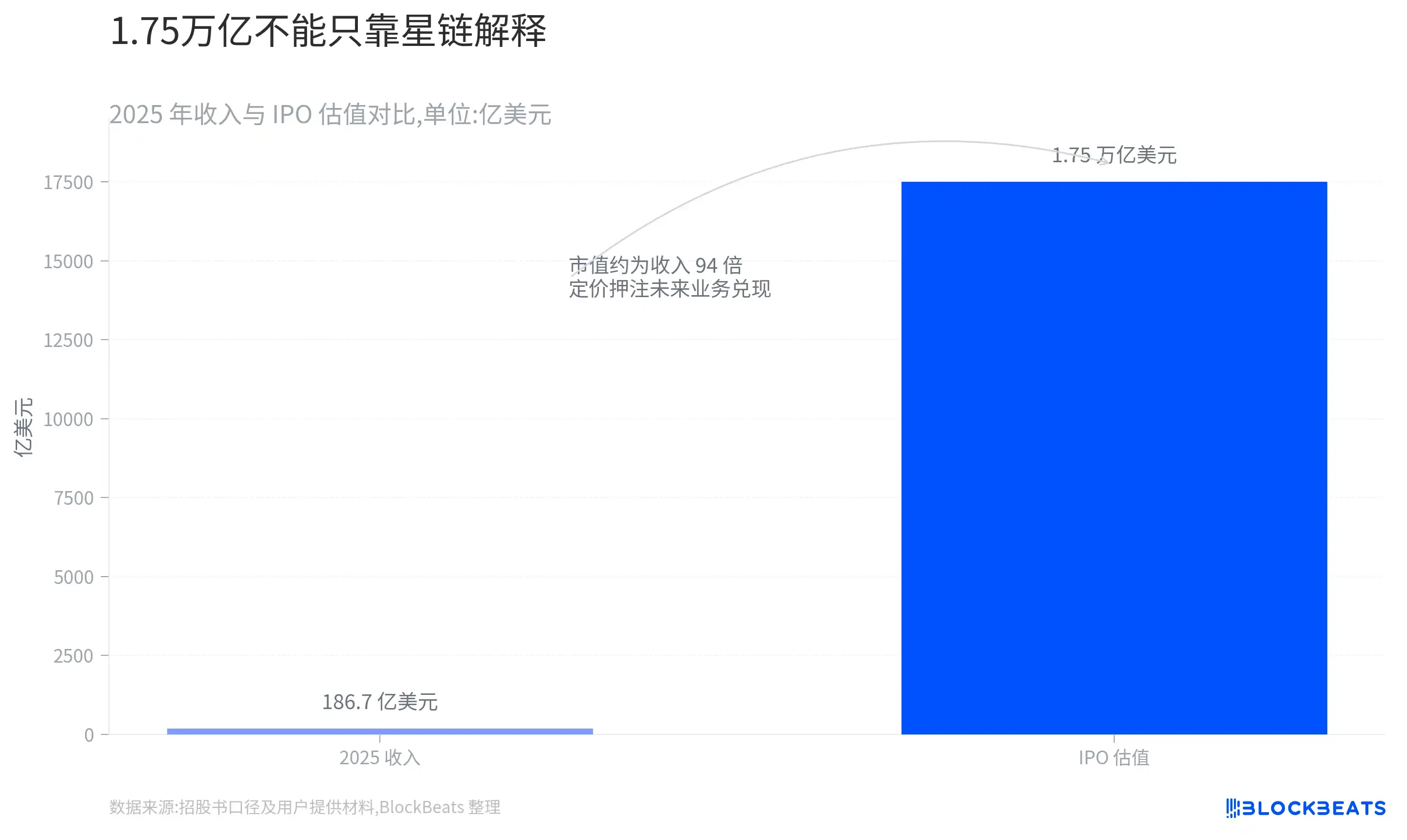
This multiple does not necessarily mean the company is overvalued. SpaceX possesses highly scarce infrastructure, and its business structure is difficult to simply compare with traditional aerospace, telecom, or technology companies.
The issue is that when the valuation reaches $1.75 trillion, existing businesses alone struggle to fully justify the market pricing.
If investors view SpaceX solely as a rocket launch and satellite internet company, the current valuation appears very aggressive. This pricing logic only becomes plausible if the market simultaneously believes that AI, orbital data centers, next-generation satellite networks, and longer-term space infrastructure can become genuine revenue sources.
This is why the grand vision in SpaceX's prospectus becomes the starting point for market controversy.
When a company's valuation relies on explaining businesses that haven't yet formed mature commercial models, the market will naturally increase its risk discount.
Profits Come from Starlink, Expenditure Comes from AI
If we temporarily set aside Mars, orbital data centers, and deep space transportation, SpaceX's current financial structure is actually quite clear.
In the first quarter of 2026, the company generated approximately $4.69 billion in revenue but reported an operating loss of about $1.94 billion. Among the three major business segments, only the connectivity services division, centered around Starlink, was profitable, posting an operating profit of roughly $1.19 billion for the quarter. The AI division generated about $818 million in revenue but recorded an operating loss of approximately $2.47 billion.
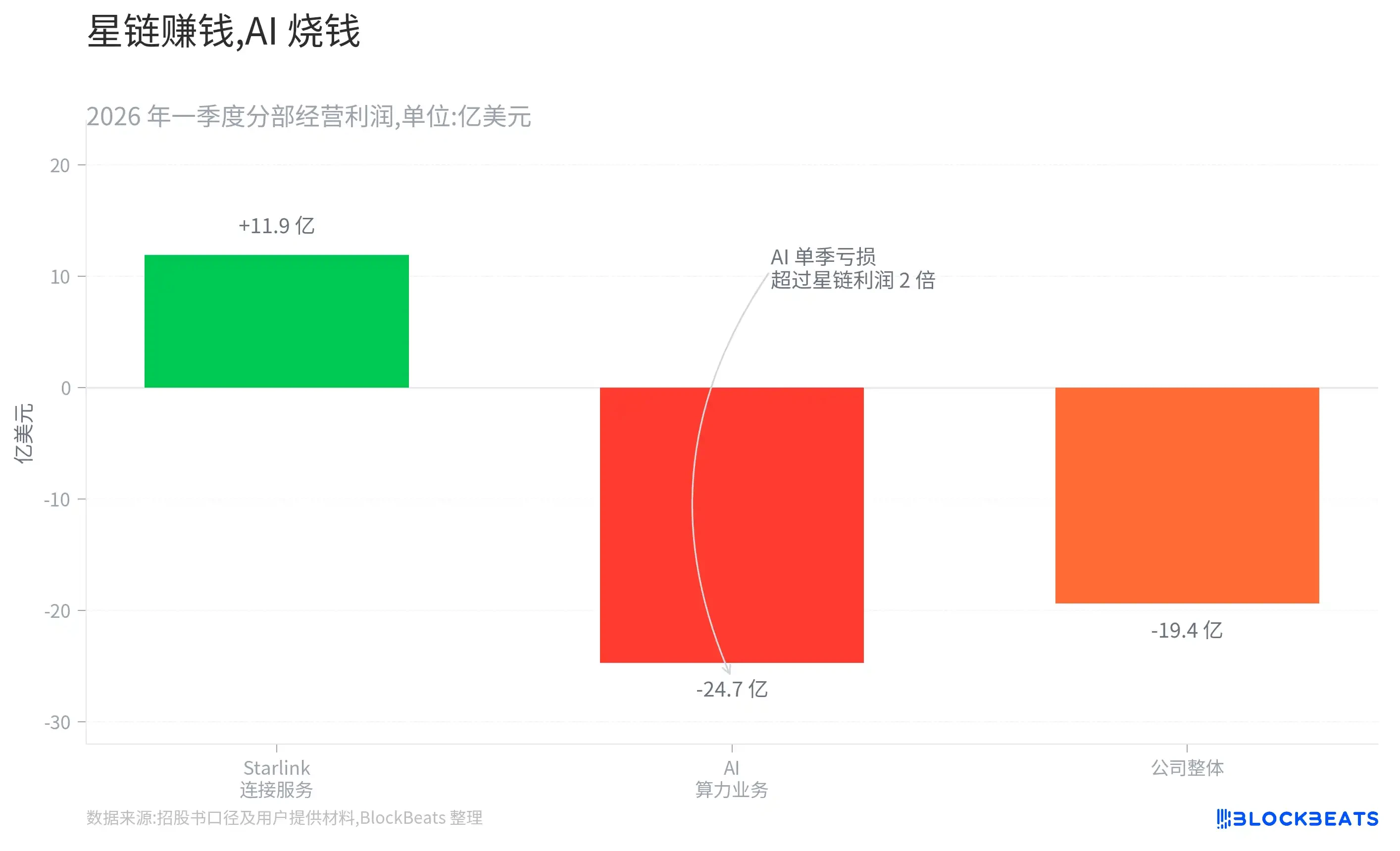
Meanwhile, SpaceX's capital expenditures are accelerating significantly. The company's capital spending in the first quarter was about $10.1 billion, with 76% flowing into AI-related businesses.
This means that SpaceX's most stable source of profit remains Starlink, while the company's most aggressive capital deployment is directed towards AI.
This model is not without its rationale. The AI infrastructure industry itself requires massive upfront capital investment, and returns from data centers, electricity, chips, and network equipment cannot be realized quickly.
However, the market's real concern is:
Is Starlink's profit being channeled into a new business that requires continuous heavy spending but still has an unclear payback period?
If AI can gradually generate stable revenue and profit, these investments will be seen as preemptive positioning.
Conversely, if the AI business remains stuck in a heavy-asset computing power rental phase for a long time, SpaceX's valuation logic will face pressure. Ultimately, the market needs to see not just revenue growth, but whether profits can keep pace with the speed of capital investment.
After Acquiring xAI, SpaceX Also Assumed the Risks of AI Expansion
SpaceX's investment in AI goes beyond simply increasing capital expenditure.
In February 2026, SpaceX acquired xAI in an all-stock transaction. The deal valued SpaceX at approximately $1 trillion and xAI at about $250 billion, resulting in a combined valuation of roughly $1.25 trillion.
Strategically, this transaction is not hard to understand. SpaceX possesses rockets, satellite networks, and potential orbital infrastructure, while xAI brings Grok, large data centers, and AI capabilities. Combining them provides a more complete framework for the orbital data center and space computing narrative.
But from a financial perspective, what SpaceX took over is not just AI's growth potential, but also the capital pressure behind AI's expansion.
The prospectus reveals that an xAI affiliate subsidiary signed AI infrastructure lease agreements exceeding $20 billion with entities related to Valor Equity Partners, involving GPUs and data center hardware. Valor founder Antonio Gracias is also a SpaceX board member and a long-time partner of Elon Musk.
Some of these transactions were classified as "failed sale and leaseback" because they did not meet the accounting recognition criteria for a normal sale and leaseback. This means the corresponding obligations need to be recorded as debt on SpaceX's balance sheet, rather than simply being treated as lease expenses.
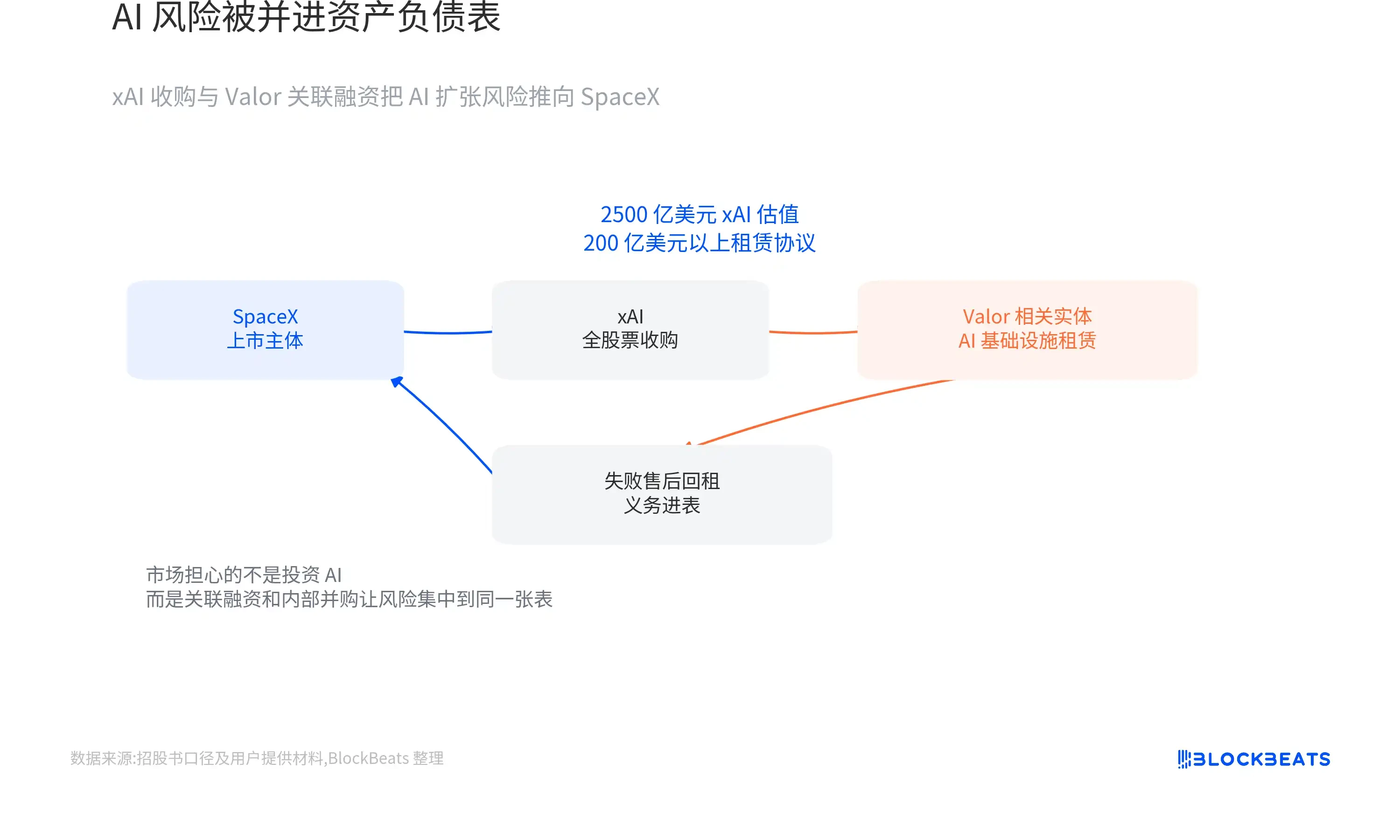
Using leasing and financing arrangements to reduce upfront cash pressure for data center construction is not uncommon. What truly raises market concerns is that the financing party is not a completely independent third party, and both the buyer and seller of xAI are controlled by Musk.
This makes two questions hard to avoid:
Is the $250 billion valuation of xAI reasonable?
Are the terms of the related-party financing transactions sufficiently transparent?
The market is not worried about SpaceX starting to invest in AI; it's worried that the debt, financing arrangements, and execution risks of the AI business are being introduced into the public company's balance sheet through internal acquisitions and related-party transactions.
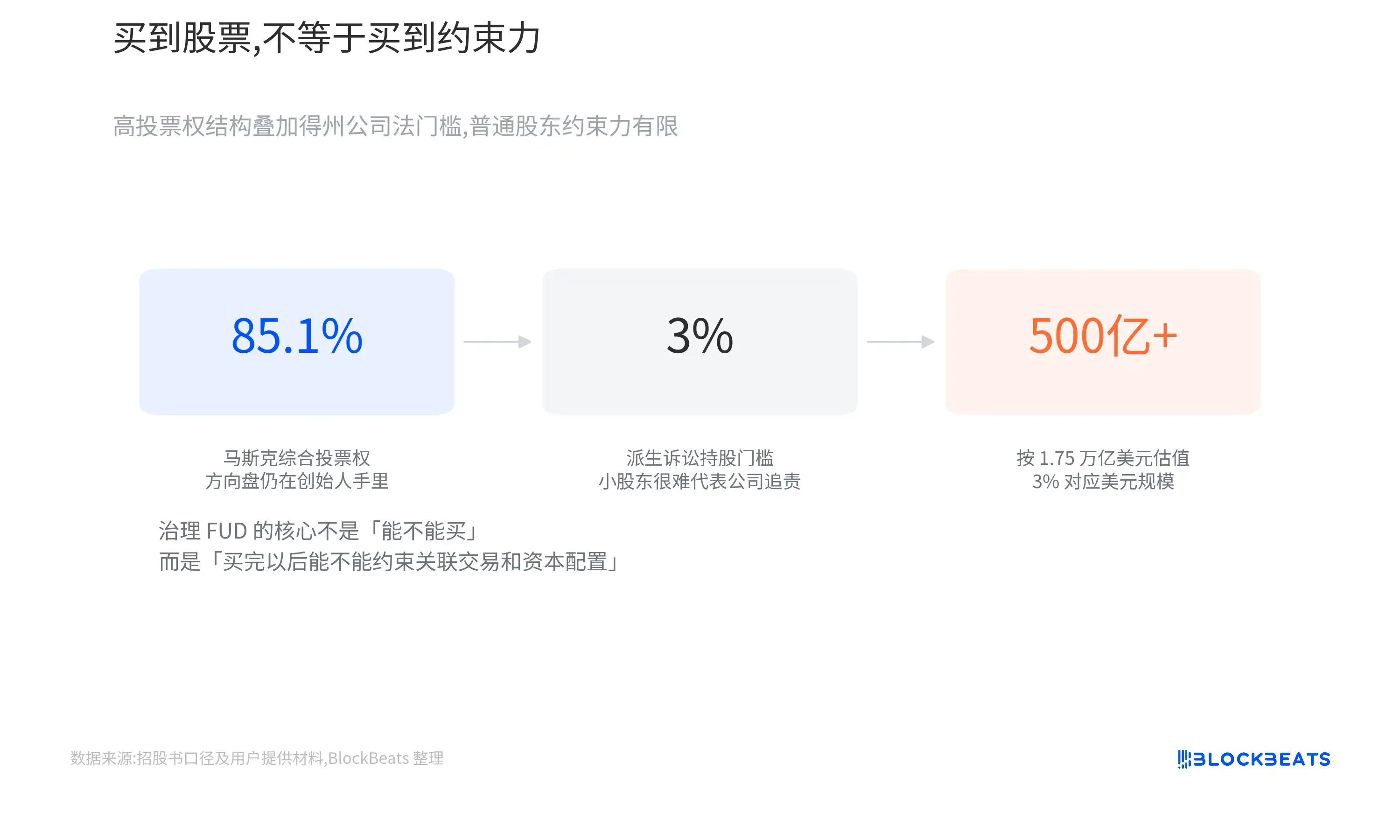
Texas corporate law further amplifies this concern. SpaceX is incorporated in Texas, and relevant laws allow public companies to raise the shareholding threshold for shareholder derivative lawsuits and restrict shareholder access to certain emails, text messages, and electronic communications. For SpaceX, with a proposed valuation of ~$1.75 trillion, a 3% equity stake represents a value exceeding $50 billion.
This does not mean ordinary shareholders can never sue the company under any circumstances.
But it does mean that if investors believe related-party transactions have harmed the company and wish to challenge directors or officers on behalf of the company, the actual barriers are very high.
When corporate boundaries become increasingly blurred, the public market bears not just business risks, but also the capital allocation risks of Musk's entire business ecosystem.
Investors Can Buy into Growth, but Have Little Influence on Decisions
Governance issues are important because SpaceX is about to become a public company, yet the influence ordinary investors can exert is very limited.
SpaceX adopts a dual-class share structure. Musk will maintain absolute control through high-voting-power shares. Even if future capital allocation controversies, related-party transaction disputes, or strategic direction disagreements arise, ordinary shareholders struggle to change the outcome through voting mechanisms.
This structure is not uncommon. Many tech companies use dual-class designs to prevent founders from losing control after going public.
But what makes SpaceX special is that the company will still need to make numerous high-risk, long-cycle, and capital-intensive decisions in the future. Investors must accept not just lower voting power, but an even more extreme governance premise:
The company can continue to pour massive resources into Starship, AI, and orbital infrastructure, and even if these projects cannot generate profits in the short term, ordinary shareholders will find it difficult to alter the strategic direction.
For long-term believers in Musk, this structure might not be a problem. SpaceX's past success was built precisely on the founder's exceptional decision-making ability and risk appetite.
But for investors who place greater emphasis on governance transparency, this means something else:
Investors must bear long-term execution risk while having very little ability to constrain management.
Starship is a Technical Project and a Valuation Variable
The market's concerns about SpaceX are not solely focused on AI and governance structure.
Whether it's next-generation Starlink satellites, orbital data centers, or Mars transportation, everything ultimately highly depends on one critical infrastructure: Starship.
The significance of Starship is not just about building a bigger rocket. It needs to significantly reduce unit launch costs, increase single-mission payload capacity, and ultimately achieve high-frequency, reusable commercial launches.
Only when Starship truly enters a phase of scaled operations can SpaceX potentially deploy its next-generation satellite network at lower costs, send larger-scale equipment into orbit, and create realistic conditions for orbital computing infrastructure.
This is why every Starship test is not just aerospace news; it also influences how the market interprets SpaceX's long-term valuation.
SpaceX's valuation doesn't just depend on whether Starship can fly, but whether it can fly as reliably, cost-effectively, and frequently as an infrastructure tool.
What is the Market's FUD Really Afraid Of?
Putting the sets of data together provides a more complete picture than just asking "Is SpaceX overvalued?": Starlink has proven its commercial value, reusable rockets have established a clear competitive moat, and AI and orbital data centers offer new growth avenues.
But at the same time, the company's valuation has reached $1.75 trillion, the AI division is still incurring substantial losses, capital expenditures continue to expand, related-party financing and internal acquisitions blur business boundaries, and the governance constraints available to ordinary shareholders are very limited.
These facts can all be true simultaneously and are not contradictory to each other.
Because the FUD surrounding SpaceX is not a denial of the company's past achievements.
Rather, it is:
When Musk folds Starlink, rockets, AI, and future orbital infrastructure into a single valuation model, which possibilities is the public market willing to pay a premium for, and for which uncertainties should it reserve a discount?


