






From Trading to Payments: MSX Launches the X Card – How to Bridge the “Last Mile” of RWA Real-World Consumption?


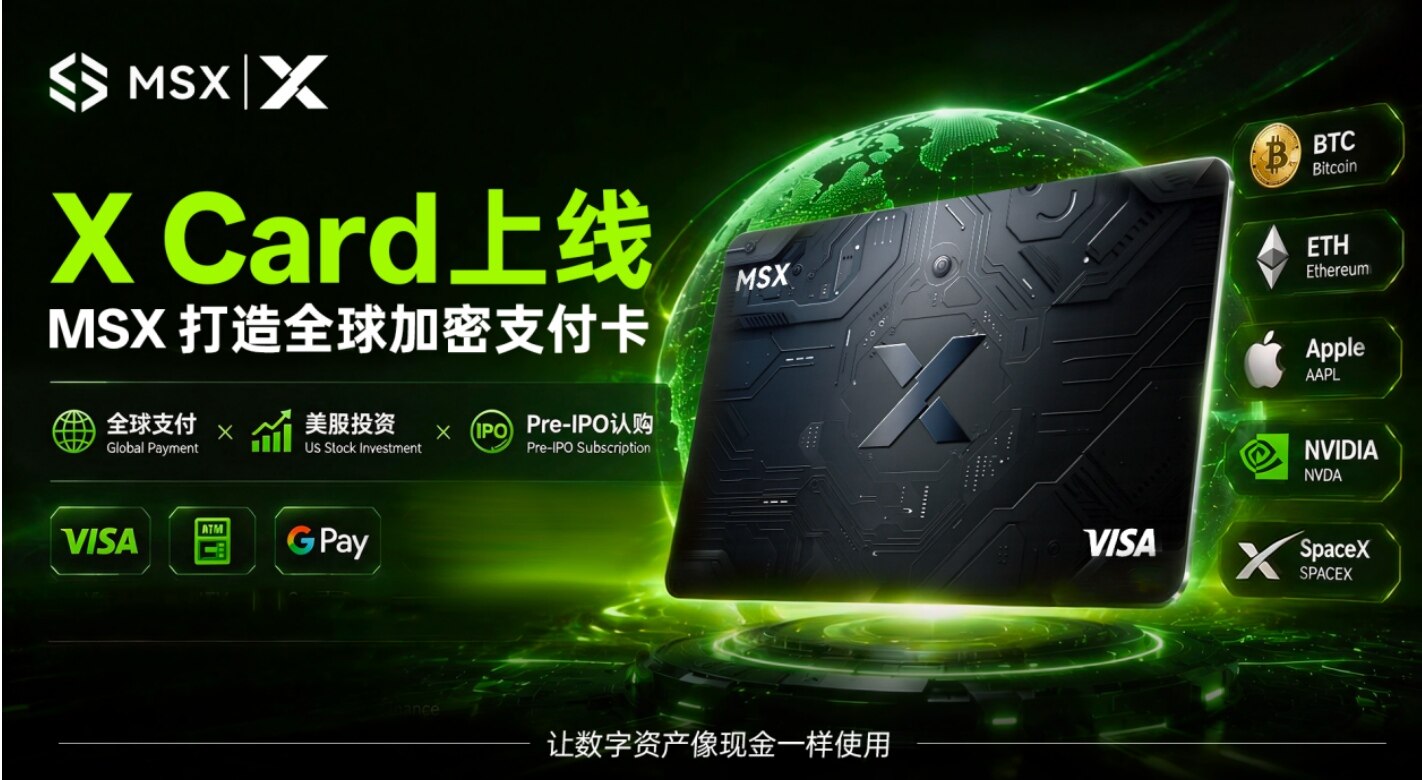
- Key Insight: MSX has launched a global crypto payment card, the X Card, designed to bridge digital asset trading with real-world consumption scenarios. This fills the “last mile” gap from asset allocation to everyday spending, creating a closed loop of “investment + consumption.”
- Key Elements:
- The X Card is integrated with the Visa network, supporting spending at global merchants and third-party payment platforms like Google Pay. It also allows ATM withdrawals worldwide (excluding mainland China and sanctioned regions).
- Transparent fee structure with zero top-up fees, zero transaction fees, and zero annual fees. Monthly spending limit reaches up to $1 million, catering to both high-frequency and high-volume needs.
- The card is deeply integrated with MSX’s RWA asset ecosystem. Users can simultaneously allocate to US stock tokens (e.g., Apple, NVIDIA) and Pre-IPO projects (e.g., SpaceX), forming a closed loop from investment to payment.
- The platform has obtained MSB registrations with the US FinCEN and Canada, adheres to PCI DSS data security standards, and emphasizes KYC/AML compliant operations.
Over the past few years, digital assets have become part of the wealth allocation for an increasing number of global users. From BTC and ETH to stablecoins, and then to tokenized US stocks, Pre-IPO, and other RWA assets, on-chain finance is bringing more asset classes into the global circulation system.
However, a long-standing issue is that while assets can be traded and held with lower barriers, they are not necessarily truly usable.
For the average user, for digital assets to enter broader financial and consumer scenarios, they cannot remain solely within trading accounts. They also need to solve the problems of payments, withdrawals, cross-border spending, and conversion into real-world purchasing power.
In other words, the next step for digital assets is not just about "how to allocate," but also "how to use." In this context, MSX Maitong has officially launched its global crypto payment card, X Card, aiming to bridge the "last mile" between asset trading, global payments, and everyday consumption.
1. From Asset Trading to Real-World Consumption: X Card Completes MSX Ecosystem's Payment Gateway
The X Card is a global crypto payment card launched by MSX Maitong, and it represents a significant extension of the MSX Maitong ecosystem from asset trading to payment applications.
If MSX previously focused more on solving the problem of "how users can use stablecoins to allocate global high-quality assets," then the X Card targets another scenario: how users can more conveniently use their held digital assets for global consumption, payment withdrawals, and real-life activities.
With the X Card, users can connect their digital assets to daily payment and global consumption scenarios, enabling the conversion from on-chain assets to real-world purchasing power. This is especially significant for users with needs for cross-border spending, global travel, asset management, and stablecoin usage. It means digital assets are no longer just an investment balance in an account but can become a more flexible payment tool.
This is also the significance of the X Card to the MSX ecosystem.
In other words, it is not an isolated payment product, but rather a connector that links MSX's existing RWA asset trading capabilities with global spending, payment, and withdrawal needs, allowing users to complete asset allocation, fund transfer, and real-world usage within a single ecosystem.
2. One Card Connecting Global Payments, Withdrawals, and High-Limit Spending Scenarios
In terms of payment networks, the X Card is integrated with the Visa global payment network, enabling users to spend crypto assets at merchants worldwide that accept Visa, covering various online and offline daily payment scenarios.
Additionally, the X Card supports binding with some major third-party payment platforms, including Google Pay, further enhancing user convenience in scenarios like mobile payments, online subscriptions, and in-store purchases.
Furthermore, for users with global payment needs, the value of the X Card lies not only in "being able to swipe," but also in lowering the operational barriers for digital assets to enter the real-world payment system. This allows users to seamlessly transition from digital assets to consumer payments without needing to constantly switch between multiple accounts and payment tools.
For cash withdrawals, the X Card supports global ATM network access, covering multiple countries and regions worldwide (excluding Mainland China and OFAC-sanctioned areas). Users in need of cash can convert the value of their digital assets into real-world purchasing power via an ATM, increasing the flexibility of asset usage.
Regarding fees and limits, the X Card adopts a relatively straightforward and transparent fee structure. Currently, it offers policies such as zero top-up fees, zero transaction fees, and zero annual fees. It also supports a monthly spending limit of up to $1,000,000 to meet the needs of high-frequency spending, cross-border payments, and large-value fund usage.
Overall, the X Card is not just for small daily transactions; it also aims to cover higher-value, more globalized, and higher-frequency digital asset payment needs. This allows it to serve both the daily spending of regular users and provide more flexible fund management tools for high-net-worth individuals, global professionals, and cross-border asset allocators.
3. Connecting the RWA Asset Ecosystem, Forming a "Consumption + Investment" Dual Closed Loop
Compared to ordinary crypto payment cards, what makes the X Card more noteworthy is that it does not stop at the payment scenario but deeply connects to the RWA asset ecosystem of MSX Maitong.
Currently, the MSX platform already supports users in participating in the allocation of tokenized assets like Apple and NVIDIA stocks, as well as mainstream digital assets like BTC and ETH. This means that with the X Card, users can simultaneously complete asset allocation, fund management, and consumer payments within the MSX ecosystem, forming a closed loop from "investment" to "usage".
Simultaneously, MSX is continuously expanding its RWA asset services like Pre-IPO. The platform has previously launched two Pre-IPO projects, covering early-stage investment opportunities in global unicorns such as SpaceX, ByteDance, and Anthropic. Notably, Cerebras from the first project successfully listed, with a peak first-day return of up to 300%.
Within this ecosystem, X Card users can also obtain exclusive subscription rights. This means the X Card is not just a payment gateway; it may also become a connection point for users to access MSX ecosystem benefits and allocate high-quality assets.
From a broader industry perspective, competition among RWA platforms is shifting from "who can list more assets" to "who can provide a more complete asset usage scenario." Users not only need to buy assets but also need to manage and use their funds more efficiently, and enjoy a smoother financial experience in the real world.
And the launch of the X Card is MSX's extension in this direction, moving further from on-chain stock, Pre-IPO and other asset allocation scenarios into the realms of payments, consumption, and global fund flow.
4. Security and Compliance: The Foundation for Long-Term Operation of Payment Products
For any product connecting digital assets to real-world payment systems, security and compliance are prerequisites for long-term operation.
Currently, MSX has completed registration with the US FinCEN MSB and Canada MSB, and continues to advance compliant operations in accordance with applicable KYC, AML, and transaction monitoring requirements.
In terms of payment security, the systems related to the X Card are progressing with payment account data protection and security management in accordance with PCI DSS requirements, aiming to comply with international payment card industry data security standards and provide users with a safer, more transparent, and trustworthy digital financial service environment.
With the launch of the X Card, the ecosystem boundary of MSX Maitong has further expanded, ranging from RWA asset trading to global payment consumption; from tokenized US stocks and Pre-IPO asset allocation to daily fund usage and real-world purchasing power conversion.
Looking ahead, MSX Maitong will continue to optimize the X Card product experience, improve the global payment network and RWA asset service ecosystem, and promote the practical application of digital assets in more scenarios, including investment, payments, consumption, and asset management.
For digital assets to truly enter mainstream financial life, it requires not only more tradable assets but also more natural and efficient ways to use them. The launch of the X Card signifies that MSX is attempting to bring its RWA asset ecosystem further, from the "trading account" into "real-world scenarios."
This might just be where the real acceleration of digital asset application adoption begins. Let's work together to make it happen.


