On the eve of Google’s earnings report, Deutsche Bank is bullish: Don’t just focus on CapEx—the real surprise may come from Google Cloud


- Core Thesis: Google parent Alphabet’s high capital expenditure in the AI era is not the core risk. What truly determines valuation is the potential for Google Cloud’s revenue growth to significantly beat expectations, with its incremental profits sufficient to cover higher investment intensity.
- Key Factors:
- Deutsche Bank expects Google Cloud’s revenue growth to reach 70% in Q2 2026, with its backlog surging 400% year-over-year to $462 billion, reflecting strong demand for AI computing power.
- The market underestimates Google Cloud’s potential: Deutsche Bank forecasts cloud revenue of $190–195 billion by 2027, approximately $50 billion higher than consensus estimates, which could contribute an additional $1 in earnings per share.
- Capital expenditure continues to rise: expected to reach $325 billion in 2027 and exceed $365 billion in 2028. However, Google can cover these costs through a mix of TPU/GPU deployments and financing.
- Search business remains solid: AI Overviews have not disrupted advertising revenue. Advertisers are starting to allocate budgets to AI-driven ads, search traffic is improving month-over-month, and Q2 growth is expected at 16.5% year-over-year.
- The impact of the delayed Gemini model release is limited: user visits and app sessions continue to grow, AI competitiveness remains unaffected by short-term events, and the long-term trend is positive.
Original author: Li Jia
Original source: Wall Street See
After the US stock market closes on July 22, Google parent company Alphabet will release its Q2 2026 earnings report. The current market trading logic is highly focused on a core proposition: Is the continuously expanding capital expenditure (Capex) in the AI era a heavy burden eroding profits, or a forward-looking realization of future growth?
In a report released on July 20, Deutsche Bank pointed out that although the market still harbors concerns about slowing search business growth, delays in the release of new Gemini models, and escalating AI investments, the truly noteworthy variable is not the capital expenditure itself, but the potential for Google Cloud revenue growth to significantly exceed current expectations. If cloud business demand materializes as expected, the incremental profits generated over the next few years will be sufficient to cover the higher AI investment intensity, leaving room for further upward revision of the company's overall profitability.
For investors, the key focus of this earnings report is not whether Capex continues to rise, but how management characterizes the demand landscape for cloud services, changes in the order backlog, and the pace of future revenue realization. These signals may determine whether the market will reprice Alphabet's valuation logic within the AI investment cycle.
Google Cloud: The True Determinant of Valuation
Deutsche Bank's most optimistic outlook centers on Google Cloud.
Analysts have raised their Q2 revenue growth forecast for Google Cloud from 65% to 70%, and anticipate further acceleration to 75% in the second half of 2026.
This forecast is based on three key judgments. First, demand for AI computing power remains in short supply; Google has recently even leased some computing resources provided by SpaceX. Second, as of the end of Q1 2026, Google Cloud's backlog of orders had reached $462 billion, a year-over-year increase of 400%. Additionally, some hyperscale cloud providers, including Amazon, have begun to raise prices for certain cloud services.
More importantly, Deutsche Bank believes the market has significantly underestimated Google Cloud's future revenue scale. It projects Google Cloud revenue could reach $190 billion to $195 billion by 2027, compared to the consensus market estimate of approximately $142 billion. Based on a 30% profit margin, this incremental revenue alone could contribute roughly $15 billion in GAAP operating profit, equivalent to an increase of about $1 per share in earnings.
Capex Will Continue to Rise, but Financing Capacity is Also Strengthening
Regarding AI infrastructure buildout, Deutsche Bank has simultaneously and significantly raised its forecasts for Alphabet's future capital expenditure. The company previously estimated 2026 capital expenditure at $180 billion to $190 billion, and indicated that 2027 levels would "increase significantly" from this year.
Combined with the order backlog, Deutsche Bank estimates that Google will need approximately 11.5 GW of computing capacity to meet existing demand; in the base case scenario for 2027, an additional 10 GW is needed. Based on construction costs of roughly $30 billion to $35 billion per GW, Deutsche Bank now forecasts 2027 capital expenditure at approximately $325 billion, up from its previous $250 billion forecast; it expects a further increase to $365 billion to $370 billion in 2028.
However, analysts also point out that because Google employs a hybrid deployment of its TPUs and NVIDIA GPUs, its unit construction costs are expected to be lower than market concerns suggest.
At the same time, the company's financing capacity remains ample. This quarter, Alphabet has completed a total of approximately $65 billion to $70 billion in financing, including a $10 billion investment from Berkshire Hathaway, two rounds of equity financing totaling about $36 billion, an at-the-market (ATM) offering program of up to $40 billion, and the issuance of multi-currency senior notes.
As of the end of Q1 2026, the company held approximately $127 billion in cash and investments, along with approximately $107 billion in unlisted securities; Deutsche Bank estimates cumulative operating cash flow will reach approximately $420 billion by the end of 2027.
Deutsche Bank believes that the issue Alphabet currently faces is not one of "excessive Capex," but rather that the market is overly focused on spending while underestimating the speed of Google Cloud revenue realization.
Search Growth Hasn't Stalled; Advertising Budgets Are Shifting Towards AI
Regarding Google's search business, the market's biggest concern stems from the potential for AI Overviews to change traditional search traffic patterns.
However, Deutsche Bank's channel checks reveal new changes in advertiser behavior. While some advertisers maintain their existing search budgets, a growing number of brands are beginning to allocate advertising budgets towards AI Overviews, while also increasing AI-related ad spend on Google Search and ChatGPT.
Meanwhile, SimilarWeb data shows that Google's website traffic and page views in Q2 2026 improved compared to Q1. Based on these figures, Deutsche Bank maintains its forecast for Google Search revenue growth of 16.5% year-over-year on a constant currency basis in Q2, with an expected 14% year-over-year growth in Q3.
Analysts believe that even with a slight delay in the release of the new Gemini model, the current AI models are already capable of continuously improving advertising efficiency, and the fundamentals of the advertising business have not materially changed.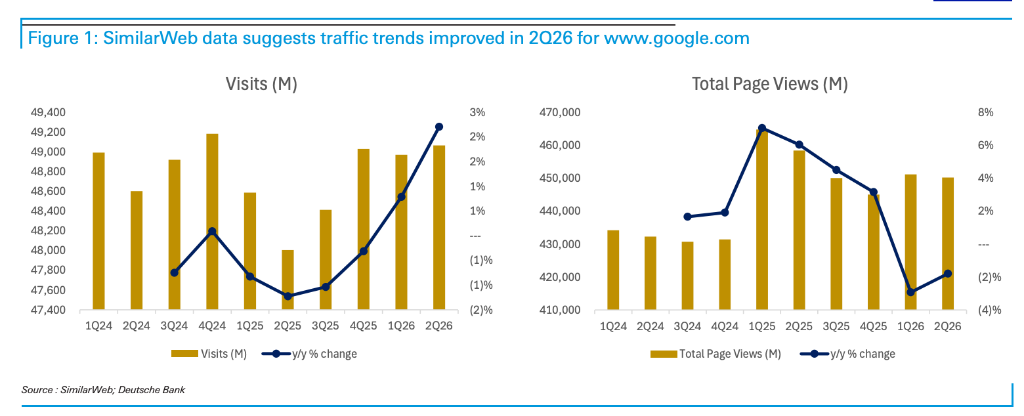
Gemini Delay Isn't Key; User Growth Continues
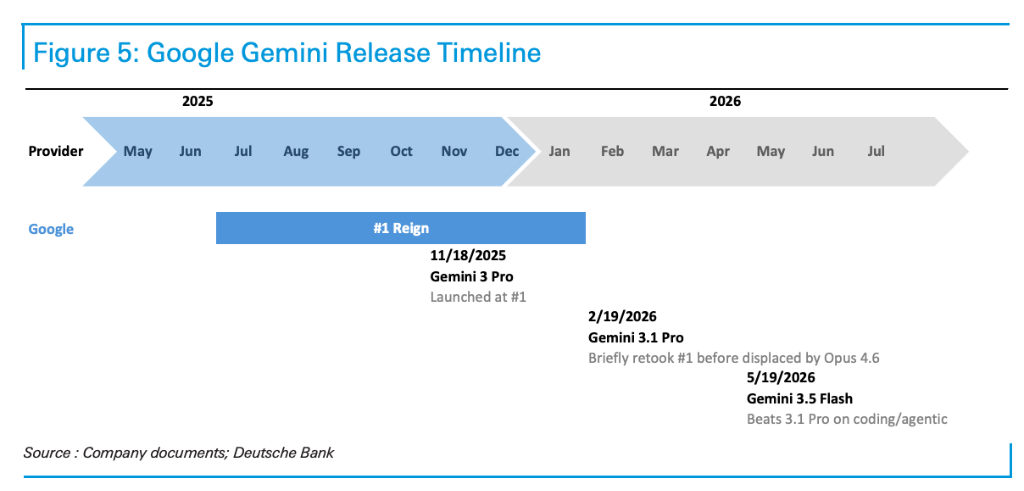
The delay in the release timeline for Gemini has become another focal point for the market. Google previously indicated at its I/O 2026 conference that Gemini 3.5 Pro would be launched subsequently, but as of now, the new model has yet to be officially released.
Nevertheless, Deutsche Bank believes the model release timing has not changed the user growth trend. SimilarWeb data indicates that Gemini's web traffic and page views continued to grow in Q2, although the pace of growth slowed. Sensor Tower data shows that while Gemini App downloads have declined from their peak in 2025, total sessions continue to grow.
In a cross-comparison, ChatGPT maintains its lead, but its session volume has largely stabilized over the past 12 months; Meta AI has shown significant growth since launching Muse Spark; and Grok's downloads and sessions have both declined this year.
Therefore, Deutsche Bank believes the adjustment to the Gemini release timeline is a short-term event and will not change Alphabet's long-term AI competitiveness.