






一年涨134%、市盈率75倍:市场为什么愿意为「零增长」的村田买单?


- Core Thesis: Murata Manufacturing's stock price has surged approximately 134.9% over the past year, pushing its P/E ratio to around 75x. This is not based on its current lackluster performance (near-zero profit growth), but rather on the market's bet on a future profit explosion driven by the structural expansion of AI demand and the company's unique pricing power.
- Key Elements:
- Stark contrast between performance and stock price: In fiscal year 2026, Murata posted record-high revenue but only 5% growth, with operating profit remaining virtually flat. Yet the stock price has doubled over the past year, indicating that the market is trading on forward expectations rather than current performance.
- Trigger for the stock surge: During an investor briefing on May 27, management extended the expected peak period for AI investment to 2030 and revealed that customers are securing volume without guaranteeing price, with demand reaching approximately twice the current capacity. This directly triggered a 12% surge in the stock the following day.
- Profit elasticity driven by guidance: The company's operating profit guidance for the current fiscal year (ending March 2027) is ¥380 billion, representing a sharp 34.8% year-on-year increase, with margins recovering to 19.4%. The market is pricing this yet-to-be-realized earnings pillar.
- AI revenue share to double: AI/data center-related revenue is projected to jump from approximately ¥170 billion to ¥325 billion, increasing its share of total revenue from 9% to 17%, making it a pillar business representing nearly one-fifth of total sales.
- Structural pricing power supports high valuation: The AI revenue growth is not simply a matter of raising prices but stems from an upgrade in the company's product mix toward higher-end MLCCs, where it holds over 70% market share. This sustainable pricing power — "only we can make it, so it's expensive" — is recognized by the market.
- High valuation risks cannot be ignored: Management has also acknowledged that some customer demand forecasts may be overly optimistic. Should AI investment slow or guidance fall short of expectations, the lofty 75x P/E ratio faces the risk of a rapid correction.
On May 28, the world's largest passive component manufacturer, Murata Manufacturing, surged 12.36% in a single day on the Tokyo Stock Exchange, hitting the daily limit intraday and closing at 8,787 yen, a split-adjusted record high. Two months ago, we analyzed an article about Murata raising prices for AI server MLCCs (Multilayer Ceramic Capacitors) by 15-35%, exploring how this sub-millimeter capacitor could disrupt the AI computing supply chain. This time, what's worth analyzing is not the capacitor, but Murata's stock itself.
Because if you look at Murata's just-concluded financial report, you'll find a stark contrast: the performance was quite平淡, yet the stock price has doubled over the past year.
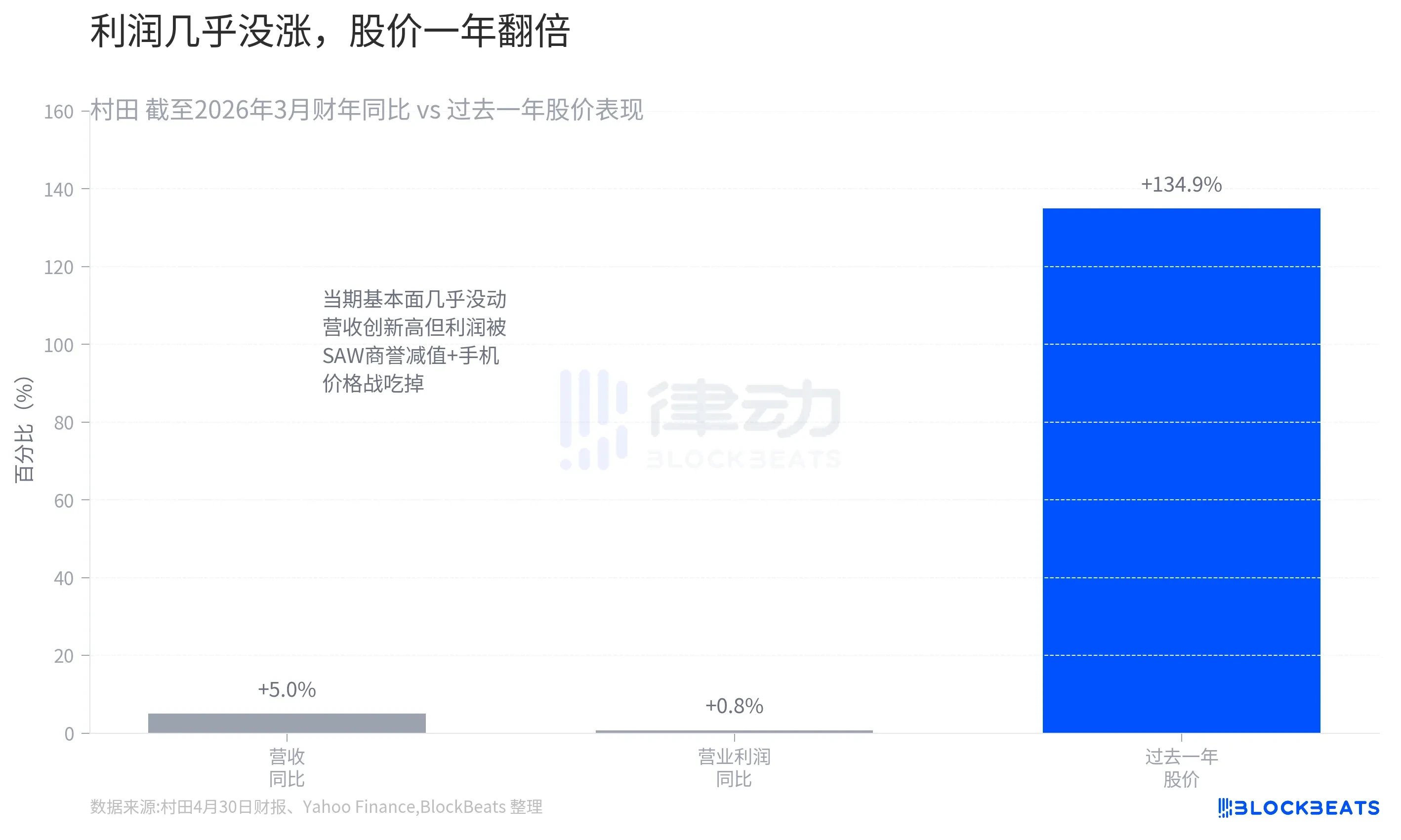
According to Murata's earnings report on April 30, for the fiscal year ending March 2026, the company's revenue was 1.83 trillion yen, a record high, but only a 5.0% increase year-on-year. Operating profit was 281.8 billion yen, up just 0.8% year-on-year, essentially flat. Two factors dragged down profits: first, an impairment of goodwill related to the Surface Acoustic Wave (SAW) filter business, and second, price wars in mature applications like smartphones. In other words, no matter how impressive the AI segment looked, it only compensated for the bleeding in the mature businesses.
Yet, in the same time window, Murata's stock price has risen approximately 134.9% over the past year (according to Yahoo Finance data). The latest stock price has climbed above 9,000 yen, pushing its market capitalization to around 17 trillion yen and its price-to-earnings (P/E) ratio to about 75 times. A company making passive components with zero profit growth in the current period is being priced at a 75x P/E by the market. This can only mean one thing: buyers aren't concerned with this year's profits at all; they are betting on a future story.
The Real Catalyst: A Small Meeting
The trigger for this surge wasn't a price hike or an earnings report, but a small meeting held by Murata for securities analysts on May 27.
According to investment blogger kabuya66, citing content from the meeting, Murata's management made two key statements. The first was revising the expected peak of AI investment from the previously stated "around 2028" to "continuing until around 2030." For a capital-intensive component manufacturer operating on a build-to-order basis, an extra two years in the boom cycle means order backlogs will continue to accumulate and the returns on expansion investments become more certain. The second statement was even more direct: customers are now "securing volume, not price," with demand being roughly twice the supply capacity. This implies downstream buyers are scrambling to secure supply, indifferent to price, just wanting to get the quantities they need.
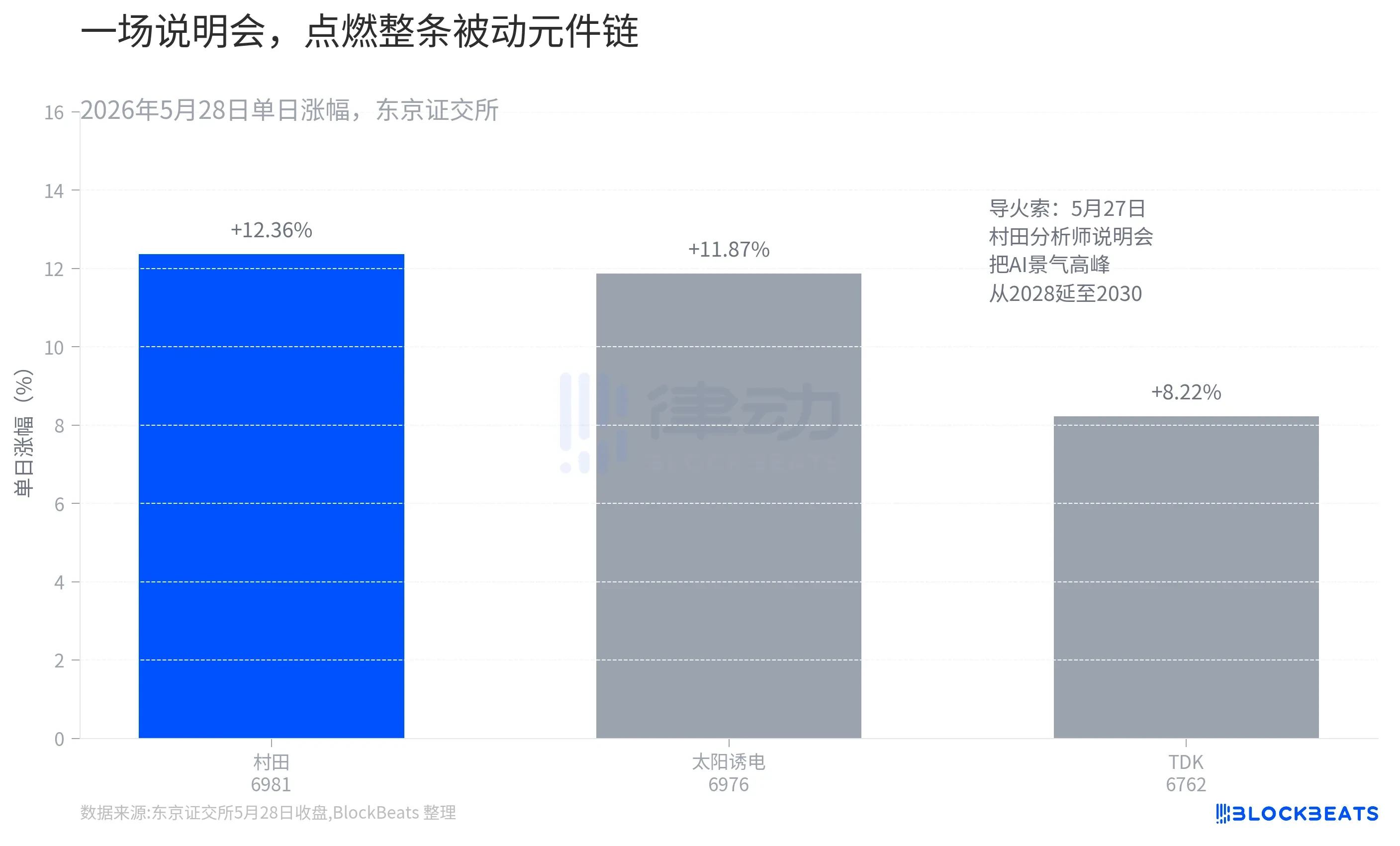
The impact of these two statements was immediately visible in the next day's trading. While Murata surged 12.36% in a single day, peers like Taiyo Yuden rose 11.87% and TDK gained 8.22% (according to TSE closing data). When a leader holds a meeting, it's not just one stock being revalued; it's the entire passive component chain. On that day, the Nikkei 225 index also topped the 66,000-point mark for the first time, with the MLCC sector being a major driver of the gains.
What the Market Buys: The Pillar of 'Next Year'
The reason the meeting ignited the rally was that it clarified Murata's profit potential for the next year.
If you visualize Murata's operating profit as three pillars, the story becomes clear. For the fiscal year ending March 2025: 279.7 billion yen. For the fiscal year ending March 2026: 281.8 billion yen. Two consecutive years of virtually zero growth, with the profit margin slipping from 16.0% to 15.4%. However, Murata's guidance for the current fiscal year (ending March 2027) points to an operating profit of 380 billion yen, a massive 34.8% year-on-year increase, with the profit margin recovering to 19.4%.
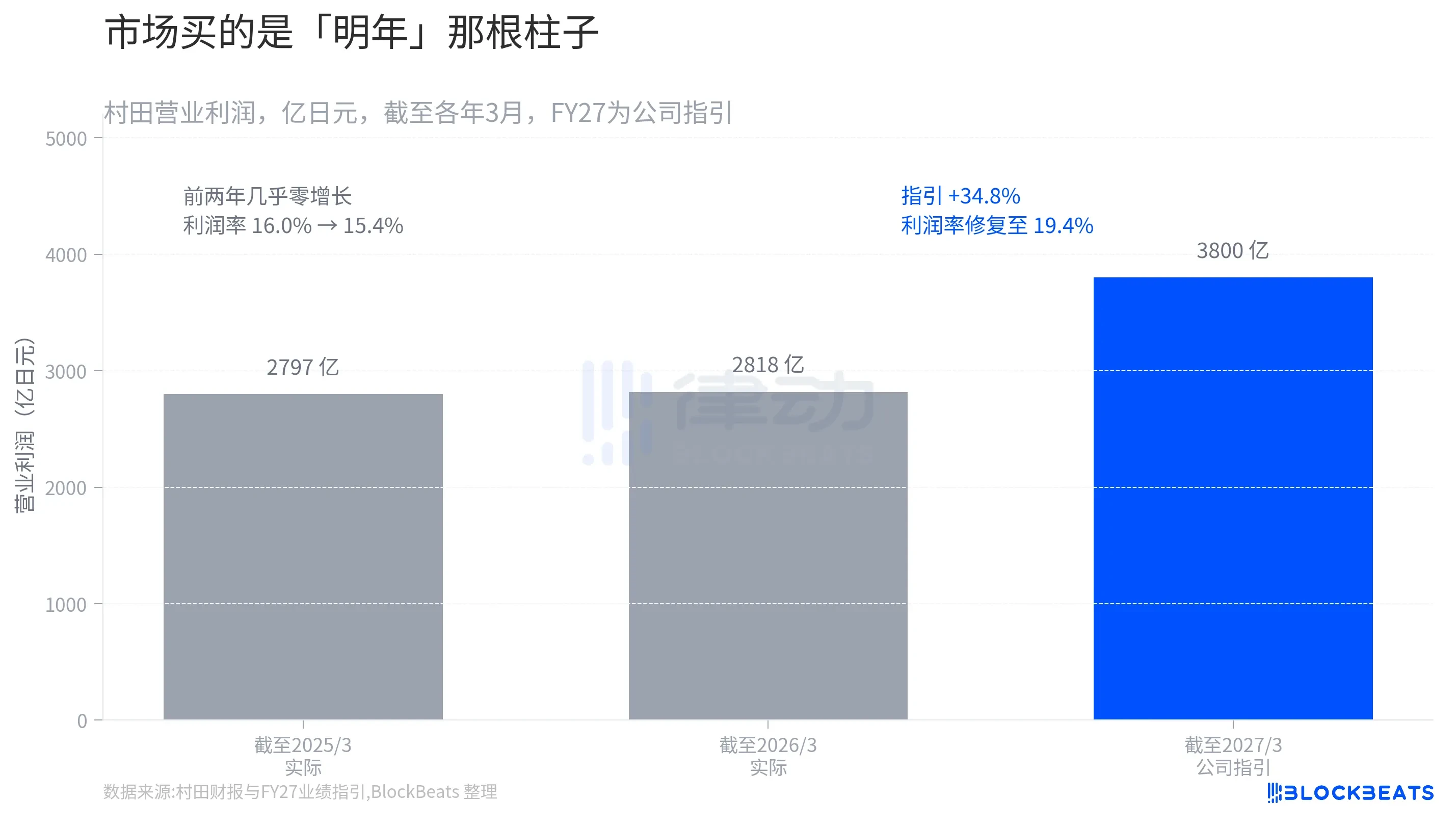
The entire growth profile is locked into the rightmost pillar. What the market is buying now is not the two years of平淡 but this yet-to-be-realized guidance pillar. A supporting indicator is orders. According to Nikkei Veritas, among listed companies with a market cap over 50 billion yen and expected profits for the current fiscal year, Murata ranked first in order backlog growth during the previous fiscal year. Order backlogs directly translate into future revenue, providing the foundation for that guidance pillar. Murata also conveniently announced a buyback plan of up to 150 billion yen, intending to repurchase 75 million shares, or 4.12% of issued shares. By committing actual capital, management signaled that they believe the current price is not expensive.
Supporting This Pillar: Doubling AI Revenue
Where will that 34.8% profit growth come from? The answer is concentrated on a single track.
According to data from Murata's meeting, the company's AI/data center-related revenue is expected to jump from approximately 170 billion yen in the previous fiscal year to a guidance of 325 billion yen in the current fiscal year, representing year-on-year growth of 85-90%. This segment's share of total revenue is projected to rise from about 9% to around 17%. In other words, within one year, AI is set to transform from a small fraction of Murata's revenue into a pillar contributing nearly one-fifth.
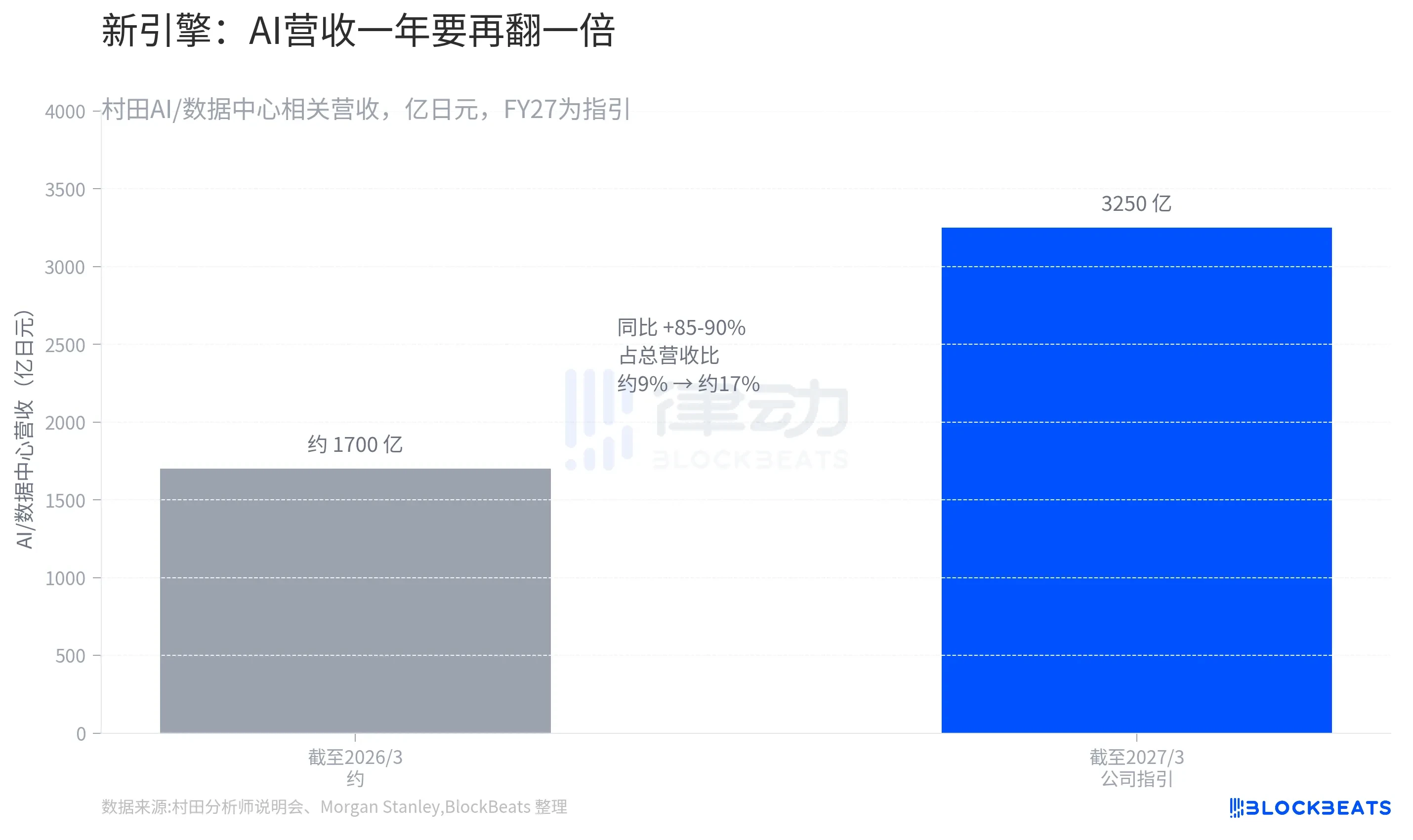
More critical is the 'quality' of this growth. According to analysis by Morgan Stanley MUFG Securities, Murata's current AI revenue growth is not driven by price increases on existing MLCC products but by a product mix upgrade. The proportion of cutting-edge products, which are smaller in size and higher in capacitance, is increasing, thereby raising the Average Selling Price (ASP). Murata commands over 70% market share in the advanced MLCCs required for AI servers, with virtually no competitor able to keep pace. This means its pricing power isn't cyclical (rising solely from supply shortage) but structural (it's expensive because only Murata can make it). The market's willingness to assign a 75x P/E precisely prices this perceived sustainable pricing power.
Of course, the flip side of taking expectations to historic highs is that expectations have run ahead of reality. Murata's President Norio Nakajima himself acknowledged that some customers' demand forecasts might be "overstated." If the pace of AI investment slows down or if subsequent quarterly guidance falls short, this high valuation carries a significant risk of a rapid correction. For high-valuation stocks, 'not good enough' is the best reason to sell.
Murata is still the same capacitor maker. What has changed is the metric the market chooses to value it by: from a cyclical component manufacturer "destined for price declines" to a "supply-constrained, pricing-powerful" AI shovel seller.


