






Anthropic Aims for $1 Trillion: Beyond Pre-IPO, What Are the Hidden "Claude Concept Stocks"?


- Core View: Anthropic's valuation has surged to nearly one trillion dollars, making it the first AI startup to hit this milestone. Its enterprise application pathway has driven a revaluation of three major categories of "Claude concept stocks" — equity, computing power, and enterprise software — offering indirect investment opportunities in the public market.
- Key Elements:
- Anthropic's valuation skyrocketed from $61.5 billion in March 2025 to nearly one trillion dollars in 2026. It is projected to generate $10.9 billion in revenue by Q2 2026 and is on track for profitability, with enterprise-level coding and Agent applications as its core narrative.
- Zoom is the "shadow stock" with the greatest valuation elasticity in the public market. Its $51 million early-stage investment, based on the current valuation, could yield $2-4 billion in paper gains, accounting for over 7%-15% of its market cap.
- Beneficiaries in the computing power ecosystem include cloud providers (AWS, Google Cloud), the AI ASIC supply chain (Broadcom), and Neo-cloud (CoreWeave). Among them, Broadcom's growth is directly tied to Claude's expansion through its partnership with Google TPU.
- Enterprise software platforms such as Salesforce, SAP, Snowflake, and ServiceNow embed Claude as a native intelligence engine within their products, representing a more sustainable distribution revenue stream.
- The asymmetry of Anthropic's equity value relative to its own market cap is the core logic of "shadow stocks." Smaller and mid-cap companies like Zoom and SK Telecom offer greater valuation elasticity compared to giants like Amazon.
The first trillion-dollar AI startup is about to be born.
As of writing, according to Nasdaq Private Market (NPM) data, Anthropic's valuation has surged from $650 billion in early May to approximately $992 billion, just a stone's throw away from the trillion-dollar mark. 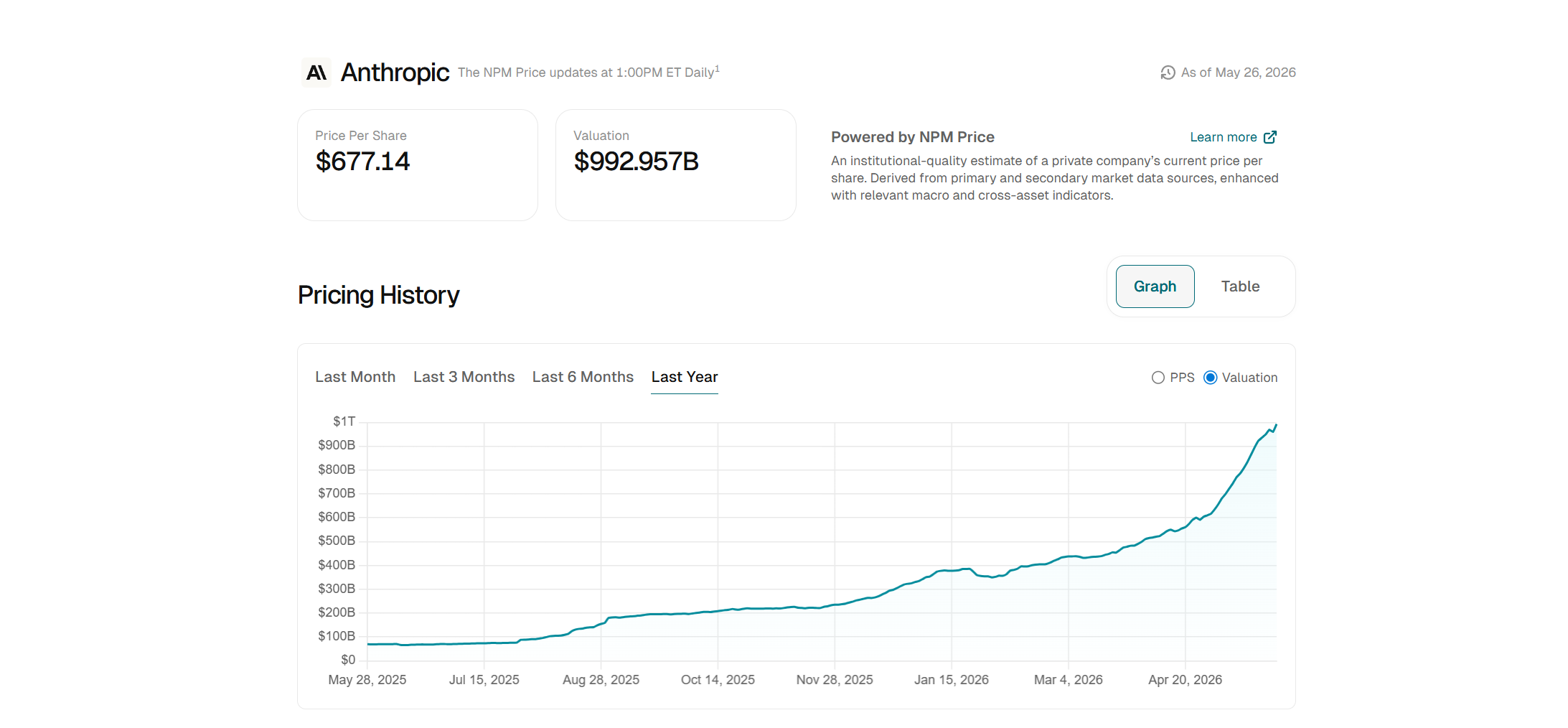
Of course, it's important to note that the NPM valuation does not equate to Anthropic's most recent official funding round valuation, nor is it a simple listing price on a platform. It synthesizes data from secondary market transactions, bid and ask prices, and the previous funding round to provide an estimate closer to the fair value in the current private market.
In other words, Anthropic hasn't officially confirmed a "trillion-dollar valuation" through a funding announcement, but the private market has already started pricing it within the range of trillion-dollar assets.
This also raises a more practical question: aside from Pre-IPO channels like MSX, it's difficult for ordinary investors to directly buy Anthropic. Are there other ways in the public market to capture the spillover opportunities from Claude's rising valuation?
The answer may not lie solely within traditional "AI stocks."
1. Why Did Anthropic Break the Trillion-Dollar Barrier First?
Undoubtedly, Anthropic's valuation surge has become one of the most explosive stories in the global capital markets of 2026.
Looking purely at the numbers, it's a very steep curve:
- In March 2025, Anthropic completed a $3.5 billion funding round at a post-money valuation of $61.5 billion;
- In September 2025, the valuation rose to $183 billion;
- In February 2026, it completed another $30 billion funding round, reaching a valuation of $380 billion;
- According to recent media reports, it is now conducting a new funding round exceeding $900 billion, surpassing OpenAI's valuation of approximately $852 billion;
Combined with the near-trillion-dollar pricing signal from private market data like NPM, on the surface, this is another instance of the capital market paying up for AI. The deeper shift is that the capital market is beginning to redefine the ceiling for frontier model companies.
This is not exactly the same as the early ChatGPT-style consumer explosion. OpenAI's strengths lie in consumer-grade interfaces, developer ecosystems, and brand mindshare, while Anthropic's advantages are increasingly concentrated in enterprise scenarios, particularly coding, agent automation, and high-security industry applications. For the capital market, this means Claude is not just a chatbot but has become a foundational infrastructure that can be embedded into the daily production processes of enterprises.
This shift is directly reflected in revenue and profit expectations. According to recent media reports, Anthropic expects Q2 2026 revenue to reach $10.9 billion, a significant increase from $4.8 billion in Q1, and is projected to achieve $559 million in quarterly operating profit. If this materializes, Anthropic will become one of the few frontier AI companies that, despite high-intensity computing investments, still approaches阶段性 profitability.
This is also a core narrative difference between it and OpenAI at present.
Of course, Anthropic is not running unilaterally in a market without competition. Recently, OpenAI has been continuously repairing its product performance and reputation in scenarios like Coding and Agentic Workflow through Codex+5.5. Although players like Gemini have faced a decline in reputation, they haven't withdrawn from the model arms race either.
In other words, Anthropic's high valuation is not a result of "the game being over," but rather a willingness by the market to temporarily pay a higher premium for its enterprise growth curve, product performance (like Claude Code), and a clearer commercialization path.
It is precisely because of this scarcity that Anthropic has become one of the most watched targets in the Pre-IPO market.
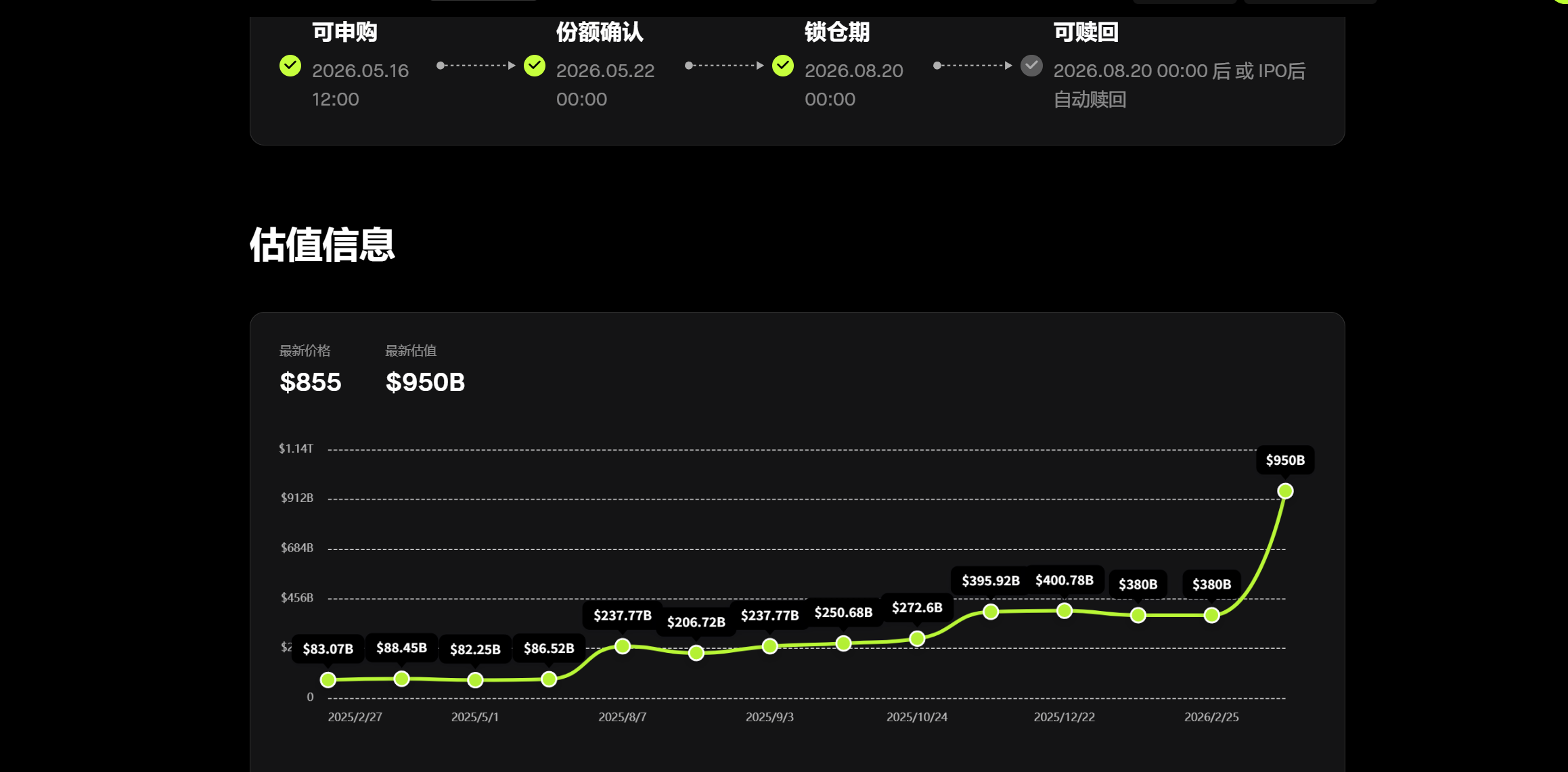
The recently concluded second phase of the Pre-IPO offering by MSX included Anthropic as one of its two targets. The subscription price was 855 U, corresponding to a valuation of approximately $950 billion. For many ordinary investors, this type of Pre-IPO product indeed provides a participation entry point closer to the private market pricing when Anthropic is not yet listed and the primary market threshold is extremely high.
But Pre-IPO is not the only perspective to consider.
When Anthropic's valuation surges towards a trillion dollars, the market may need to reprice not just Anthropic itself, but an entire shadow chain surrounding Claude: who invested in it, who supplies its computing power, who brings it into enterprise software—these entities could all be re-marked by capital.
So, besides Pre-IPO, which companies are actually positioned on Claude's equity, computing power, and enterprise distribution chain?
2. If You Can't Buy Anthropic, What Will the Market Buy?
If we categorize by "how close they are to Anthropic," Claude concept stocks can be roughly divided into three types: First are the equity shadow stocks that directly participated in Anthropic's investments. Second are the cloud and chip companies that fulfill Claude's computing power needs. Third are the software platforms that integrate Claude into enterprise workflows.
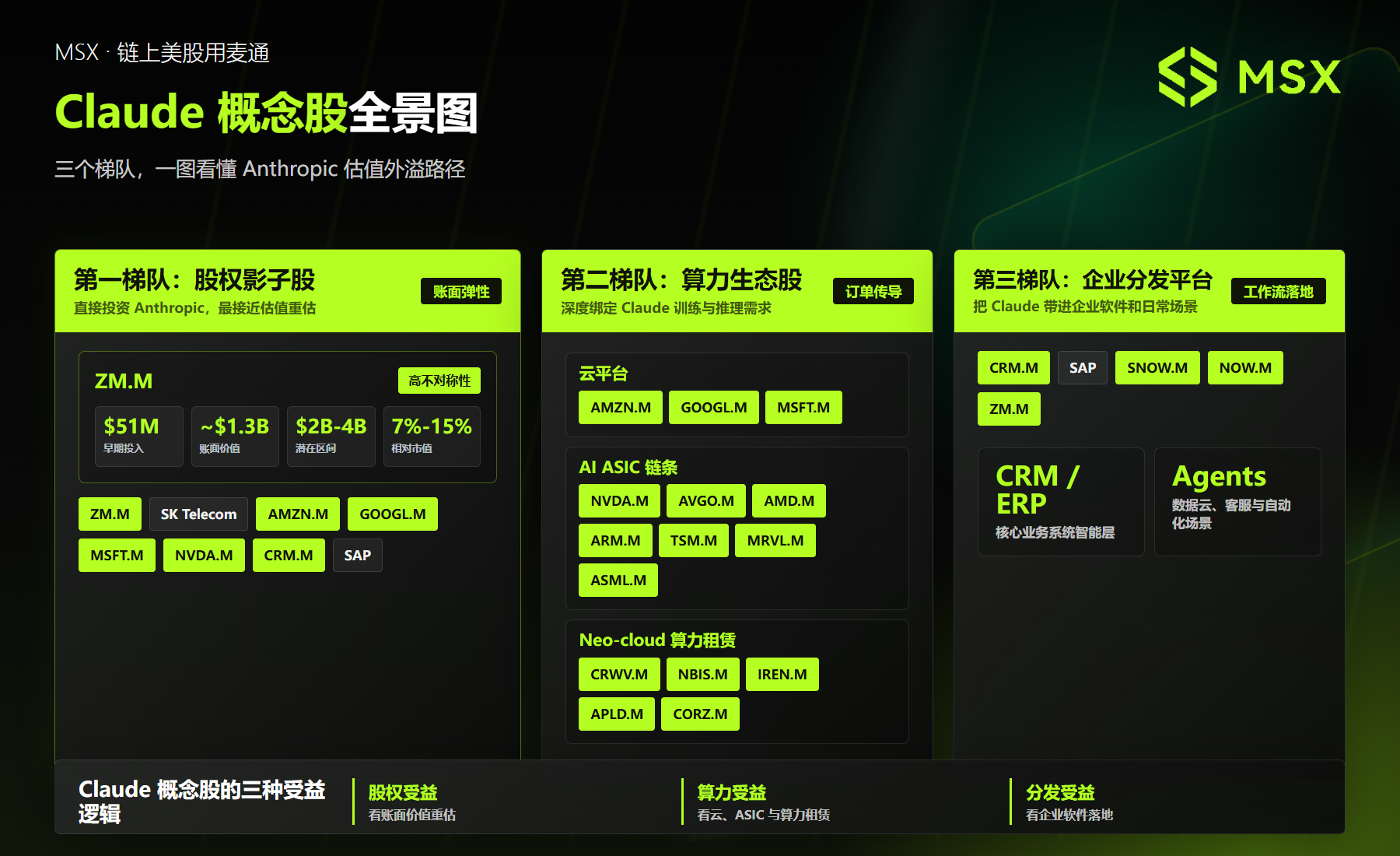
Although these three types of companies are all called "Claude concept stocks," the ways they benefit are completely different:
- Equity shadow stocks benefit from the book value revaluation caused by Anthropic's rising valuation;
- The computing power chain benefits from orders driven by the expansion of Claude's training and inference needs;
- Enterprise software platforms benefit from whether Claude can become a native capability within their own products;
1. First Tier: "Shadow Stocks" with Direct Equity Investments, Accessible in the Public Market
Public information shows that Anthropic has gone through 7 funding rounds from Series A to G since its inception. Major shareholders include Google, Amazon, NVIDIA, Microsoft, Sequoia, Blackstone, GIC, etc. After completing the Series G round (post-money valuation of approximately $380 billion), the shareholding ratios of major investors were: Amazon (9%), GIC (8%), Microsoft (7%), Coatue Management (6%), Google (6%), NVIDIA (5%), with founders and team holding 21% and the employee stock option pool at 19%.
However, the entity that most resembles a "hidden shadow stock" is not tech giants like Amazon, Google, or Microsoft, which invested tens or even hundreds of billions, but rather Zoom.
Zoom announced a strategic partnership with Anthropic back in 2023 and invested approximately $51 million via Zoom Ventures (when Anthropic's valuation was only $4.1 billion). The collaboration involved integrating Claude into the Zoom platform, gradually covering various product lines like Team Chat and Meetings.
The interesting part of this is that although Zoom's investment amount was modest at the time, even considering subsequent funding dilution, the value of this stake has reached the $2-4 billion range or higher. Compared to Zoom's current market cap of around $29 billion, this single investment accounts for 7% to 15% or even more of its market cap.
For giants like Amazon and Google, such investments might be just a non-core item on their financial statements. But for Zoom, the significance is completely different—Zoom's current market cap is around $30 billion. If its Anthropic stake is valued at several billion dollars, it becomes a significant variable capable of influencing the market's re-understanding of its asset value.
This is what makes Zoom so special—a small temple housing a giant Buddha.
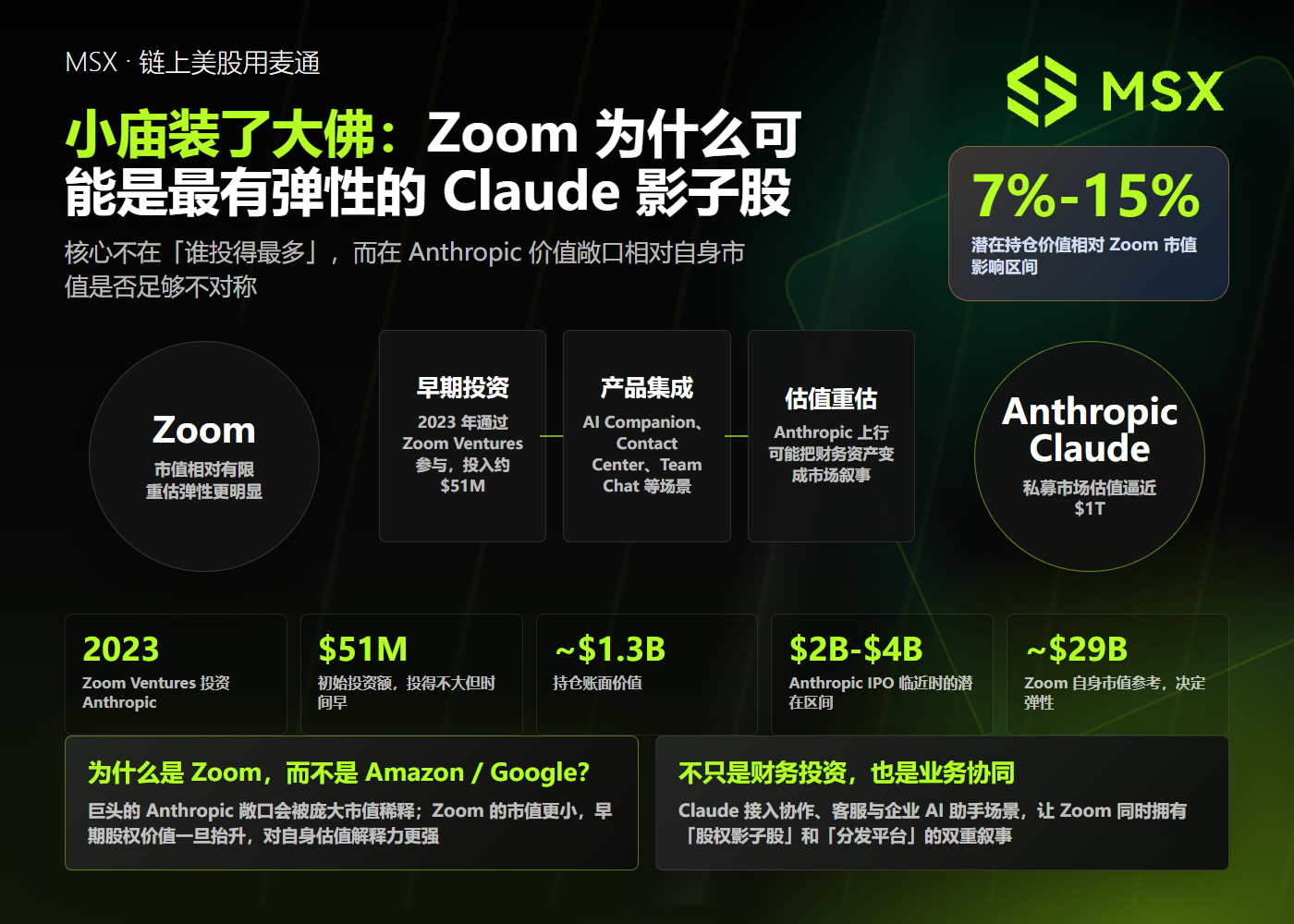
In recent years, Zoom's core video conferencing business growth has gradually slowed, and its market appeal has clearly diminished compared to the pandemic era. However, by considering the Anthropic equity stake, Claude integration, and the AI transformation of enterprise customer service centers and collaboration scenarios together, Zoom is no longer just a slow-growing video conferencing company. It becomes a public market super shadow stock that unexpectedly holds an early ticket to Claude.
A similar equity shadow logic can be extended to SK Telecom.
SK Telecom announced an additional $100 million investment in Anthropic in 2023, collaborating to develop a multilingual large language model for the telecommunications industry. Compared to Zoom, SK Telecom's uniqueness lies in it being a traditional telecom operator with a relatively smaller market cap. Therefore, the book value of its Anthropic stake could have a more pronounced impact on its overall valuation.
For this reason, overseas markets have also briefly viewed SK Telecom as a quirkier but direct Anthropic shadow asset.
2. Second Tier: The Computing Power Ecosystem - From Cloud Providers, AI ASICs to Neo-cloud
However, beyond Zoom and SK Telecom, the larger Claude industry chain actually lies within the computing power layer.
If equity shadow stocks are about the book value revaluation from Anthropic's rising valuation, then computing power ecosystem stocks address a different question: as Claude grows larger, enterprise calls increase, and coding and agent scenarios become heavier, who will meet the underlying training, inference, and data center needs?
This chain cannot be viewed solely through NVIDIA or traditional cloud providers. More accurately, Claude's computing power ecosystem can be broken down into at least three groups:
- The first group comprises cloud platforms like AWS, Google Cloud, and Azure;
- The second group comprises AI ASICs like TPU and Trainium, along with their supply chains;
- The third group comprises Neo-clouds like CoreWeave, Nebius, Lambda, and Crusoe, which specialize in providing AI computing power rental;
For instance, Anthropic's binding with Amazon is the earliest and deepest. Amazon has invested tens of billions of dollars cumulatively in Anthropic, and AWS is one of Anthropic's most important cloud and training partners. They have deep collaborations around AWS Trainium, the Neuron software stack, and Project Rainier. For Amazon, Anthropic is not just a financial investment but a crucial lever for AWS to compete for cloud workloads in the generative AI era.
Google represents a different route. Google invested early in Anthropic and subsequently expanded its cloud and TPU collaboration. In 2026, Anthrophic expanded its partnership with Google and Broadcom, planning to secure multi-GW levels of next-generation TPU computing power starting from 2027 to support the expansion of Claude models and enterprise applications.
Objectively speaking, Anthropic uses both AWS Trainium and Google TPU, and also accesses the NVIDIA architecture through Microsoft Azure. This diversified computing power strategy reduces reliance on any single supplier and, on the other hand, allows more public market companies to become indirect beneficiaries of Claude's growth.
This also leads to a direction often overlooked in the past: the AI ASIC chain.
In the past, when the market discussed AI computing power, NVIDIA GPUs were the first thought. However, as front-tier model companies increasingly focus on inference costs, supply stability, and unit token costs, the importance of cloud providers' self-developed chips and custom ASICs is rising. AWS Trainium and Google TPU are essentially designed to provide a more controllable cost structure for training and inference of large models, beyond GPUs.
Within this line, Broadcom is one of the companies most worthy of discussion as a Claude concept stock. It is not a public equity investor in Anthropic, but it is a key chip and network supplier behind the Google TPU ecosystem. If Anthropic's future growth indeed relies on larger-scale TPU deployments, Broadcom becomes an unavoidable hardware and network node in this chain.
Further extending this, Marvell, TSMC, advanced packaging, optical interconnects, and high-speed networking chains can also be included in a broader AI ASIC industry chain for observation. Broadcom's connection to Claude is more direct because it sits at the intersection of Google TPU and Anthropic's expanding collaboration. Other ASIC and semiconductor supply chain companies are more of a beta play on the overall expansion of AI computing power demand, not necessarily exclusive beneficiaries of Claude.
Microsoft and NVIDIA entered a clearer collaboration framework towards the end of 2025. NVIDIA and Microsoft committed to investing up to $10 billion and $5 billion respectively in Anthropic. This is quite interesting, meaning Microsoft is buying an "insurance policy outside of OpenAI" for its own AI ecosystem. NVIDIA's logic is more direct: regardless of whether Anthropic uses Trainium, TPU, or NVIDIA GPUs, as long as the frontier model competition intensifies, NVIDIA remains one of the hardest computing power cores to bypass.
However, on the Claude front, NVIDIA is not the only winner, because Anthropic emphasizes the diversification of computing power sources more than many model companies.
Beyond traditional cloud providers and AI ASICs, there is a newer set of beneficiaries from computing power: Neo-clouds. Simply put, these are a new type of cloud provider specializing in providing high-density GPU/accelerated chip computing power rental for AI training and inference. Unlike AWS, Azure, or Google Cloud, which offer a wide range of cloud services, they focus more on AI workloads, localized high-performance clusters, GPU-as-a-Service, and the elastic computing power needed by model companies.
In this line, the relationship between CoreWeave and Anthropic is the most direct. In April 2026, CoreWeave announced a multi-year agreement with Anthropic, under which Anthropic will use CoreWeave's cloud platform to run production-level workloads.
This also means that Claude's computing power ecosystem is not a binary choice of "cloud provider vs. chip company," but a multi-layered structure: at the bottom, there are different chip routes like NVIDIA GPUs, Google TPUs, AWS Trainium; in the middle, there are traditional cloud platforms like AWS, Google Cloud, and Azure; and simultaneously, there are Neo-clouds like CoreWeave, Nebius, Lambda, and Crusoe serving as a more flexible computing power rental and delivery layer.
Therefore, for a more complete understanding of the Claude computing power ecosystem, Broadcom represents the AI ASIC and custom chip chain, CoreWeave represents the Neo-cloud computing power rental chain, and Amazon, Google, and Microsoft represent the computing power entry points of traditional cloud platforms.
These three groups of companies together illustrate one thing: The higher Anthropic's valuation gets, the more the market is repricing not just Claude itself, but also the increasingly complex network of computing power procurement, chip design, and cloud infrastructure behind it.
3. Third Tier: Software Platforms Integrating Claude into Enterprise Workflows
Besides equity and computing power, there is a third category of companies that are easier to overlook: enterprise software platforms.
The most typical examples here are Salesforce, SAP, Snowflake, and ServiceNow.
Salesforce Ventures participated in Anthropic's relatively early funding rounds and has continued to support it in subsequent rounds. More importantly, Claude has already entered Salesforce's product systems like Slack and Agentforce. Especially in industries with higher security and compliance requirements, such as finance, healthcare, and the public sector, Claude has the potential to become a key model in Salesforce's enterprise AI solutions.
SAP's logic is more centered on core enterprise systems. In 2023, SAP announced strategic investments in generative AI companies like Anthropic, Cohere, and Aleph Alpha. In 2026, SAP announced an expansion of its partnership with Anthropic, planning to make Claude one of the primary reasoning and Agent capabilities within the SAP Business AI Platform, Joule, and Joule agents system.
This is a significant development because SAP connects to the most core enterprise systems: ERP, finance, HR, supply chain, and operations management. If Claude can enter SAP, it's not just entering a software gateway; it's entering the underlying business processes and data structures of global enterprises.
Snowflake and ServiceNow represent another path for enterprise AI distribution.
Snowflake expanded its partnership with Anthropic, committing $200 million to drive the integration of Claude models into Snowflake Cortex AI, Snowflake Intelligence, and enterprise data analysis Agent scenarios. ServiceNow announced Claude as the default model for ServiceNow Build Agent, used for application development, industry workflows, and internal employee productivity. ServiceNow also stated that it has deployed Claude for tens of thousands of its employees.
These companies are not direct beneficiaries of Anthropic's valuation increase, but they represent another, more important direction: Claude is transforming from a standalone AI product into an inference engine and workflow engine embedded within enterprise software.
For the public market, this might be a more sustainable clue. The book value elasticity of equity shadow stocks has limits, and computing power orders are easily affected by capex cycles. But if Claude truly becomes the default intelligent layer in enterprise software, companies like Salesforce, SAP, Snowflake, and ServiceNow have the opportunity to alleviate market concerns that "AI will disrupt SaaS."
In essence, Anthropic's rise doesn't only imply a threat to traditional software companies; it may also mean that a group of enterprise software companies have gained an opportunity to repackage their own valuation narratives.
Additionally, extending enterprise workflows further into government, intelligence, and defense scenarios, Palantir is worth a special mention. It is becoming an important distribution platform for Claude to enter high-security-level government scenarios in the US: In 2024, Palantir, Anthropic, and AWS announced a partnership to integrate Claude 3 and Claude 3.5 series models into Palantir AIP for US intelligence and defense agencies. Subsequently, Anthropic joined the Palantir FedStart program, promoting Claude for Enterprise into government departments under FedRAMP High and DoD IL5 standards.
3. How to Clearly See the Panorama of "Claude Concept Stocks"
Therefore, to build a clearer framework for "Cl





