Tonight, the triple major test for global markets: US CPI, the Walsh hearing, and earnings season


- Core Viewpoint: This Tuesday, the convergence of three major events – the US CPI data, the new Fed Chairman Walsh's congressional hearing, and earnings reports from the five largest banks – will determine the market's direction. Interest rate hike expectations have sharply intensified due to hawkish statements from Fed officials, exerting triple pressure on US stocks through growth, capital costs, and historical precedents.
- Key Elements:
- Fed Governor Waller explicitly stated that if core inflation data runs hot, a near-term rate hike needs to be considered, pushing the probability of a July rate hike from below 10% to approximately 50%.
- The market expects June's headline CPI month-over-month to fall to -0.2% due to declining gasoline prices, but core inflation remains the central concern. Goldman Sachs predicts a core CPI month-over-month increase of 0.17%.
- Walsh will likely scale back forward guidance, increasing policy opacity. If CPI exceeds expectations and Walsh's tone is hawkish, the probability of a rate hike will significantly increase.
- Goldman Sachs estimates Q2 S&P 500 earnings growth of approximately 22% year-over-year, but AI-related stocks contribute roughly 50% of this growth and are highly sensitive to capital costs.
- If rate hikes resume, US stocks face triple pressure: suppressing growth expectations, raising the high capital intensity costs of AI infrastructure, and the tendency for high-valuation bull markets to top out during historical rate hike cycles.
- Goldman Sachs sets a year-end S&P 500 target of 8600 points, but this assumes no substantial tightening in the macro policy environment. This week will directly test that premise.
Original Author: Xu Chao
Original Source: Wall Street CN
A sudden surge in Federal Reserve rate hike expectations, the official start of bank earnings season, and the new Chair's first appearance before Congress—three variables converging in the same time window make this Tuesday the most decisive single day for the market in recent times.
This Tuesday, the U.S. June CPI data will be released first at 8:30 AM Washington time. Subsequently, Federal Reserve Chair Kevin Warsh will testify for the first time in his new role before the House Financial Services Committee. On the same day, JPMorgan Chase, Bank of America, Wells Fargo, Goldman Sachs, and Citigroup will collectively release their second-quarter results, kicking off the earnings season. Ian Lyngen, Head of U.S. Rates Strategy at BMO Capital Markets, stated, "The combination of CPI data and Warsh's testimony will inevitably and significantly alter the probability of a rate hike in one direction or another."
Federal Reserve Governor Christopher Waller clearly outlined the triggers for a rate hike on Monday, stating that if this week's core inflation data is "hot again," the FOMC will need to consider tightening monetary policy in the near term. This statement quickly reshaped market pricing: the probability of a July rate hike implied by the money market surged from below 10% to approximately 50%, pushing the two-year U.S. Treasury yield to 4.28%, its highest level in over a year. Concurrently, geopolitical tensions between the U.S. and Iran escalated again, with Brent crude oil rising nearly 10% in a single day, delivering a dual shock to inflation expectations.
On the earnings front, Goldman Sachs expects the year-over-year earnings growth rate for the S&P 500 in the second quarter to reach 22%, with AI infrastructure-related stocks projected to contribute about 50% of the index's total earnings growth. However, Goldman Sachs also warned that if the Fed initiates a rate hike cycle, suppressed growth expectations, rising capital costs, and the historical vulnerability of high-valuation markets will create a triple headwind for U.S. stocks.
CPI Forecast: Energy Drags Down Headline, Core Inflation Remains the Core Issue
Market consensus expects the June CPI to be roughly -0.2% month-over-month, with the year-over-year figure slowing to 3.8% from 4.2% in May. This would mark the first monthly decline since the onset of the pandemic in 2020, primarily driven by falling gasoline prices—conventional gasoline prices dropped approximately 15% cumulatively from mid-May to the end of June.
Goldman Sachs forecasts a headline CPI MoM of -0.11% and a core CPI MoM of 0.17%, slightly below the market consensus of 0.2%. Goldman Sachs economists point to several sources for future inflation improvement: airline fares are expected to decrease with falling jet fuel prices; hotel prices, measured at the time of booking, are set to decline from their elevated levels during the World Cup; and rental inflation is expected to continue slowing.
However, the pace of improvement in core PCE inflation is expected to be slower than that of core CPI. Goldman Sachs anticipates an average monthly core PCE increase of about 0.23% over the next three months, partly due to the persistent rise in imputed prices for financial services fueled by stock market gains, and price increases for software and related products—a category whose weight in core PCE is 30 times that in core CPI.
The situation is more complex on the PPI front. The energy shock from the Iran conflict continues to propagate along supply chains. The 12-month year-over-year growth rate for core PPI is expected to accelerate from 4.9% to 5.2%.
Warsh's Congressional Debut: Reduced Forward Guidance Adds to Policy Opacity
Warsh is scheduled to testify before the House and Senate on Tuesday and Wednesday, respectively. This marks his first public testimony on monetary policy since assuming the role of Fed Chair in May.
Unlike the Powell era, Warsh has previously indicated he will scale back forward guidance on the interest rate outlook. This stance makes it difficult for the market to anchor policy expectations. Ed Al-Hussainy, a portfolio manager at Columbia Threadneedle, stated bluntly, "The probability of a rate hike in July is higher than no hike." He also noted that to get inflation back down to 2%, "we will need some luck."
Lyngen suggested that even if CPI data appears soft, the market might maintain a certain degree of pricing for a July rate hike, and the possibility of the Fed surprising the market with a hike when it's not fully priced in cannot be ruled out.
Andrew Sacher, Chief U.S. Economist at Bloomberg, offered a more moderate assessment. He believes that to significantly increase the probability of a rate hike, you would need both "a hotter-than-expected CPI" and "a clearly hawkish tone from Warsh"; the probability of both occurring simultaneously is low. The current market-implied probability of 24% for a rate hike itself reflects the mainstream expectation's cautious stance on near-term tightening.
Big Five Bank Earnings Kick Off: High Profit Growth Meets Policy Uncertainty
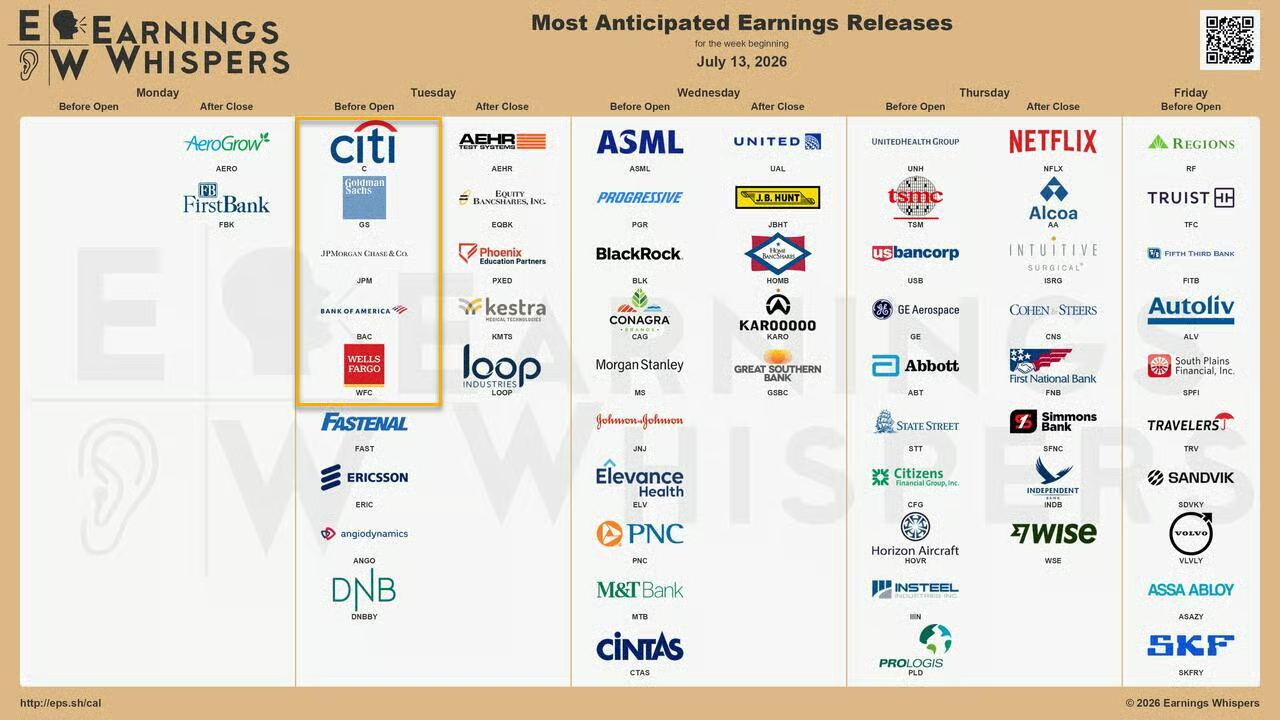
The opening lineup for this earnings season is unprecedentedly dense. JPMorgan Chase, Bank of America, Wells Fargo, Goldman Sachs, and Citigroup will all release their results before the market opens on Tuesday. Later this week, earnings from ASML and TSMC will provide a direct test of the global AI chip demand landscape.
According to Goldman Sachs' trading desk estimates, market consensus expects S&P 500 earnings to grow approximately 22% year-over-year in Q2, the highest level since 2021. However, actual results have beaten consensus expectations for 11 consecutive quarters—Q1 actual growth was a robust 27%, exceeding expectations by about 15 percentage points, with the surplus primarily coming from AI-related sectors.
On the banking side, a key focus for JPMorgan Chase is the potential impact of Marianne Lake's departure on its management premium. For Bank of America, the visibility of expense guidance and NII (Net Interest Income) is seen as a core variable for its stock price on the day. Citigroup is expected to benefit from the positive impact of ECB rate hikes on its Services NII, and with relatively low market expectations, its upside potential might be significant. Goldman Sachs is widely viewed as a core beneficiary of the AI capital market cycle, with its stock trading division under close scrutiny. Whether Wells Fargo can achieve its 2026 NII target remains uncertain, given the risk of insufficient deposit growth in the second half of the year.
Goldman Sachs' market analysis warns that this earnings season may lack the additional catalyst provided last quarter by a significant upward revision in AI capital expenditure expectations. The market's reliance on earnings to continue driving the index higher faces greater challenges in achieving this against a backdrop of a tightening macro-policy environment.
Waller Draws the Rate Hike Trigger Line, Policy Tilt Becomes Clear
Waller's speech on Monday at the New York Association for Business Economics was interpreted by the market as the clearest warning of a rate hike to date.
He stated that the core Personal Consumption Expenditures (PCE) price index had already risen by 3.4% year-over-year through May and has been trending higher since January, exhibiting an upward trajectory even before the onset of the U.S.-Iran conflict. Factors driving inflation include tariffs, energy prices, and the massive build-out of AI infrastructure. "By any measure, inflation is moving up this year," he said. "I am currently concerned about the elevated trajectory of core inflation."
Waller also cited the policy mistakes of 2021-2022, when inflation spiraled out of control, as a cautionary tale, warning that the FOMC faced widespread criticism for delaying rate hikes back then and that such errors cannot be repeated. He explicitly stated that if he saw several consecutive months of cooling data, he would support maintaining the current stance, but the conditions are stringent.
These remarks align with the tone of last month's FOMC minutes, which showed that half of the 18 officials expected at least one 25-basis-point rate hike at some point this year. The option of a rate hike is moving from a fringe issue towards the center of policy discussions. According to analysis by the team of Goldman Sachs economist Jan Hatzius, Waller's latest comments, combined with the June meeting minutes, confirm that the Committee's openness to restarting rate hikes is significantly increasing.
The Triple Pressure of Rate Hike Risk: Growth, Capital Costs, and Historical Precedent
In its latest weekly U.S. equity strategy report, Goldman Sachs clearly stated that if the Fed resumes rate hikes, U.S. stocks will face triple pressure in the short term.
First, tightening policy will directly dampen growth expectations. While economic growth is more important for the stock market than the level of interest rates, monetary tightening, all else being equal, will drag down the market's assessment of the growth outlook.
Second, the current economic cycle is characterized by significantly higher capital intensity. AI infrastructure-related stocks now account for 42% of the S&P 500's total market capitalization and are expected to contribute about 50% of the index's earnings growth in 2026. Goldman Sachs data shows that capital expenditure for hyperscale cloud companies this year is expected to be equivalent to 100% of their operating cash flow. Their net debt reached $239 billion in the first quarter of 2026, a surge of roughly 190% year-over-year. Concurrently, total U.S. equity financing in the second quarter reached $252 billion, a historic record surpassing the previous high set in Q1 2021. Any increase in capital costs will directly impact this most important growth engine of the cycle.
Third, historical data indicates that Fed rate hikes are a significant precursor to peaks in high-valuation, high-concentration bull markets. Rate hike cycles in 1929, 1972, 1987, and 1999 all preceded the peak of the bull market. In 2022, the market topped out ahead of time as rate expectations rose. Goldman Sachs rates strategists estimate that if interest rate volatility rises to the levels seen during the 2022-2023 rate hike cycle, it would correspond to a contraction of roughly 6% in the S&P 500's P/E multiple, equivalent to about 1x valuation.
Goldman Sachs currently sets its year-end S&P 500 target at 8,600 points and its 12-month target at 8,300 points, implying potential upside of about 14% and 10%, respectively, from the current level of 7,544 points. However, strategists emphasized that achieving these targets is predicated on the macro-policy environment not tightening materially—a premise that will face its most direct test over the next two days.