The "Fix" Myth of Software Stocks: After the Rebound, Is AI Agent a Killer or a Savior?


- Core Thesis: The recent rebound in software stocks is not merely a technical fix, but the market is re-screening winners based on their AI Agent deployment capabilities: platform-based software companies that control customer entry points, enterprise data, workflows, and permission systems could become AI beneficiaries, while SaaS companies lacking moats face business model disruption.
- Key Elements:
- The software ETF, IGV, rose approximately 17.4% from the end of March to May 22nd, but the recovery is uneven. Sectors like cloud monitoring, security, and databases have shown stronger rebound momentum.
- The traditional SaaS per-seat pricing model is challenged by AI Agents, as the market questions that automation will reduce enterprise demand for software seats.
- AI Agent deployment requires four elements: entry point, data, processes, and permissions. This gives software companies possessing these capabilities (e.g., Salesforce, Snowflake) a revaluation logic.
- For Salesforce (CRM), the key in its earnings report is whether Agentforce can generate real orders, proving AI enhances rather than replaces CRM. Market expectations are for revenue of approximately $110.5 billion, up 12% year-over-year.
- For Snowflake (SNOW), the key in its earnings report is whether the AI narrative can translate into data consumption growth. The market is watching its product revenue guidance (approx. $12.6 billion, up 26.9% YoY) and large customer data.
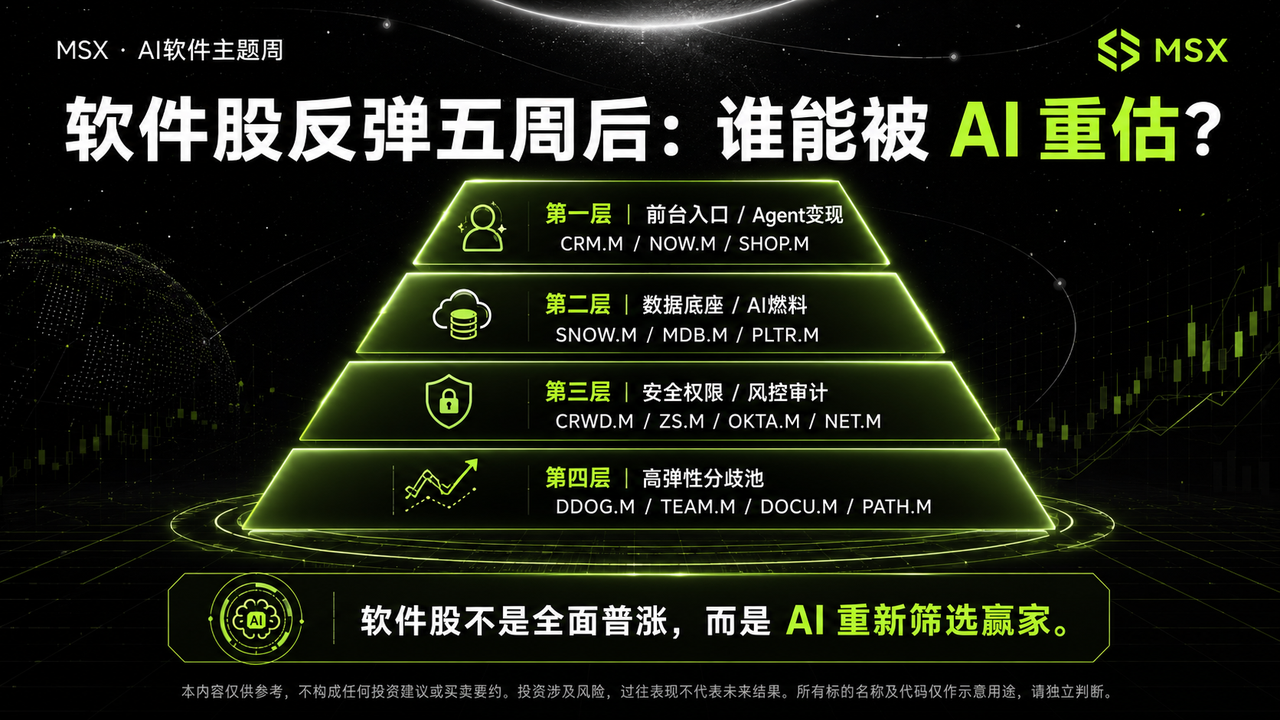
- Software stocks can be layered by AI capability: Front-end entry points (CRM, NOW), data foundation (SNOW, MDB), security and permissions (CRWD, ZS), and high-elasticity pools (DDOG, TEAM). Each layer's outlook depends on its respective earnings verification.
Over the past two months, if there was one dominant theme in the U.S. stock market, it would undoubtedly be AI hardware, computing power, Nvidia, optical communications, electricity, and data centers.
However, another sector has also been quietly recovering – software stocks.
This isn't hindsight. In the article "Oil Prices Spike, Rates Hard to Cut, 'Magnificent Seven' Stumble: Where Are the Excess Returns in Q2 U.S. Stocks?", Maitong clearly pointed out the 'valuation correction' in the software sector, emphasizing that not all SaaS stocks are worth watching, but rather security software, enterprise platform leaders, and high-elasticity divergence pools, including PANW.M, CRWD.M, NET.M, CRM.M, NOW.M, ZS.M, INTU.M, ADBE.M, MDB.M, SNOW.M, DDOG.M, TEAM.M, etc.
Looking back now, this judgment has been partially validated: Calculated over the period from March 31 to May 22, the software ETF IGV rose from $80.05 to $94.01, an increase of approximately 17.4%. In other words, software stocks have experienced a clear round of low-level repair.
However, the bigger question remains: Is this rebound merely a technical correction after a significant decline, or are AI Agents causing the market to reprice some software companies?

1. Beyond the Rebound, Why Were Software Stocks Shunned by the Market?
As shown below, let's look at a set of data first.
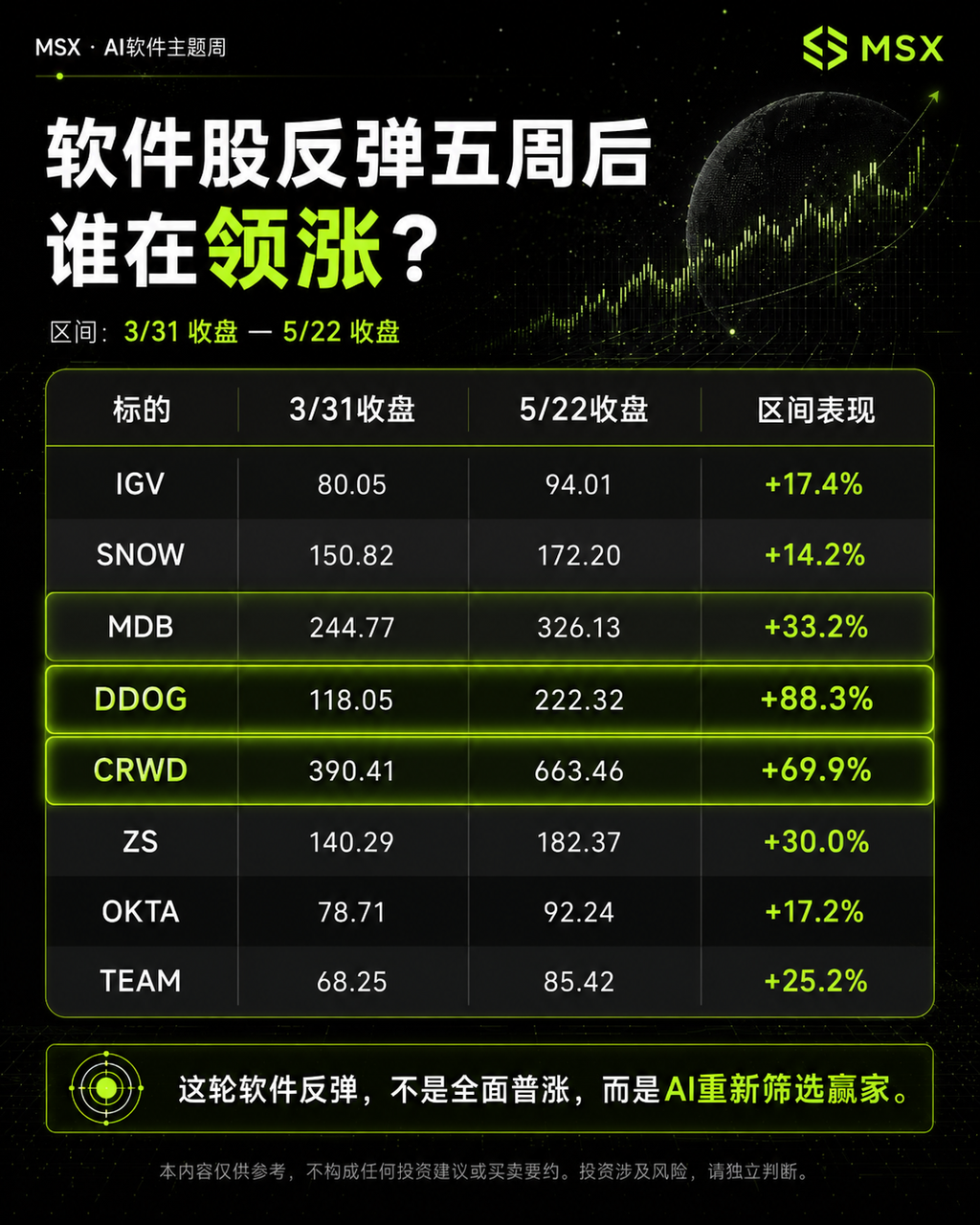
Actually, this data illustrates a very intuitive point: It's not that nobody is buying software stocks overall; the market has already begun repricing in certain areas, especially cloud monitoring, security, databases, and data cloud companies. Their rebound momentum has even significantly outpaced IGV itself.
But this doesn't mean 'all SaaS is heading back to a bull market.'
More accurately, this software rebound is AI rescreening the winners. The market is starting to distinguish which software will be replaced by AI Agents and which software will become more important because of their implementation.
As everyone knows, over the past period, software stocks were suppressed not just because of deteriorating performance, but because the market began to doubt the business model of traditional SaaS.
Traditional SaaS is often charged per head or per seat. Companies pay subscription fees based on the number of sales seats, customer service seats, or collaboration seats they buy. But after the emergence of AI Agents, the market started asking a very sharp question: If one AI Agent can do the work of multiple employees in the future, will companies still need that many SaaS seats?
This is the core logic behind why software stocks had their valuations crushed in the past.
AI Agents might automatically write emails, follow up with customers, generate contracts, analyze data, handle tickets, and execute approvals. Once these tasks are automated, the traditional software logic of 'more people equals more seats equals higher revenue' will be challenged.
At the same time, corporate AI budgets have been flowing more towards GPUs, cloud computing power, data centers, and infrastructure. Software companies have been in a squeezed position instead. More troubling is that if AI only brings increased R&D and computing costs without improving profit margins, the valuation pressure on software companies will persist.
As we also mentioned in our Q2 outlook, for enterprise software, platform technology, and cybersecurity companies, if AI only increases investment without improving profit margins, valuation pressure will continue to rise.
Therefore, what the market truly dislikes about software stocks is not just the growth rate, but the certainty of the business model.

2. The Key Isn't 'Having AI,' But Whether AI Can Generate Revenue
The market is also beginning to realize that AI Agents don't operate in a vacuum.
For a truly implementable enterprise AI Agent, at least four things are needed:
- First, an entry point, such as sales, customer service, marketing, IT tickets, and office collaboration – these are where real enterprise work happens;
- Second, data. Without internal enterprise data, an AI Agent can only provide generic answers and struggles to make real decisions;
- Third, processes. Enterprises don't want AI for casual conversation; they want AI to initiate approvals, update CRMs, handle tickets, generate quotes, and close business loops;
- Fourth, permissions and security. In the future, it's not just humans who make mistakes; Agents could also misoperate, access data beyond authorization, or leak data. Therefore, identity management, security, and auditing will become even more critical;
This is why software stocks are starting to show a recovery logic. AI Agents might not necessarily bypass software; instead, they might have to be built on top of software.
In other words, AI Agents will indeed impact the part of SaaS that 'only sells seats, lacking data and process moats.' But for software companies that control customer entry points, enterprise data, workflows, and permission systems, it could conversely become a new growth driver.
And one of the most critical software earnings reports this week is from Salesforce.
Salesforce will report its FY2027 first-quarter results after the market close on May 27. The company has clearly positioned itself as the '#1 AI CRM,' stating it helps enterprises become 'agentic enterprises' by integrating humans, agents, apps, and data into a unified platform.
Market expectations are for Salesforce to report revenue of around $11.05 billion for the quarter, representing approximately 12% year-over-year growth, and adjusted EPS of around $3.11, up from $2.58 in the same period last year. The options market also indicates that traders expect a potential swing of nearly 9% in CRM's stock price following the earnings release.
But the real focus of this earnings report isn't whether traditional CRM revenue can slightly exceed expectations, but whether Agentforce can prove that AI Agents can truly be commercialized.
The market will look at several issues: Does Agentforce have real orders? Are AI features driving improvements in RPO and subscription revenue? Are customers willing to pay extra for AI Agents, or do they just see it as an add-on to existing software? Can profit margins and share buybacks continue to support the valuation of a mature software company?
CRM's answer is critical. If Salesforce can prove that AI Agents enhance CRM rather than replace it, then the rebound in software stocks won't just be a valuation repair; it could potentially enter an AI-driven revaluation phase.
Another key earnings report is from Snowflake.
Snowflake will report its FY2027 first-quarter results after the market close on May 27. The company positions itself as the AI Data Cloud, emphasizing that its platform helps enterprises derive value from data, applications, and AI.
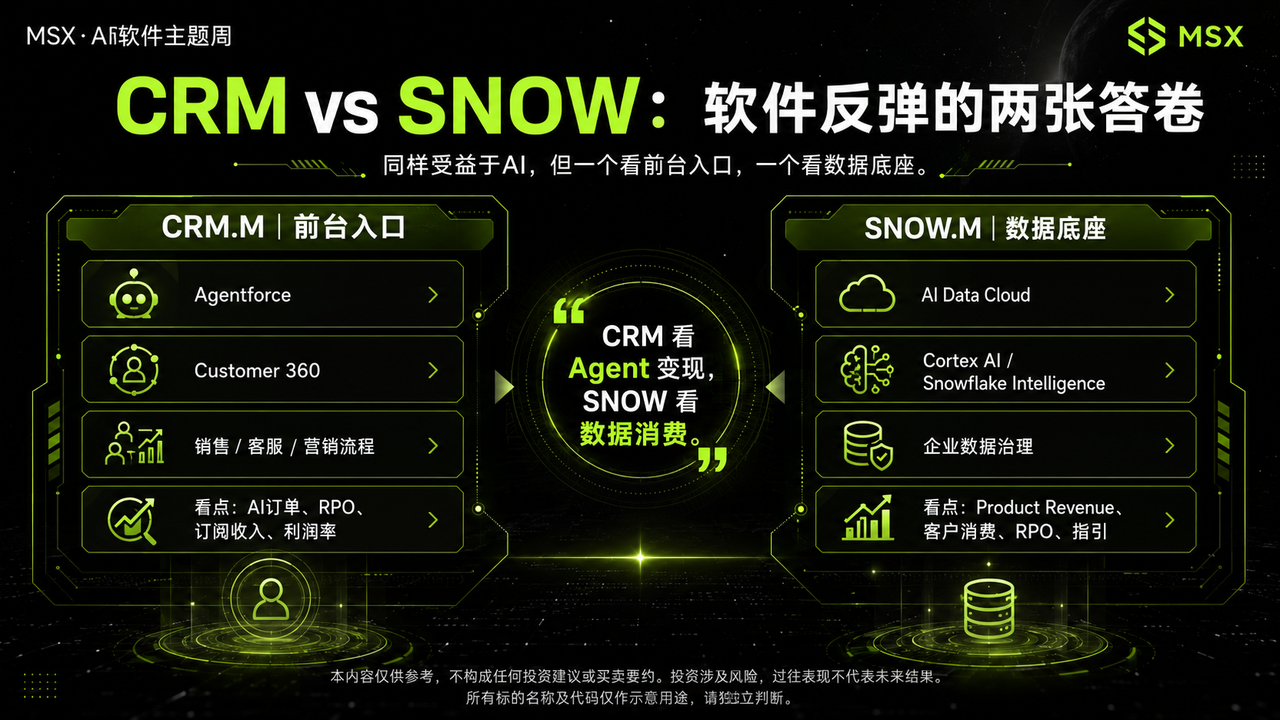
SNOW.M and CRM.M operate under different logics.
CRM is more like the front-end entry point, whereas SNOW is more like the back-end data foundation. For AI Agents to help enterprises make decisions, they first need to access, understand, and govern internal enterprise data. No matter how powerful the model, it's difficult to truly implement without clean, unified, and callable data.
Before the earnings release, Snowflake provided FY2027 Q1 product revenue guidance of $1.262 billion to $1.267 billion, corresponding to roughly 27% year-over-year growth. The Zacks consensus estimate for Q1 product revenue is around $1.26 billion, representing approximately 26.9% year-over-year growth. The market will also pay attention to the number of million-dollar customers, total customer count, net revenue retention rate, and the adoption of AI products like Snowflake Intelligence and Cortex Code.
Therefore, the key for SNOW.M isn't 'whether there's an AI narrative,' but whether the AI narrative can translate into more data consumption.
If Product Revenue exceeds the high end of guidance, customer consumption continues to recover, and RPO and the number of large customers continue to improve, it indicates that enterprise AI isn't just staying at the model layer but is starting to drive usage of data platforms.
Conversely, if the AI products are talked up enthusiastically but consumption growth and guidance aren't strong enough, the market might interpret this rebound as 'valuation repair' rather than 'fundamental revaluation.'
In a nutshell, CRM.M's story is about whether Agents can generate revenue, while SNOW.M's story is about whether AI can drive data consumption.
3. How to Layer the Analysis of Software Stocks?
This rebound in software stocks shouldn't be simplistically viewed as all software rising together. A more reasonable approach is to layer them based on the capabilities required for AI Agent implementation.
- The first layer is Front-end entry points and Agent monetization. Representative companies include CRM and NOW. They control sales, customer service, business processes, and enterprise workflow entry points. If AI Agents truly enter workflows, these companies have the opportunity to monetize AI as a product;
- The second layer is the Data foundation and AI fuel. Representative companies include SNOW, MDB, and PLTR. For AI Agents to understand an enterprise, they must access internal enterprise data. The more complex the data, the more important governance becomes, and the higher the value of such platforms;
- The third layer is Security, identity, and permissions. Representative companies include CRWD, ZS, OKTA, and NET. The more automated Agents become, the more enterprises need to manage permissions, audit behavior, and prevent data leaks. In the future, security software won't just protect people; it will also need to define the behavioral boundaries of Agents;
- The fourth layer is the High-elasticity divergence pool. Examples include DDOG, TEAM, DOCU, and PATH. These companies have high elasticity but also depend more heavily on earnings reports for validation. If AI can improve usage frequency, customer stickiness, and revenue growth, they can continue to recover. If it's just a valuation rebound, the sustainability will be much weaker;
So, are AI Agents the killers of software, or its saviors?
The answer is: both are possibilities.
For software companies lacking data moats, process moats, and customer entry points, AI Agents might compress their value. However, for platform-type software companies that control customer relationships, enterprise data, business processes, and security permissions, AI Agents could conversely become a new growth driver.
This is also why software stocks have rebounded for five or six weeks, but the market hasn't yet delivered a final verdict.
The real answers will be hidden in the upcoming earnings reports – CRM needs to prove if Agentforce can generate real orders; SNOW needs to prove if enterprise AI can drive data consumption; security software needs to prove that in the era of AI automation, the demand for permissions and risk control will only grow stronger; high-elasticity software stocks need to prove that the rebound is driven by revenue, profit margins, and guidance, not just sentiment.
In short, true gold fears no fire. Ultimately, companies with entry points, data, processes, and permissions are the ones that have the chance to transition from 'AI victims' to 'AI beneficiaries.'