






SK Hynix's Inheritors: When the Chaebol Playbook Fails


- Core Thesis: SK Group's third-generation successor has broken the traditional Korean chaebol inheritance playbook of "eldest son, equity, marital alliances, and father's approval." Against the backdrop of SK Hynix's market capitalization surpassing 1,000 trillion won during the AI cycle, the three children have each forged independent professional identities outside the family business—through biopharmaceuticals, geopolitics and AI healthcare startups, and consulting firms. The core of succession has shifted from controlling the family conglomerate to possessing the capability to navigate the global AI industry chess game.
- Key Elements:
- Traditional Playbook Fails: Chaebols like Samsung and Hyundai followed the eldest son succession model, but SK Chairman Chey Taewon publicly stated that succession has "not yet been decided" and demanded his children prove their own capabilities, transforming inheritance into a public test of legitimacy.
- Eldest Daughter Chey Yunjung Focuses on Biopharma: She leads radiopharmaceutical pipelines at SK Biopharmaceuticals and serves as head of SK Inc.'s Growth Support Division, establishing her candidacy for succession through scientific training and an executive position rather than marriage.
- Second Daughter Chey Minjung Bridges Geopolitics: After serving in the South Korean Navy, she worked at SK Hynix's US subsidiary handling international trade and policy, and later founded an AI healthcare company. Her career path mirrors SK Hynix's new role as a geopolitical asset.
- Eldest Son Chey Ingeun Chooses Silence: Although he studied physics, joined SK, and later moved to McKinsey—a path resembling a traditional heir—he holds no shares and has made no public statements, proving that the status of eldest son alone can no longer automatically confer succession legitimacy.
- Elite Marriage Networks Reshaped: The eldest daughter married an AI infrastructure entrepreneur, while the second daughter married a former US Marine Corps officer. The network of marital alliances has shifted from the domestic chaebol circle to Silicon Valley and Washington D.C., reflecting the changing resources SK requires.
On November 26, 2024, at the Walkerhill Hotel in Gwangjin-gu, Seoul, the 50th-anniversary ceremony of the Korea Foundation for Advanced Studies was held. The venue lights dimmed, and an AI-generated video appeared on the screen. It showed Choi Jong-hyun, the second-generation chairman of SK Group and the founder of the foundation.
He had passed away suddenly in Los Angeles in 1998, 26 years prior. In the AI video, he spoke again, addressing the young people who had gone abroad on the foundation's scholarships in the past: "Plant a seed in your hearts, and may you nurture the dream of growing into a great tree; we are willing to wait until the seed you planted grows into a tree."
Sitting at the central table in the audience were his son, Chey Tae-won, the current chairman of SK Group and the head of South Korea's second-largest chaebol, along with the two children he had brought to witness this scene: his eldest daughter, Chey Yoon-jeong, and his eldest son, Chey In-geun. Chey Tae-won later explained to the media why he brought them: "This is our legacy, so they need to receive training. They need to see what their grandfather did and what their father did." He said it was a "mandatory requirement for them to attend." During the event, he also mentioned the virtue of drinking water and remembering the source: when you drink water, think about where it comes from, and beneficiaries should remember the one who originally dug the well.
SK Hynix's stock has surged 700% over the past year, with its market capitalization just breaking the 1,000 trillion won mark, surpassing its older rival Samsung Electronics to become the most valuable asset in the history of South Korean chaebols. As the AI cycle propelled Hynix to the center of attention in the South Korean capital market, outsiders looking for the company's successors found that the third generation of SK did not neatly fall into the roles dictated by the traditional chaebol script. The eldest daughter was the first to enter the group's executive narrative, the second daughter had the deepest connections to Hynix, Washington D.C., and the U.S. military network, while the eldest son, who appears the most like the heir apparent, is actually the quietest.
After Hynix's surge, the old script for chaebol succession is broken
Succession in South Korean chaebols has historically revolved around four key elements: the eldest son, equity, marriage connections, and the father's approval. Samsung, Hyundai, and Hanwha have all repeated this script.
In October 2022, Lee Jae-yong, the third-generation leader of Samsung Group, was officially appointed as chairman, completing the generational transition; his eldest son, Lee Ji-ho, recently enrolled in the Korea Naval Academy to prepare for military service, which itself is a typical "succession training move" for the new generation of South Korean chaebols. Hyundai Motor Group followed suit slightly later, with third-generation leader Chung Eui-sun taking the helm in 2020. Hanwha Group, in 2025, saw Chairman Kim Seung-youn transfer half of the holding company's shares to his three sons, effectively handing the empire over to Vice Chairman Kim Dong-kwan, who is 42 years old this year and whose status as the eldest son has never been doubted by outsiders.
The core of this script is "letting the public and the market recognize the crown prince early." From Lee Jae-yong to Chung Eui-sun to Kim Dong-kwan, regardless of their differences in personality, ability, or path, they were all written into the "successor" role by their fathers, families, and the media, and they gradually moved towards that seat through equity stakes, military service, education, and career training.
SK is different. Chey Tae-won and his ex-wife, Roh So-young, have three children: eldest daughter Chey Yoon-jeong (born 1989), second daughter Chey Min-jeong (born 1991), and eldest son Chey In-geun (born 1995). All three children are currently related to the group's future, but none can fill the "crown prince" position.
Chey Yoon-jeong was early on dubbed the "most obvious succession candidate" by South Korean financial media, but her focus is not on semiconductors; it's on SK Biopharmaceuticals. Chey Min-jeong previously handled international trade and policy responses at SK Hynix's US subsidiary, but in 2022, she left Hynix to start a medical venture in San Francisco. Chey In-geun is the most traditional male heir, but in July 2025, he left SK E&S to join McKinsey's Seoul office. Following the conventions of the third generation of South Korean chaebols, a stint at a consulting firm is a path for "external experience," not a succession mandate.
Chey Tae-won himself was quite frank in a 2021 interview with BBC Korean: "Nothing has been decided yet. My children also have to strive to earn their opportunities. My son is still young and will live his own life; I won't force him." When asked if the children's participation in management would require board approval, he answered, "Yes."
This statement transformed succession from a family matter into a public test of legitimacy. All three children have to prove themselves, and the tools they can use to do so are no longer equity, marriage connections, or being the eldest child.
Chey Yoon-jeong: The "Most Obvious Successor," From the Lab to the Boardroom
On June 28, 2024, at the SKMS Research Institute in Icheon, Gyeonggi Province, SK Group held a management strategy meeting. Attendees included the CEOs of major subsidiaries like SK, SK Innovation, SK Telecom, and SK Hynix, along with key family members of the group, totaling over 30 people. Chey Tae-won, who was on a business trip in the US, attended via video link. The media described the meeting as an intensive discussion filled with a sense of crisis, spanning one night and two days. On the first day, "there was no preset end time" until a direction was established.
Chey Yoon-jeong was at the table. She was the only attendee in her capacity as Chey Tae-won's child and is the youngest executive within SK Group. The media interpreted her "sudden appearance" as part of a management training course.
To understand how she earned a seat at that table, we need to look back at her training. Born in August 1989 at the Seoul Regional Military Hospital, her maternal grandfather, Roh Tae-woo, was the sitting President of South Korea at the time. She spent her childhood and middle school years at an international school in Beijing, then earned her undergraduate degree in biology from the University of Chicago – the same university her parents attended. During her undergraduate studies, she spent two years as a research fellow at the Chicago Institute for Neuroscience and had research experience at the Harvard Institute for Physical Chemistry. After graduating, she worked for two years as a consultant at Bain & Company. This is standard training for the third generation of South Korean chaebols.
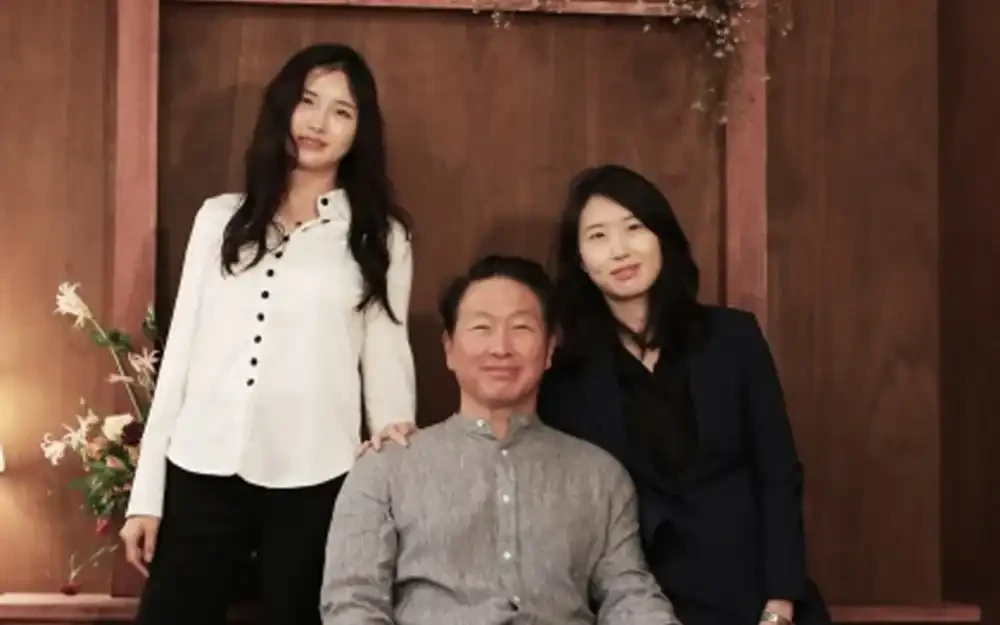
Chey Yoon-jeong (left) with Chey Tae-won (center) and Chey Min-jeong (right)
In 2017, she joined SK Biopharmaceuticals as the head of the Strategic Investment team. However, in 2019, she made a decision that seemed uncharacteristic for an heir: she temporarily left SK to pursue a master's degree in Biomedical Informatics at Stanford University. This was in the field of computational biology, not general biology. Two years later, she returned to SK to continue working in strategy while simultaneously starting a PhD in Biological Sciences at Seoul National University, majoring in Genetics and Development. She is still pursuing her PhD.
In January 2024, she was promoted to Head of Business Development (Vice President level) at SK Biopharmaceuticals, leading the introduction of radiopharmaceutical therapy (RPT) and radioisotope supply contracts. This is a core pipeline for SK Biopharmaceuticals' transition from traditional neurological drugs to precision medicine for the AI era. Later that year, Chey Tae-won established a new "Growth Support Department" at SK Group's top holding company, SK Inc., responsible for mid-to-long-term planning, portfolio management, global expansion, and new business evaluation, and placed it directly under her purview.
Her marriage also doesn't follow the old chaebol script. In October 2017, she married Yoon Do-yeon, a colleague from Bain. Yoon Do-yeon, a graduate of Seoul National University's Business School, later became co-CEO of More (모레), a South Korean AI infrastructure startup. The company develops a software platform for AI model training and computation parallelization. It received strategic investment from KT in 2021 and was valued at approximately 350 billion won in 2025. This is not a traditional chaebol marriage alliance, nor is it what Chinese media often call "marrying an ordinary employee." It represents a new kind of elite network integration: the eldest daughter of a chaebol marrying a tech entrepreneur of the AI era.
In the succession narratives for daughters of chaebols like Samsung and CJ over the past few decades, they were most visible through art galleries, hotels, charitable foundations, luxury retail, or their dowries. Chey Yoon-jeong's position is different. She sits at the table where SK Group decides its future direction. Her visibility isn't defined by marriage, art, or image crafting, but by scientific training, consulting experience, a doctoral dissertation, strategic investments, and a high-ranking executive position within the group.
The way chaebol daughters are seen is changing. Yet, Chey Yoon-jeong rarely speaks publicly. She is discussed by South Korean media under the label of being the "most likely succession candidate," but her personal story remains quiet in public reports.
Chey Min-jeong: A Warship, Washington D.C., and Hynix' Globalizing Heir
On October 13, 2024, again at SK Group's own Walkerhill Hotel, Chey Tae-won's second daughter, Chey Min-jeong, and Chinese-American entrepreneur Kevin Hwang held their special wedding ceremony.
About 500 guests attended, including Lee Jae-yong, Koo Kwang-mo, Kim Dong-kwan, and other members of the SK family. For the first time since their 1.38 trillion won divorce lawsuit, Chey Tae-won and Roh So-young appeared in the same space, sitting side-by-side in the bride's parents' seats. Beside them was the dog co-owned by Chey Min-jeong and Kevin Hwang.
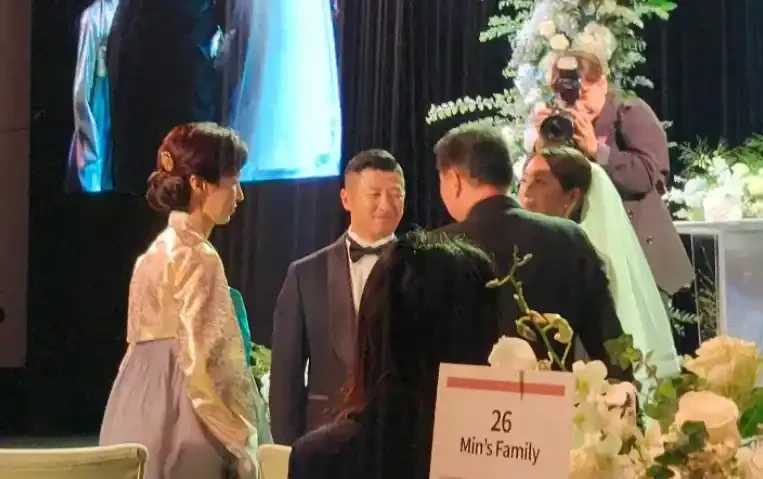
Chey Min-jeong's wedding scene
After the groom entered, Chey Min-jeong walked into the venue alone, without being escorted by her father. The entire ceremony had no officiant. Her older sister, Chey Yoon-jeong, gave a congratulatory speech, and the groom's brother spoke in English. Before the ceremony began, a moment of silence was held for the fallen heroes of the Korea-US alliance. An empty table was set up on one side of the venue, adorned with a medal, a dog tag, a rose, and a lemon – this is the Missing Man Table, a US military tradition to honor missing and fallen service members.
Born in 1991, Chey Min-jeong attended the High School Affiliated to Renmin University of China for her secondary education and earned her undergraduate degree in Business Administration from the Guanghua School of Management at Peking University. Among the third generation of South Korean chaebols, almost none have come to China for their undergraduate studies; others typically go to Ivy League schools or stay at prestigious South Korean universities. During her studies in Beijing, she reportedly covered her living expenses through scholarships, part-time convenience store jobs, and teaching at test prep academies, barely accepting financial support from her parents. This "self-reliance path" is an extremely rare marker among the children of South Korean chaebols.
In 2014, she made a decision that baffled all South Korean media: she applied for the 117th class of the Republic of Korea Navy Officer Candidate School. While military service is mandatory for men in South Korea, it is entirely voluntary for women. This was the first time a woman from a South Korean chaebol family had voluntarily enlisted for active duty. During her interview, she said she was inspired by the spirit of challenge and leadership of Antarctic explorer Ernest Shackleton from 1915. During the 11 weeks of pre-commission training, she often repeated the same phrase to her visiting family and friends: "I am proud of myself for being a daughter of the Republic of Korea. After going through the training period, I have an even greater sense of pride."
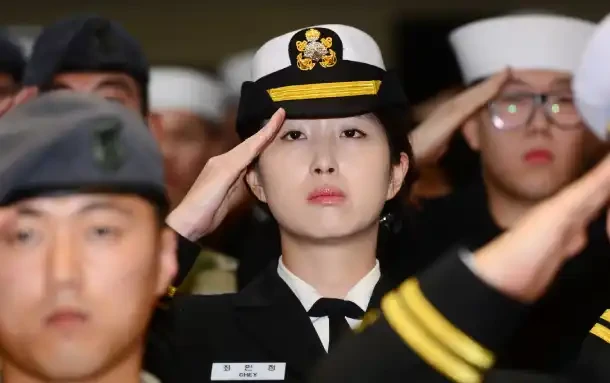
Chey Min-jeong in military service
She was assigned to the destroyer ROKS Chungmugong Yi Sun-sin (DDH-975), serving as an Operations Information Officer. In December 2015, she deployed with the 19th contingent of the Cheonghae Unit to the Gulf of Aden off the coast of Somalia for anti-piracy escort missions. Before her discharge, she served as a Situation Control Room Officer at the 2nd Fleet Command Combat Corps Headquarters. She was discharged from active duty on November 30, 2017, with the rank of Lieutenant (JG).
After her military service, she returned to China, working in private equity at an investment firm for about a year, before going to Georgetown University in the US for a master's degree in International Business Policy. In August 2019, she joined SK Hynix's INTRA department, the unit overseeing external cooperation. Her role involved international trade and policy response, with her work based between Washington D.C. and Seoul. This was her direct point of connection to SK Hynix. She was neither an engineer, a product manager, nor involved in factory operations. She worked in policy, later moving to the strategy department of SK Hynix's US legal entity, focusing on M&A and investments.
This was also around the time she met her husband, Kevin Hwang. They were neighbors in the DuPont Circle area of Washington D.C.
Kevin Hwang, born in Indiana, USA, holds a BA from Harvard and an MBA from Stanford. He joined the US Marine Corps as a commissioned officer in 2016 and served in South Korea for about nine months starting in October 2020 as a logistics plans officer for US Forces Korea. Both having military backgrounds, the South Korean media described their relationship as "deepened by their shared military experience."
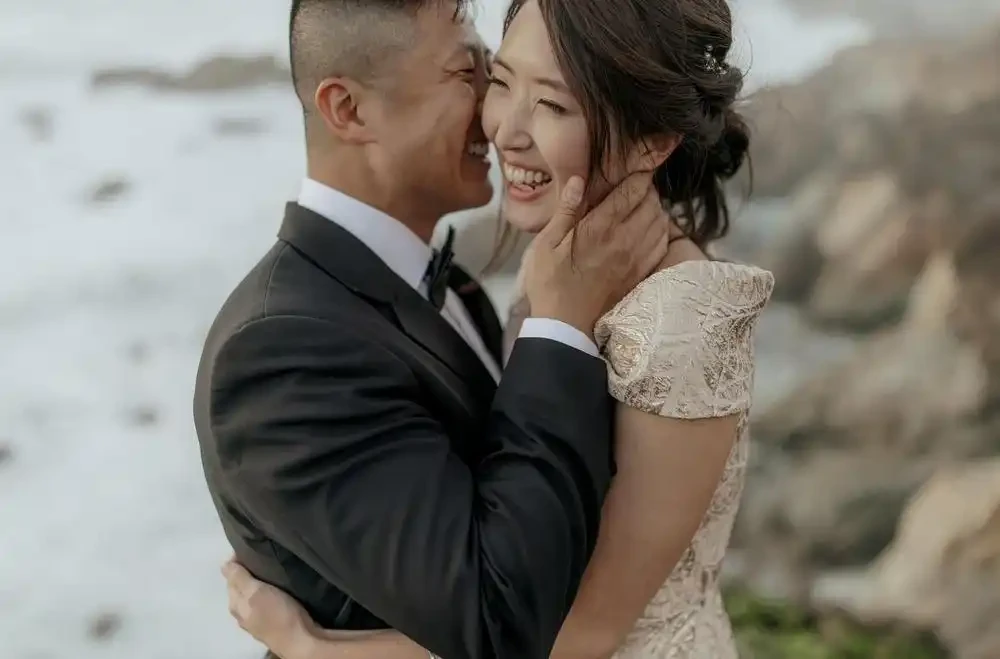
In February 2022, Chey Min-jeong took a leave of absence from SK Hynix. She went to San Francisco to work as an unpaid advisor for Done Global, a telehealth startup. South Korean media later revealed that she actually served as its CFO. A year later, she co-founded Integral Health with a scholar from the Yale School of Medicine's Department of Psychiatry, serving as CEO. The company focuses on AI-driven collaborative care and behavioral health integration.
Her current LinkedIn bio reads: "Founder of Integral Health | Investor in Healthcare & AI | Veteran | 2x Exits." The "Veteran" tag remains in the most prominent position.
A recurring theme runs through Chey Min-jeong's life: military service. From Shackleton to the Gulf of Aden, from SK Hynix's INTRA in Washington D.C. to marrying a former US Marine Corps captain. She hasn't entered SK's internal management layer like her sister, nor has she married into a prestigious South Korean family according to the traditional chaebol script. However, she has vividly embodied the new era of SK Hynix's position. Semiconductor companies are increasingly becoming geopolitical companies in the AI cycle, needing to navigate US policy, trade controls, supply chain security, and capital M&A. Chey Min-jeong's resume is precisely built along this axis.
Chey In-geun: The One Most Likely to be the Heir, Yet the Most Silent
Chey In-geun's story begins in a hospital room.
In 2003, SK Group was embroiled in an accounting fraud scandal, which led to Chey Tae-won's imprisonment. In the same year, Chey In-geun, the youngest son of Chey Tae-won and Roh So-young, was diagnosed with juvenile diabetes. Doctors said he would need lifelong insulin injections. Chey In-geun was 8 years old then.
During that period, Roh So-young, the daughter of a former South Korean president, stayed with her son in the pediatric ward of Seoul National University Hospital. At night, while Chey In-geun slept, she would sit alone by his side. In a later interview, Roh So-young recalled that even at 17, her son was still struggling hard against diabetes. But he was a very bright boy, often serving in the choir at a church near their home, performing special beatbox songs during worship, and copying Bible passages with his second sister, Chey Min-jeong, by their mother's side in the evenings.
Chey In-geun's educational path differed from his two older sisters. He first attended a non-traditional middle school in South Korea known for its innovative education, and later transferred to Hawaii. His mother, Roh So-young, believed that "there's no need to be anxious about forcing children into the same universities as everyone else" and that one should explore different, creative methods of parenting. While Chey In-geun attended high school in Hawaii


