






Three Lines of AI Infrastructure: Which Rises First, Which is the Strongest, and Which Can Still Be Chased?


- Core Thesis: The outbreak of the AI industry presents a clear transmission chain: First, chips benefit (underlying computing power demand), second, the energy bottleneck becomes apparent (high power consumption of data centers), and finally, storage demand is lifted in the long term (continuous data throughput by AI systems). This logic has been significantly validated by the gains in U.S. and A-share related assets over the past year.
- Key Elements:
- Chip Layer: AI demand first translates into orders for GPUs (Nvidia), HBM, and advanced manufacturing processes. Nvidia's fiscal 2026 revenue grew 65% year-over-year, while equipment makers (ASML, Lam Research) saw gains of 27%-30% at the start of the year.
- Energy Layer: The power per rack for AI data centers has increased to 50-100 kilowatts (compared to 5-15 kilowatts traditionally). The IEA predicts global data center electricity consumption will reach 945 TWh by 2030, a doubling, driving the revaluation of assets like gas turbine manufacturers (GE Vernova, up 167% YoY) and nuclear power operators.
- Storage Layer: AI creates pressure from frequent data reads/writes, real-time calls, and caching. Memory chip manufacturers (SK Hynix Q1 revenue up 198%, profit up 406%) and HDD makers (SanDisk up 350% YTD) have shown outstanding performance.
- Regarding the three lines of chips, energy, and storage mentioned by Justin Sun in a tweet last November, buying into U.S. storage stocks like Micron and SanDisk at that time would have yielded gains of 180% to 552% by now.
- In terms of domestic assets, Haiguang Information's 2024 revenue reached 91.62 billion yuan, up 52.4% year-over-year. Domestic computing chip and storage design companies (e.g., GigaDevice, Puya Semiconductor) also benefited simultaneously.
Original Author: Changan I Biteye Content Team
In November last year, Justin Sun posted a tweet:

If this statement is taken as an industry judgment, rather than a catchy quote, looking back now reveals:
These three lines almost perfectly map out the most realistic profit path of the AI bull market.
If, after that tweet was posted, one bought into US-listed memory and storage concept stocks, what would the result be today?
• Micron: +214%
• Seagate: +180%
• Western Digital: +190%
• Sandisk: +552%
This article breaks down these three lines to examine:
Why does AI first benefit chips, then hit an energy bottleneck, and ultimately drive long-term demand for storage? Which assets have already outperformed in this structural cycle?
1. Chips: The First Thing AI Booms Deliver is Not Narratives, But Orders
What burns first in AI is not the application layer, but the underlying computing power.
Whether it's training large models, daily inference, Agent calls, or multimodal processing, the first step is to get the computation running. Ultimately, all this computation relies on GPUs, HBM, high-speed interconnects, and advanced manufacturing processes.
In other words, growth in AI demand doesn't first trickle down to the very end of the chain; it translates into a much more immediate reality:
More chips are needed. Stronger chips are needed. Higher bandwidth chips are needed.
This is precisely why AI demand was first reflected in the chip sector.
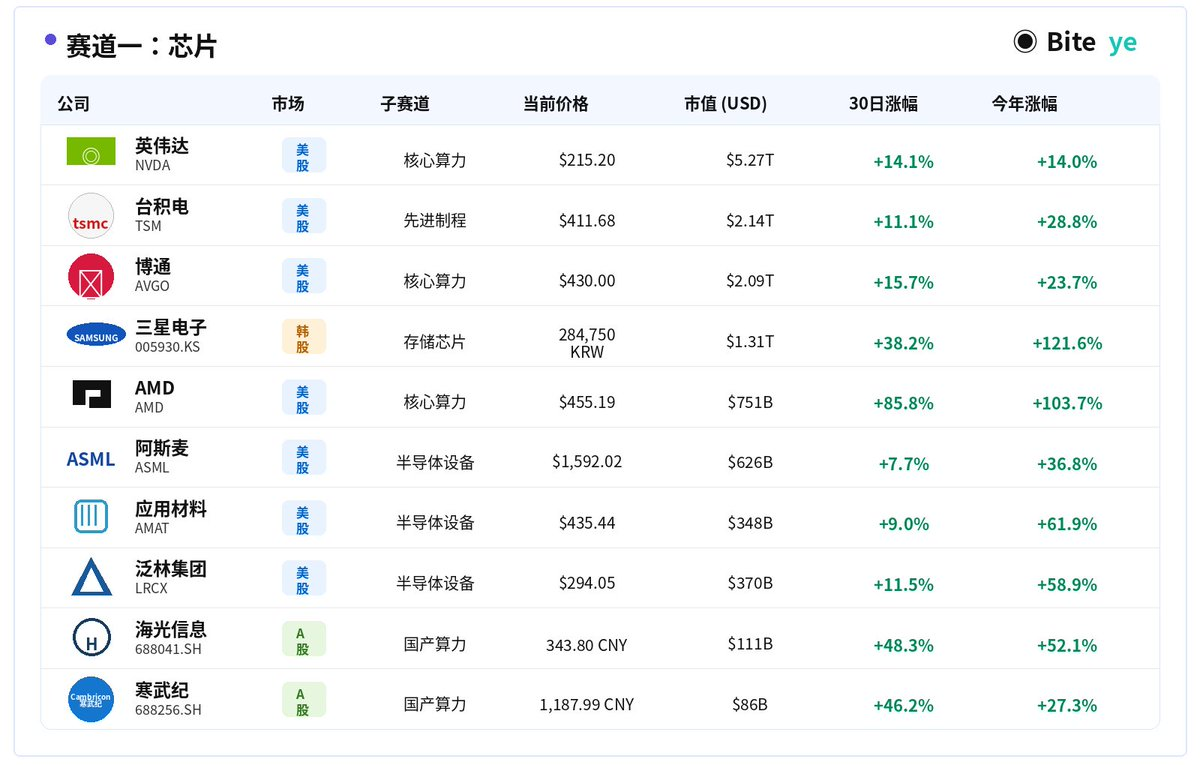
Industry data has already made this very clear. Based on the fiscal year 2026 run rate, NVIDIA's revenue grew 65% year-over-year, indicating that demand for high-end computing chips continues to be released.
🌟Assets in this direction
Core Computing Layer: NVIDIA (NVDA), AMD, Broadcom (AVGO), TSMC (TSM)
Domestic Computing Layer: Haiguang Information (688041.SH), Cambricon (688256.SH), etc. Haiguang Information is one of the representative domestic x86 server CPU companies, with 2024 revenue of 9.162 billion RMB, up 52.4% year-over-year.
Semiconductor Equipment Layer: ASML, Applied Materials (AMAT), Lam Research (LRCX). The ADR price of lithography giant ASML hit an all-time high at the start of 2026, surging over 8% on January 2nd, with a year-to-date gain of 27% in 2026; Lam Research is up 30% year-to-date; Applied Materials is up 28% year-to-date. All three major semiconductor equipment giants have significantly outperformed the S&P 500 index.
🌟Performance over the past year
The chip sector was the earliest and strongest mover in this wave of the AI bull market. As the leader, NVIDIA has accumulated gains of over 1000% since the beginning of 2023. The equipment sector continued to hit new highs in early 2026, still in a strong upward cycle. Citigroup released a research report predicting that the global semiconductor equipment sector is entering a "Phase 2 Bull Upcycle," with the main themes for chip stocks in 2026 clearly set on ASML, Lam Research, and Applied Materials.
2. Energy: As AI Scales Up, the Bottleneck Shifts from Chips to Electricity
No matter how many chips you have, they can't run without power.
Buying chips is just the beginning. The long-term operation of large models, data centers, and inference services requires sustained power supply, plus additional load for heat dissipation and cooling. Traditional data center racks typically consume 5 to 15 kW per cabinet, while AI data centers have significantly increased this to 50 to 100 kW, making the power and cooling demands an entirely different order of magnitude. An IEA analysis this year notes that data center electricity consumption could rise to around 945 TWh by 2030, roughly doubling from current levels, with AI being the primary driver. The U.S. Department of Energy has also explicitly stated that the growth in data center power demand is putting significant pressure on regional grids.
🌟Assets in this direction
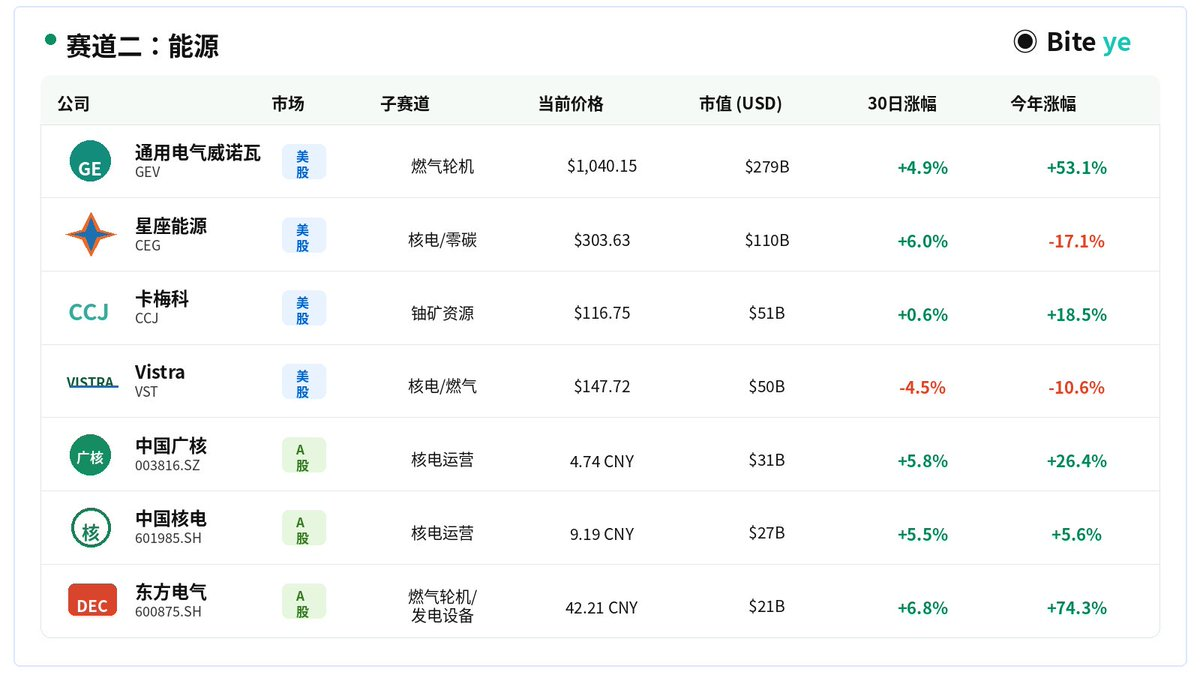
Gas Turbines: GE Vernova (GEV): Gas turbine orders are booming, with total full-year orders reaching $59 billion in 2025 and backlog growing to $150 billion. Management raised its 2026 revenue guidance to $44-$45 billion.
Independent Power Producers: Constellation Energy (CEG): The largest zero-carbon power operator in the U.S., with nuclear assets directly signing long-term power purchase agreements with tech giants. Vistra (VST): Has both nuclear and gas assets, with the midpoint of 2026 EBITDA guidance raised by approximately 30% compared to 2025.
Uranium Resources: Cameco (CCJ): The world's largest publicly traded uranium miner, benefiting upstream from the nuclear power revival.
🌟Performance over the past year
GE Vernova's stock price has risen 167% over the past year. Its 52-week low was $408, reaching a high of $1181, nearly doubling in that range. Constellation Energy hit an all-time high in 2025 but subsequently corrected about 28% from its peak due to regulatory policy fluctuations, currently trading at relatively lower levels. Vistra has maintained strength overall as long-term power supply contracts with data centers continue to materialize. The energy sector has been repriced from a traditional defensive position to a core beneficiary of AI infrastructure.
3. Storage: The Most Easily Overlooked Direction, But a Long-Term Beneficiary
The core logic favoring storage is simple: AI is not a one-time call; it's essentially a system that continuously ingests, accumulates, and calls data.
Training requires reading vast amounts of data, checkpoints must be saved during the process, inference requires loading models and caches, and RAG and Agents constantly need to access knowledge bases, logs, and memory.
Consequently, AI brings not just "more data," but:
• More frequent data reading and writing
• More real-time data retrieval
• More complex data management
• Greater pressure on data migration and caching
Looking further, the more expensive GPUs become, the less they can afford to idle. So the industry will increasingly focus on how to deliver data to the computing power end faster and more reliably.
In other words, the more AI develops, the more storage becomes not just a "warehouse for data," but the foundational data layer that ensures the entire AI system can run continuously.
🌟Assets in this direction
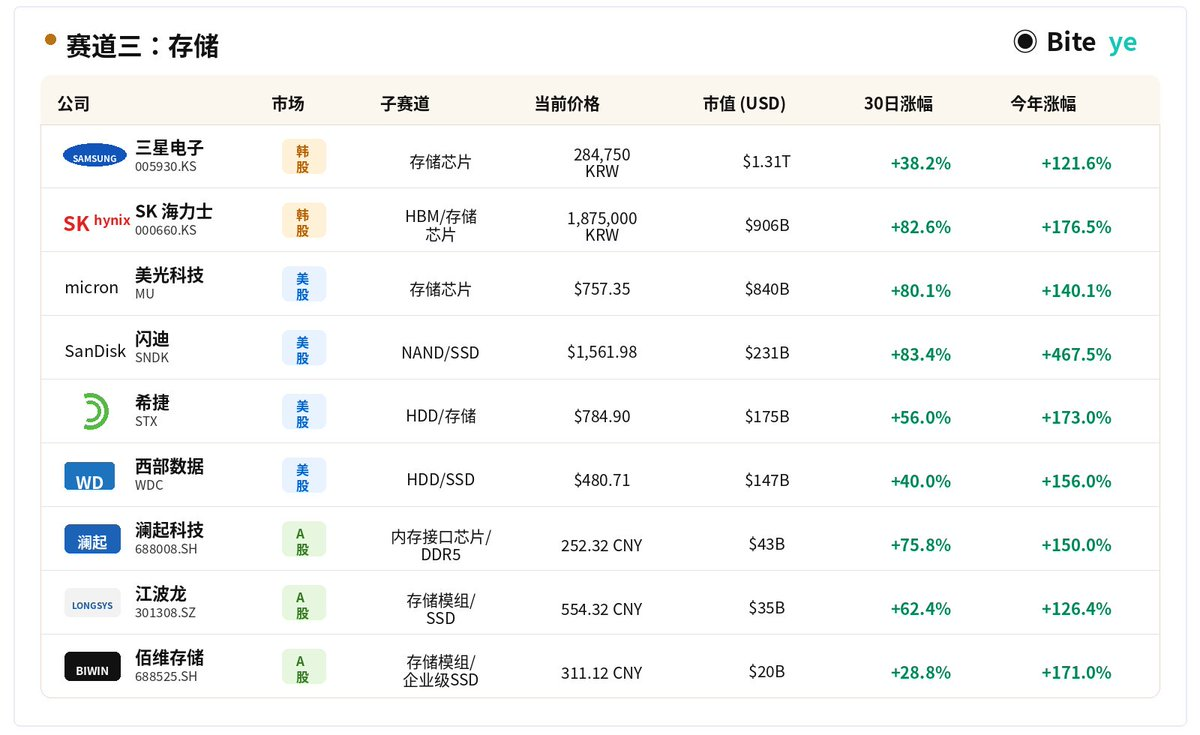
Memory Chip Manufacturers: SK Hynix (000660.KS), Samsung Electronics (005930.KS), Micron Technology (MU)
NAND / SSD / HDD Manufacturers: Sandisk (SNDK), Seagate (STX), Western Digital (WDC)
Domestic Storage Design: GigaDevice, Puya Semiconductor, Dongxin Semiconductor, Ingenic Semiconductor, Montage Technology, as well as storage module manufacturers such as Demingli, XC Core, and Longsys.
🌟Performance over the past year
Since the beginning of 2026, the storage sector has been one of the strongest segments within the AI supply chain. In the US stock market, driven by AI infrastructure investment and demand for high-capacity storage, Seagate, Sandisk, and Western Digital have all surged significantly this year. Reuters mentioned in late April that Seagate and Western Digital had more than doubled year-to-date, while Sandisk was up approximately 350% year-to-date. Memory chip manufacturers also strengthened in tandem. Micron has risen sharply this year, while SK Hynix continues to benefit from HBM shortages and capacity grabs by major players, reporting Q1 revenue up 198% year-over-year and operating profit up 406%, further solidifying its profitability.
Final Thoughts: Chips Surge First, Power Catches Up, Storage Lags But Lasts
The first wave of AI delivery is chips; the second bottleneck is energy; the third long-term beneficiary is storage.
A correct logic does not guarantee a comfortable entry point. Structural opportunities exist, but it's not about blindly chasing highs.
What's truly valuable isn't the hype itself, but where you stand along the industry chain.
Disclaimer: The above is merely a review of the industry chain and does not constitute investment advice. In particular, some targets have already seen extreme gains in 2026; correct logic does not guarantee a comfortable entry point.


