






Gate Research: The Evolution of Liquidity and Trading Strategies for Crypto Leveraged ETFs


- Core Thesis: The introduction of crypto ETFs has injected institutional-grade liquidity into the market, reducing the volatility of mainstream assets like Bitcoin. Against this backdrop, leveraged ETFs on centralized exchanges have emerged as high-leverage tools without margin requirements. By employing trading strategies centered on "trend-following entries" and volume-driven momentum breakouts, a dynamic balance between risk and return can be achieved while controlling volatility decay.
- Key Elements:
- ETFs stabilize price deviations through the arbitrage mechanism of Authorized Participants (APs). The entry of institutional capital (e.g., BlackRock's IBIT) has altered market structure, lowering Bitcoin's volatility center and compressing maximum drawdowns from the historical 70-80% range to within 50%.
- The core difference between crypto leveraged ETFs and traditional leveraged ETFs lies in the "volatility decay" caused by their daily rebalancing mechanism, creating a non-linear compounding relationship. In a highly volatile, range-bound market, a 5x leveraged ETF's net value can plummet by over 90% even when the underlying asset's price remains unchanged.
- Crypto leveraged ETFs are most suitable for one-sided trending markets. The optimal holding period is 1-5 days and should not exceed one month. When daily volatility reaches 4%, a 5x ETF can theoretically incur a decay of up to 40% over 20 days.
- Based on Gate MCP data analysis, 5x leveraged products (such as XRP5L, SOL5L, ETH5S) exhibit excellent liquidity, making them preferred choices for strategies. The 90-day correlation coefficient between ETH5S and ETH spot is stable between -0.91 and -0.97, establishing it as a reliable hedging tool.
- The strategy framework is centered on "trend-following entries," incorporating a triple-confluence signal: technical breakdown (e.g., daily closing price below the 20-day moving average with a 2% deviation), sentiment volatility (7-day volatility heating up), and a shift in futures capital (perpetual funding rate positive for three consecutive days).
- Exit mechanisms utilize a time stop-loss (single position holding period not to exceed 5 days) and a trailing take-profit (reduce position by 50% when profit reaches 20% and move the take-profit level up) to control volatility decay and avoid the self-consumption of net value from long-term holding.
- Backtesting of the ETH5S momentum breakout strategy, based on signals from volume exceeding 3x the 20-day average volume and price breaking a trendline, shows a win rate of approximately 67% and an expected reward-to-risk ratio of about 1.2:1. When combined with a 15-20% position size limit and a -15% stop-loss, it can achieve a positive expected return.
This report provides an in-depth exploration of the liquidity evolution in the crypto ETF market, its profound impact on the volatility of underlying assets, and the mechanisms and usage scenarios of leveraged ETFs. Simultaneously, the report offers a detailed comparison between leveraged ETFs in the crypto market and those in traditional financial markets. Based on real-time trading data from the Gate platform, it constructs actionable trading strategies. The core strategy revolves around "right-side entry," enhanced by volume-driven momentum breakout signals to generate excess returns. Through phased position building, momentum-based accumulation, and strict exit mechanisms, it achieves a dynamic balance between risk and reward while controlling volatility decay.
1. Introduction: Amid the Rise of Crypto ETFs, Who is Buying with Real Money?
The early crypto market resembled a series of fragmented private transactions, primarily relying on over-the-counter (OTC) matching. At that time, liquidity was highly fragmented, bid-ask spreads were enormous, and even a moderately large order could trigger dramatic price swings. With the advent of the derivatives market, particularly the introduction of short-selling mechanisms and the popularization of basis arbitrage strategies, price discovery in the crypto market became more efficient, and bid-ask spreads narrowed significantly. Perpetual swaps on centralized exchanges, in particular, propelled trading volumes to skyrocket.
The true catalyst for the market's expansion, however, was the listing of spot crypto ETFs. ETFs introduced a key player—the Authorized Participant (AP). They act as market regulators: when an ETF's price exceeds its net asset value (NAV), APs create shares and sell them on the market, compressing the premium; conversely, when the price falls below NAV, they redeem shares. This arbitrage mechanism not only virtually eliminates ETF premiums and discounts but, more importantly, continuously injects institutional-grade depth and liquidity into the entire market.
Take BlackRock's IBIT as an example: it took only 47 trading days after its launch to surpass $10 billion in assets under management (AUM). In contrast, the gold ETF GLD, which previously held the record for the fastest growth, took nearly three years to reach that scale. Furthermore, in 2025, the year of the Treasury Strategy (DAT) boom, the total capital absorbed by all newly issued spot crypto ETFs and crypto asset treasuries accounted for over 12% of the total market circulating supply. This proportion signifies that institutional holdings have evolved from a negligible factor to a critical force capable of influencing market supply and demand.
As the dominant players shifted from high-frequency traders and native crypto users to institutions, the market's rhythm subtly changed. Traditional financial theory presents two opposing hypotheses regarding the impact of ETF introduction: one suggests that ETFs' "arbitrage transmission mechanism" stabilizes underlying asset volatility, while the other worries that ETF scale expansion amplifies market co-movement and herding behavior through a "common ownership effect."
However, empirical data from the crypto market reveals a more complex dynamic than either hypothesis suggests. Taking Bitcoin as an example, we can divide its volatility history into three phases and compare them using the objective metric of realized volatility (RV).
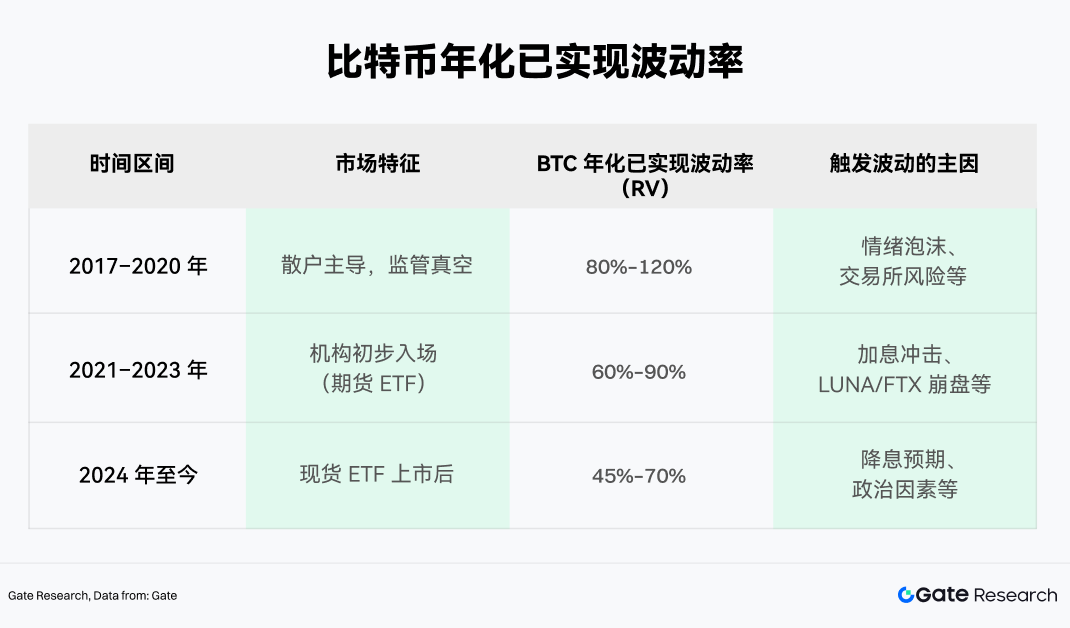
Data since 2024 shows that the center of gravity of Bitcoin's annualized realized volatility has moved downward. Although its absolute value remains high compared to the stock market, the peaks of volatility have been significantly suppressed. The mechanism behind this is the persistent presence of ETF arbitrage funds. Arbitrage capital facilitates faster mean reversion from extreme price deviations, while quarterly institutional inflows provide periodic price support.
Simultaneously, Bitcoin spot ETFs have a visible buffering effect against extreme volatility. In the market cycle from 2022 to early 2026, Bitcoin's maximum drawdown from peak to trough never exceeded 50%, a stark contrast to historical plunges of 70% to 80%. This volatility compression effectively anchors a pool of long-term, price-insensitive capital in the market. When retail panic triggers selling pressure, institutional ETF holdings act as a "liquidity cushion," effectively absorbing the sell-off.
2. Analysis of Crypto Leveraged ETF Mechanisms and Characteristics
As arbitrage and institutional allocation capital became the market's main force, overall volatility did indeed converge. Interestingly, this stability itself paved the way for more complex financial structures—especially when market risk appetite rises and capital seeks higher return elasticity, plain spot exposure becomes insufficient. Consequently, leveraged ETFs, which offer amplified returns and volatility as their core selling point, began to enter the crypto market investors' purview.
Since the approval of the first Bitcoin leveraged ETF in 2023, this track has accelerated rapidly. Currently, leveraged products on the market can be broadly categorized into two camps:
• SEC-regulated compliant ETFs, such as those issued by institutions like ProShares and Volatility Shares.
• Leveraged tokens issued by centralized exchanges (CEXs), such as ETH5S and BTC3L.
In the compliant leveraged ETF space, BITX (Volatility Shares' 2x Bitcoin ETF) currently holds the top position with an AUM nearing $969 million. However, its management fee is also high at 2.38%. ProShares' BITU (also a 2x Bitcoin ETF) has a fee of 0.98% and an AUM of approximately $422 million.
It is noteworthy that leveraged tokens issued by CEXs have begun to emerge in recent years, gradually capturing market attention. Compared to traditional ETFs, they offer structural advantages such as no margin requirements, no liquidation risk, and direct spot trading. Moreover, they are closer to the needs of native crypto users in terms of trading hours, listing speed, and strategic flexibility, making them an important tool connecting high-frequency trading and risk hedging.
2.1 Core Differences Between Crypto Leveraged ETFs and Traditional Financial Leveraged ETFs
While the operational mechanisms are similar, the unique nature of crypto assets exposes crypto leveraged ETFs to distinctly different risks compared to their traditional counterparts.
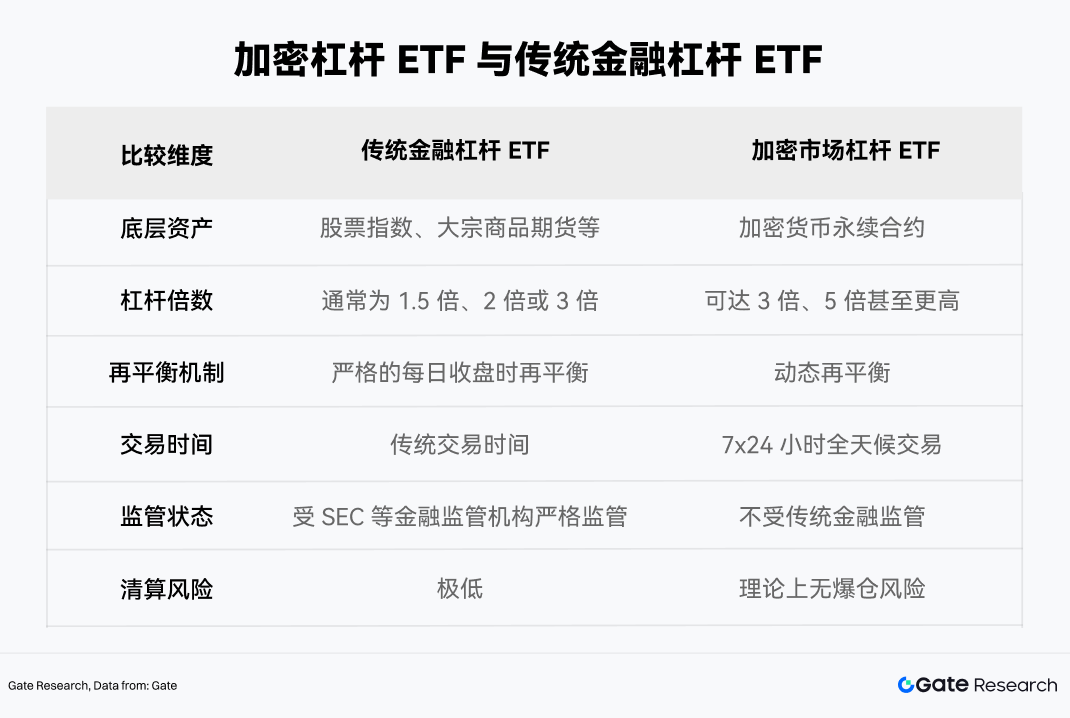
Although both rely on rebalancing and derivative positions to achieve leverage, the crypto market's characteristics—24/7 trading, high volatility, and a weaker regulatory environment—cause the risks of crypto leveraged ETFs to exhibit stronger non-linearity and tail amplification effects. Furthermore, compared to traditional leveraged ETFs, crypto leveraged ETFs are more prone to net value erosion from "volatility decay" during consecutive trending moves, and in extreme cases, the net value can go directly to zero.
2.2 Daily Rebalancing Mechanism and "Volatility Decay"
The "daily reset" feature is the most significant difference between a leveraged ETF and a regular leverage position. To ensure precise exposure to the underlying asset multiple at the start of each trading day, the fund must undergo daily rebalancing.
Many investors fall into the misconception that "if the underlying asset rises 10%, a 2x ETF rises 20%." While this holds true for a single day, over multiple days, the relationship becomes non-linear due to the compounding effect of daily rebalancing.
Specifically, if Bitcoin rises on day T, the 2x ETF's NAV increases, causing its total exposure ratio to fall below 2x. Consequently, the fund must "buy high" before the T+1 day open, purchasing more Swaps or futures contracts. Conversely, if it falls on day T, the fund must "sell low" to reduce its position. This mechanical "chasing highs and selling lows" is precisely the source of NAV decay in a volatile market.
Suppose the underlying asset rises 10% on day one and falls 9.09% on day two (returning to the starting point):
• Underlying Asset: $100 × 1.10 × 0.9091 = $100 (0% return)
• 2x ETF: $100 × 1.20 × 0.8182 = $98.18 (-1.82% loss)
• 3x ETF: $100 × 1.30 × 0.7273 = $94.55 (-5.45% loss)
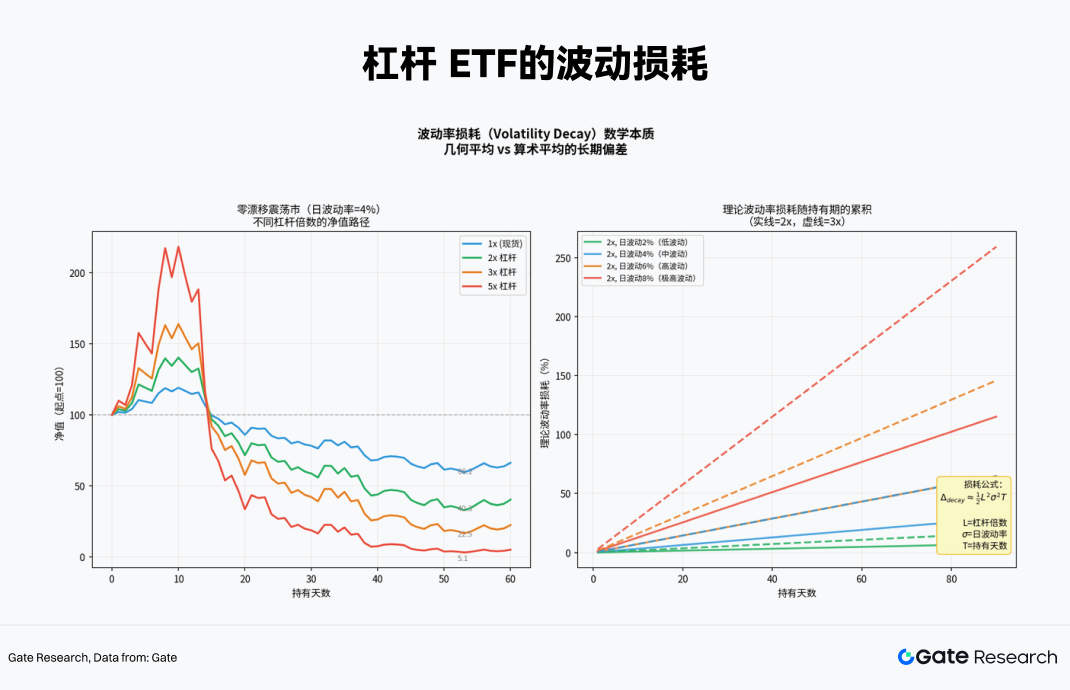
In a zero-drift (price returns to origin) high-volatility oscillating market, the higher the leverage multiple, the exponentially greater the long-term decay. For instance, after 60 days, the NAV of a 5x leveraged product could potentially be only 5.1% of its original value.
2.3 Market Conditions Suitable for Crypto Leveraged ETFs
To determine the suitable market conditions for crypto leveraged ETFs methodically, we utilized Monte Carlo simulations over a 60-day rolling period to illustrate the performance differences of products with various leverage multiples under different market environments.
In the simulation, using the historical returns and volatility of the underlying asset (ETH in this case) as baseline parameters, we generated numerous price paths through random sampling. For each path, we calculated the NAV changes for different leveraged ETFs (±1x, ±2x, ±3x, ±5x) using daily compounding while incorporating the volatility decay mechanism. This yields the return distribution under various market structures. Based on this method, we can intuitively compare the long-term performance of different leveraged products under the same market conditions.
Empirical results reveal distinct return differences for various leverage multiples in three typical market scenarios:
1. Strong Trending Markets: This is the only environment where leveraged ETFs can generate positive excess returns. Due to daily "buy-high" adjustments, the base position continually increases, creating a compounding effect. In this scenario, holding a 3x or 5x ETF yields returns far greater than manually leveraging a 3x position via margin (which lacks the compounding effect).
2. High-Volatility Oscillating Markets: The "meat grinder" for leveraged ETFs. The underlying asset's price might be unchanged after 60 days, but both a 5x long and a 5x short ETF could plummet over 90%. Volatility decay completely consumes the capital. The longer the holding period, the more certain the loss.
3. Low-Volatility Oscillating Markets: Decay exists but is relatively manageable. Sometimes, -1x or -2x products might even generate slight positive returns due to minor trends or funding rate advantages, making them suitable for short-term event-driven hedging.
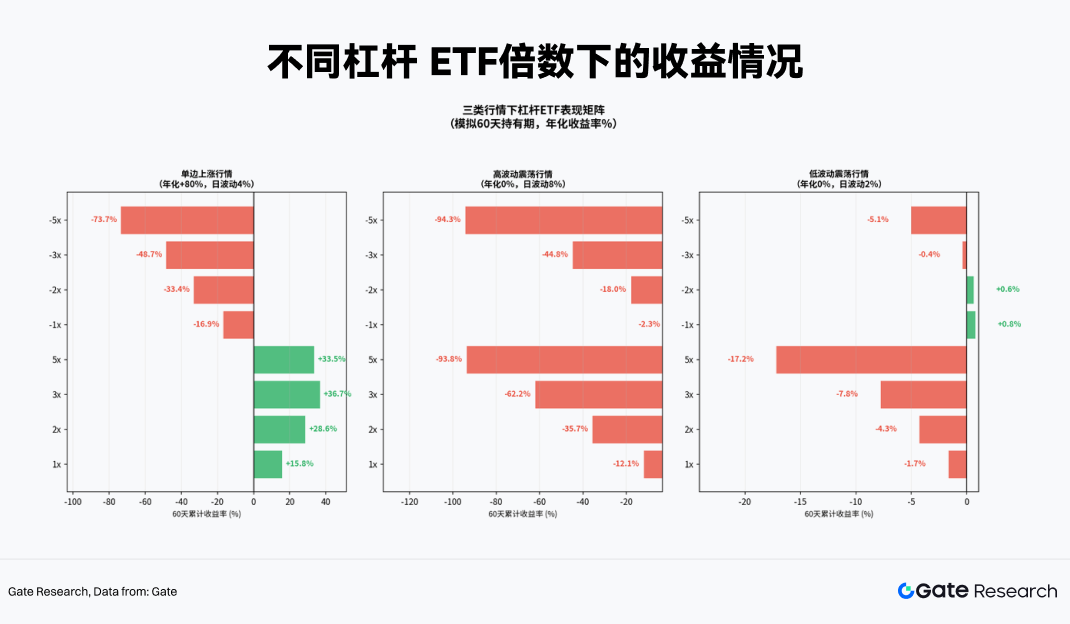
Therefore, the most favorable environment for crypto leveraged ETFs is a strong, unidirectional trend. To avoid net value erosion in choppy markets, leveraged ETFs are better suited for short-term tactical allocation rather than long-term core holdings.
So, how long can a leveraged ETF be held? This can be visualized through the heatmap below, considering different volatility and leverage levels:
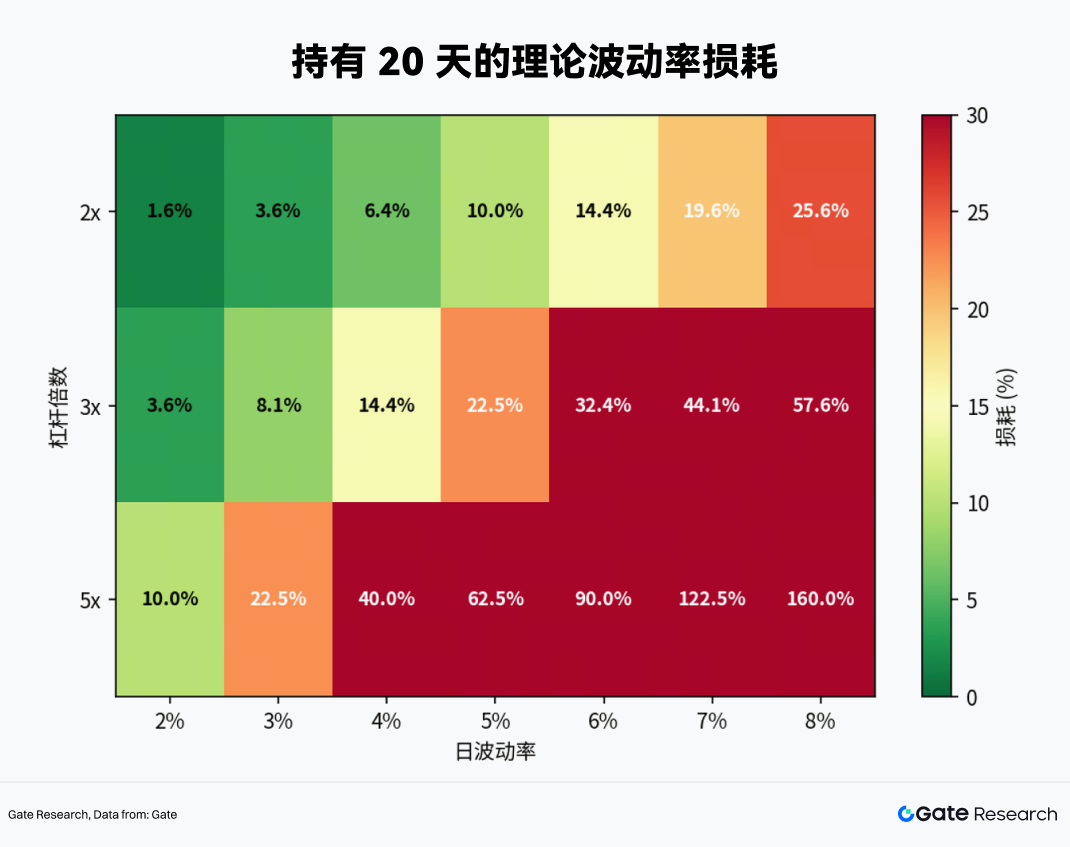
• When the daily volatility reaches 4% (a norm in the crypto market), the theoretical decay for a 2x ETF reaches 6.4% in 20 days, 14.4% for a 3x ETF, and a staggering 40% for a 5x ETF.
• 30 days represents a critical survival threshold. Unless the underlying asset exhibits an extremely strong uptrend, under normal volatility, 2x and 3x ETFs struggle to survive past 30 days before starting to lose principal.
The conclusion is simple: The holding period for crypto leveraged ETFs should never exceed one month, with the optimal tactical cycle being 1–5 days.
3. Live Trading Test of Leveraged ETFs Based on Gate MCP
To apply theory to practice, we accessed real-time data from the current crypto market via the Gate MCP interface and conducted an in-depth analysis.
3.1 Asset Screening
Liquidity is the primary prerequisite for the feasibility of any leveraged ETF strategy. Products with excessively low volumes not only face slippage risks but also have prices that are more prone to deviate from NAV, distorting strategy signals. To this end, we extracted trading volume data for all leveraged ETF products from the beginning of 2026 to the end of March via the Gate MCP interface, using this as the first filter for asset selection.
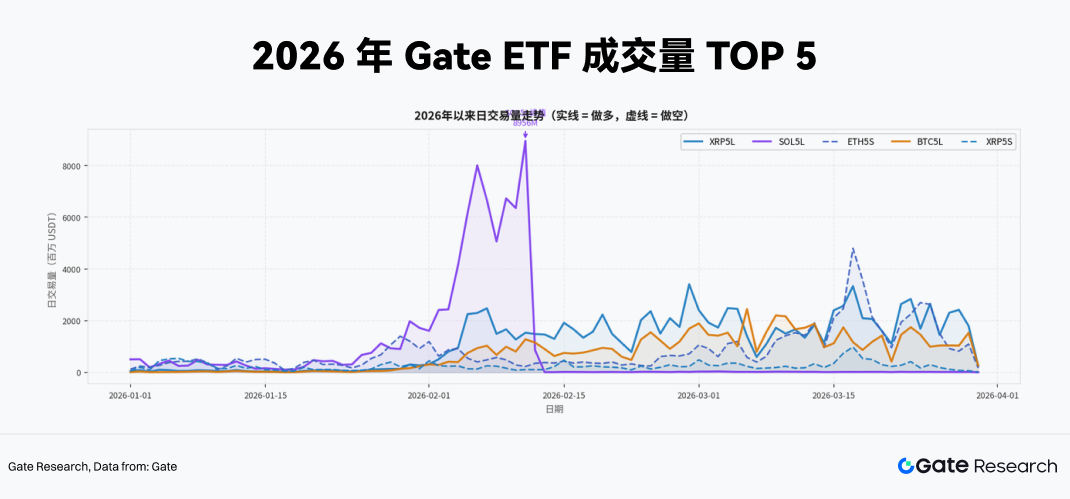
The latest cumulative trading volume rankings show the absolute dominance of 5x leveraged products. The top 5 products (XRP5L, SOL5L, ETH5S, BTC5L, XRP5S) are all 5x leveraged products. This indicates that in the current crypto market environment, capital participating in leveraged ETF trading exhibits a very high risk appetite, preferring to use extreme leverage to speculate on short-term volatility or perform high-intensity spot hedging. Furthermore, observing daily volume trends reveals that SOL5L experienced an extreme peak in early February, with single-day volume approaching 9 billion USDT. Such liquidity pulses are often highly correlated with major fundamental events in the underlying asset, representing classic event-driven trading surges.
In summary, when constructing actual trading strategies, we focus on these 5x leveraged products with daily trading volumes reaching hundreds of millions of USDT. They offer entry depth and exit efficiency unmatched by lower-multiple or less popular products, effectively absorbing the impact costs of large orders.
3.2 Dynamic Hedging and Momentum Breakout Strategy Design for High-Leverage ETFs
The biggest pain point for investors holding spot crypto positions is protecting against downside exposure in a low-cost, liquidation-free manner during macro events or technical breakdowns. Traditional solutions typically involve three options: opening an equivalent short position in the perpetual swap market, buying put options, or converting to stablecoins.
Each of these three options has significant drawbacks: perpetual swaps require margin and carry liquidation ("wicks") risk; options have prohibitively high premium costs in high implied volatility environments; and converting to stablecoins means completely forfeiting potential upside gains. Leveraged ETFs, such as XRP5L, SOL5L, and ETH5S, offer a fourth path with unique structural advantages under specific conditions:
• No Margin Requirements: Buying an inverse ETF is essentially a spot transaction, with the maximum loss capped at the initial principal. This mechanism structurally eliminates the "wicks and liquidation" risk common in the derivatives market.
• Extreme Capital Efficiency: 5x leverage means hedging an equivalent notional amount of spot exposure requires only 20% of the capital. The remaining 80% can be allocated to other yield-generating assets or held as liquidity reserves.
• Hedging Precision: For example, the actual correlation coefficient between ETH5S and ETH consistently ranges from -0.91 to -0.97, making the hedging effect highly reliable in the short term (to be verified below).
Based on the above analysis, we construct the following trading strategy framework for high-liquidity, high-leverage (5x) crypto ETFs like XRP5L, SOL5L, and ETH5S.
3.2.1 Entry Signal Design
One core risk of leveraged ETFs is rapid NAV decay from wrong directional bets, making "right-side" positioning the first principle of strategy design. Before trading, relevant buy signals can be set. For example, ahead of macro events like Fed decisions or NFP data releases, or when the crypto spot price breaks through/falls below key support levels (e.g., the 20-day moving average) and volatility indicators (e.g., 7-day annualized volatility) start to turn, one could buy the corresponding leveraged ETF.
Taking hedging or speculation using a 5x short ETF as an example, the following triple resonance conditions must be met simultaneously:
1. Technical Breakdown: The underlying asset (e.g., ETH or SOL) closes below its 20-day Simple Moving Average (SMA) on a daily chart, with a deviation exceeding 2%.
2. Sentiment Volatility Surge: The 7-day annualized realized volatility of the underlying asset rises sharply compared to the previous week (e.g., an increase of over 15%), indicating heightened market sentiment and attention.
3. Derivatives Capital Shift: From a short-selling perspective, the perpetual swap funding rate remains positive for 3 consecutive days. This means long positions are still paying funding, indicating that bulls haven't fully deleveraged and the selling momentum hasn't been fully released, making a long squeeze highly likely. The opposite applies for a long position.
Regarding position building rhythm: On the day the signal triggers, only establish 50% of the target position. If the downtrend is confirmed by the close of the next day, increase the position to 100%, avoiding being trapped by a false breakdown.
3.2.2 Momentum Breakout Detection
Beyond structural hedging, high-leverage ETFs themselves are excellent tools for capturing extreme trending moves. As shown by SOL5L's volume surge in early February, high-leverage ETFs can provide astonishing excess returns during major events.
The core signal for a momentum breakout strategy comes from abnormal volume surges in the ETF itself. In genuine extreme market conditions, capital inflows often lead price indicators:
• Trigger Condition: When a specific 5x ETF's daily volume exceeds 3 times its 20-day average volume, and its price simultaneously breaks through a recent consolidation range or resistance level.
•&


