






Gate 2026 Q1 Spot Listing Key Data: Consistently Delivering Effective Opportunities in a Weak Market, 35.7% of Exclusive Projects Surged Over 100% in One Week


- Core View: Against the backdrop of market pressure in Q1 2026, Gate exchange has established systematic listing advantages through high coverage, a high proportion of first listings, and strong exclusive project screening capabilities. Its newly listed assets have demonstrated stable positive return performance across multiple holding periods.
- Key Elements:
- Coverage and Structural Advantages: Gate listed 37 new assets in Q1, covering 77.1% of the new projects added by top exchanges during the quarter. Among these, 73% were first listings, and 37.8% were exclusive projects, reflecting deep participation in mainstream supply and independent judgment capabilities.
- Stable Post-Listing Performance: Across multiple time dimensions from 5 minutes to 7 days, the proportion of newly listed projects that rose remained above 50%. The median gains at the 24-hour and 3-day dimensions were +9.3% and +10.0% respectively, indicating a certain level of continuity for positive return opportunities.
- High Resilience of First-Listed Projects: First-listed projects (27) achieved average gains of 502.8%, 440.7%, and 364.3% at 24 hours, 3 days, and 7 days respectively, serving as the platform's high-payout opportunity entry point.
- High Win Rate for Non-First-Listed Projects: Among the 10 non-first-listed projects, the proportion that rose within 24 hours reached 90%, with a median gain of +72.9%, providing a more stable path to returns and complementing the first-listed projects.
- Outstanding Quality of Exclusive Projects: The 14 exclusive projects achieved a 71.4% success rate of rising within a 72-hour window, with median returns significantly higher than the overall sample, reflecting the platform's strong active screening and pre-positioning capabilities.
In the first quarter of 2026, against the backdrop of overall pressure in the crypto market and a cautious risk appetite among capital, high-quality early-stage assets were one of the most attractive structural opportunities in the market. Gate's spot trading section listed a total of 37 new assets in Q1, covering 77.1% of the new projects added by leading exchanges during the quarter. Among these, 27 were first listings, accounting for 73% of Gate's newly listed assets for the quarter; there were also 14 exclusive projects, representing 37.8%. In an environment of increased market volatility, Gate maintained a stable listing pace, strong capacity to onboard quality projects, and the ability to consistently deliver positive return opportunities.
1. Overall Overview: High Coverage, High First-Listing Rate, and Significant Exclusive Share Form the Foundation
Looking at the total sample, in Q1 2026, taking 7 leading platforms including Gate as the sample, the leading exchanges collectively listed 48 new projects. Among these, Gate listed 37 projects in this quarter, corresponding to a coverage rate of 77.1%. This means that among the new high-quality supply contested by leading platforms in Q1, Gate covered over three-quarters of the projects.
For ordinary users, the importance of coverage is self-evident. It directly affects whether users can see a sufficiently complete picture of the market's core new projects on the same platform. If a platform's coverage is low, even if a few projects perform well, it can easily leave users with the impression that important project coverage is insufficient. A 77.1% coverage rate indicates that, at least during the Q1 period, Gate remained closely aligned with the mainstream new project supply system, allowing users to access most of the noteworthy new assets on the platform.
However, what truly determines Gate's competitiveness is not just coverage breadth, but also the structure of that coverage.
Among all 37 newly listed assets on Gate in Q1, first-listing projects reached 27, accounting for 73%; exclusive projects numbered 14, accounting for 37.8%. If calculated further based on the overall sample of leading exchanges, Gate's first-listing coverage rate reached 56.3%. In other words, among the 48 new projects collectively listed by leading exchanges in Q1, over half were first listed on Gate.
A high proportion of first listings indicates that Gate holds strong appeal at the critical juncture when projects transition from primary market narratives to the secondary market. Project teams' willingness to choose Gate as one of their first public trading venues essentially represents recognition of Gate's user base, liquidity onboarding capacity, initial price discovery efficiency, and market dissemination capabilities. A platform's ability to consistently secure first listings often signifies a relatively proactive position in the competition for project resources.
A significant share of exclusive projects reflects another layer of valuable capability. First listings demonstrate a platform's ability to participate in mainstream high-quality supply, while exclusive projects indicate whether a platform possesses independent judgment and differentiated sourcing capabilities. Especially in a weak market environment, the difficulty of screening exclusive projects is higher. Exclusivity means there isn't sufficient external platform validation; the platform must first shoulder the responsibility of judgment itself. If project selection falters, post-listing data will quickly reveal issues; if exclusive projects perform well after listing, it not only shows the platform has resources but also strong pre-listing judgment capabilities.
From the overall overview, Gate's Q1 foundation can be summarized by three characteristics.
(1) Sufficiently broad coverage, indicating the platform's continuous participation in leading new supply;
(2) High proportion of first listings, indicating strong onboarding capacity for quality projects at their market entry point;
(3) Significant share of exclusive projects, indicating the platform is not merely following the market but actively attempting to discover and pre-position differentiated assets.
These three points combined constitute the starting point for Gate's spot listings in Q1. Only when coverage, first listings, and exclusivity are all present does a platform's listing system possess completeness.
2. Post-Listing Performance: Relatively Stable Positive Return Coverage from Short-Term to 7-Day Windows
Evaluating a platform's listing performance cannot rely solely on whether it secures projects; it also depends on the stability of project performance after listing. An important characteristic of Gate in Q1 was that newly listed projects exhibited relatively coherent time-series characteristics across multiple holding periods, with overall positive return coverage remaining relatively stable.
Figure 1: Proportion of Gate's Newly Listed Tokens Showing Price Increases Across Timeframes from 5 Minutes to 7 Days
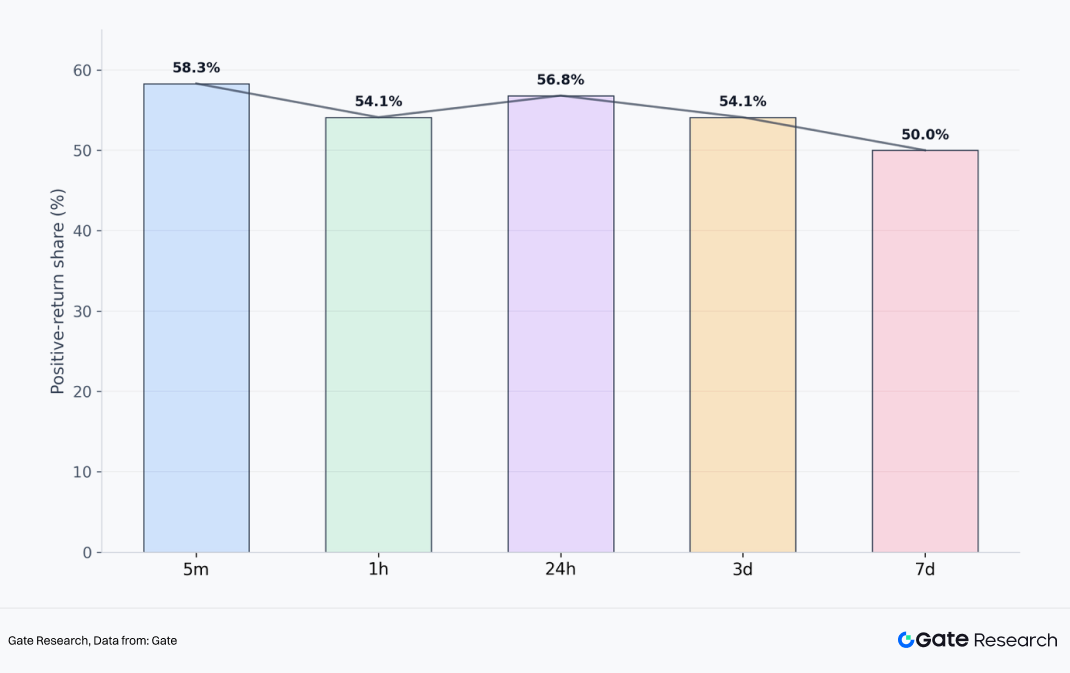
Looking at the proportion of price increases, among Q1's newly listed projects, 58.3% achieved price gains within 5 minutes of opening, 54.1% maintained gains at the 1-hour mark, 56.8% remained profitable after 24 hours, 54.1% showed gains after 3 days, and 50.0% of projects maintained gains after 7 days. The data clearly shows that Gate's listed projects maintained relatively stable positive return coverage across multiple holding periods.
Many new projects experience rapid surges during the opening phase driven by front-running capital, short-term sentiment, and traffic diffusion. However, if the project lacks fundamental support or the platform's capital onboarding capacity is insufficient, such gains often quickly recede, leading to significantly weaker performance after 24 hours. Gate's overall Q1 sample did not follow this pattern. Whether at 5 minutes, 1 hour, 24 hours, or 3 days, the proportion of gains remained consistently above 50%, indicating that this batch of projects listed on the platform did not generally exhibit a pattern of high opening followed by decline during the core post-listing price discovery window.
Particularly, the 24-hour and 3-day time points hold higher practical reference value. Not all participants in new token trading are ultra-short-term traders; many are closer to intraday, overnight, or short-term holders. For these users, the 56.8% proportion of projects gaining after 24 hours and 54.1% after 3 days represent data more closely aligned with the real participation experience. It indicates that the positive return opportunities for Gate's newly listed projects are not confined to the opening moment but possess a degree of continuity within the core post-listing holding window.
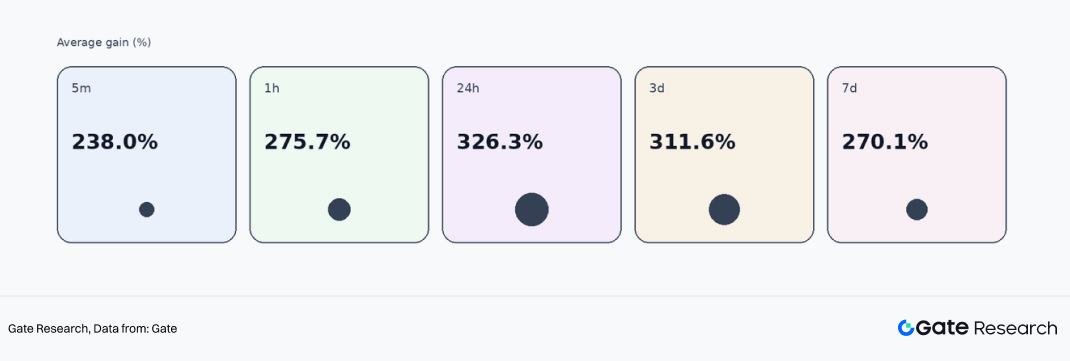
Examining the average gains of appreciating projects provides a clearer understanding of return elasticity. In Q1, the average gains for appreciating projects across the 5-minute, 1-hour, 24-hour, 3-day, and 7-day timeframes were 238.0%, 275.7%, 326.3%, 311.6%, and 270.1%, respectively. This shows that once Gate's quality new tokens establish positive feedback early on, their price appreciation potential remains considerable. Especially in the 24-hour and 3-day windows, average gains hovered around 300%, meaning the wealth effect of quality projects did not disappear in the weak market but became more concentrated in a subset of high-quality assets that passed screening.
Figure 2: Average Gains of Gate's Appreciating Projects Across Timeframes (5m–7d)
Of course, looking only at average gains does not provide a complete picture. Averages can be skewed by extreme high-multiple projects, masking the typical performance of the majority. Therefore, the significance of the median is particularly important here.
The median gains for Q1's newly listed projects were: +3.2% at 5 minutes, +2.4% at 1 hour, +9.3% at 24 hours, +10.0% at 3 days, and +0.01% at 7 days. Even setting aside the influence of extreme high-multiple projects and looking solely at the typical project performance within the sample, Gate's new tokens still exhibited a clear positive return state at the 24-hour and 3-day stages. This indicates that the overall performance of Gate's spot listings this quarter was not solely reliant on a few extreme cases pulling up the average; rather, most projects possessed a foundational positive return potential during the core observation window post-listing.
Figure 3: Median Gains of Gate's Newly Listed Projects Across Timeframes (5m–7d)
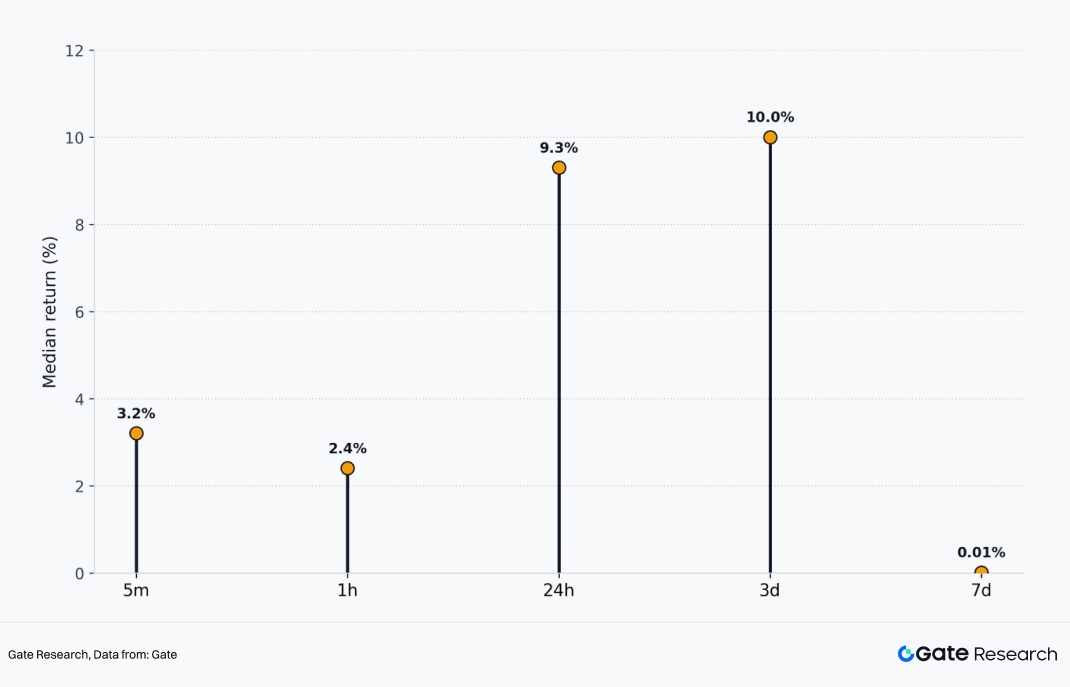
For ordinary users, what truly determines the participation experience is not whether there are one or two "moon-shot" tokens with exaggerated gains, but whether the overall quality of the platform's new tokens is sufficiently consistent and possesses a degree of repeatability. Based on the median data, Gate's Q1 performance, at least from the 24-hour to 3-day stage, provides a relatively clear answer: the platform's spot listings exhibit strong consistency and a certain positive expectation.
Simultaneously, the near-flat median at 7 days also indicates another reality. The advantage of new tokens is primarily concentrated in the early price discovery stage post-listing, not infinite continuation. By the 7-day mark, the market has entered a phase of more thorough differentiation and淘汰, with disparities between projects rapidly widening. Therefore, for users, not all new tokens should be held long-term; instead, the overall density of clearer, more stable return opportunities is more pronounced within the first 24 hours to 3 days post-listing.
3. First Listings vs. Non-First Listings: A Dual-Track Structure
When discussing a trading platform's listing capabilities, many instinctively focus entirely on first listings. First listings are undoubtedly important, but if a platform truly possesses a mature listing system, its advantages are reflected not only in first listings but also in the ability of different project types to form their own clear return logics. Q1 data shows this is particularly evident for Gate.
3.1 First-Listing Projects: Dominant in Quantity, Stronger in Return Elasticity
In Q1, Gate had a total of 27 first-listing projects, constituting 73% of all newly listed projects. First-listing projects formed the main body of Gate's Q1 listing system, meaning in most cases, they directly participated in the initial stage of a project's entry into the secondary market.
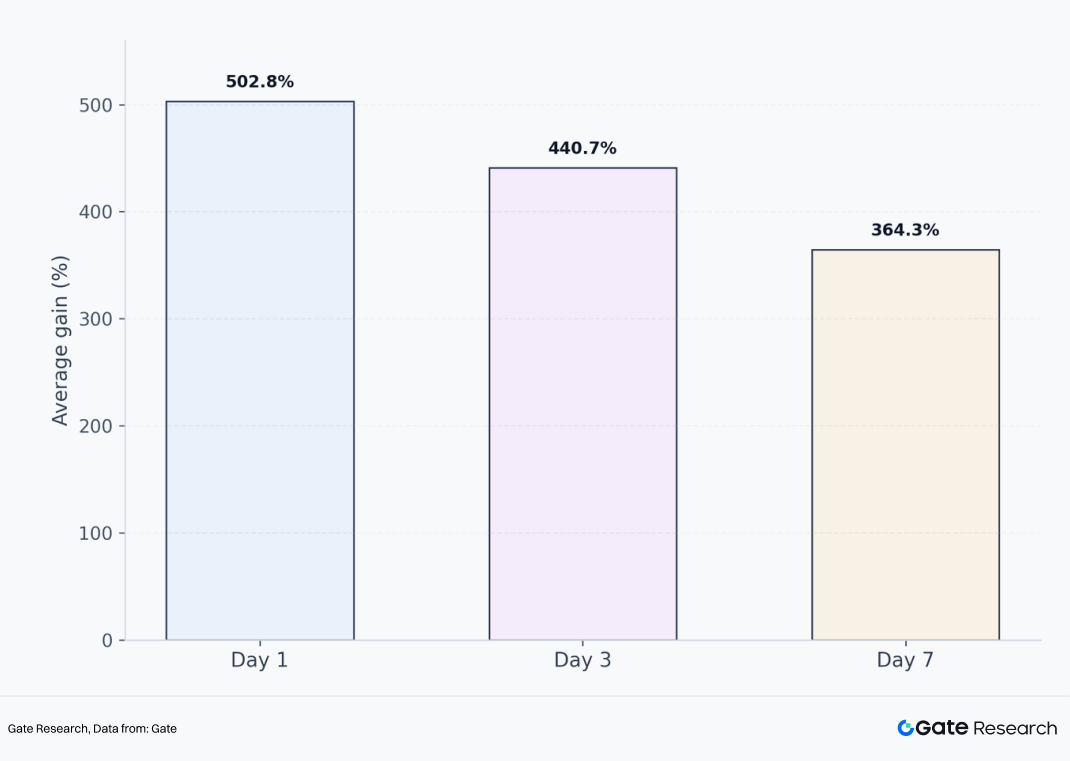
In terms of performance, the most prominent feature of first-listing projects is high return elasticity. Data shows that nearly 46% of first-listing projects maintained price gains 7 days after listing; the average gains for appreciating projects on the first day, at 3 days, and at 7 days reached 502.8%, 440.7%, and 364.3%, respectively. This means the core advantage of Gate's first-listing projects is not merely early listing, but that the market synergy often formed starting from Gate can unleash stronger price elasticity.
Figure 4: Average Returns of Gate's Appreciating Projects Across Different Holding Periods (1d, 3d, 7d)
Looking at the distribution of extreme returns, this high elasticity is further validated. Among Q1's first-listing projects, 7.4% achieved gains exceeding 500% or even 1,000% within 24 hours. This indicates that the first-listing segment plays the role of a high-payout-ratio opportunity entry point within Gate's listing system. It's not that every project will necessarily surge, but once a first-listing project selected by the platform resonates with market热度, narrative strength, and traffic diffusion, the resulting price feedback is often more pronounced.
The logic behind this is not complex. First-listing projects are in the earliest stage of public trading, price discovery is not yet fully complete, market perception of the project is still rapidly forming, and capital is more easily concentrated in a short time. For platforms, whoever can secure quality projects at this stage has a greater chance of providing users with an early trading entry point characterized by high payout ratios and high attention. For users, first-listing projects offer the possibility of earlier介入 and higher return elasticity, but also entail higher volatility and faster differentiation.
3.2 Non-First-Listing Projects: Fewer in Number, but More Stable in Trend
Compared to first-listing projects, Gate had a total of 10 non-first-listing projects in Q1, a significantly smaller number. However, in terms of performance, these projects exhibited more稳健 median returns.
Figure 5: Proportion of Gains and Median Gains for Gate's Non-First-Listing Projects Across Timeframes (5m–7d)
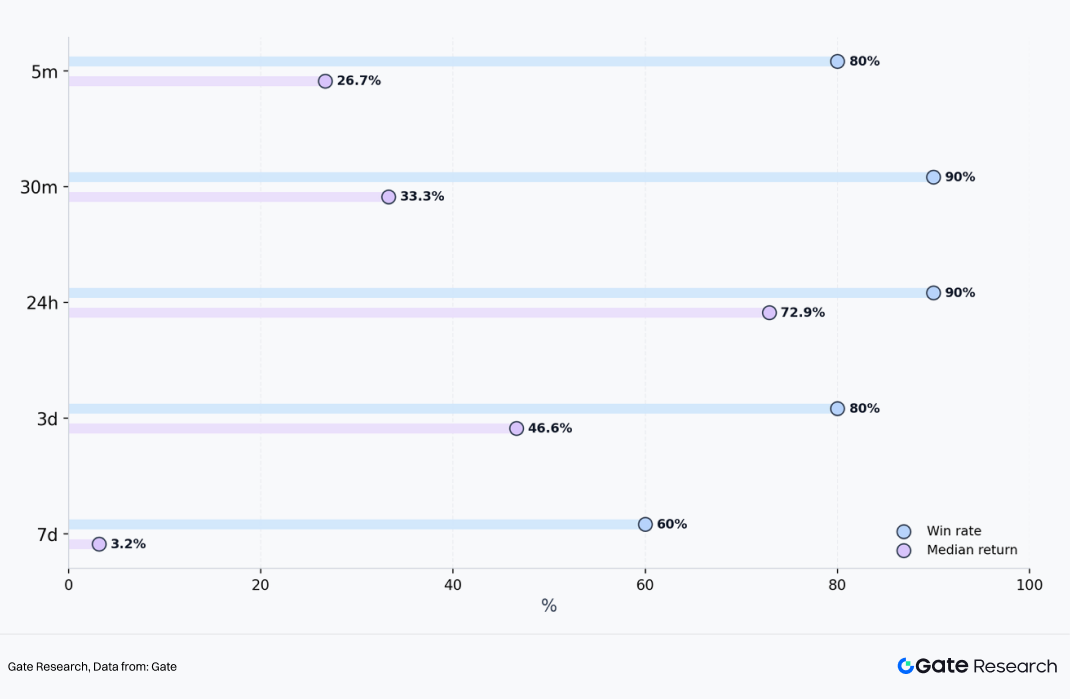
Data shows that the proportion of gains for non-first-listing projects at the 5-minute, 30-minute, 24-hour, 3-day, and 7-day timeframes reached 80%, 90%, 90%, 80%, and 60%, respectively; the corresponding median gains were +26.7%, +33.3%, +72.9%, +46.6%, and +3.2%. Additionally, 40% of non-first-listing projects achieved gains of 100% or more within 24 hours.
The data indicates that although Gate's non-first-listing projects may not have direct early pricing power like first listings, under the platform's screening mechanism, they反而 exhibit a higher success rate for price appreciation. The reason is that non-first-listing projects have typically undergone preliminary market validation. When introducing them, the platform can conduct secondary screening based on more comprehensive price performance, community热度, narrative diffusion, and market onboarding情况, making them更容易 excel in terms of certainty compared to first listings.
Overall, Gate's listing structure does not rely solely on first listings to demonstrate advantages; instead, it has formed two complementary paths: first-listing projects provide higher elasticity and stronger wealth effects, while non-first-listing projects provide more稳健 median returns. The former leans "offensive," the latter leans "stable," together constituting the platform's adaptability to different user preferences. From a platform perspective, this dual-track structure is more mature than单纯 relying on first listings. It shows that Gate does not mechanically pursue more first listings at all costs; beyond first listings, it can also continuously provide users with effective opportunities through the timely introduction and re-screening of non-first-listing projects.
4. Exclusive Projects: The Segment Best Reflecting Gate's Proactive Judgment Capability
If first-listing projects reflect a platform's ability to participate in mainstream quality supply, then exclusive projects reflect a platform's more proactive screening capability, resource acquisition capability, and pre-judgment capability. Exclusive projects directly reflect a platform's project审美, risk control capabilities, and execution efficiency.
In Q1, Gate exclusively listed a total of 14 projects, accounting for 37.8% of all newly listed projects. This proportion itself indicates that Gate, during this quarter, was not merely passively participating in the market's mainstream listing节奏 but possessed its own differentiated project pool to a significant extent. More crucially, the post-listing results of these exclusive projects were not weak; instead, they demonstrated strong competitiveness across multiple key windows.
Figure 6: Proportion of Gains and Median Gains for Gate's Exclusive Projects Across Timeframes (24h–7d)
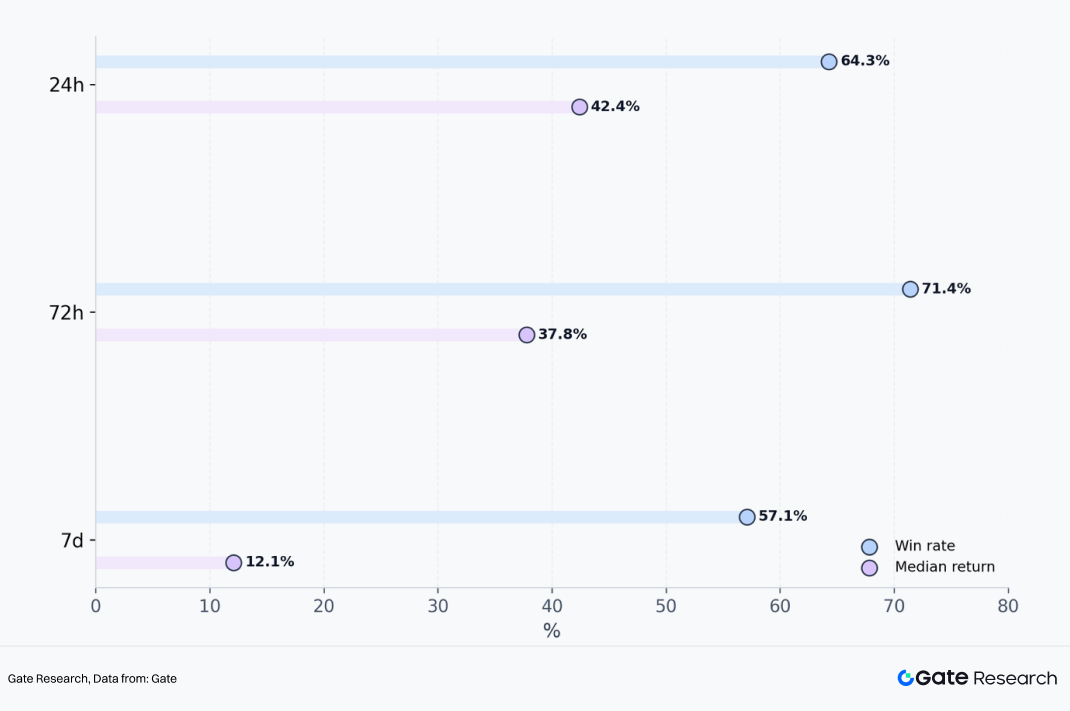
In terms of win rate, the success rate for price appreciation of exclusive projects at the 24-hour, 72-hour, and 7-day timeframes reached 64.3%, 71.4%, and 57.1%, respectively. Performance was most prominent in the 72-hour window. This means that during the period from the 2nd to the 3rd day after listing, Gate's exclusive projects did not weaken rapidly as opening热度 faded; instead, they formed clearer market capital onboarding and upward momentum.
Looking at median returns, exclusive projects achieved +42.4%, +37.8%, and +12.1% at the 24-hour, 72-hour, and 7-day timeframes, respectively. This indicates that exclusive projects not only have a high proportion of gains but also明显 higher median returns than the overall sample. This means the good performance of exclusive projects is not driven by a few extreme cases; rather, the majority of projects can provide relatively good回报 quality during core windows.
Examining the distribution of extreme returns further clarifies the characteristics of exclusive projects. From 30 minutes after opening to 30 days,始终 over 20% of exclusive projects achieved gains of 100% or more; during the 3 to 7-day stage, the proportion of projects with gains exceeding 100% was as high as 35.7%, significantly higher than the 15.4% level for all first-listing projects; even extending to the 30-day timeframe, 12.5% of exclusive projects still achieved gains of 500% or even 1,000%.
This data collectively illustrates one fact: Gate's exclusive projects do not merely gain a bit of热度 at opening due to scarcity. Instead, across multiple post-listing time windows, they can continuously complete price discovery and receive buy-side support, with a strong probability of exhibiting more significant return curves.
5. Case Review
Looking at Q1 cases, Gate's project selection大致 revolved around three paths: one category involves全网 high-attention projects that Gate首发 or prioritized onboarding early, later validated by other platforms following suit; another category consists of projects exclusively listed on Gate with持续 strong subsequent performance, reflecting the platform's independent screening capability; and a third category includes narrative projects with strong community dissemination and话题扩散 capabilities, reflecting the platform's敏锐度 towards sentiment-driven sectors.
5.1 Solana Mobile (SKR): Front-Row First-Listing Onboarding for a High-Attention Project
Solana Mobile belongs to the DePIN赛道. After its TGE, its ATH gain reached 2,459%,


