






Quick Look at the 24-Year-Old "AI Stock God's" Latest Portfolio: 60% Hedging Against the Semiconductor Downturn


- Core Thesis: The Q1 portfolio of newly-minted "AI Stock God" Leopold Aschenbrenner has been revealed, with total market value surging to $137 billion. The fund employs large-scale put options to hedge against short-term valuation泡沫 in AI semiconductors, while continuing to heavily invest in energy and computing infrastructure. This reflects a core judgment of "short-term bearish on chips, long-term bullish on infrastructure" within the AI industry chain.
- Key Elements:
- Total portfolio value grew 148% to $137 billion, with 32.51% attributed to net new capital inflows, indicating substantial external subscription activity.
- Over 60% of the notional value in new positions was allocated to put options on AI semiconductors, with the top five being PUTs on SMH, NVDA, ORCL, AVGO, and AMD.
- Simultaneously holds both call and put options on Micron (MU) and TSMC (TSM), employing a two-way betting strategy to capitalize on potential large swings triggered by earnings or geopolitical events.
- Increased positions focused on common stock, notably adding to SanDisk (SNDK) and CoreWeave (CRWV), continuing the "electricity is the new oil" logic by investing in computing and power infrastructure companies.
- Liquidated call options on Intel (INTC CALL) as well as optical chip and module companies LITE and COHR, indicating a move to reduce high leverage and exit the AI networking hardware sector.
- Among reduced positions, Bloom Energy fell from the top holding to 6.42%, and CoreWeave call options saw significant deleveraging—both actions are likely profit-taking or risk-reduction maneuvers.
Original: Odaily (@OdailyChina)
Author: Azuma (@azuma_eth)
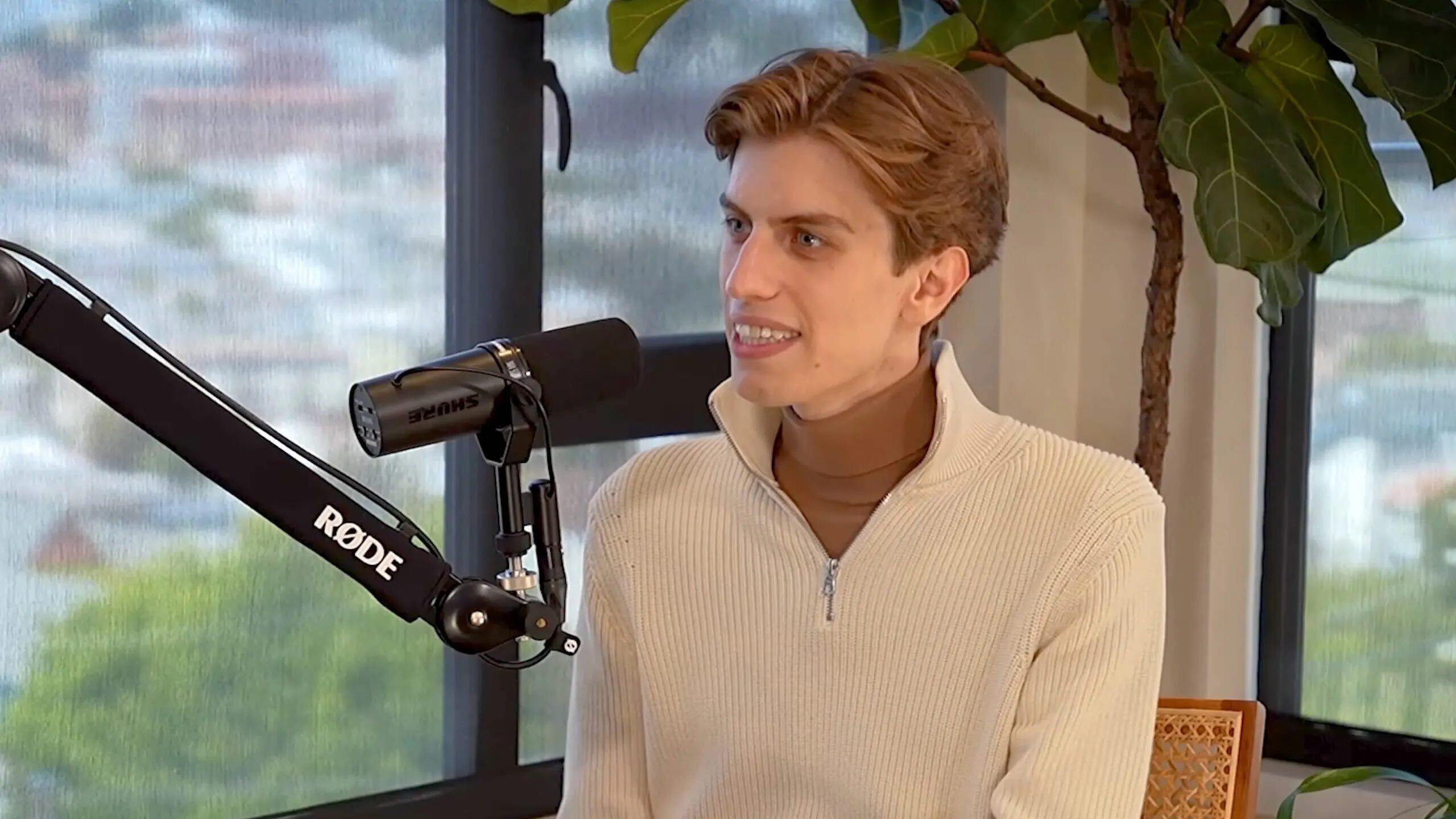
No confidentiality request! No complete liquidation either! The newly minted "AI Stock God" Leopold Aschenbrenner's fund, Situational Awareness LP, officially released its 13F filing this evening.
- Note from Odaily: For details on Leopold Aschenbrenner's personal story, see SBF's Little Brother Turned $225 Million into $5.5 Billion in One Year.
This confirms that the first scenario we outlined this morning in The Answer Revealed Today? The Whole Market Awaits the 24-Year-Old 'AI Stock God's' Playbook was the reality. Situational Awareness LP simply submitted its filing late on the May 15 deadline, causing the SEC to miss posting it on its website that day. The market endured another weekend of suspense until the SEC returned on Monday to finally reveal the fund's holdings.
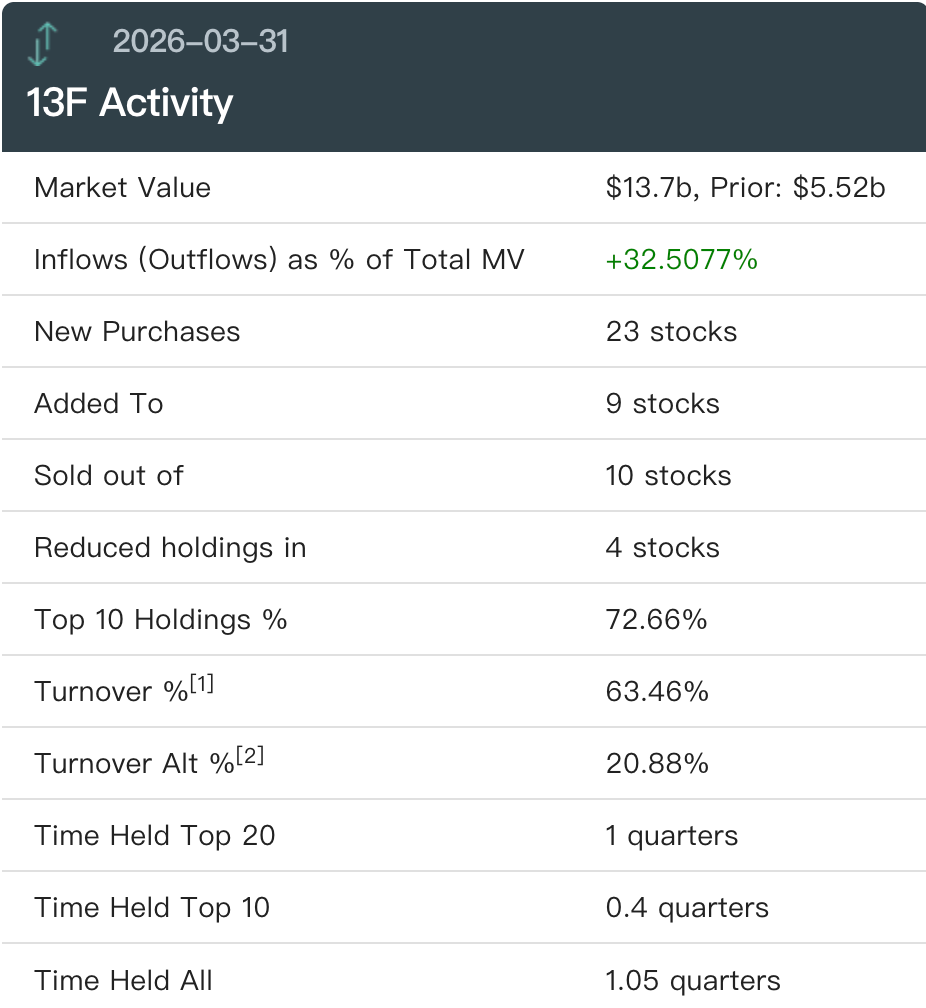
According to this latest 13F filing, as of March 31, 2026, Situational Awareness LP's total nominal holdings surged to $13.7 billion, more than doubling (148%) from $5.52 billion on December 31, 2025.
- Note from Odaily: It is important to note that in US stock 13F filings, the market value displayed for options typically represents the "Notional Value" of the underlying stock, not the actual premium cost paid by the fund. This means that while the fund has constructed a semiconductor hedge wall with tens of billions in notional assets, its actual cash cost (maximum loss) is much smaller, representing a classic high-leverage macro hedge.
Furthermore, net capital inflows for the quarter accounted for 32.51% of the fund's total portfolio value, indicating the fund's explosive growth was driven not only by portfolio appreciation but also by substantial new external capital subscriptions.
Aggressive Portfolio Restructuring
The filing also reveals that Situational Awareness LP executed a sweeping portfolio overhaul in the first quarter of this year.
- New Purchases: 23 stocks (including options);
- Added To: 9 stocks;
- Sold out of: 10 stocks (including options);
- Reduced holdings in: 4 stocks (including options).
New Purchases: 60% of Portfolio Hedging Against Semiconductor Downturn
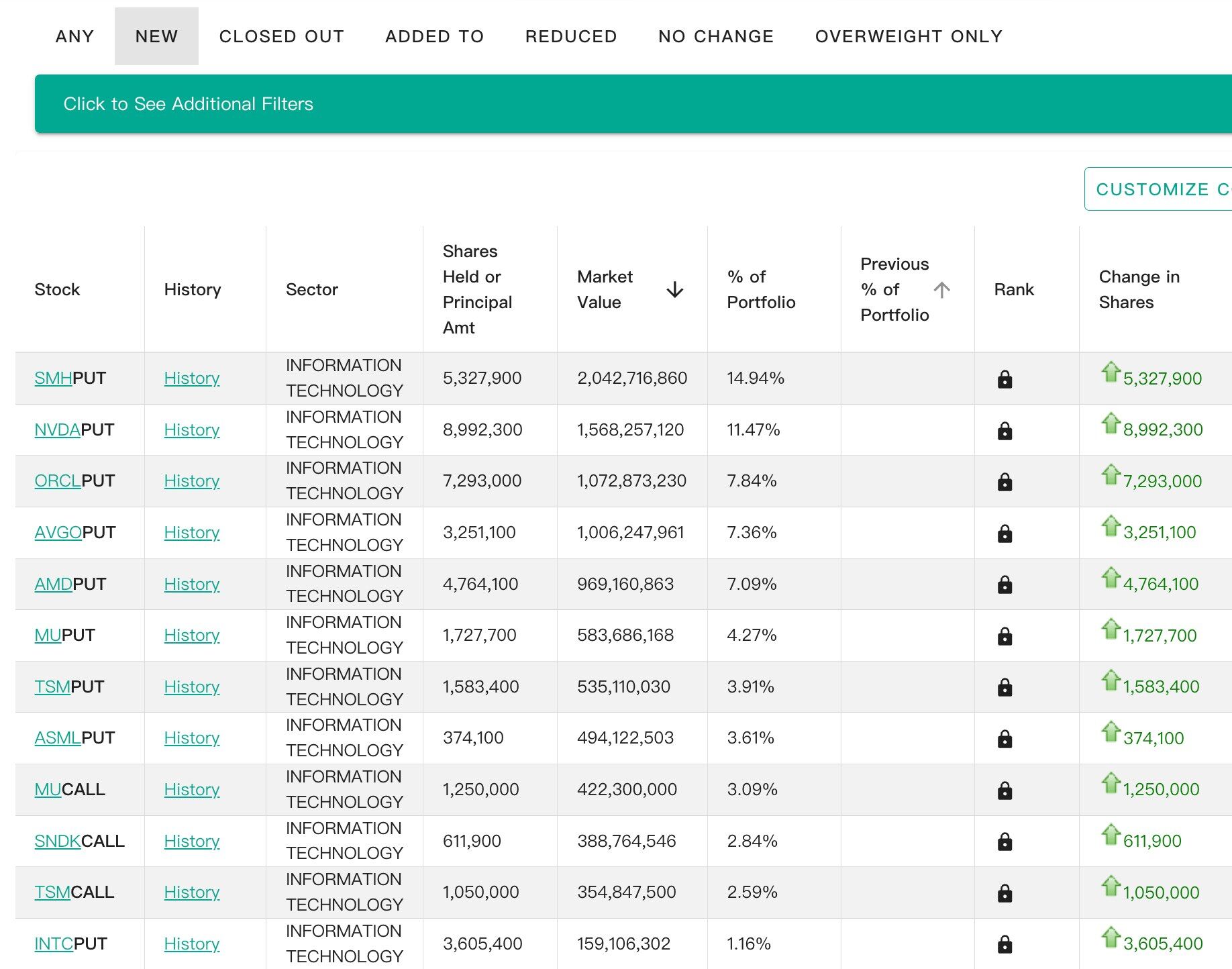
- Note from Odaily: The chart above only covers new stock positions valued over $100 million. Click here to view all 23 new stock positions.
Let's start with the new purchases, which contain the most shocking information in Situational Awareness LP's entire 13F report. The fund systematically hedged against downside risk in the AI semiconductor and compute hardware sectors by establishing massive put option positions in the first quarter.
Let's look directly at the data:
- SMH PUT (VanEck Semiconductor ETF Put Option): 14.94% of portfolio ($2.04 billion) – Largest new position;
- NVDA PUT (NVIDIA Put Option): 11.47% of portfolio ($1.56 billion) – Second largest new position;
- ORCL PUT (Oracle Put Option): 7.84% of portfolio;
- AVGO PUT (Broadcom Put Option): 7.36% of portfolio;
- AMD PUT (AMD Put Option): 7.09% of portfolio;
These top five put option positions alone account for 48.7% of Situational Awareness LP's total $13.7 billion nominal portfolio value. Adding put options on Micron (MU), Taiwan Semiconductor (TSM), ASML (ASML), and Intel (INTC), over 60% of the fund's nominal positions are betting on or hedging against a decline or extreme volatility in core AI hardware stocks.
Furthermore, it's noteworthy that Situational Awareness LP simultaneously bought both call and put options on the same stock. For example, alongside buying MU PUT (4.27%), it also purchased MU CALL (3.09%). Similarly, while buying TSM PUT (3.91%), it also acquired TSM CALL (2.59%).
This is a common bi-directional betting strategy used by hedge funds. It suggests the fund believes that Micron (memory chips) and TSMC (foundry) could experience stock price swings far exceeding market expectations in upcoming 2026 earnings reports or industry cycles, driven by geopolitical factors or severe supply-demand imbalances. As long as the one-sided swing is large enough, it can profit from both directions.
Added To: Still Favoring SanDisk and CoreWeave via Common Stock
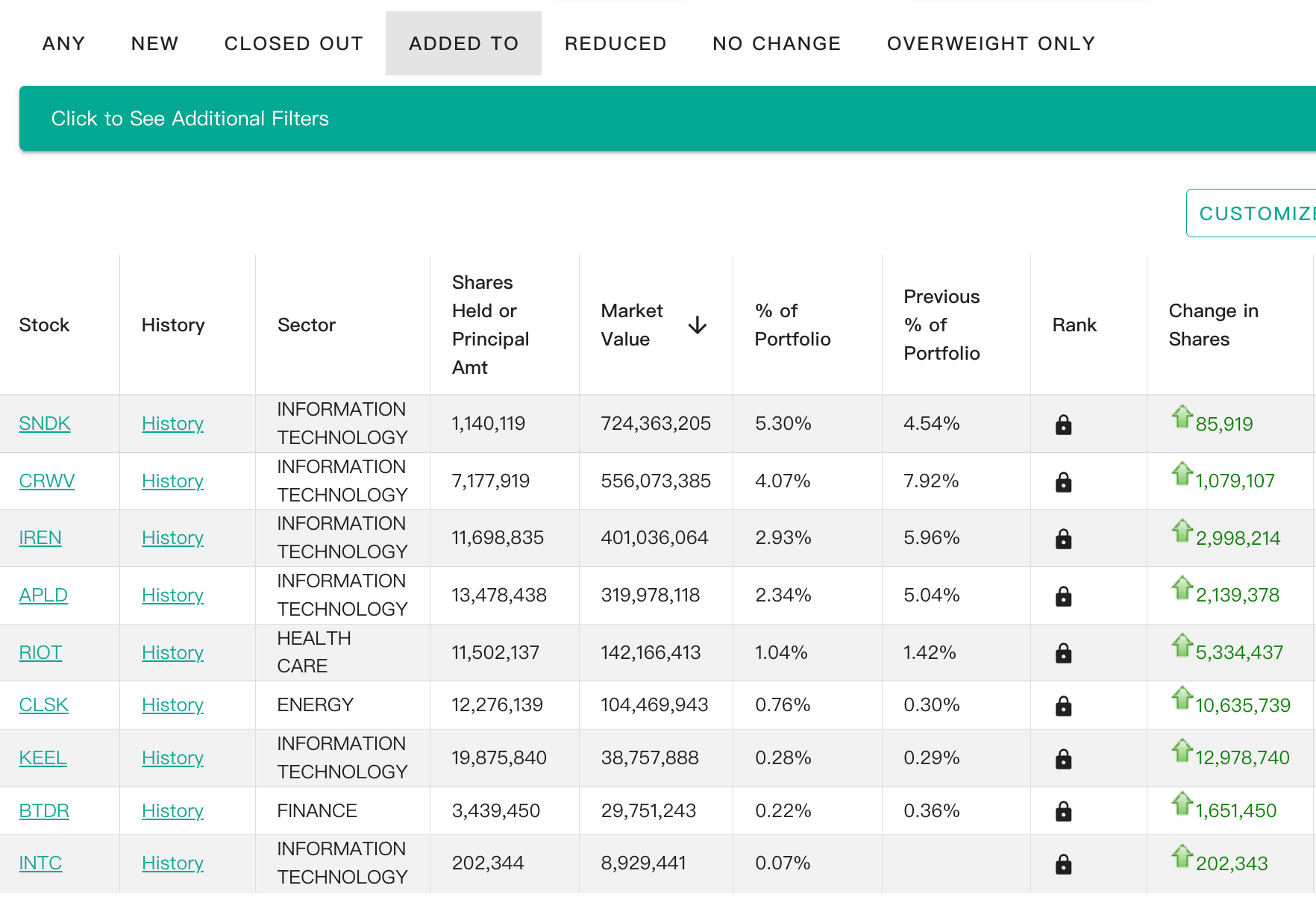
Regarding additions, Situational Awareness LP did not opt for options but instead increased its holdings in 9 stocks through common stock purchases.
In Q1, Situational Awareness LP slightly increased its SanDisk (SNDK) holdings by 85,000 shares, bringing its total to 1.14 million shares, with a market value of $724 million, representing 5.30% of the total portfolio. This is one of the very few super-heavy positions held entirely in common stock within Situational Awareness LP's portfolio.
Another key move worth noting is that Situational Awareness LP significantly added over 1.07 million shares of CoreWeave (CRWV) in Q1, pushing the position's value to $556 million, representing 4.07% of the portfolio. CoreWeave is one of the most closely watched infrastructure companies in the AI GPU cloud services space and a key partner in the NVIDIA ecosystem. After its IPO, Situational Awareness LP quickly integrated it into its core portfolio and aggressively added shares. This indicates that while the fund is shorting NVIDIA's short-term valuation (via PUTs), it remains intensely bullish on cloud giants that directly convert GPUs into computing power for major AI models.
Additionally, Situational Awareness LP increased positions in compute or power infrastructure companies like KEEL, IREN, APLD, RIOT, CLSK, and BTDR, continuing the theme popularized by Leopold Aschenbrenner that "electricity is the new oil."
Sold Out: Exiting Intel Call Leverage, Withdrawing from Optical Communication
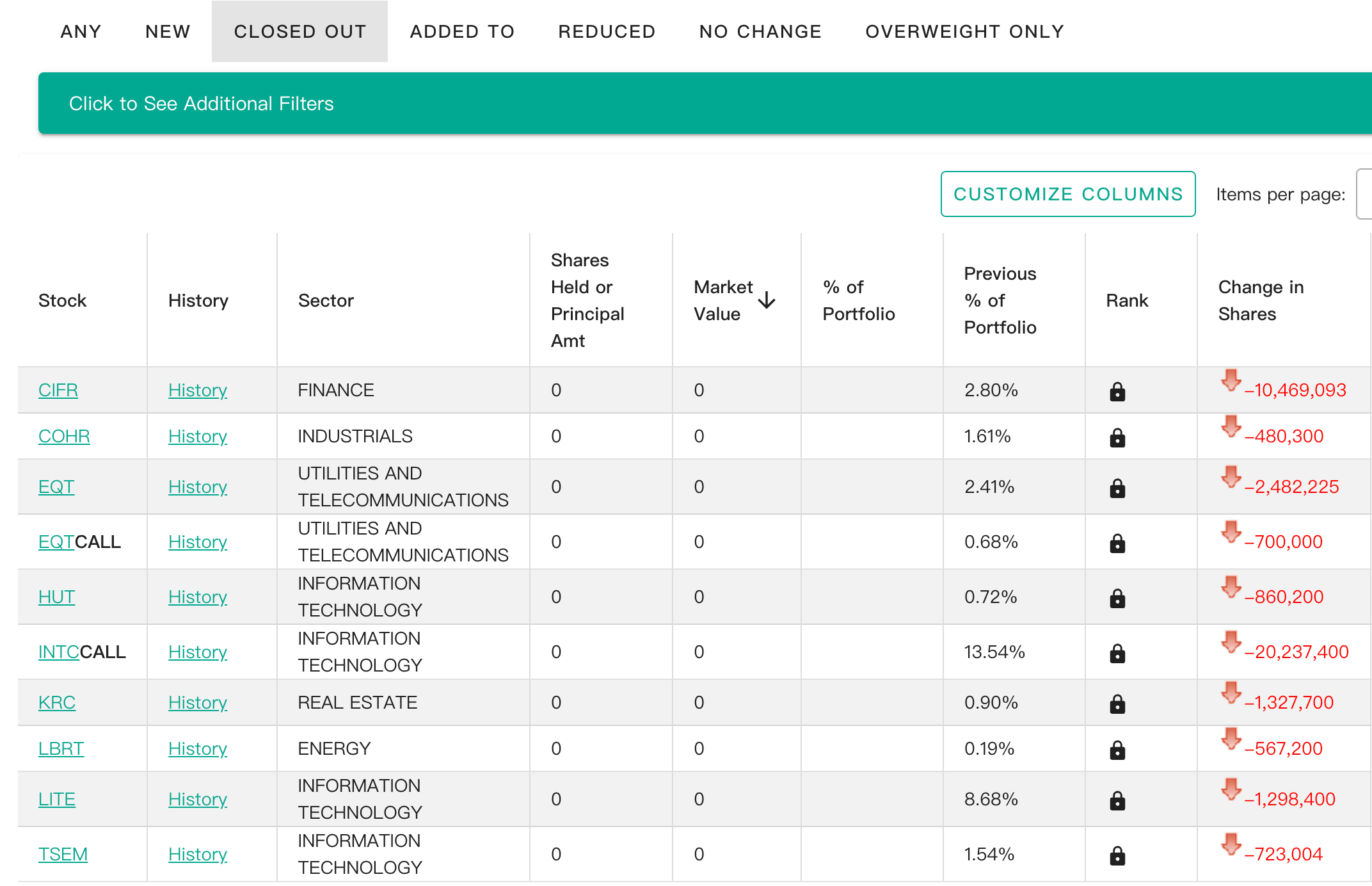
Regarding sales, Situational Awareness LP's biggest move was completely unwinding its leveraged position in Intel call options (INTC CALL). In the previous reporting period, Situational Awareness LP had over 13% of its portfolio allocated to Intel call options (a massive 20.23 million option contracts), representing a high-leverage directional bet. It fully liquidated this position in Q1, switching to a minimal common stock position (0.07%).
Furthermore, Situational Awareness LP completely exited positions in LITE (8.68% weight last period) and COHR (1.61% weight last quarter). LITE and COHR are among the world's leading optical communication chip and optical transceiver giants. This liquidation indicates Situational Awareness LP is retreating from the AI optical module/network hardware sector.
Situational Awareness LP also sold its positions in CIFR (2.80% weight last period) and HUT (0.72% weight last period) in Q1, both cryptocurrency mining companies (including CORZ, which was reduced – see next section). Considering the concurrent additions to similar companies like RIOT, CLSK, and BTDR, these likely represent routine portfolio rebalancing.
Reduced Holdings: Significant Profit-Taking on BE
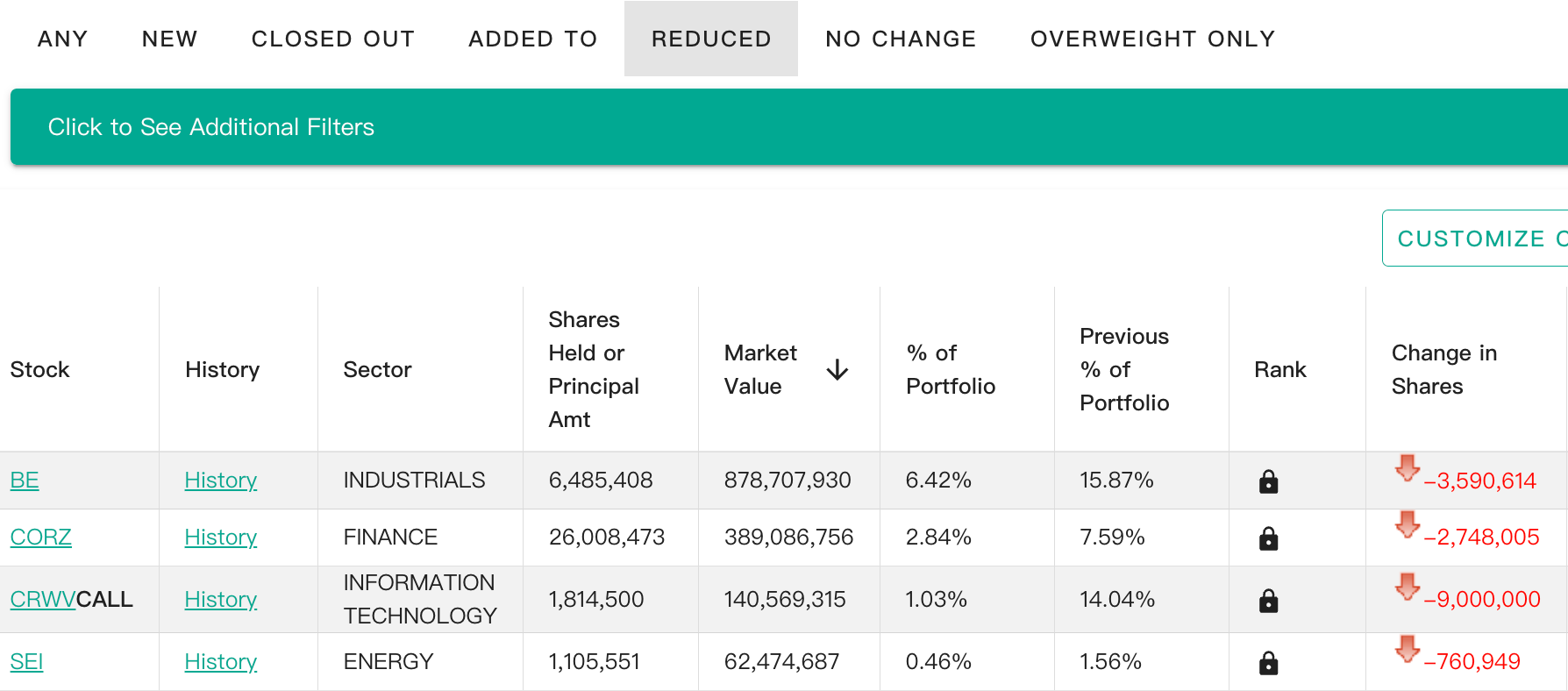
Finally, looking at reductions, Bloom Energy (BE) was Situational Awareness LP's largest disclosed position in the previous 13F filing. This quarter, the fund sold 3.59 million shares, reducing the position's portfolio weight from 15.87% to 6.42%.
Bloom Energy specializes in solid oxide fuel cell technology and is a core target for data centers utilizing "on-site independent power generation" to bypass traditional power grids. Given the remaining position is still substantial, this reduction likely represents routine profit-taking rather than a loss of confidence in the company.
The CoreWeave call option (CRWV CALL) was Situational Awareness LP's second-largest reduction, with its portfolio weight plummeting from 14.04% to 1.03%. As mentioned earlier, the fund shifted to holding CRWV via common stock, so this move is primarily about de-leveraging.
Situational Awareness LP also reduced its stake in Core Scientific (CORZ) by 2.74 million shares, lowering the position from 7.59% to 2.84% of the portfolio. CORZ is a leading Bitcoin miner transitioning into AI compute hosting. However, given that Situational Awareness LP added other mining companies still in their transition phase and offering better value, reducing CORZ seems more like partial profit-taking.
What is the "AI Stock God" Really Thinking?
Looking only at the surface data of this 13F, many might draw a simple, blunt conclusion: Leopold Aschenbrenner, who once boldly predicted "AGI by 2027," has now turned fully bearish on AI.
But the reality is clearly not that simple. Within Situational Awareness LP's portfolio structure, there exist two seemingly contradictory yet highly consistent core themes.
- On one hand, there is extreme vigilance towards short-term valuation bubbles in the "chip sector." Situational Awareness LP used a staggering nominal amount of put options, effectively buying "crash insurance" for the entire AI semiconductor supply chain, including NVIDIA, Broadcom, and others.
- On the other hand, there is an almost zealous optimism regarding long-term AI infrastructure demand. Whether it's CoreWeave, Bloom Energy, or a series of power, transformer, and data center-related companies, the underlying logic points to a single certainty: the AI compute war has entered deep waters.
This likely represents Situational Awareness LP's core current thesis. What will truly be scarce in the future may not necessarily be the GPU chips themselves, but the energy, power systems, and data center infrastructure required to run them continuously. GPU production can be scaled up, and advanced manufacturing processes will gradually ramp, but megawatt-scale power supply capacity, transformers, transmission systems, and the construction timelines for massive data centers are far more difficult to replicate quickly. Compared to the already well-priced "selling picks and shovels" narrative, Leopold Aschenbrenner seems more focused on where the real bottlenecks might emerge in the next phase of the AI industry.
This explains why Situational Awareness LP would simultaneously buy large-scale semiconductor put options to hedge against volatility while continuing to heavily invest in GPU cloud services, power, and compute infrastructure assets.
In a sense, this 13F filing serves less as a simple disclosure of holdings and more as a directional roadmap from Leopold Aschenbrenner for the next phase of the AI supply chain's evolution.
When a genius investor who rose to fame by going all-in on AI begins deploying tens of billions in notional value to buy insurance for the AI sector, it signals at least one thing: even the most steadfast AI bulls of this era are starting to take volatility seriously.


