






The biggest beneficiary of the AI boom: The rise of Leopold, the new stock god of Wall Street


- Core Thesis: By betting on AI physical infrastructure (power, sites, chip manufacturing) rather than popular AI software companies, former OpenAI researcher Leopold Aschenbrenner grew his hedge fund from $383 million to $5.517 billion in 12 months. This validates that the AI bottleneck is shifting from model algorithms to the physical world supporting their expansion.
- Key Elements:
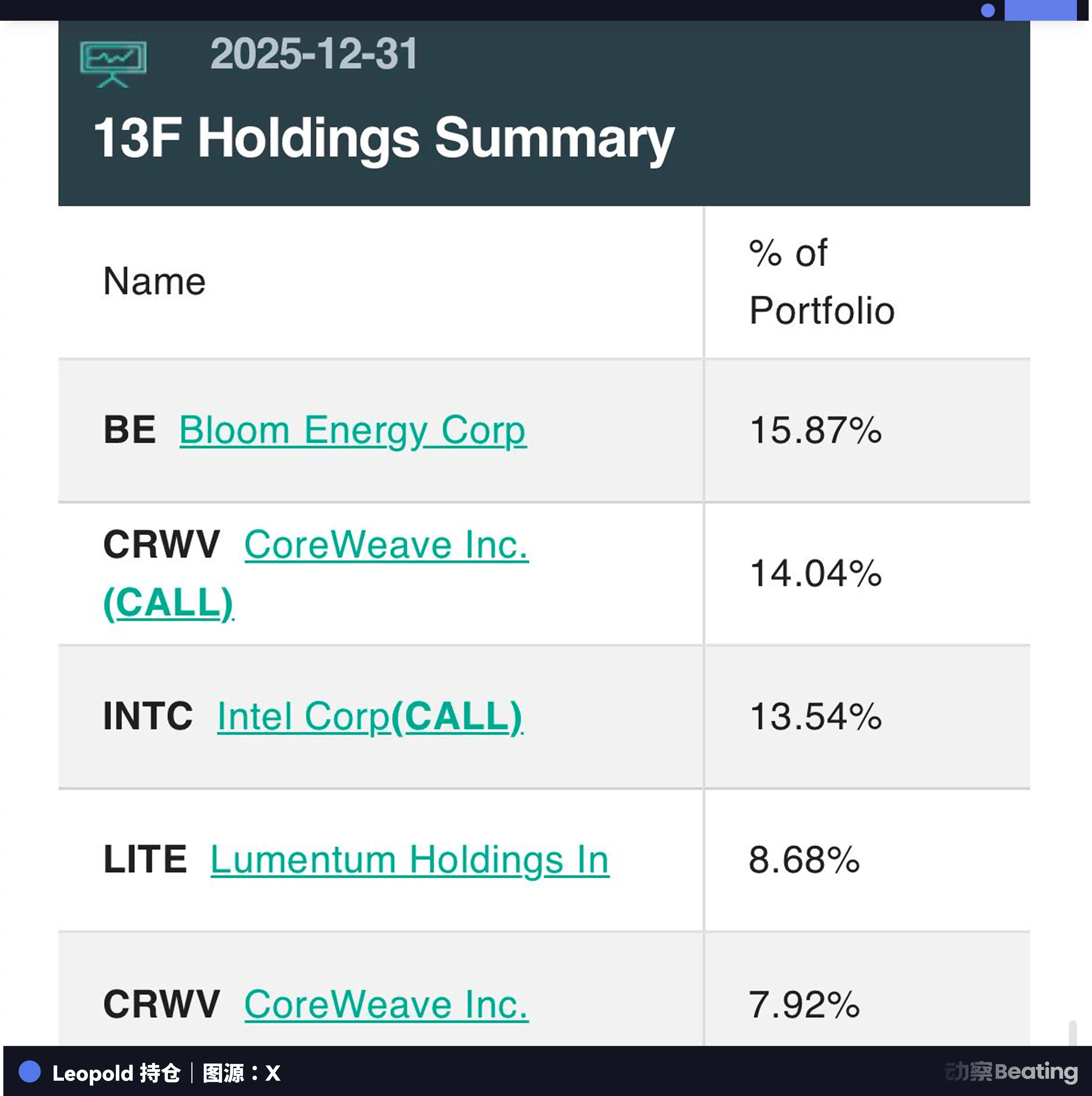
- Leopold's total portfolio market value reached $5.517 billion. Core holdings include Bloom Energy (fuel cells, 15.87%), CoreWeave (GPU cloud services, 22%), Intel (call options, 13.54%), and several Bitcoin mining companies such as Core Scientific and IREN.
- The investment logic is based on his 165-page "manifesto": predicting AGI could be achieved by 2027, requiring massive computational power, making electricity, sites, and chips the bottlenecks – while avoiding popular stocks like Nvidia.
- Bitcoin mining companies are transforming into AI data center providers, possessing cheap electricity and sites. For instance, Core Scientific signed a $10.2 billion contract with CoreWeave, and IREN signed a $9.7 billion contract with Microsoft.
- Intel received $7.86 billion in funding from the US CHIPS Act, becoming the only option for domestic chip foundry; Leopold bet on "national will" rather than technological strength.
- During the DeepSeek shock, the market panicked and sold off AI stocks. Leopold bought against the trend, believing that improvements in algorithm efficiency would stimulate demand rather than reduce it. The sector rebounded quickly afterward.
- He liquidated positions in popular stocks like Nvidia and Broadcom and shorted Indian outsourcing company Infosys, as AI programming tools compress outsourcing demand. His holdings cover the full chain: power generation, chips, computing power, storage, and fiber optics.
- Bloom Energy can generate electricity directly next to data centers, bypassing the bottleneck of the aging grid. CoreWeave transitioned from crypto mining to GPU cloud. Copper cables and optical components (Lumentum) are core to data center interconnection.
Leopold Aschenbrenner's holdings have surged yet again. As a rising star in the hedge fund world, his investment thesis is being validated in real-time by market movements.
Over the past few days, multiple stocks in the public portfolio of Leopold's Situational Awareness LP have rallied together: Bloom Energy, Cipher Mining, Intel, Applied Digital, SanDisk, IREN and other targets saw single-day gains exceeding 10% at one point. This has prompted the market to revisit his 13F filing from late last year, trying to understand why this former OpenAI researcher was able to bet on the AI infrastructure narrative ahead of time.
What makes him worth watching isn't the clickbait labels of being 'young' or 'getting rich quick', but rather the framework he provides, which differs from mainstream AI trading. Most equate AI investment with NVIDIA, Microsoft, OpenAI, and model capabilities. However, Leopold's portfolio sidesteps the most crowded superstar assets, pivoting instead towards Bloom Energy, CoreWeave, Core Scientific, Lumentum, Intel, Bitcoin mining companies, and power-related firms.
The AI narrative is shifting from 'whose model is stronger' to 'who can support the model's continued expansion'. Training and inference require GPUs, GPUs need data centers, and data centers need power, land, cooling, fiber optics, permits, and long-term energy supply contracts. Leopold is betting on the physical bottlenecks that AI's continued growth must navigate. Fortune recently summarized his latest holdings: the former OpenAI researcher is translating his own AGI thesis into billion-dollar bets on power, AI infrastructure, and crypto miners.
In early March, 动察Beating conducted an in-depth analysis of Leopold, his fund's holdings, and his investment logic, sharing his vision of the future landscape of AI competition. This vision is now being mirrored in reality: the AI narrative is retreating from models on screens back down to the land and the power grid beneath our feet. In the future, the most valuable things may not be algorithms, but the physical world that supports the algorithms' continued expansion.
Below is the original content from 动察Beating:
In February 2026, hedge fund Situational Awareness LP filed its quarterly holdings report, revealing that as of the end of Q4 2025, the total market value of the fund's U.S. stock holdings was $5.517 billion.
Wall Street manages trillions of dollars in assets, so $5.5 billion is just a drop in the bucket. However, just 12 months prior, this fund's assets under management were less than $400 million. Moreover, its founder and Chief Investment Officer is a young man born in 1999.
His name is Leopold Aschenbrenner. He is 27 years old.
In 12 months, he grew the fund from $383 million to $5.517 billion, an increase of over 14 times. Over the same period, the S&P 500's gain was in the single digits.
Even more surprising is his portfolio. Opening the quarterly holdings report, you won't find any of the AI superstar companies constantly making financial headlines. Instead, you'll find a fuel cell company, Bitcoin miners just crawling back from the brink of bankruptcy, and a chip giant being abandoned by the entire market.
He says his fund invests in AI, but this portfolio looks nothing like an AI fund. It looks more like a madman's shopping list.
Yet, this madman is precisely one of the earliest and most profound thinkers on how AI will change the world. Before joining Wall Street, he was a researcher at OpenAI, tasked with thinking about how to ensure AI doesn't spiral out of control when it becomes smarter than humans. Later, he was ousted for saying things he shouldn't have. He then wrote a 165-page manifesto, predicting a future that most people find absurd.
Afterwards, he went all-in with his entire net worth.
Deconstructing the $5.5 Billion: What Did He Actually Buy?
To understand Leopold Aschenbrenner's genius in investing, the most direct way is to open his holdings report and read it line by line.
His largest holding is Bloom Energy, with a market value of $876 million, accounting for 15.87% of the total portfolio.
This company makes fuel cells. More precisely, it makes something called a 'solid oxide fuel cell', which converts natural gas directly into electricity with extremely high efficiency. Founder KR Sridhar is a former NASA Mars exploration program engineer, hailed by Fortune magazine as 'one of the top five futurists shaping the future today'.
An AI fund placing its biggest bet on a power generation company.
According to Gartner's forecast, global electricity consumption by AI-optimized servers will skyrocket from 93 terawatt-hours in 2025 to 432 terawatt-hours in 2030, nearly quintupling in five years. Grid power demand from U.S. data centers is expected to nearly triple by 2030, reaching 134.4 gigawatts. Meanwhile, the average age of U.S. power infrastructure exceeds 25 years, with many components aged between 40 and 70 years, far exceeding their design lifespan.
In other words, the electricity AI needs is far more than the grid can provide. And the grid itself is aging and falling apart.
The scarcest resource in the AI era isn't chips; it's electricity.
Bloom Energy's fuel cells happen to bypass this bottleneck. They don't need to connect to the grid; they generate power directly next to the data center, 24/7. In 2025, Bloom Energy secured a contract from CoreWeave to provide fuel cells for its AI data center in Illinois.
Speaking of CoreWeave, this is exactly Leopold's second-largest holding.
He holds $774 million in CoreWeave call options, plus $437 million in common stock, totaling over $1.2 billion, or 22% of the portfolio. CoreWeave is a GPU cloud service provider that pivoted from cryptocurrency mining.
In 2017, Mike Intrator, Brian Venturo, and a few others pooled resources to mine Bitcoin. When the crypto market crashed in 2018, mining became unprofitable. But they had a bunch of GPUs. In 2019, they had a eureka moment: GPUs can not only mine crypto but also run AI.
So the company pivoted, transforming from a mining farm into an arms dealer for AI computing power. On March 27, 2025, CoreWeave went public on the Nasdaq, raising $1.5 billion at $40 per share. A company born from a mining farm had become a core supplier of AI infrastructure.
Leopold values CoreWeave's massive GPU inventory and its deep relationship with NVIDIA. In an era where compute power equals productivity, whoever has the GPUs is king.
But what truly baffles many is his third-largest holding: Intel. The portfolio value is $747 million, entirely in call options, representing 13.54% of the total.
In 2025, Intel was one of the most unloved companies on Wall Street. Its stock price had halved from its 2024 highs, market share was being eaten by AMD and NVIDIA, and CEOs changed repeatedly. Almost every analyst declared Intel was finished.
Yet Leopold chose this exact moment to heavily invest via call options. This is an extremely aggressive bet – a moonshot that could soar or go to zero.
What is he betting on? Two words: Chip Foundry.
In November 2024, the U.S. Department of Commerce announced that Intel would receive up to $7.86 billion in direct funding under the CHIPS and Science Act. The sole purpose of this money was to make Intel a domestic chip foundry, competing with TSMC.
Against the backdrop of U.S.-China tech decoupling, America needs an 'insider' to manufacture chips. Intel, despite being behind, is the only option. Leopold isn't betting on Intel's technology; he's betting on the national will of the United States.
The subsequent holdings are even more interesting. Core Scientific, $419 million; IREN, $329 million; Cipher Mining, $155 million; Riot Platforms, $78 million; Hut 8, $39.5 million.
These companies share a common trait: they are all Bitcoin mining enterprises.
Why would an AI fund invest in a bunch of Bitcoin miners?
Simple. Bitcoin miners have the cheapest electricity and the largest data center sites in the United States.
Core Scientific possesses over 1,300 megawatts of power capacity. IREN plans to expand by 1.6 gigawatts in Oklahoma. To survive intense computational competition, these miners had long locked in the cheapest power resources globally through long-term power purchase agreements.
Now, what AI data centers need most are precisely power and land.
In 2022, Core Scientific filed for bankruptcy following the crypto market crash. It completed restructuring in January 2024, shedding about $1 billion in debt, and relisted on the Nasdaq. Then, it signed a 12-year contract with CoreWeave worth over $10.2 billion, converting its mining facilities into AI data centers. To fully commit to this pivot, Core Scientific even planned to sell all its Bitcoin holdings.
IREN (formerly Iris Energy) signed a $9.7 billion AI contract with Microsoft, receiving $1.9 billion upfront. Cipher Mining inked a 15-year lease agreement with Amazon. Riot Platforms signed a 10-year, $311 million contract with AMD.
Overnight, Bitcoin miners became the landlords of the AI era.
Now, let's complete the puzzle.
Bloom Energy provides power; CoreWeave provides GPU compute; Bitcoin miners provide land and cheap electricity; Intel provides domestic chip manufacturing capability. Add to this the fourth-largest holding, Lumentum ($479 million, optical components essential for interconnecting AI data centers), the ninth-largest, SanDisk ($250 million, data storage), and the eleventh-largest, EQT Corp ($133 million, natural gas producer fueling the fuel cells).
This is a complete AI infrastructure supply chain.
From power generation to transmission, chip manufacturing, GPU compute, data storage, and fiber optic interconnection. He bought into every link.
Another move he made simultaneously makes this logic even clearer. In Q4 2025, he completely liquidated his positions in NVIDIA, Broadcom, and Vistra. These three companies were precisely the star performers with the biggest gains in the 2024 AI rally.
He also shorted Infosys, one of India's largest IT outsourcing companies.
Selling off the hottest AI chip stocks to buy unloved power plants and mining farms. Shorting traditional IT outsourcing because AI coding tools are making programmers more efficient, compressing the demand for outsourcing.
Every trade points to the same judgment: AI's bottleneck isn't software, it's hardware; not algorithms, but electricity; not models in the cloud, but the physical world.
So the question arises: how did a 27-year-old form this understanding?
From Son of East German Doctors to OpenAI's Rebel
Leopold Aschenbrenner was born in Germany to parents who are both doctors. His mother grew up in East Germany, his father in West Germany; they met after the Berlin Wall fell. This family background itself carries the imprint of historical rupture – Cold War, division, reunification. His later obsession with geopolitical competition might trace its earliest seeds here.
But Germany couldn't hold him. He said in an interview later, "I really wanted to leave Germany. If you're the most curious kid in the class, wanting to learn more, the teacher doesn't encourage you; they get jealous and try to suppress you."
He calls this the 'tall poppy syndrome' – whoever grows tall gets cut down.
At age 15, he convinced his parents and flew alone to the U.S. to attend Columbia University.
Attending university at 15 is an anomaly anywhere. But Leopold's performance at Columbia turned 'anomaly' into 'legend'. He majored in both Economics and Math-Statistics, winning numerous awards like the Albert Asher Green Memorial Prize, the Romine Economics Prize, and being inducted into the Junior Phi Beta Kappa honor society.
At 17, he wrote a paper on economic growth and existential risk. Renowned economist Tyler Cowen commented after reading it: "When I read it, I couldn't believe it was written by a 17-year-old. I would be impressed if it were an MIT PhD dissertation."
At 19, he graduated from Columbia University as valedictorian, the highest undergraduate honor. In 2021, while the world was still under the shadow of the pandemic, a 19-year-old German boy stood at Columbia's commencement ceremony, delivering the valedictory address on behalf of all graduates.
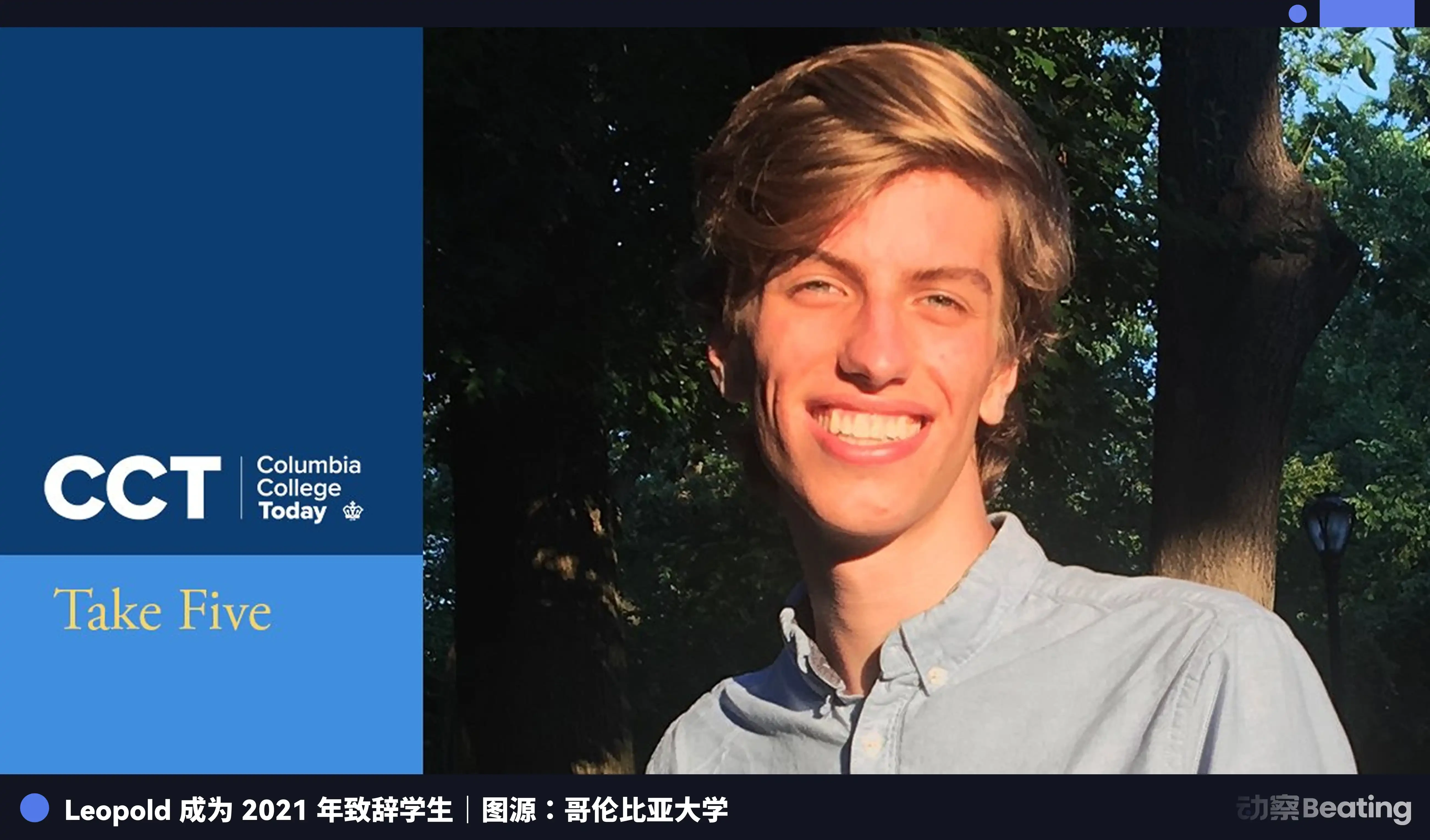
Tyler Cowen gave him one piece of advice: don't pursue a PhD in economics.
Cowen felt the economics academia had become somewhat 'decadent', encouraging him to do bigger things. Cowen also introduced him to Silicon Valley's 'weird Twitter' intellectual circle – a group fascinated by AI, effective altruism, and the long-term fate of humanity.
After graduation, Leopold first joined the Forethought Foundation, researching long-term economic growth and existential risks. He then joined the FTX Future Fund founded by SBF, working alongside core figures of the effective altruism movement, Nick Beckstead and William MacAskill. His title was 'Economist affiliated with the Global Priorities Institute at Oxford University'.
This experience is crucial. It means that before entering the AI industry, Aschenbrenner had already spent several years systematically thinking about one question: what kind of events could fundamentally alter the course of human civilization.
Then, he joined OpenAI.
The exact timing is unclear, but he joined a specific team – the 'Superalignment' team. This team was established on July 5, 2023, co-led by OpenAI co-founder Ilya Sutskever and alignment team lead Jan Leike. Its goal was to solve the superintelligence alignment problem within four years – ensuring that an AI much smarter than humans still follows human instructions.
OpenAI had pledged to dedicate 20% of its compute power to this team. But a chasm separated the promise from reality.
Inside OpenAI, Leopold witnessed things that disturbed him. He submitted a security memo to the board, warning that the company's safety measures were 'severely inadequate' to prevent foreign governments from stealing key algorithmic secrets. The company's reaction surprised him. Human Resources interviewed him, stating his concerns about espionage were 'racist' and 'unconstructive'. Company lawyers interrogated him about his views on AGI and the loyalty of his team.
In April 2024, OpenAI fired him, citing 'leakage of confidential information'.
The alleged 'leak' involved him sharing a brainstorming document about AGI safety measures with three external researchers. Leopold claims the document contained no sensitive information and that sharing such documents internally for feedback was normal practice.
A month later, Ilya Sutskever left OpenAI. Three days later, Jan Leike also departed. The Superalignment team disbanded, and the promised 20% compute power was never delivered.
A team researching 'how to control superintelligence' was disbanded by the very company building it.
The irony of this cannot be overstated. But for Leopold, being fired became a liberation. He was no longer an employee, no longer needing to tiptoe in internal memos. He could say what he truly wanted to say to the world.
On June 4, 2024, he published a 165-page article on a website called situational-awareness.ai. The title was 'Situational Awareness: The Decade Ahead'.
The 165-Page Prophecy
To understand Leopold's investment logic, you must first read this manifesto. Because that $5.5 billion portfolio is the financial translation of these 165 pages.
The core thesis of the manifesto can be summarized in one sentence: There is a very high probability that AGI (Artificial General Intelligence) will be achieved by 2027.
This judgment sounded like madness in June 2024. But Leopold's method of argument was straightforward: count the orders of magnitude.
From GPT-2 to GPT-4, AI capability achieved a qualitative leap, going from preschool level to a smart high school student. Behind this leap was roughly a 100,000-fold (5 orders of magnitude) increase in effective compute. This growth came from stacking physical compute power, improving algorithmic efficiency, and unleashing model capabilities through 'de-scoping'.
His prediction was that by 2027, a similar magnitude of growth would occur again. For physical compute, resources used to train the frontier models would be 100x more than for GPT-4. Algorithmic efficiency would improve by about 0.5 orders of magnitude per year, totaling roughly 100x over four years. Adding the 'de-scoping' gain, turning AI from a chatbot into an agent capable of using tools and acting autonomously, represents another order of magnitude jump.
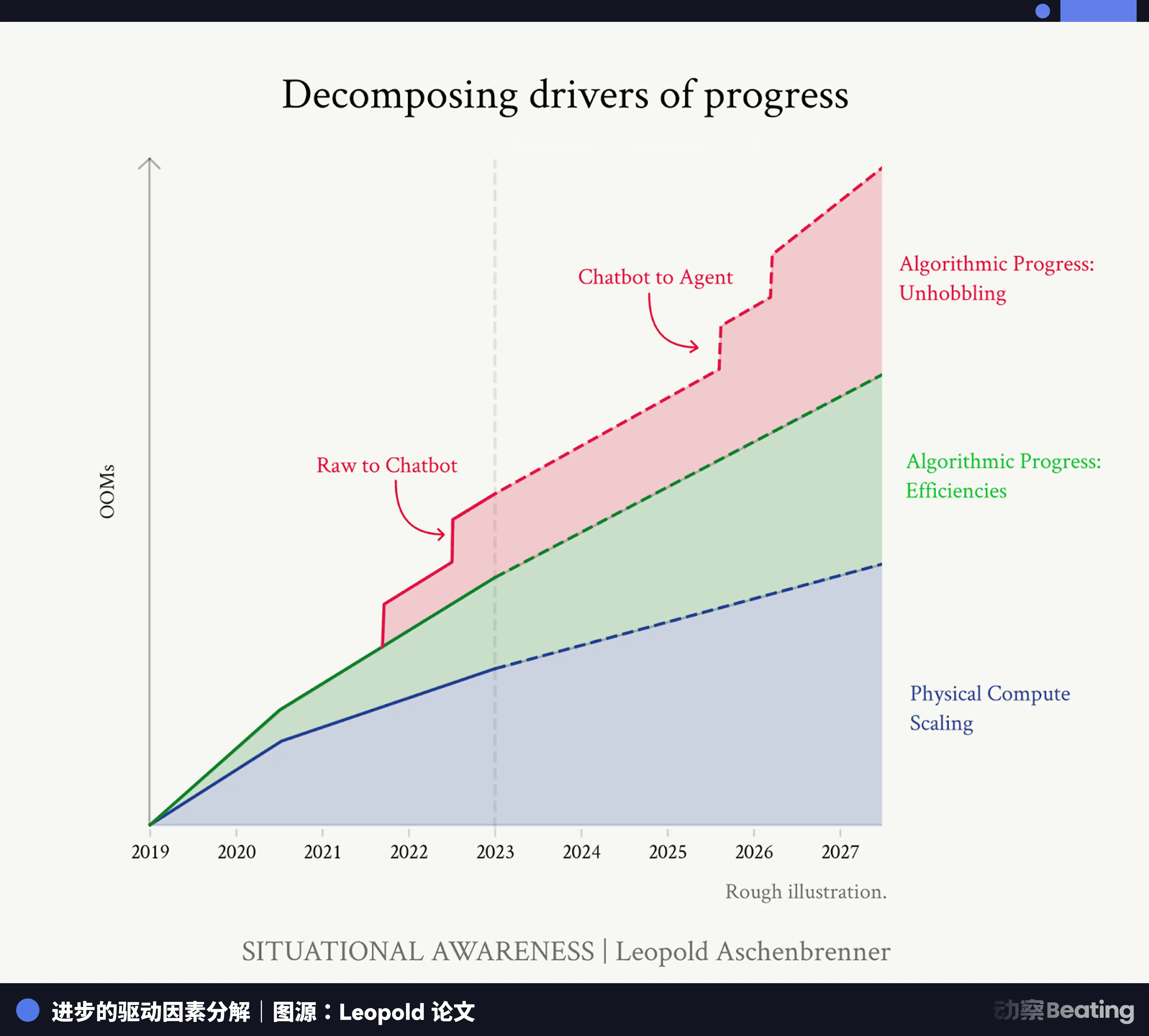
Three 100x factors combined give another 100,000-fold increase, another qualitative leap. From a smart high schooler to surpassing human capabilities.
What truly makes the article unsettling are the consequences he derives from this prediction.
First consequence: Trillion-dollar compute clusters.
He wrote that over the past year, conversations in Silicon Valley had shifted from $10 billion compute clusters to $100 billion clusters, and recently to trillion-dollar ones. Every six months, another zero


