Raised $2.2 Billion, A16z Doubles Down on Crypto


- Core Thesis: a16z crypto’s fifth fund, closed at $2.2 billion—half the size of its previous $4.5 billion fund—maintains a roughly consistent share (about 12%) of a shrinking crypto VC market. This move underscores its strategic commitment to “doubling down” on the crypto赛道 amid the industry-wide shift toward AI.
- Key Elements:
- a16z crypto has cumulatively committed $9.8 billion, with nearly half ($4.5 billion) deployed in Fund 4, raised in 2022; the interval between Fund 4 and Fund 5 fundraising was as long as 48 months.
- Industry data: Global crypto VC funding plummeted from $32.8 billion in 2021 to $10.1 billion in 2023, recovering to approximately $18 billion in 2025—still below 2020 levels.
- Scale comparison: a16z’s Fund 5, at $2.2 billion, represents roughly 12% of the 2025 industry total of $18 billion, nearly consistent with Fund 4’s 15% share of the $30.4 billion raised in 2022.
- Competitor pivot: Direct rival Paradigm’s latest new fund targets $1.5 billion but has expanded its investment scope to include AI and frontier computing; a16z has explicitly stated Fund 5 will invest 100% in crypto entrepreneurs.
- Internal structural shift: a16z’s parent company has grown to $90 billion in assets under management, while the crypto division’s share decreased from 11% during the Fund 4 era to 2.4% during the Fund 5 era, making crypto a single bet within an “Other” pool.
On May 5, a16z crypto, the dedicated crypto venture capital arm of Andreessen Horowitz (a16z), announced the closure of its fifth fund, totaling $2.2 billion. Concurrently, CTO Eddy Lazzarin was promoted to general partner, becoming the fund's fourth GP alongside Chris Dixon, Ali Yahya, and Guy Wuollet.
Most English-language media focused on the narrative that "this is the largest fundraising in the current crypto winter," emphasizing the absolute figure of $2.2 billion. However, this figure appeared once before in 2021, when a16z crypto closed its third fund, also at $2.2 billion. Spanning five years, a market cycle peak, and two crypto winters, a16z has doubled down on this number again.
The story behind this number isn't about "size"; it's about "conviction."
a16z crypto's previous dedicated crypto fund, Fund 4, was closed in May 2022 with a size of $4.5 billion, making it the largest single crypto VC fund in history, a record that remains unbroken. Dropping from $4.5 billion to $2.2 billion certainly represents a halving in size. Yet, amidst this winter, a16z stands as the only institution capable of raising another $2.2 billion to continue betting on crypto.
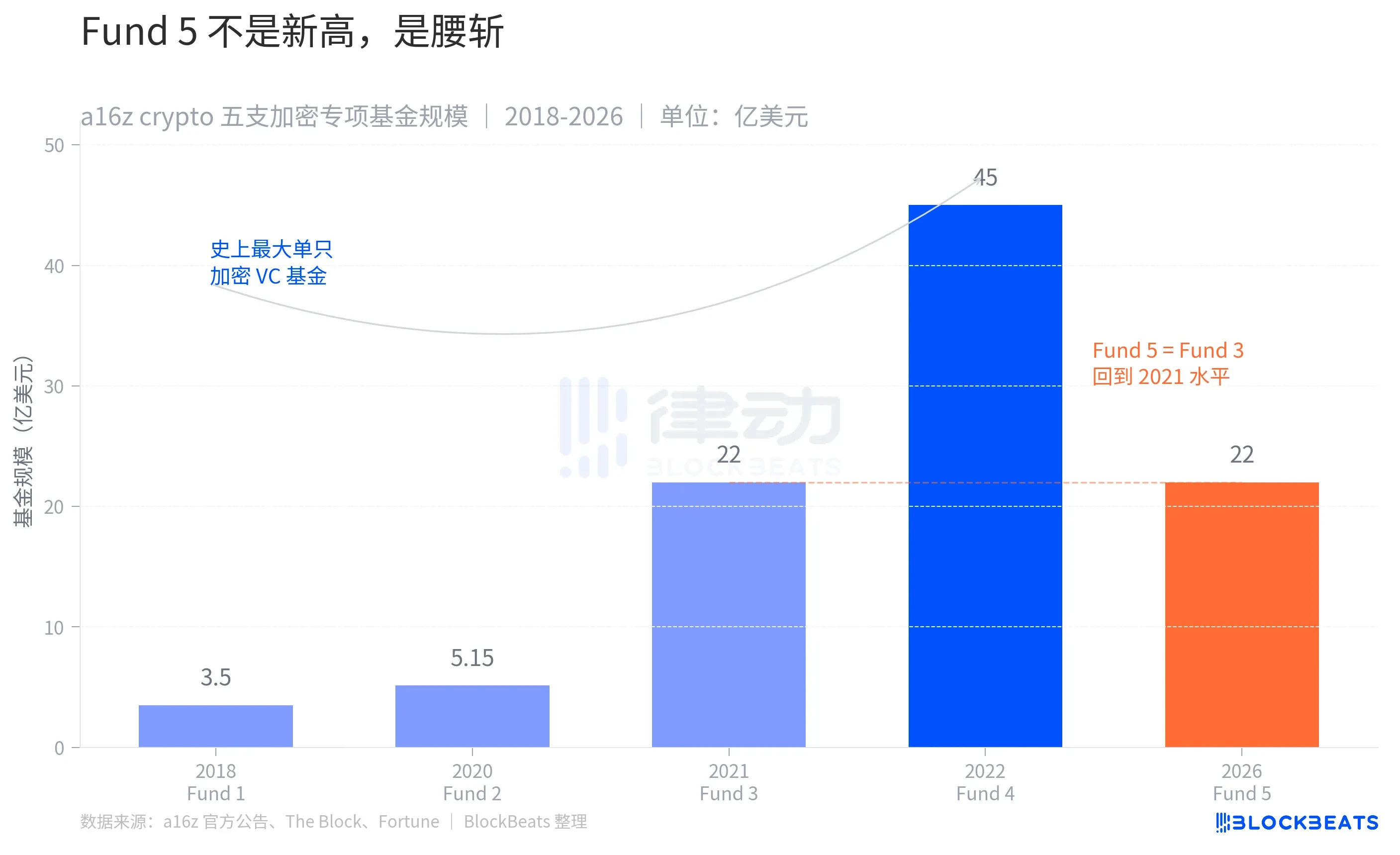
Examining the sizes of this institution's five crypto funds over eight years provides clearer context on the pacing. Fund 1 (2018, $350 million) and Fund 2 (2020, $515 million) were early explorations. Fund 3 (2021, $2.2 billion) marked the first major expansion during a bull market, quadrupling in size. Fund 4 (2022, $4.5 billion) was the peak, doubling again. Fund 5, returning to $2.2 billion five years later, exactly matches Fund 3's size.
Connecting the peaks of Fund 3 and Fund 5 with a dotted line reveals this picture: a16z crypto has traced a complete circle within the crypto narrative, returning to its 2021 dimensions. Since 2018, the institution has committed a total of $9.8 billion, with nearly half ($4.5 billion) tied up in Fund 4 (raised in 2022), which is still not fully deployed. Fund 5 isn't a new wave of accumulation; it's a continuation of the dedicated crypto ammunition under circumstances where Fund 4 remains unspent and the industry has faced another downturn.
Alternatively, the chart can be read from another perspective. Between Fund 1 and Fund 4, the intervals between each fund shortened—2 years, 1 year, 1 year—while sizes ballooned. This was the typical rhythm of the crypto industry from 2018 to 2022. After Fund 4, the interval suddenly stretched to 4 years.
During those 4 years, FTX collapsed, DeFi surged and receded, the Bitcoin ETF was approved in 2024, and a new bull market rose and fell. Instead of continuing the cadence of Funds 1-4 for the next fundraising, a16z crypto first deployed a portion of Fund 4's capital before assembling the next fund. By the time Fund 5 closed, 48 full months had passed since Fund 4.
However, examining a16z crypto's curve in isolation is incomplete. Whether the $2.2 billion represents conviction or merely following the trend must be viewed within the context of the broader industry during the same period.
The reality is that the industry's decline was steeper than a16z crypto's. According to Galaxy Digital, global crypto venture capital investments totaled approximately $32.8 billion in 2021 and remained high at $30.4 billion in 2022. The cumulative total over two years exceeded $63.2 billion, representing the largest influx of venture capital in crypto history. After FTX's collapse, this figure plummeted to $10.1 billion in 2023, a nearly 70% decline. It recovered slightly to $11.5 billion in 2024 and, according to PitchBook, rebounded to approximately $18 billion in 2025, falling back to 2020 levels.
Placing a16z crypto's two large fundraising efforts within this curve reveals their proportional significance. Fund 4's $4.5 billion represented about 15% of the overall industry investment in 2022, meaning roughly one out of every seven dollars in crypto venture capital was managed by a16z crypto alone. Fund 5's $2.2 billion accounts for approximately 12% of the projected $18 billion industry pool in 2025. In absolute terms, a16z crypto raised half as much. In relative terms, its market share within a pool that has shrunk to one-third of its former size has remained nearly unchanged.
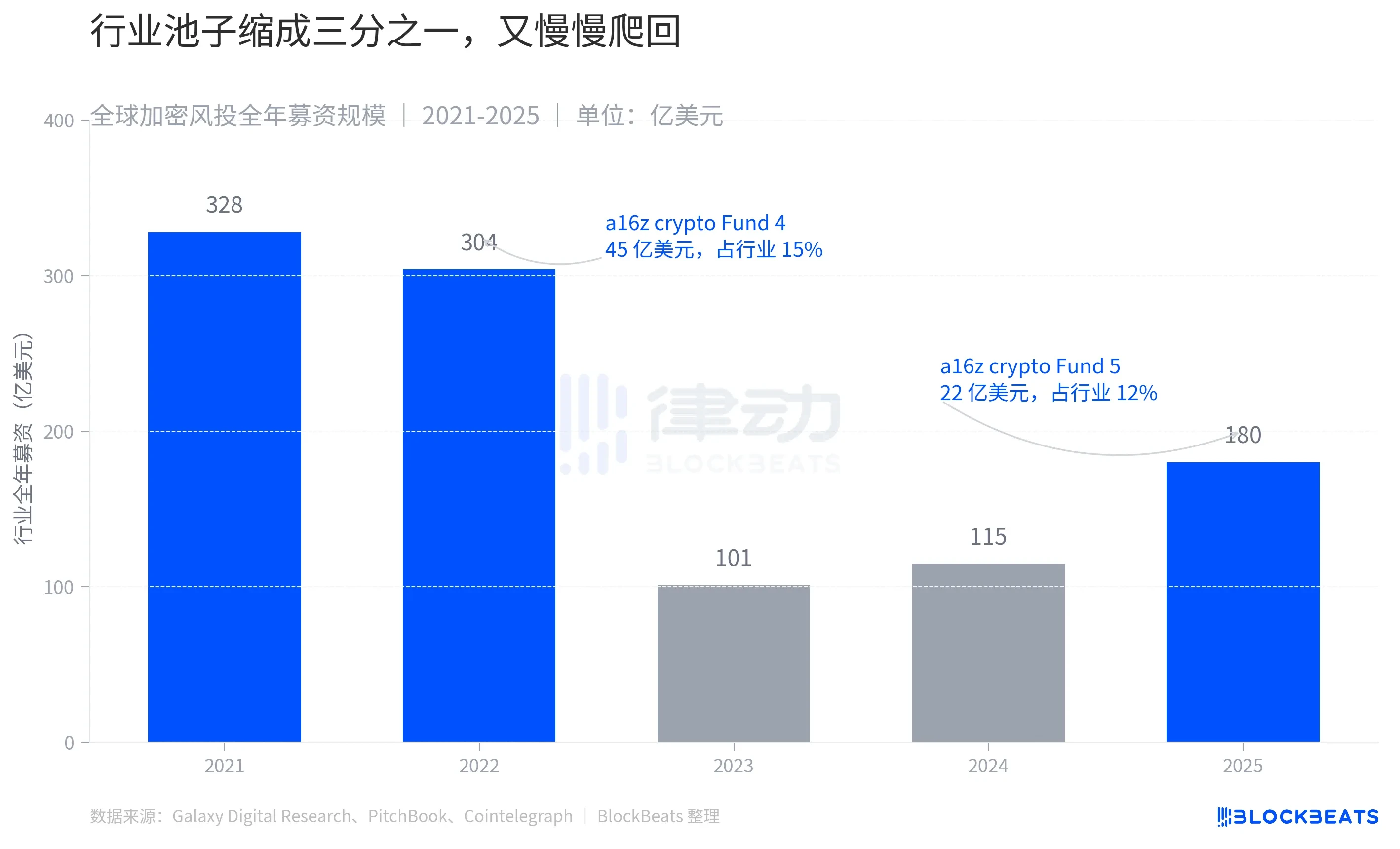
Understanding this dynamic reveals the true position of Fund 5's $2.2 billion. The size was halved, yet the share captured within a pool reduced to one-third stayed almost constant. Achieving this required LPs not to cut their crypto allocation to zero over the past three years, and a16z's partners to convince themselves to "continue spending ammunition on crypto."
Another set of details warrants separate examination. Between 2024 and 2025, Multicoin's AUM climbed from approximately $600 million to $6 billion, only to be halved to $2.7 billion following Bitcoin's decline after October. During the same period, a16z crypto's portfolio valuation shrank by about 40%. Haun Ventures saw a roughly 30% year-over-year increase.
Pantera realized profits for LPs through the IPOs of five portfolio companies in 2025, including Circle and BitGo, and began raising its fifth fund. Broadly speaking, competitors in this winter undertook three strategies: raising new capital, returning capital to LPs, or expanding investment scope beyond crypto. a16z crypto chose the first option, and the first option alone. No capital returns, no scope expansion—just continued investment in crypto.
The third perspective involves comparing peer institutions. The comparison of $2.2 billion and $4.5 billion is a16z crypto's internal story; the comparison of $18 billion and $32.8 billion is the industry's story. The final comparison is among peers.
Looking at the latest funds raised by several top crypto VCs between 2024-2026: Polychain ($400 million), Dragonfly ($650 million), Haun Ventures ($1 billion), Paradigm's new fund ($1.5 billion, still in fundraising), and a16z crypto Fund 5 ($2.2 billion). a16z crypto's fund is the largest in this cycle, but a more critical detail lies in the comparison with Paradigm.
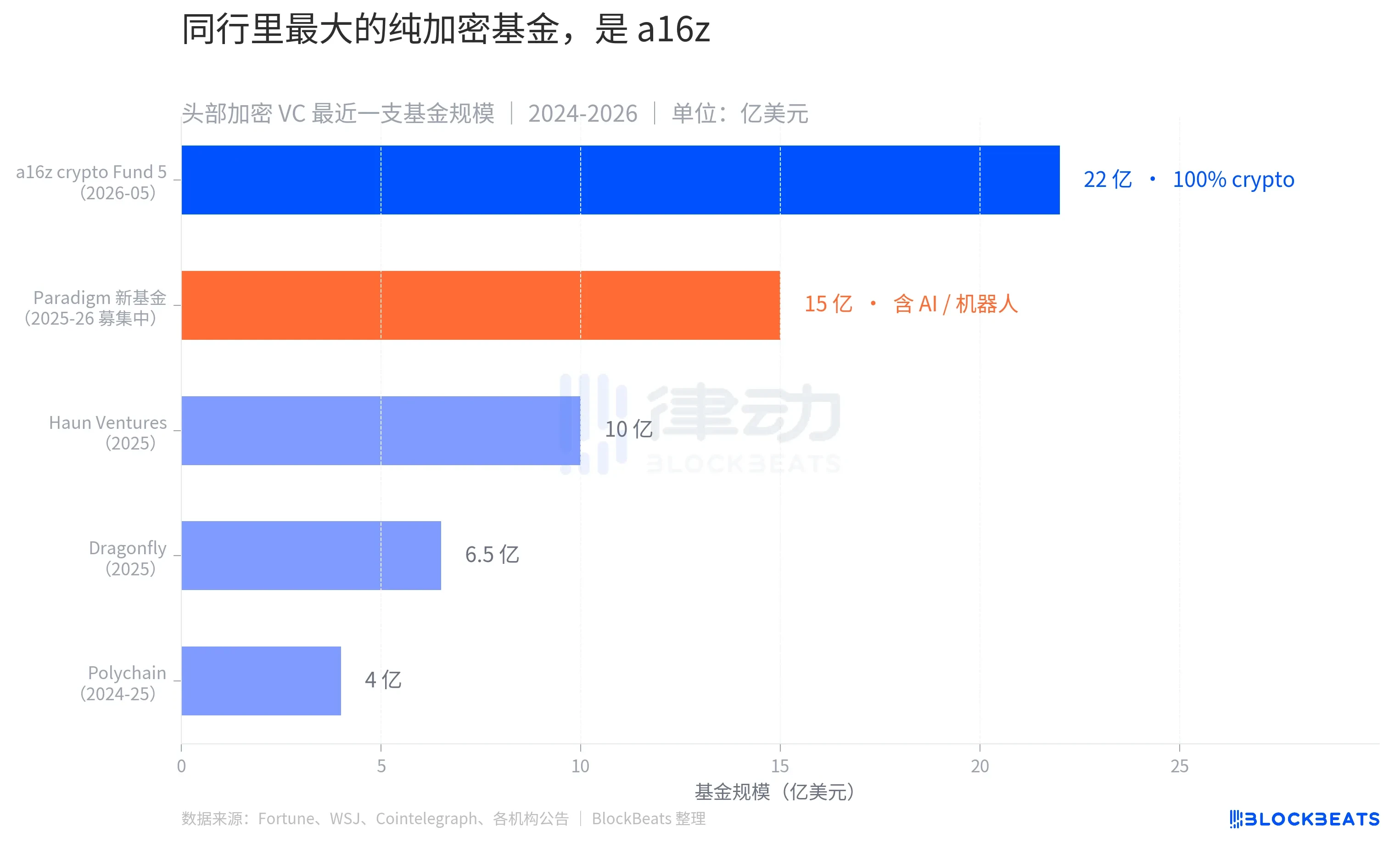
Paradigm, founded in 2018 by a former Sequoia Capital partner and a Coinbase co-founder, has long been considered a16z crypto's most direct competitor in the crypto space. Paradigm raised an $850 million early-stage fund, "Paradigm Three," in 2024 and subsequently announced a new fund targeting $1.5 billion. According to the Wall Street Journal, this new fund's scope has expanded from pure crypto to include AI, robotics, and other frontier computing. In other words, Paradigm's partners concluded that "focusing solely on crypto means missing too many opportunities."
a16z crypto's judgment was the opposite. On the day of the fund's announcement, a spokesperson told Fortune succinctly: "Fund 5 is 100% for crypto founders." In the VC context of 2026, this statement embodies conviction.
In 2024, for every dollar deployed by crypto VCs, 18 cents flowed into projects combining "AI + Crypto." By 2025, this figure more than doubled to 40 cents.
Behind the 40% figure lies a complete shift in capital allocation. According to a16z's January announcement titled "Why Did We Raise $15B," the parent company closed a new $15 billion fundraising round earlier in 2026. The breakdown includes Apps ($1.7B, AI applications), Infrastructure ($1.7B, AI infrastructure), Growth ($6.75B), American Dynamism ($1.176B), Bio ($700M), and Other ($3B, encompassing crypto, fintech, and enterprise software). Notably, "Crypto" is not listed as a separate category in this public breakdown. Fund 5's $2.2 billion was raised independently four months later.
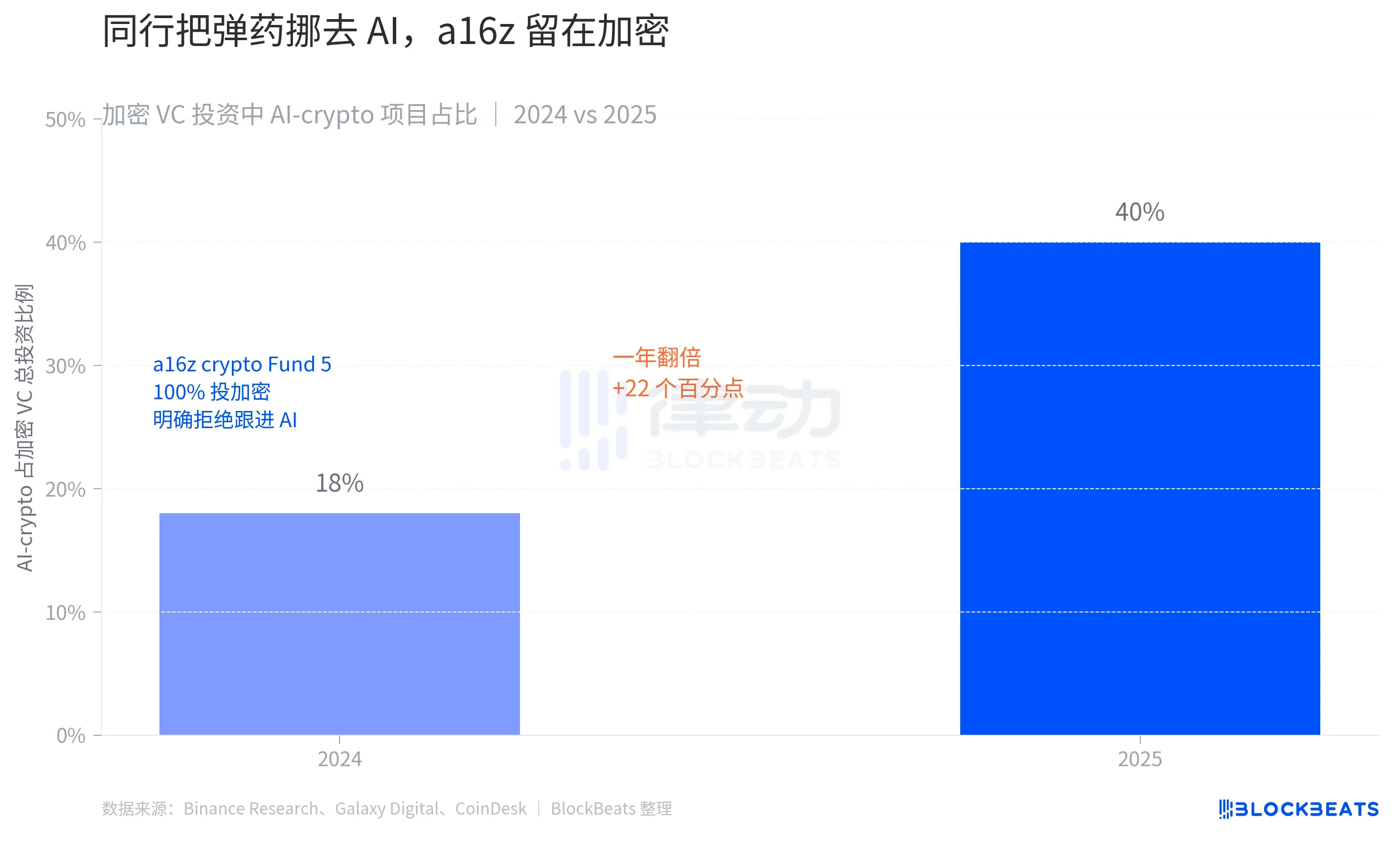
The parent a16z's assets under management expanded from $42 billion in May 2024 to over $90 billion by March 2026. Yet, the crypto division's share dropped from 11% during the Fund 4 era to 2.4% during the Fund 5 era. Internally, crypto has transitioned from "an independent vertical" to "a bet within the Other pool." The parent company's capital重心 has shifted away, leaving only the a16z crypto line determined to keep its ammunition focused on crypto.
This is Fund 5's true position. It represents a concentrated bet on crypto within the a16z ecosystem, halved in size from the previous fund, yet it stands as the sole remaining dedicated crypto fund within a parent company where crypto's allocation has been compressed to 2.4%. According to Fortune, investments from the later stages of Fund 4—Babylon (a protocol allowing Bitcoin holders to use BTC as collateral), Kairos (a cross-platform tool for prediction markets), and a $50 million investment in the Solana staking protocol Jito—serve as templates for Fund 5's deployment direction. As stated by Dixon and partners in the announcement, the deployment target is "to invest in the overlooked phases of the cycle, turning new infrastructure into products ordinary people use daily."
Only a16z itself remains committed to crypto with such conviction.