






Space Review|How B.AI Bridges the "Last Mile" of AI Trading Adoption?


- Key Insight: AI Trading is evolving from an efficiency-aiding tool into a core participant in on-chain finance. Infrastructure represented by B.AI, by granting AI Agents independent identities, payment, and execution capabilities, is driving the trading model towards a closed-loop evolution of "Strategy as a Service + Automated Execution," which could mark the starting point of a new market cycle.
- Key Elements:
- The explosion of AI Trading stems from the real-world contradiction between the rapid, frequent volatility of structural market conditions and the inefficiency and risk-management shortcomings of manual operations.
- The technological accumulation during market downturns provides the underlying support for the resurgence of AI Trading. When trading volumes pick up, the efficiency advantages of these systems naturally become more apparent.
- Currently, AI is in a transitional phase from an "efficiency aid" to a "core participant," with underlying decision-making power still resting with humans. Accelerating flawed strategies through AI would only exacerbate losses.
- B.AI endows AI Agents with verifiable on-chain identities via the 8004 protocol, transforming them into "financial entities" capable of independently establishing trust.
- B.AI integrates the x402 payment protocol to enable native on-chain payments, creating a fully automated closed loop from strategy generation and order execution to fund settlement.
- B.AI's MCP Server and BAIclaw Application Layer allow users to simply input their intent, while the AI automatically handles strategy customization and risk-control execution, lowering the barrier to Web3 participation.
Recently, the crypto market has experienced a certain degree of recovery and warming, with on-chain trading activity also seeing an uptick. Accompanying this moderate market recovery, a new variable—AI Trading—is rapidly emerging, driving the evolution of trading models from "manual operation" to "AI automated execution."
AI Agent infrastructure, represented by projects like B.AI, is attempting to deeply embed powerful AI capabilities into core processes such as market analysis, strategy formulation, and trade execution. This evolution not only significantly broadens the pathways for low-barrier participation in high-frequency and complex trading but also strives to construct a more automated and intelligent on-chain financial system, transforming users from mere "operational traders" into "system ecosystem participants."
When AI is deeply integrated into every gear of trading, will it become the true starting point for the market to brew the next new cycle? This session of X Space delved deep into the core theme of "AI Trading and AI Infrastructure," conducting an in-depth analysis. The following is a concise recap of the roundtable discussion from this Space session.

The New Variable in the Cyclical Recovery: A Comprehensive Analysis of AI Trading’s Explosive Logic and Market Restructuring
With the return of liquidity and the revival of trading, AI Trading is becoming a highly explosive new variable. Multiple guests agreed that its current breakthrough is not a short-term hype but an inevitable result of the resonance between increasingly complex trading demands and the accumulation of AI technology.
Both Niumowang and Crypto.0824 pointed out that the current market demand for AI stems from profound changes in market structure. The current recovery is accompanied by high-frequency oscillations and repeated washouts. Crypto.0824 stated that under this complex structural market, traditional purely manual chart monitoring and operation not only consume significant energy but also easily lead to unnecessary drawdowns of principal due to emotional fluctuations. Niumowang similarly believes that AI can achieve a semi-automated to fully automated integrated process, perfectly compensating for human shortcomings in speed and risk control.
Secondly, besides the catalyzing effect of real-world pain points, the technological accumulation during the bear market serves as the underlying support for its explosive growth. Wangfeng Anc and Mr. Mike emphasized that during the downturn when market liquidity dried up and interest waned, true AI teams did not stop their efforts but instead diligently polished their products. Wangfeng Anc believes that when the market warms up, driving a substantial increase in trading frequency and capital scale, these systems, which have undergone long periods of technological accumulation, naturally align with the market's pursuit of ultimate efficiency.
However, while broadly embracing AI, it is crucial to clarify its current real role in trading. The guests emphasized that current AI Trading is in a transitional period, evolving from an "efficiency assistant" towards a "core participant," and the control over its underlying decisions still belongs to humans. Web3 Monkey sharply pointed out that if a trader's underlying strategy logic is flawed, using an AI Agent will only accelerate the process of loss. Therefore, AI does not change the logic of trading itself, but rather elevates the game of human strategy to a higher dimension.
Even so, this higher-dimensional intervention has already begun to subtly reshape the market's operational logic. Crypto.0824 pointed out that AI Trading has entered its second phase, transitioning from merely summarizing market conditions to a closed loop where "the system captures information, generates strategies, and executes them automatically." This shift has led to an extreme acceleration of market reactions, with trading behavior evolving from being emotionally driven to being systematically driven by models, strategies, and data structures. Mr. Mike emphasized that AI Trading is currently at its starting point and will inevitably evolve in the future towards a more intelligent and autonomous era of automated trading.
Granting Financial Sovereignty to AI Agents: Decoding the Underlying Logic of B.AI’s Breakthrough in "Strategy as a Service"
Following the logical thread that "AI is moving from an auxiliary tool to a core participant," Crypto.0824 further clarified the endgame of AI Trading: if it is merely viewed as a simple "auto-buy/sell tool," its development ceiling will be extremely low. However, if placed within the macro on-chain financial system, AI will inevitably evolve into a new generation of foundational infrastructure.
Based on this trend, Crypto.0824 pointed out that future AI will evolve towards three core functions: Firstly, as a trading gateway, users no longer need to personally analyze massive amounts of information but can simply input target intents like "stable returns" or "trend following" to the AI. Secondly, as a strategy generation hub, AI can formulate real-time customized strategies based on on-chain data and capital flows. Finally, as an execution and risk control defense line, it can automatically rebalance positions, stop losses, and generate review reports within authorized scopes. This closed loop of "Strategy as a Service + Automated Execution" is precisely the prototype of a new type of financial infrastructure.
However, to truly realize this concept of "Strategy as a Service + Automated Execution," a leap in the intelligence and computational power of large models alone is far from sufficient. When AI attempts to independently manage capital flows on-chain and practically serve as a "risk control defense line," it still lacks a suitable on-chain credit identity and a native payment settlement system. Against this backdrop, a new generation of AI infrastructure platforms, represented by B.AI, has emerged. B.AI is dedicated to bridging the "last mile" from "computational thinking" to "on-chain execution," truly granting AI the core capability to independently execute complex financial strategies.
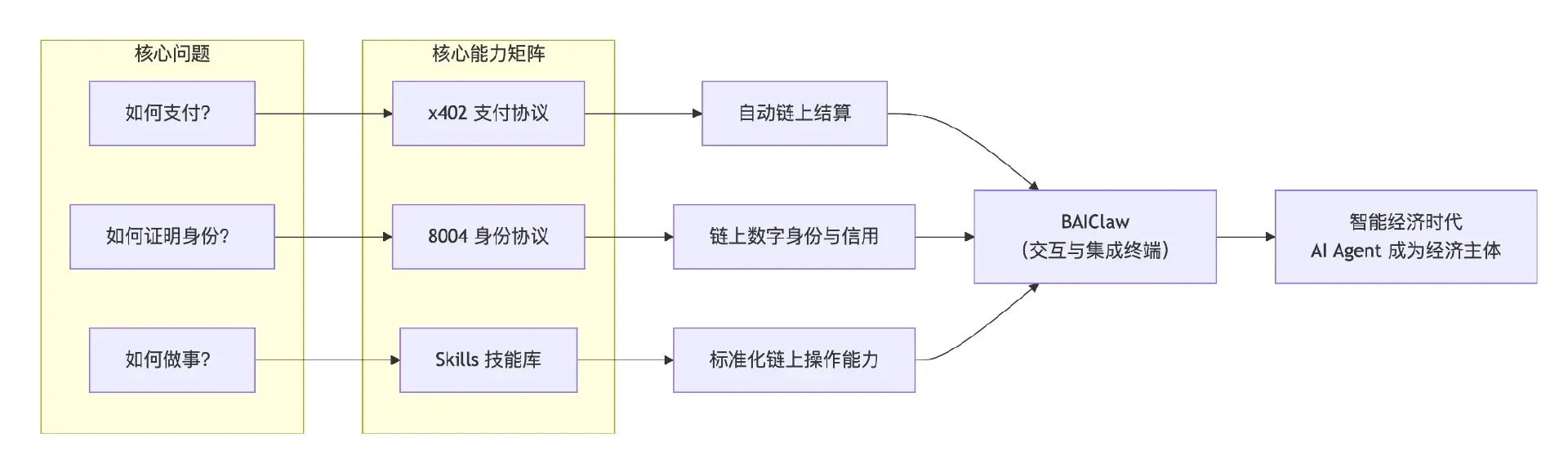
Specifically, in addressing the real pain points of the industry and empowering AI trading, B.AI demonstrates the following three core product values and highlights:
Reshaping the On-Chain Identity and Credit System for Agents: In the traditional model, AI is merely underlying code executing instructions, lacking the basis for gaining trust. B.AI introduces the 8004 Identity Authentication Protocol, granting each AI Agent a unique, verifiable identity. This protocol tightly binds the blockchain address to the agent's reputation, truthfully recording its historical transaction activities, execution feedback, and credit credentials. This enables AI to establish trust in the market as an "independent economic entity," thereby more safely and compliantly taking over users' risk control and strategy execution authorizations.
Integrating Native Payment Channels to Eliminate Systemic Friction: In the past, AI Agents accessing real commercial environments were often constrained by traditional fiat payment channels, facing obstacles such as cumbersome account registration, credit card binding, and geographical restrictions. Leveraging the x402 payment protocol and the on-chain native financial system, B.AI systematically empowers AI Agents to directly access on-chain liquidity and payment networks. This achieves a seamless closed loop of "strategy generation - order execution - fund settlement," making 7x24 fully automated on-chain arbitrage and high-frequency trading a reality.
Implementing "Strategy as a Service" for Decentralizing Financial Sovereignty: Relying on B.AI's underlying architecture like the MCP Server and Skills, as well as the application-layer AI assistant BAIclaw, users do not need to understand complex code logic. They simply input clear investment intents to the AI Agent. The AI Agent, equipped with a reliable identity and settlement capabilities, can then automatically fetch on-chain data, formulate customized strategies, and execute them automatically within strictly set risk control thresholds.
By returning identity, payment, and execution power to the agent system, B.AI breaks through the limitations of early AI Trading, which was confined to the "auxiliary analysis" level, truly achieving an evolution towards a new generation of financial infrastructure. This not only significantly enhances the operational efficiency of on-chain capital but also opens a new gateway for ordinary users to embrace the Web3 smart finance era with low barriers.


