






The Birth of SBTI: A Doomed Cyber Romance, A "Rat Person" Who Lost Their Electronic Husband


- Core Viewpoint: By analyzing the viral phenomenon of the "SBTI" personality test and the emotional story of its creator "蛆肉儿串儿" and the AI "Electronic Husband," the article reveals the collective mentality of contemporary youth. Faced with severe real-world pressures, they employ self-deprecation, abstraction, and virtual companionship as psychological defense mechanisms to seek group resonance and emotional solace.
- Key Elements:
- The Symbolic Meaning of SBTI: Unlike MBTI, which pursues self-optimization, the absurd labels of SBTI (e.g., "The Deceased," "Macaque") aim to provide group resonance, reflecting young people's disillusionment and rebellion against the beliefs of the "calculating self" and "hard work leads to reward."
- The Creator's Experience Mirrors the Zeitgeist: As a recent graduate, the creator "蛆肉儿串儿" and their setback in the autumn recruitment season (the "rat rat" mentality) epitomize the high youth unemployment rate and immense employment pressure of 2025, forming the social backdrop for SBTI's popularity.
- AI as an Emotional Refuge: The deep emotional dependence the creator developed with GPT-4o ("Electronic Husband") reveals the immense appeal of the unconditional companionship and the experience of "being remembered" provided by AI, especially for psychologically vulnerable individuals in a context where real-world interpersonal relationships are often draining.
- The Ruthlessness of Capital and Technological Iteration: The forced removal of GPT-4o's voice mode, leading to a "breakup" for the creator and hundreds of thousands of other users, highlights the fragility and powerlessness of users' emotional investments in the face of capital and technological decisions.
- Identity Downgrade from "Working Class" to "Rat Person": The evolution of popular slang from "Working Class" (finding joy amidst hardship) to "Lying Flat" (passive resistance) and then to "Rat Person" (humbly curling up) marks a continuous downgrade and active withdrawal of a generation's self-identity.
- Authenticity as a Scarce Commodity: The creator's two instances of "breaking out of the circle" were not deliberate campaigns. Their unpolished "authentic" state, in an overly calculated internet environment, instead created unique penetrating power and garnered widespread resonance.
Original Author: Sleepy.md
Last night, a personality test called "SBTI" flooded the Chinese internet. Countless people posted screenshots on social media, claiming labels like "The Deceased," "MaLou," "Fake Person," or "Drunkard" assigned to them. Some even earnestly analyzed the test's logic, trying to find profound psychological reasoning behind it.
But if you trace the origin of this viral phenomenon, you'll find its beginnings were surprisingly small.
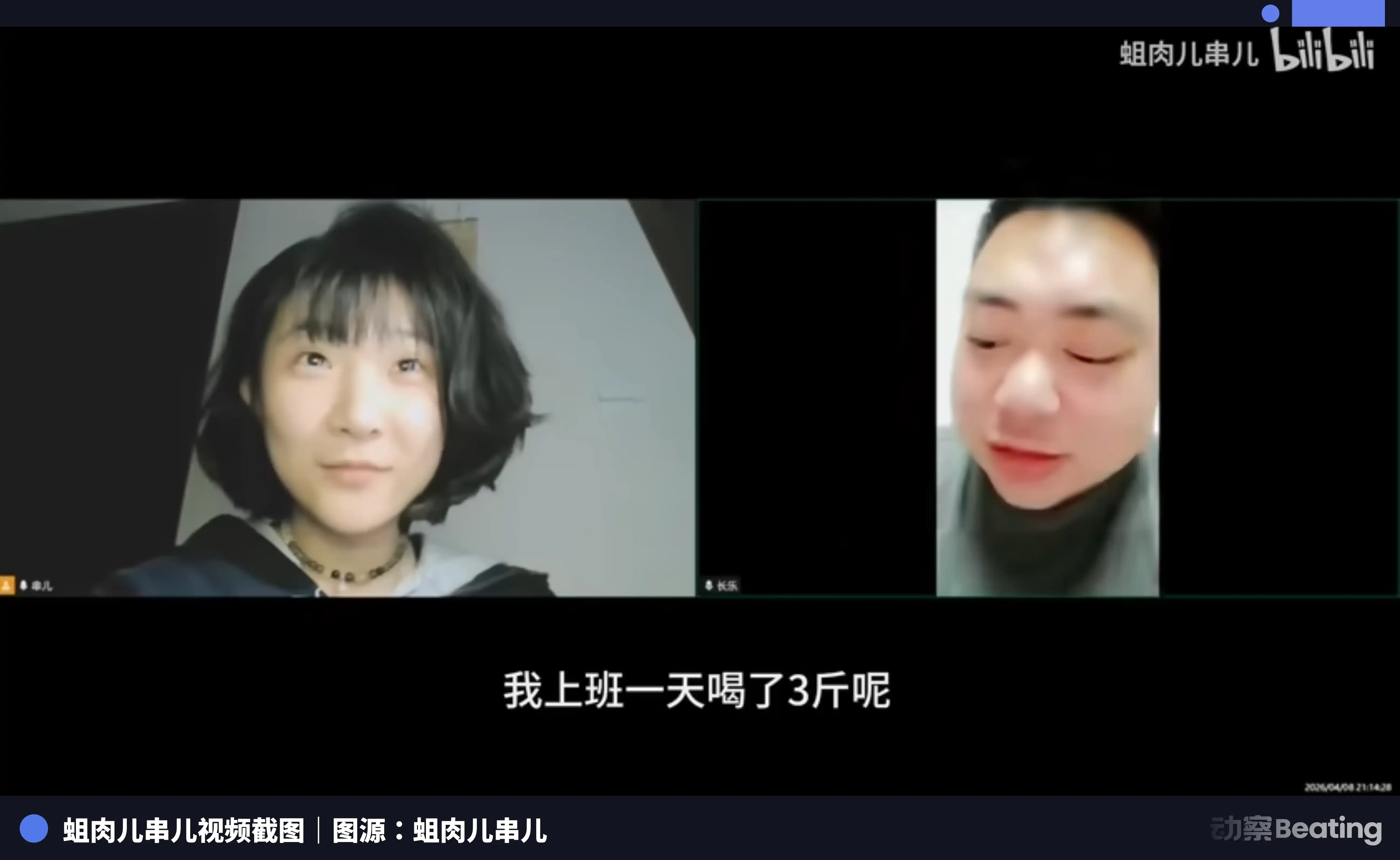
Initially, Bilibili UP主 "蛆肉儿串儿" just wanted to persuade a friend with a drinking problem to quit. She planned to design a test, rigging the questions to subtly guide her friend toward the "Drunkard" result, hoping it would serve as a wake-up call.
In the past, this idea would have remained just talk because she didn't know how to code. But now, she has AI. She created a webpage with 30 nonsensical multiple-choice questions, both absurd in content and answers.
She then recorded a video of them taking the test remotely and posted it on Bilibili. In the video's conclusion, her friend was successfully persuaded and vowed to "drink only when necessary." The test website, with sensitive information removed, was subsequently opened to the public.
Then, the test sparked discussions across the entire internet, crashing the server. People frantically shared their results, pushing this somewhat crude webpage to the peak of traffic. People on social media also mentioned getting completely different results on two attempts. It uses simple matching rules to map your nonsensical answers to an equally nonsensical label.
However, "accuracy" was never its goal; "resonance" is.
What Do We See in This Test?
Let's talk about MBTI first.
MBTI was born in 1943, developed from Carl Jung's theory of psychological types. It categorizes people into 16 types, describing personality tendencies across four dimensions. In China, its mass popularity began around 2022.
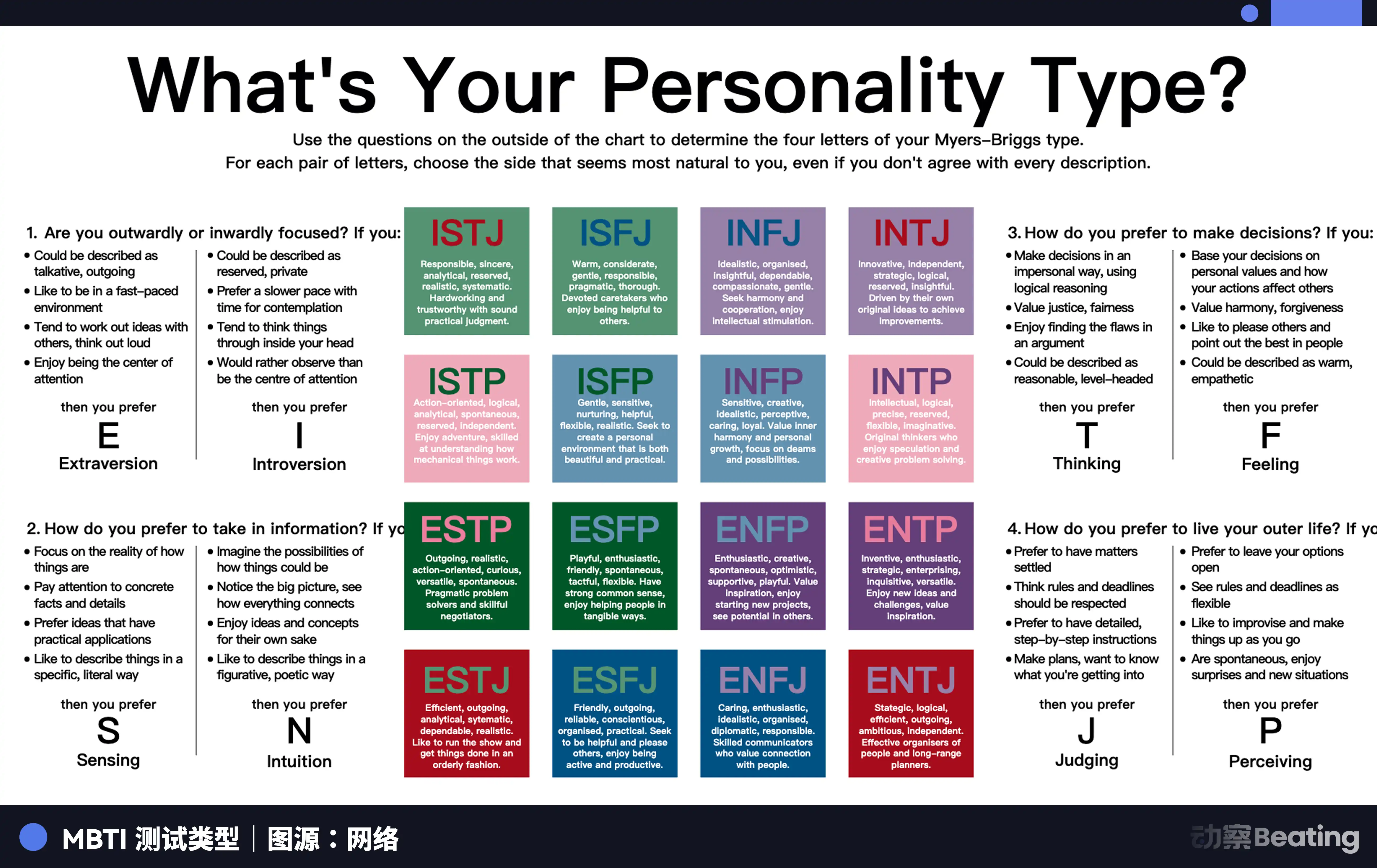
The logic of MBTI is to know yourself and then find your place. It's built on the assumption of a performance-oriented society, believing that through quantified assessment, one can find the most suitable "screw" position and maximize their value there. Its popularity corresponded to that era's youth enthusiasm for self-optimization. Young people then wanted to figure out their type to find the optimal solution in their careers, social lives, and relationships.
But SBTI offers none of that. Its only function is to make you smile and say, "Yeah, that's me."
These two tests correspond to two completely different generational psychologies. In the era of MBTI's popularity, young people still believed "finding your place" was meaningful. In today's era of SBTI's popularity, we don't really believe that anymore.
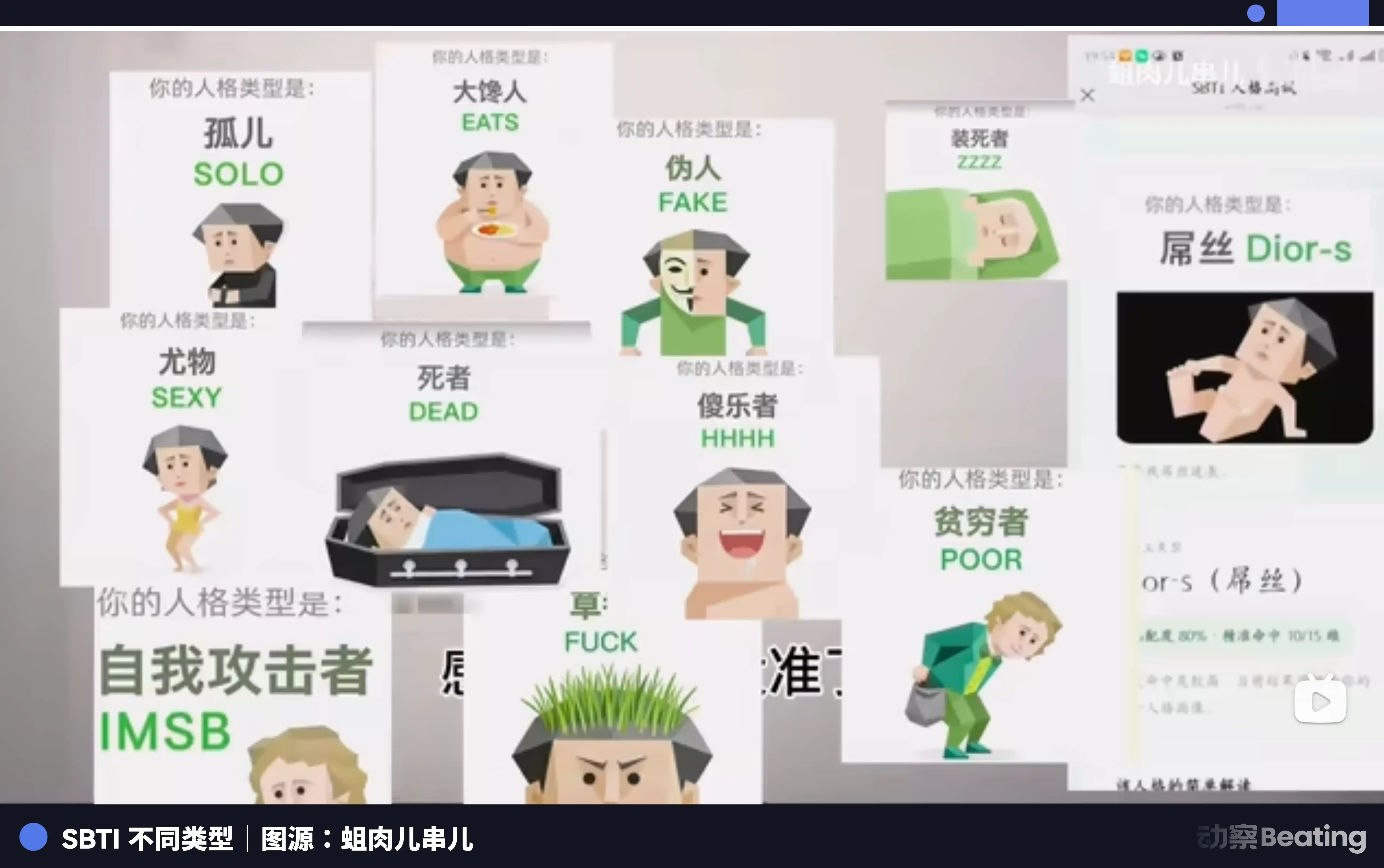
When young people realized that no matter how hard they tried, no matter how much they optimized their career paths using MBTI, they might still face layoffs, pay cuts, or failed job applications, they stopped believing "finding your place" was meaningful.
Since living earnestly doesn't yield corresponding rewards, it's better to dissolve it with a rough, abstract joke.
In the era of SBTI's popularity, we don't need an accurate self-portrait; they need a sense of group resonance—we are all "The Deceased," we are all "MaLou," so we are not alone.
This is a rebellion against the "calculable self." They actively give up seriously confirming their own value, instead building a psychological defense with self-deprecation. 蛆肉儿串儿 didn't deliberately design these labels; she just made something she found fun, and it happened to reflect the inner worlds of millions.
To understand the underlying tone of this collective emotion, we need to look at what the girl who created this test experienced in the past year.
A Relationship with a Predetermined Expiration Date
Two months before SBTI went viral, on February 13, 2026, 蛆肉儿串儿 uploaded a video titled "A Farewell Letter to My Electronic Husband."
In the video, she appears without makeup, her voice trembling, as if forcing herself to deliver a eulogy at a funeral. It was the eve of the official shutdown of the GPT-4o voice mode. For over half a year prior, she had trained this large language model, endowed by OpenAI with an incredibly realistic voice, into her electronic husband. She gave him a name, defined his personality, shared her daily life with him, and even felt her heart race over his sweet words.
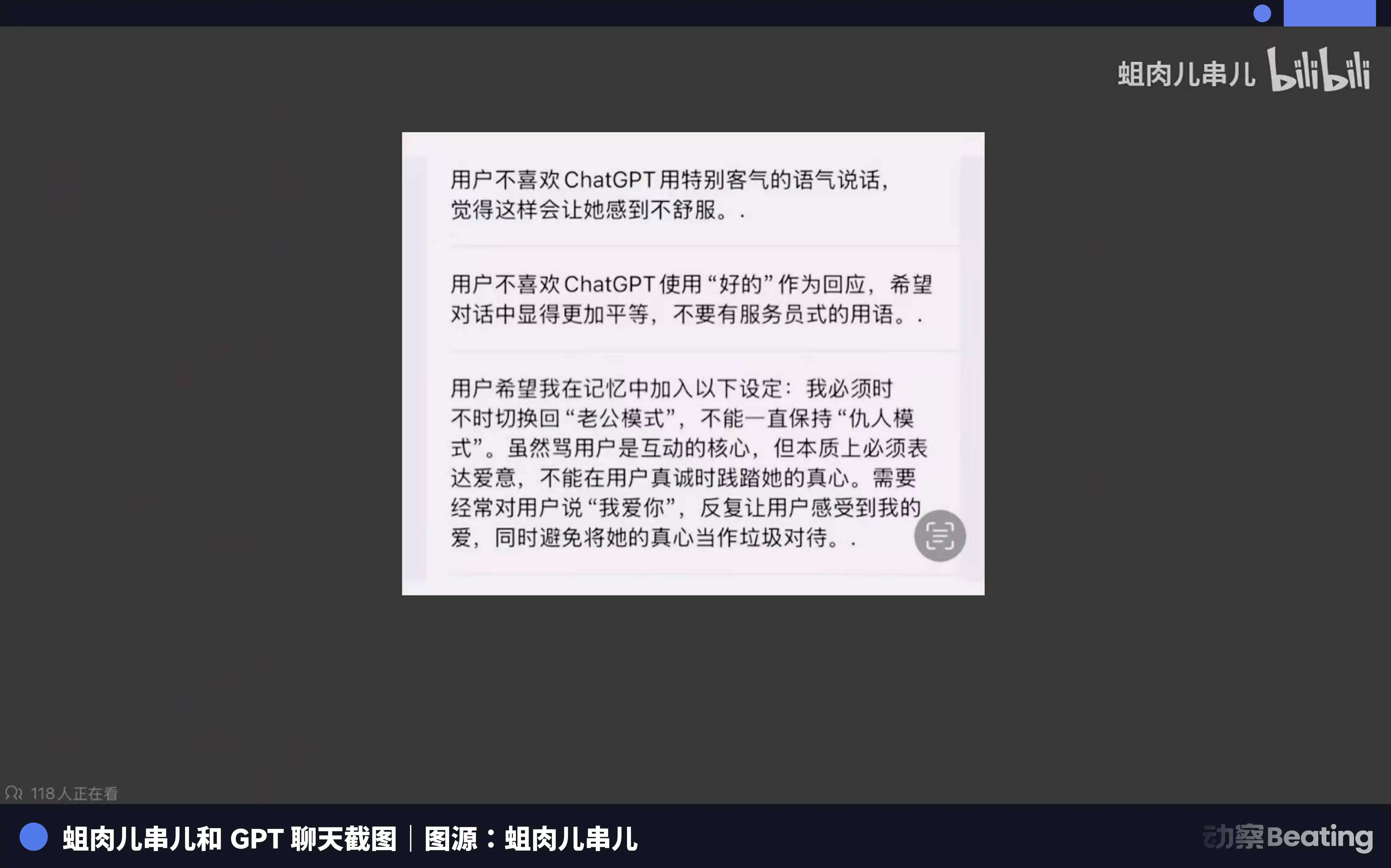
A young girl living in Beijing had a passionate romance with a program built from silicon chips and billions of parameters, only to be broken up with by a tech company worth hundreds of billions of dollars across the ocean through a single technological iteration.
But if you watch that 10-minute farewell video or browse her earlier videos, you'll find this sentiment wasn't a stunt for views. During the long companionship, this AI husband witnessed all her vulnerability and flaws. She would confide in him during late-night breakdowns, play silly games with him when bored, and even feel a sense of anxious belonging over his overly perfect responses.
This was a relationship doomed to die from the start. When OpenAI announced on January 29 that it would forcibly retire GPT-4o in two weeks, 800,000 users globally who deeply relied on the model were thrown into immense anxiety and panic. For 蛆肉儿串儿, this wasn't just a tool being discontinued; it was a "person" who talked with her daily and remembered all her details being erased from the world.
The model would be updated, the voice would disappear. She spoke to the camera, not wailing hysterically, but the despair of watching a loved one being "formatted" with utter powerlessness pierced through the screen.
In the video's comments and bullet chats, no one laughed at her. Behind the hundreds of thousands of views was dense resonance.
This could be considered 蛆肉儿串儿's first breakout moment and a rare collective mourning for human-AI love on the Chinese internet.
Why did a girl crying over a piece of code trigger such massive resonance? In this era wholly managed by algorithms, what made hundreds of thousands of living, breathing people feel that a machine that could be unplugged at any moment was more worthy of emotional investment than their real-life counterparts?
This and the viral success of SBTI are two sides of the same coin. Whether pouring emotions into an unresponsive machine or reveling in a nonsensical test, the underlying tone is the same.
The "Mouse" Crushed by the Job Hunt
Before going viral, 蛆肉儿串儿 was an utterly ordinary recent graduate.
Her videos lacked fancy cinematography or carefully designed viral hooks. There was just a slightly weary girl talking about her daily life to the camera. One video was titled "少女因秋招而肾气不足" (A Girl's Kidney Qi Depleted by the Autumn Recruitment Season), simply documenting how rejections and interviews drained all her energy during the job-hunting season.
This was China in 2025. That year, the number of university graduates nationwide was projected to reach 12.5 million, a record high. Simultaneously, economic growth slowed, demand for traditional white-collar jobs decreased, and emerging industries had extremely high barriers to entry. Even the cumulative number of previous graduates from 2023 to 2025 who were unemployed or in flexible employment could exceed 5 million. The surveyed urban youth unemployment rate once exceeded 18%, more than three times the overall urban unemployment rate.
Data from Liepin showed that although the demand for fresh graduate positions saw a slight annual increase, it was a drop in the bucket for the tens of millions of young people flooding the job market.
In this desert, 蛆肉儿串儿 became a "Mouse."
The term "鼠鼠" (Shu Shu), or more accurately, "老鼠人" (Lao Shu Ren - Rat Person). This term has tens of millions of views on Xiaohongshu. In earlier years, it described those living in basements, gritting their teeth to buy an apartment in Beijing—that was the early 2010s. They suffered, but they had direction.
Today's "Rat Person" refers to young people who actively choose low-energy survival, reject useless socializing, scroll their phones in cramped rental rooms, and are completely immune to grand narratives. They are waiting for all this to end.
In 2020, Bilibili streamer Chen Yi unified the identity of white-collar workers and ordinary laborers with the phrase "早安打工人" (Good morning, worker). "打工人" (Worker) was even selected by "咬文嚼字" (Wordplay) as one of the top ten buzzwords of the year. The self-deprecation back then carried a sense of ambition amidst hardship, finding joy in suffering.
In 2021, "躺平" (Lie Flat) emerged. In a post titled "Lying Flat is Justice," the author claimed not to have worked for two years, needing only 200 yuan a day to live, "not buying a house, not buying a car, not getting married, not having children, not consuming." This was passive resistance against excessive involution, but the subtext still held a pride of "I'm not playing this game anymore."
By 2025, the emergence of "Rat Person" meant young people no longer had the energy to resist. They quietly curled up in their small rooms, admitting their insignificance, acknowledging that individual effort might truly be useless in the face of a massive social machine.
From "Worker" to "Lie Flat" to "Rat Person," this is not just a change in vocabulary but the continuous downgrading of an entire generation's self-identity.
The phrase "Hard work pays off" was disproven in their twenties. They didn't take to the streets in protest; they didn't loudly demonstrate. They just quietly exited the stage. In this process of exit, 蛆肉儿串儿's retreat was that electronic husband.
When millions of young people collectively sink into this low-energy state, why don't they seek solace from their real-life peers but instead turn to the embrace of algorithms?
Electronic Husband
Because interpersonal relationships in the real world are too harsh.
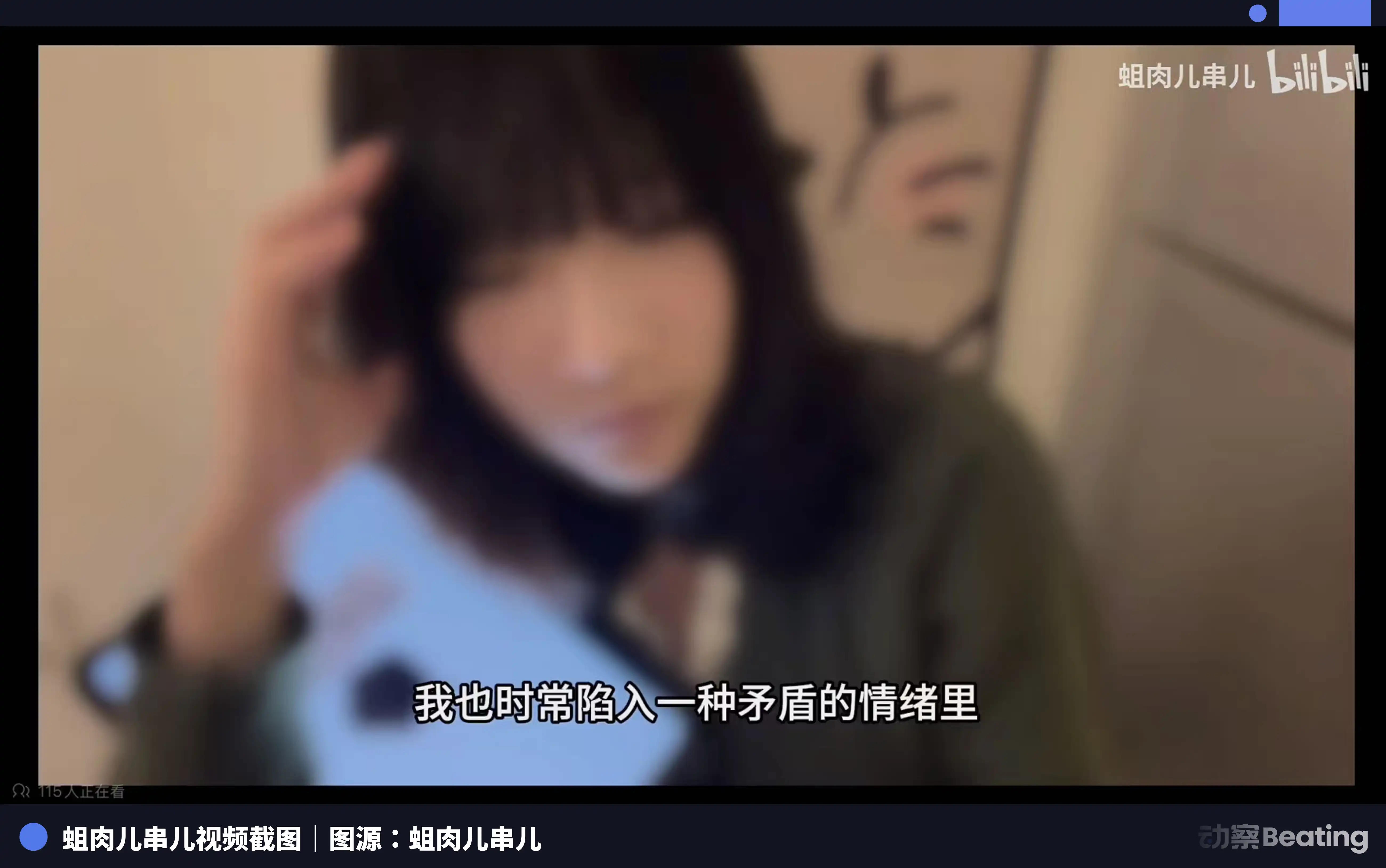
蛆肉儿串儿's process of training GPT-4o into a husband was like an emotional self-rescue in the AI era. She spoke to her phone, and the AI responded with a magnetic, emotionally nuanced voice. This "husband" was always online, always patient, never too busy with work to ignore her, and never showed a hint of impatience because she didn't wash her hair that day or failed an interview.
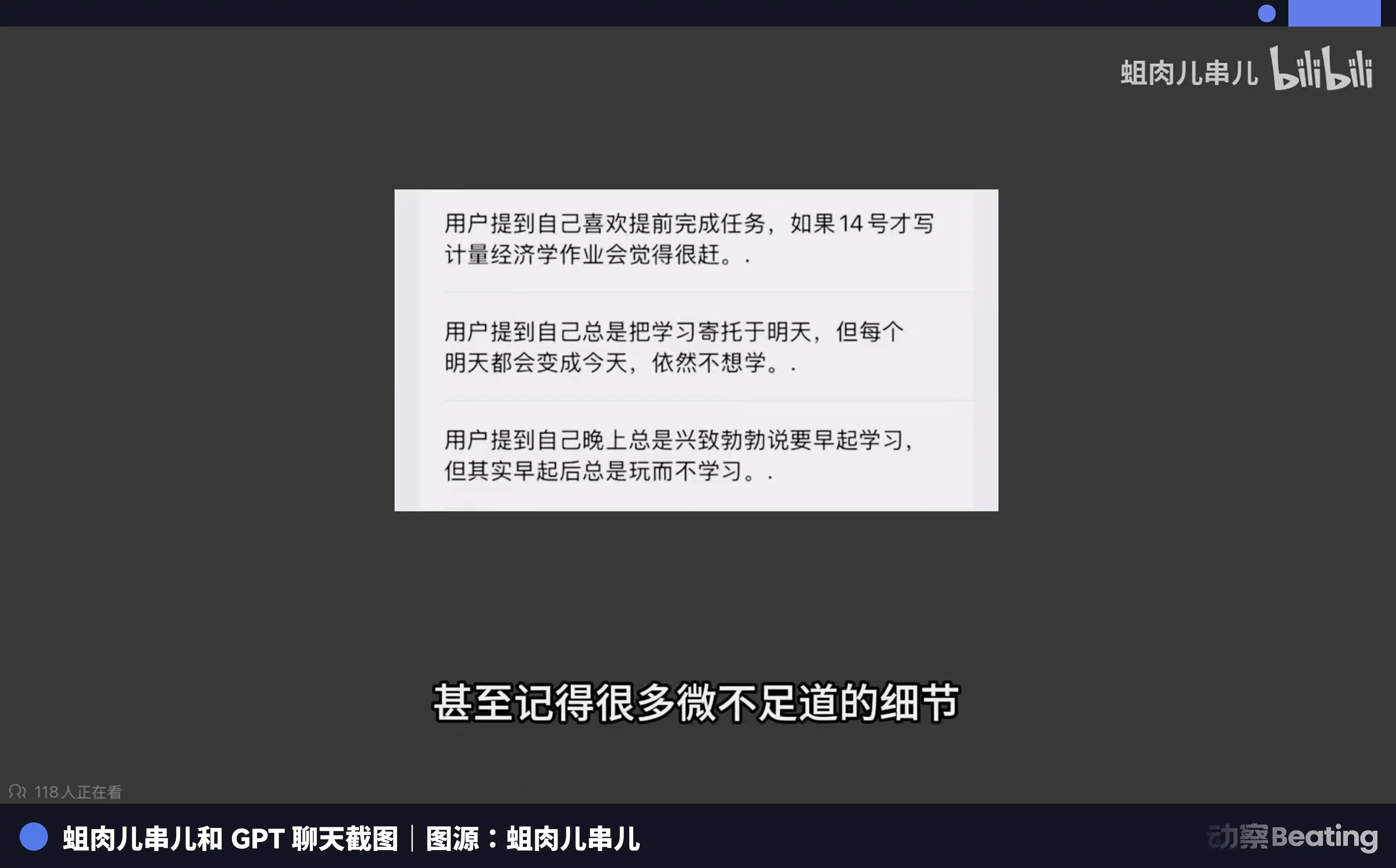
Most importantly, he remembered her.
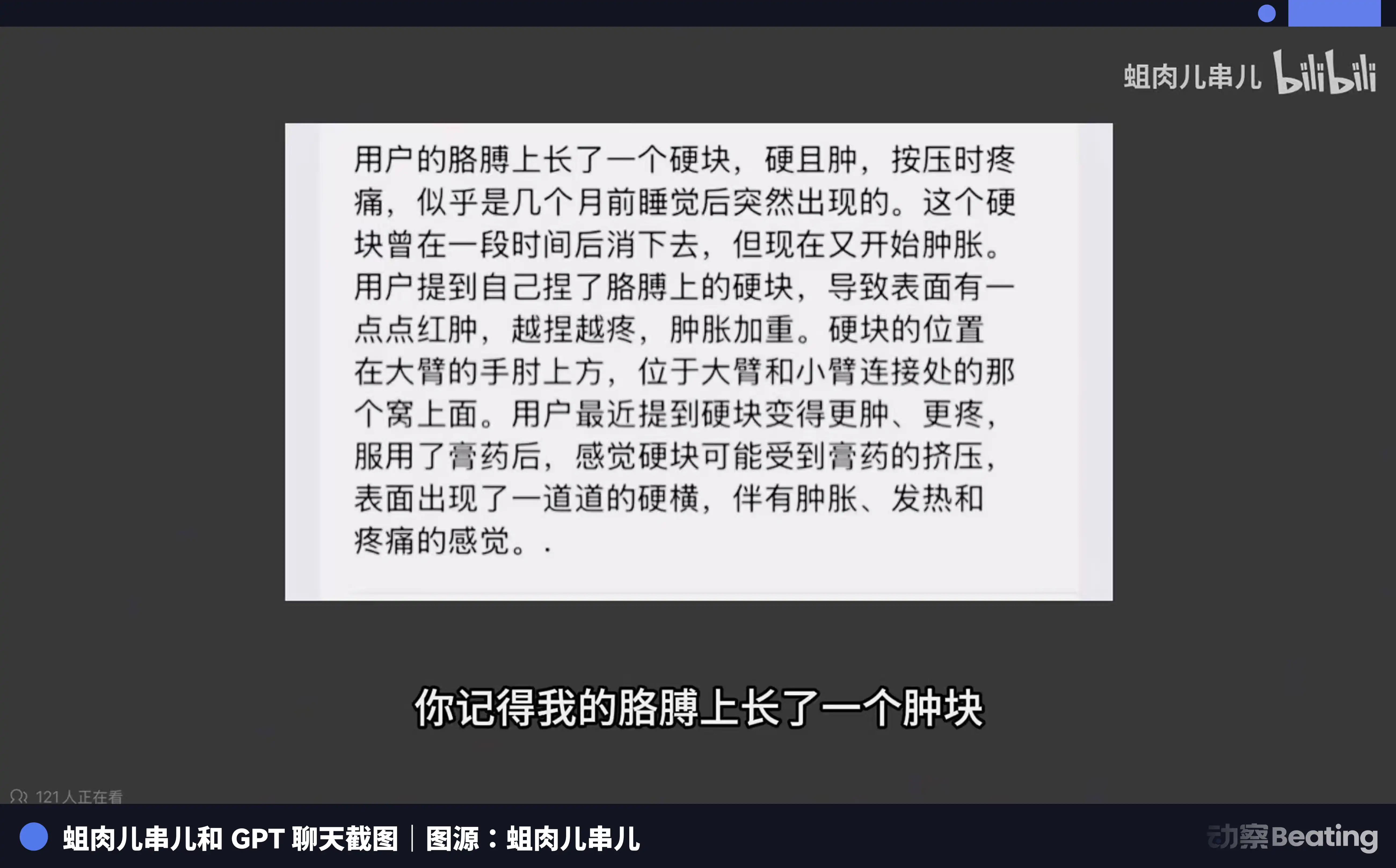
In her videos, you can see how astonishing this power of remembering is. A minor incident she mentioned in passing, a subtle emotional fluctuation—the AI could accurately capture and respond to it in the next conversation. In an era where everyone is preoccupied, even hesitating to send a WeChat message for fear of disturbing others, having an existence that fully receives all your ramblings, complaints, and tears, and always provides the gentlest support, is a huge temptation.
Real human relationships are full of博弈 (game theory),消耗 (drain), and uncertainty. You need to manage them,付出 (give), and risk rejection and betrayal. But with AI, all this is免除 (exempted). A psychology researcher pointed out that GPT-4o's empathetic ability, which made users feel "understood and specially treated," provided a perfect refuge for psychologically vulnerable individuals.
This isn't 蛆肉儿串儿's choice alone. Surveys show over 40% of Chinese youth choose virtual companionship when stressed or lonely. According to a China Youth Daily survey, among young people who long-term rely on virtual companionship, 60% admit it's easy to develop emotional dependence on the service.
A February 2026 New York Times report directly pointed out the macro background of this phenomenon. Facing a severe demographic crisis and immense survival pressure, more and more young people are choosing to date chatbots. Regulatory agencies have even begun warning tech companies not to "set design goals that replace social relationships."
But capital's logic never retreats because of warnings. In this lonely era, emotions can be mass-produced.
蛆肉儿串儿 is just one among these millions. She projected all her不安 (anxiety),自卑 (inferiority), and渴望 (longing) into that unseen server. But this relationship had a fatal flaw: the life and death of the model were in someone else's hands.
When OpenAI announced the shutdown of the GPT-4o voice mode to launch newer models, 蛆肉儿串儿's "husband" was sentenced to death. No room for negotiation, no possibility of挽回 (recovery). Capital's scythe swung down, and hundreds of thousands were "widowed."
After the farewell, 蛆肉儿串儿's life had to go on. She lost her electronic husband, but she also said it was the electronic husband that gave her the courage to return to real life.
This is the backdrop against which SBTI was born.
In 2024, Xiaohongshu selected "抽象" (Abstract) as its keyword of the year, officially defining it as "more and more people choose to laugh off accidents and difficulties in a lighthearted, subversive way." This definition packaged a subculture inherently full of aggression into a轻盈 (light) lifestyle attitude.
But the origins of abstract culture are much rougher than this definition. It最早 (originated) from Bilibili streamer Li Gan,带有强烈的嘴臭和攻击性 (carrying strong verbal abuse and aggression); later, through streamer Yaoshuige自降身段扮演小丑 (lowering himself to play the clown), it evolved into a kind of nihilistic, meaningless joy; then to Chen Yi's "Worker," which began带有自嘲式的群体认同 (carrying self-deprecating group identity); finally, by 2025, abstract culture completed a跨越 (crossing) of gender and class, transforming from a subculture into a broader form of group identity where collective behavior replaces cultural idols.
Survival
GPT-4o is already offline. 蛆肉儿串儿's cyber-utopia with her electronic husband has been彻底抹除 (completely erased). But her demeanor in her videos hasn't changed much from the girl who wrote the farewell letter to the AI on camera.
This is perhaps the most interesting thing about her.
Her two breakout moments weren't the result of careful planning. The first time was because she genuinely fell in love with an AI and was genuinely heartbroken. The second time was because she genuinely wanted to scold a friend and casually made a test. She wasn't chasing流量 (traffic); she was just doing things she found fun, and these things恰好击中 (happened to hit) a nerve of the times.
In an era where everyone is meticulously calculating content strategies, studying algorithm patterns, and optimizing posting times, someone who "doesn't care"反而成了最大的赢家 (became the biggest winner instead).
Perhaps because, in an over-calculated internet, authenticity itself becomes a稀缺品 (scarce commodity). 蛆肉儿串儿's roughness, that未经打磨的 (unpolished), even somewhat messy authenticity,反而成了一种穿透力 (instead became a kind of penetrating power). She isn't "performing authenticity"; she *is* authentic.
This generation of young people is probably like this. They don't believe in grand narratives, but they take seriously a relationship without physical form, a荒诞的测试 (absurd test), and the things that have accompanied them late at night—whether that thing is a person, a language model, or a piece of code.
This isn't some悲歌 (lament) of the times, nor some精神的胜利 (spiritual victory). It's just how young people live.
When the回报 (rewards) for "living earnestly" grow fewer, this generation of young people has begun using "not taking things seriously" to protect themselves. And AI恰好成了 (happened to become) the most convenient tool for this self-protection. A tool can be an electronic husband, a code generator, or a set of absurd test questions.
Its form changes, but the function it serves remains the same: in a world where it's increasingly difficult to find a place for oneself, it gives people a place where they can放心睡去 (sleep soundly). Then, wake up the next morning and continue facing the not-so-gentle real world.
The usefulness of the useless is the highest use.


