A "Targeted Blast" Flash Loan Attack Exposes Structural Cracks in Stablecoin Liquidity


- Core Insight: The flash loan attack on the DUSD/USDC pool on Curve in early 2026 reveals that under the combined effects of oracle dependency, concentrated liquidity, and DeFi composability, a local liquidity pool can become a "single point of failure" for systemic risk, rather than an issue with the stablecoin protocol's inherent security.
- Key Elements:
- The attacker borrowed approximately $280 million USDC via a flash loan, manipulated the pool's price to create an illusion of sufficient liquidity, and ultimately drained assets worth about $4.2 million (approximately 1,299 ETH).
- The attack scope was limited to a single Curve liquidity pool, not affecting DUSD's minting/redemption mechanism or its holders; losses were entirely borne by that pool's liquidity providers.
- The attack leveraged the characteristics of flash loans—requiring no upfront capital and enabling instantaneous operations—and exploited the time-lag vulnerability in oracle price responses, constituting a typical instantaneous price distortion attack.
- The issuer, Makina Finance, responded swiftly post-incident, contained the impact, and initiated recovery and redemption plans for affected LPs, demonstrating improved crisis management capabilities.
- The event contrasts with the trading pair's previous history of high liquidity, reaching a TVL of $129 million, indicating that liquidity depth itself does not equate to security, and highly concentrated capital pools are more susceptible to becoming attack targets.
- This incident highlights the structural challenges brought by DeFi composability, where a local failure can disproportionately impact specific user groups (e.g., LPs).
Event Overview
In the early hours of January 20, 2026, a highly precise flash loan attack drained approximately $4.2 million from the DUSD/USDC liquidity pool on Curve, marking it as one of the most technically targeted stablecoin attacks in early 2026. This attack did not target DUSD's core minting or redemption mechanisms but instead focused on a single liquidity venue. It clearly revealed how systemic risk can be rapidly amplified in a localized manner when oracle dependencies, liquidity assumptions, and DeFi composability intersect.
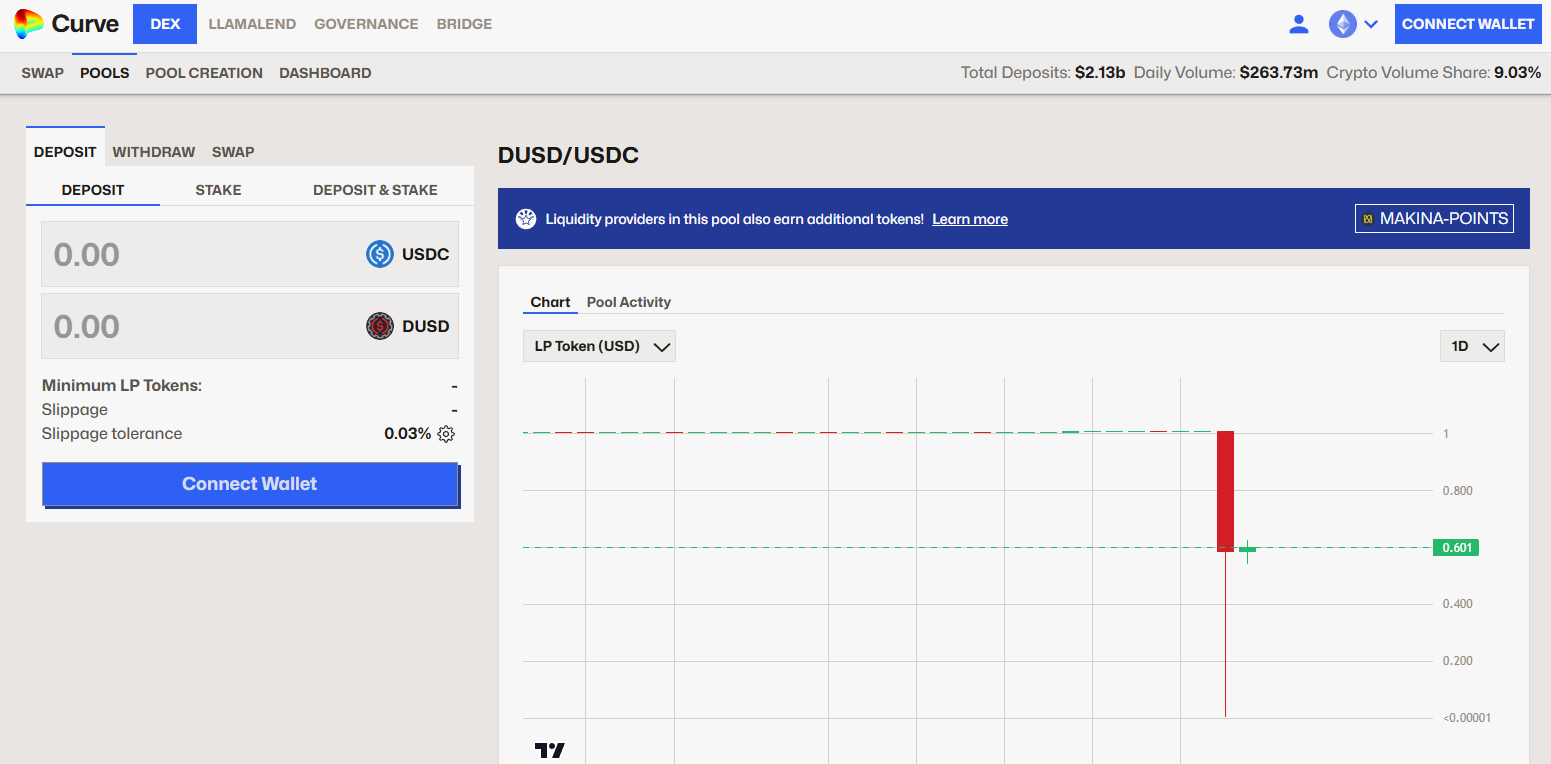
DUSD is a stablecoin issued by the multi-chain DeFi execution engine Makina Finance. According to post-incident disclosures, the attacker borrowed approximately $280 million worth of USDC via a flash loan, manipulated the price inputs related to the pool within an extremely short timeframe, artificially inflated the book value of liquidity positions, and executed arbitrage before the system could recalibrate, ultimately transferring out all assets equivalent to about 1,299 ETH from the pool.
It is crucial to emphasize that this incident did not affect DUSD's overall supply nor impact users who simply held DUSD, Pendle, or Gearbox positions. Makina clarified this boundary immediately after the event. However, the speed and precision of the attack still indicate that even seemingly well-isolated liquidity pools can become a "single point of failure" under conditions of highly concentrated capital and time lags in oracle responses.
How the Attack Was Executed
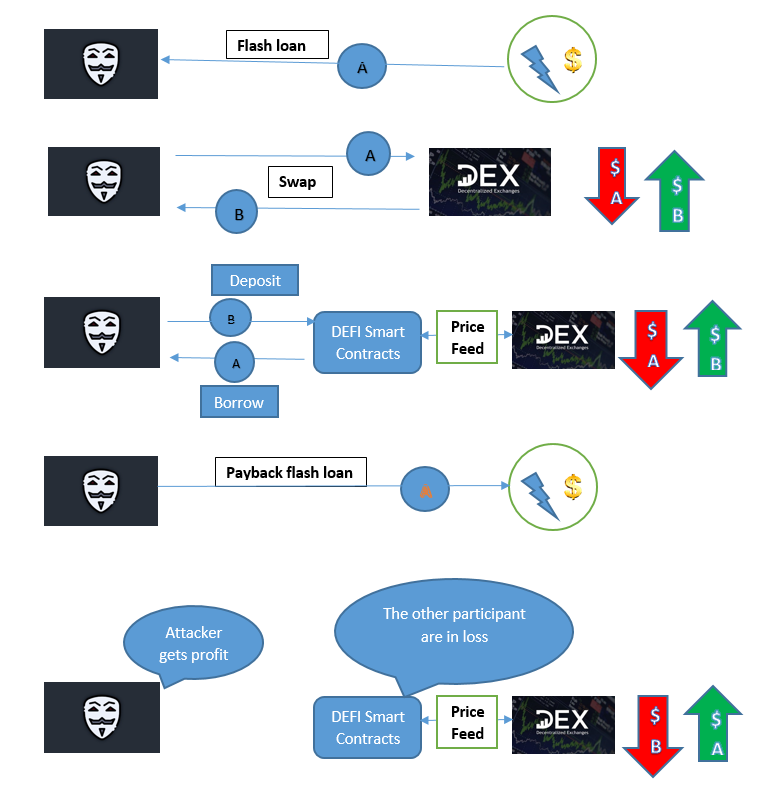
From a technical perspective, this attack followed a pattern familiar to DeFi security researchers in recent years but was executed with greater restraint and focus. The attacker used a massive, instant injection of USDC to distort the price structure of the DUSD/USDC pool, causing dependent logic within the same block to make erroneous judgments, thereby creating an illusion of "sufficient liquidity" to enable risk-free arbitrage.
Since flash loans require no upfront capital and must be repaid within the same transaction, the attacker bore almost no directional risk. The core tactic lay in price manipulation across the time dimension. This type of vulnerability has repeatedly appeared in various DeFi scenarios, especially when liquidity pools rely on single or short-term price signals rather than time-weighted or multi-source aggregated data, making them more susceptible to exploitation during brief imbalances.
The final outcome was not a systemic collapse but a clean extraction. Makina later disclosed that approximately $5.1 million worth of USDC-equivalent assets were drained from the pool. The loss was entirely borne by liquidity providers, while the rest of the protocol continued to function normally.
Post-Incident Response and Isolation
Makina's response speed, to some extent, reflects the increased maturity of DeFi following multiple security incidents. The team quickly confirmed that the attack was limited to the DUSD/USDC pool on Curve, had already taken a snapshot of liquidity provider balances before the attack, and activated a "recovery mode." This allowed affected LPs to perform a one-sided redemption to DUSD to prevent further panic-driven bank runs.
In an official statement released on January 21, Makina indicated it had obtained clues regarding the attacker's on-chain identity and was attempting to make contact. The team also promised to re-enable redemption functions after completing security adjustments and to provide alternative exit options. This handling contrasts sharply with the chain reactions caused by information delays and unclear impact scopes in early DeFi incidents. It also suggests that the differences between protocols today increasingly lie in post-incident management capabilities rather than absolute promises of "zero vulnerabilities."
Market Signals and Liquidity Memory
One of the key takeaways from the DUSD incident is its stark contrast with previous liquidity narratives. Just a few months earlier, in September 2025, the DUSD/USDT trading pair topped PancakeSwap's TVL rankings, with a total value locked (TVL) of $129 million, a 24-hour trading volume of $82.11 million, and a cumulative 7-day trading volume of $439 million. It was seen as a representative of high activity and strong liquidity within certain trading ecosystems.
This historical context is particularly important because it reveals a recurring DeFi pattern: liquidity depth itself is not equivalent to security. When capital is highly concentrated and a stablecoin's peg is taken for granted, such pools can ironically become ideal targets for "precision strikes," especially when incentive mechanisms and price assumptions are not subjected to continuous stress testing.
From this perspective, the attack does not directly negate DUSD's viability as a stablecoin. However, it reaffirms a long-standing reality: the most "stable" venues often become the most cost-effective attack targets when adversaries possess sufficient tools.
Broader Implications for Stablecoins
Looking beyond this single event, the flash loan attack on DUSD highlights the structural challenges faced by on-chain stablecoins during cross-chain and cross-protocol expansion. Composability greatly enhances capital efficiency but also builds complex dependency networks, where a local failure can disproportionately impact specific user groups.
As regulators, institutional capital, and infrastructure providers increasingly view stablecoins as a payment and settlement layer rather than mere trading instruments, incidents like this are forcing the market to more clearly distinguish between protocol-level robustness and the risks of specific liquidity venues. For users chasing LP yields, this distinction is crucial yet often overlooked.
In this incident, DUSD holders themselves were unaffected, which may help Makina maintain its overall credibility. However, from a longer-term perspective, the next phase of DeFi stability may no longer be determined by TVL figures or surface-level liquidity. Instead, it will depend on how protocols design, isolate, and reinforce their most vulnerable points—especially where flash liquidity and price discovery collide head-on.