






Oil Prices, Votes, and the Strait: A "Sped-Up" War


- Core Viewpoint: The article analyzes that multiple current signals suggest the Middle East conflict may be nearing its end. The United States is facing domestic election pressure and is attempting to reshape the Iranian regime by supporting internal opposition forces (such as the exiled Pahlavi family). This series of geopolitical changes will have complex and far-reaching impacts on the global energy landscape, financial markets, and cryptocurrencies (like Bitcoin).
- Key Elements:
- Signals of War's End: Trump's statements on troop withdrawal, secret US-Iran contacts, and the removal of senior Iranian officials from strike lists all point to the conflict potentially ending in the short term to avoid affecting US midterm and presidential elections.
- Internal Changes in Iran: The regime has been unstable since Khamenei's death. The US may support opposition forces represented by former Crown Prince Reza Pahlavi, who has already released a detailed regime transition plan and is attempting to mobilize domestic forces in Iran to defect.
- Energy and Shipping Lane Game: A long-term blockade of the Strait of Hormuz is unlikely, but it may shift towards a "toll-based passage" model. China, due to its high dependence on this shipping lane, faces greater pressure, and energy trade routes may be reshaped.
- Domestic Pressure in the US: Rising oil prices directly affect people's livelihoods, eroding voter trust in the government. This has become a key "kitchen table economy" factor influencing the midterm elections and could jeopardize Republican control of the House of Representatives.
- Financial Market Reassessment: Post-conflict, a new US-led energy supply order may emerge, potentially reinforcing the hegemony of the US dollar. Gold benefits from risk premiums and credit hedging, while Bitcoin's trend depends heavily on the Federal Reserve's liquidity policies rather than its safe-haven attributes.
Everyone hopes the Middle East war will end as soon as possible.
Trump's statement about "withdrawing troops within three weeks," the confirmed date for his visit to China in May, the 10 oil tankers allowed passage through the Strait of Hormuz, the removal of Iran's Foreign Minister and Speaker of Parliament from the strike list, rumors of secret U.S.-Iran contacts...
These signals all point to a significant possibility of the Middle East war ending in the short term.
The best time for the war to end was yesterday, the second best is now. For the Trump administration, prolonging the conflict offers no benefits. The choice before him is not between "good and bad," but between "worse and worst." Only by achieving a swift resolution as much as possible can the conflict be prevented from spilling over, affecting the midterm elections this November, and even further impacting the 2028 presidential election.
The Strait of Hormuz and the Energy Game
If the war is truly nearing its end, what state will the Strait of Hormuz move towards? Will it be blockaded long-term?
From a practical standpoint, this possibility is actually not high. Even if the Iranian regime does not undergo a change, after a round of military strikes, its overall strength will be significantly weakened, making it difficult to rely on a single strait to confront the world long-term.
More crucially, this is not just Europe's problem. The ones who would feel the pressure first might actually be China, one of Iran's most important buyers.
Europe can still source energy from other regions, but China's dependence on the Strait of Hormuz is higher. Once the shipping lane is obstructed long-term, the pressure on China would be more direct. Therefore, a core variable in this matter is actually China's stance, especially how China and the U.S. communicate and coordinate, which could very well become a key factor influencing the subsequent situation.
Meanwhile, the U.S. clearly has a much stronger capacity to withstand pressure on this issue. Over the past few years, the localization of U.S. energy production has significantly increased, and it is no longer as highly dependent on Middle Eastern crude oil as in the past. From a supply-side perspective, even if issues arise in the Strait of Hormuz, the direct impact on the U.S. mainland is relatively limited; the ones primarily affected would still be European and Asian countries.
Of course, there is another grayer, yet equally realistic scenario: Iran may not have the capability to completely blockade the strait but could turn to "charging for passage," imposing a form of disguised extortion on passing oil tankers. This method would also cause continuous disturbances.
The U.S. has clearly stated that such behavior should not be accepted, but "whether to accept" and "whether one can prevent" are two different matters.
In this situation, responses among different countries are likely to diverge. For instance, if Iran, to ensure its survival, might "give China a pass" and allow its vessels through, then trade routes and flows could be reshaped. Some intermediate links—transshipment, resale, arbitrage—could emerge. However, this could lead to Chinese merchants buying low-priced oil and smuggling it to Europe for huge profits, further complicating the issue.
The Chaotic Iranian Regime
The New York Times recently published a series of reports on Iran, including contributions from several journalists who have long studied authoritarian systems. They made a key judgment: Iran's internal state is currently highly fragmented, with a blurred power structure, and to some extent, a situation where "no one is truly calling the shots" has emerged.
According to reports, during the large-scale protests in Iran in 2019, the Iranian regime was actually once close to the brink of collapse, with a very fragile internal state, though the outside world was unaware. On the surface, however, Khamenei managed to "suppress" the situation through a series of measures at the time, making the regime appear stable again and successfully weathering that crisis.
The problem is that Khamenei died in the joint U.S.-Israeli strike two months ago. Whether his son, Mojtaba, can truly take over this mess amidst the artillery fire and chaos is a question no one can answer definitively.
Against this backdrop, Trump's strategy becomes more apparent. He is not simply negotiating with a stable government but is attempting to identify, or even screen for, a faction within Iran that is more "pro-American" or more cooperative.
Once an agreement is reached, the U.S. might use external forces to help this faction come to power.
Currently, the most prominent "force that could be supported" is Reza Pahlavi.
The Little Prince Pahlavi in Exile for Forty Years
In 1978, the 17-year-old Pahlavi went to the U.S. for pilot training. One year later, in 1979, the Islamic Revolution erupted, ending the "Pahlavi Dynasty" and the "Imperial State of Iran," and abolishing the monarchy. After that, the regime changed, and the country's name became the "Islamic Republic of Iran." He never returned, settling in the United States.
For the next forty years, he navigated between Western think tanks and media as an exiled crown prince, never leaving Iran's political landscape.
Without proper legitimacy, words lack authority; without authoritative words, actions cannot succeed. When an old regime collapses and various forces rise, possessing the bloodline of the former dynasty is a significant political asset.
Now, Pahlavi has encountered the most representative "highlight moment" of his exile. Following Khamenei's death in the joint U.S.-Israeli action in late February this year, Pahlavi engaged in intensive political mobilization in March.
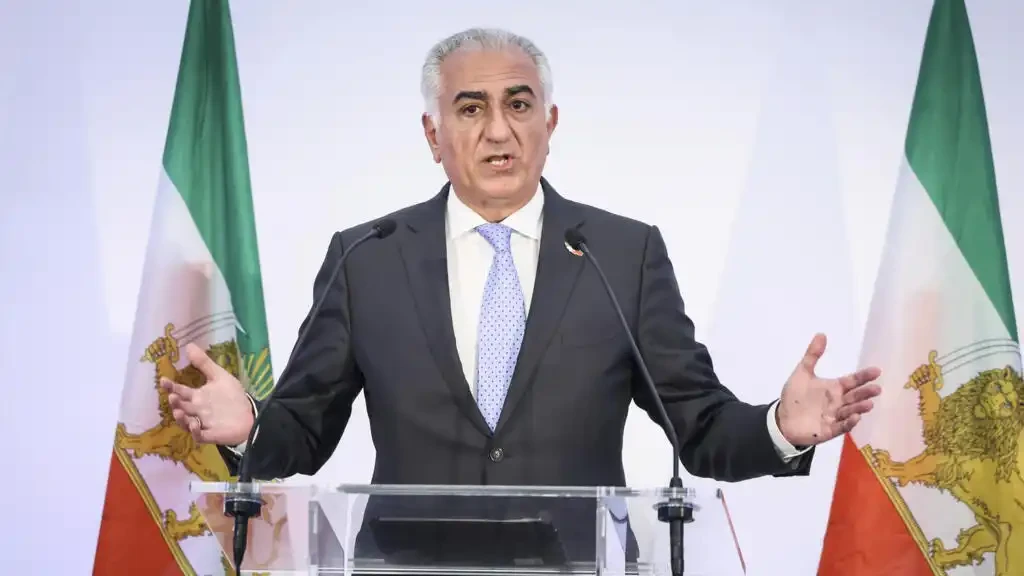
He has stated multiple times that his goal is not necessarily to restore the monarchy but to give the Iranian people the freedom to choose their form of government. If the people choose a republic, he said he would accept it. He frequently appears in Western media and think tank events, calling on Western countries to pressure the Iranian government and supporting human rights movements within Iran (such as the recent "Woman, Life, Freedom" protests).
The most pivotal event was his speech at the CPAC (Conservative Political Action Conference) in Texas on March 28, 2026, and the supporting rally he initiated in Washington D.C. the same month.
At CPAC, Pahlavi's speech was highly compelling. Its core message included deeply binding Iran's future with American values. He told the audience that a free Iran would no longer be a nuclear threat, would no longer support terrorism, and would no longer blockade the Strait of Hormuz. Furthermore, Iran would establish strategic partnerships with the U.S. and Israel, which could bring over $1 trillion in potential benefits to the U.S. economy.
At the end of his speech, he even mimicked Trump's slogan, delivering the line that brought the audience to a frenzy: "President Trump is making America great again, and I intend to make Iran great again. MIGA."
He also deliberately addressed the biggest external concern. He said Iran is not Iraq; he would not repeat the mistake of "de-Ba'athification," nor let a power vacuum devolve into anarchy. He promised to preserve the existing bureaucracy and part of the military infrastructure, only removing the top layer of theocratic oppression.
Western media's characterization of him also quietly shifted this month. Fox News and The Jerusalem Post no longer refer to him as the "former crown prince" but as the "Iranian opposition leader."
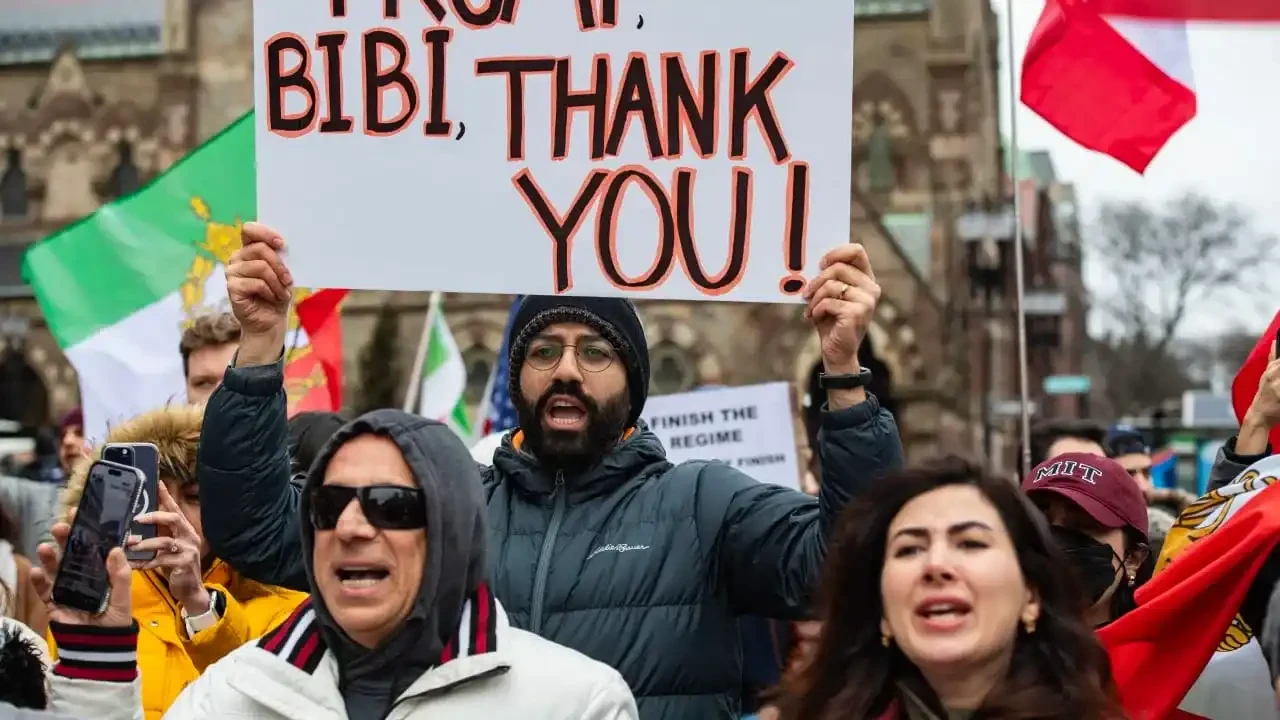
Some Iranian-Americans gather at Copley Square, calling for the downfall of the Islamic Republic of Iran
"Across cities, generations, and social classes, Pahlavi has become the only widely recognized opposition figure with genuine legitimacy, his name chanted across the country," an article in The Jerusalem Post noted. "For many Iranians, he is not just one political option among many. He represents a clear break with the Islamic Republic and a link to Iran's national continuity beyond it."
Pahlavi is not merely a symbolic figure; he has undertaken substantial preparatory work over the past two years.
In April 2025, he formally launched the "Iran Prosperity Project," a 170-page operational manual for regime transition compiled by over 100 experts over several years. Its core logic shifts the focus from "how to overthrow" to "what to do from Day 1 to Day 180 after the overthrow," covering lifting sanctions, recovering $120-150 billion in frozen overseas assets, rebuilding energy supply, integrating the military, and holding a national referendum.
His focus is on preventing Iran from descending into Iraq- or Libya-style anarchy after regime collapse.
In October 2025, he released a supporting digital mobilization platform called "We Take Back Iran." According to his team, by early 2026, tens of thousands of active-duty Iranian security forces, police, and government employees had registered through the platform, indicating their willingness to defect during a regime change.
The core political gamble in Pahlavi's "We Take Back Iran" plan is his call for the regular Iranian Defense Force (Artesh) to defect. This armed force of about 350,000 exists parallel to the Islamic Revolutionary Guard Corps (IRGC) within the system but has long been marginalized.
The Long-Standing Rift Within Iran's Military
The longstanding conflict between Iran's two military forces is another entry point for regime change in Iran.
Within this highly militarized theocratic state, the antagonism between the Defense Force (Artesh) and the Islamic Revolutionary Guard Corps (IRGC) is not a recent development but a structural malignancy planted since the regime's founding in 1979. These two armed forces are fundamentally different in lineage and soul.
The Defense Force is Iran's long-standing regular army. Its professional traditions, military doctrines, and even the family memories of many senior generals can be traced back to the more secular, nationalist-oriented Pahlavi era. For them, they defend "the land of Darius and Cyrus."
The Revolutionary Guard, however, is the "private army" established by Khamenei and his predecessor to consolidate their own power. Consequently, the IRGC not only controls Iran's most elite missile units and its richest overseas secret accounts but also monopolizes the country's construction, telecommunications, and energy industries through its vast business empire.
In Iran's capital, Tehran, a mid-level IRGC officer might own a mansion in the northern part of the city, while a colonel in the regular Defense Force might still worry about his family's basic health insurance. The conflict between the two has intensified to a critical point in the 2026 war.
According to battlefield reports from mid-March 2026, the Defense Force bore the brunt of frontline air defense and territorial defense tasks against external airstrikes but suffered from severe supply shortages. There are reports that the IRGC, which controls the logistics lifeline, refused to provide medical evacuation for wounded Defense Force soldiers and even intercepted ammunition. This has sparked immense anger within the Defense Force.
There are already signs that the U.S. military is maintaining informal communication with senior Iranian Defense Force officials through Qatar.
These analyses also point to the conclusion that, in today's Iran of "warlord fragmentation," the U.S. military is also identifying, waiting for, and assisting the most suitable "local power" to regain control of Iran.
The Realistic Pressure of the U.S. Midterm Elections
The echoes of war ultimately transmit to the most tangible place: the gas station.
As the midterm elections approach, the negative feedback effects of the Iran war on U.S. domestic politics are becoming apparent.
A key variable is that domestic support for the Iran war in the U.S. was never high to begin with. This is a point many analysts have criticized Trump for—the war's public relations have largely been ineffective, arguably failing to establish an effective narrative from the start. For ordinary Americans, they may not care about the complex logic of geopolitics, but they are very concerned about their cost of living, such as gas prices.
So information is layered. For those who follow the news or were already strong Trump supporters, they might feel this war is "important" on a macro level, related to the global situation, energy, and geopolitics. But for most ordinary Americans, their feelings are very concrete: spending an extra $100 per week on gas is more direct than any grand narrative.
Gas prices in many places have already risen to $3.8, even exceeding $4 per gallon in quite a few areas. In this context, Trump's emphasis on "this is short-term pain" is logically sound but psychologically difficult for voters to accept. Because for most people, short-term pain is precisely the clearest, hardest-to-ignore pain.
Whether this translates into votes is still too early to judge. But it is certain that inflation is eroding trust in the government, and "kitchen table economics" is once again becoming the decisive factor.
From the perspective of the congressional landscape, the war's direct impact is limited. Influenced by economic factors like rising oil prices, if voting were held now, Republicans could potentially lose the House of Representatives. However, with seven months until the midterms and the war not yet over, the situation remains unclear.
Furthermore, anti-war sentiment in the U.S. has not formed an overwhelming consensus. Opponents have not mobilized strongly, and non-opponents are not particularly firm either. This "middle ground" is difficult to translate into dramatic swings in votes.
Meaningful analysis will require waiting until June or July, breaking down about 20 to 25 key swing seats one by one, to possibly form a relatively reliable judgment.
Although Republicans face the risk of losing the House, the Senate landscape is much more stable.
For Democrats to truly change the situation, they would need to defend their current seats and gain at least 4 more to have a substantive advantage; gaining 3 seats wouldn't mean much, as a 50:50 split can be broken by the Vice President's tie-breaking vote.
Therefore, based on the current state-by-state structure, Democrats face a high difficulty in taking the Senate. In states like Texas and Alaska, Democrats have little realistic chance of winning. States with some potential for change are swing states like New Hampshire; North Carolina could also become a key battleground for Democrats.
Overall, the theoretical "ceiling" for Democrats is gaining four seats, but more realistically, it's likely an increase of one or two seats. Moreover, we are far from the most intense phase. Primaries are still ongoing in many states. For example, in Texas, the Democratic candidate lacks thorough vetting, and past statements are constantly being unearthed, which will weaken their competitiveness.
In the mid-to-lower stage leading to the 2028 election, the script will likely be a "divided Congress": Republicans control the Senate to safeguard appointments and foreign policy authority, while even if Democrats retake the House, they will face a "policy vacuum" due to legislative gridlock.
During this period, large-scale domestic stimulus packages would be stillborn as fiscal subsidies struggle to pass. While this political stalemate would reduce government efficiency, from a macro-analytical perspective, it might, through the unilateral strengthening of executive orders, maintain an extremely robust continuity in U.S. policy on core areas like energy extraction and border security.
Financial Markets Repricing
Amid the current Iranian turmoil, the valuation models for global macro assets are undergoing profound reconstruction.
The core variable in this repricing lies in the U.S. utilizing its energy advantage to conduct a targeted harvest and redistribution of global wealth. The performance of the crude oil market exhibits extreme asymmetry: in the short term, fears of supply disruption support oil prices oscillating at historical highs, but smart money has already begun pricing in a potential "supply glut" post-conflict.
With the maximum release of U.S. domestic production capacity and the reactivation of Venezuela's development rights, a new Western-dominated energy supply order is taking shape. This implies that the market influence of Middle Eastern crude oil is facing permanent dilution.
In the currency markets, the U.S. dollar's hegemonic status has not been weakened by the turmoil but has instead been inversely reinforced. In contrast, the euro is trapped in a long-term depreciation channel due to energy shortages and political fragmentation. The buck-passing between France and Spain in military actions not only exposed the weakness of European defense but also severely damaged market confidence in the euro. Lacking a deep energy moat like the U.S., this absence of economic sovereignty is translating into a currency disaster. Under the potential influence of fiscal plans like the "Save America Act," global capital may accelerate its flow back to the U.S., seeking a safe haven amidst the geopolitical storm.
Gold's rise in this script stems from three overlapping drivers:
The first is geopolitical risk premium. Before Pahlavi truly solidifies his footing, there is an inevitable period of vacuum. No one knows what Iran will ultimately become. Until the situation fully settles, with the IRGC not completely dismantled, remnants active, and regional proxies still operating, gold will remain elevated. This driver will persist until the situation truly clarifies.
The second is the structural pressure on dollar credibility. Even if a Pahlavi regime is ultimately established and the petrodollar expands, before that, the U.S. will have undergone a costly war, a resurgence of inflation, and renewed questioning of its fiscal sustainability. In this process, gold plays the role of a "fiat currency credibility hedge," not just a geopolitical risk haven.
The third is the structural gold-buying trend by global central banks. This trend formed after 2022; the Middle East war will only accelerate it, not reverse it.
The impact on Bitcoin needs to be viewed from two dimensions.
The first dimension is liquidity.
Falling oil prices, receding inflation, and the opening of the Fed's rate-cut space create a macro environment of


