






Daily Chart Eight Consecutive Green Candles Signal Strong Return: ETH Breaks Through $2,300, Whales Continue to Buy the Dip


- Core Viewpoint: The recent rebound in the crypto market is driven by multiple factors, including easing macro geopolitical risks, expectations for Federal Reserve rate cuts, and sustained inflows into ETFs. On-chain data shows market selling pressure has dropped to cyclical lows, with some analysts suggesting this could mark the beginning of a new upward cycle.
- Key Factors:
- On the macro front, easing tensions in the Middle East have led to a decline in international oil prices, alleviating inflationary pressures. The market expects the Fed to hold rates steady this week, providing liquidity expectations to support risk assets.
- On the capital flow front, both Bitcoin and Ethereum spot ETFs have seen net inflows for three consecutive weeks. Last week, Bitcoin ETFs recorded their first five-day streak of inflows since 2026, indicating sustained institutional capital entry.
- On-chain data shows the Sell-side Risk Ratio, which measures the activity of profit-taking, has fallen to about one-sixth of its cycle average, indicating extremely low selling pressure and a clear accumulation phase.
- While whales and institutions are buying the dip in Bitcoin, they are also showing a preference for ETH. Multiple whale addresses have accumulated ETH worth tens to hundreds of millions of dollars over the past week.
- A macro model based on historical data (US10Y×CN10Y) recently issued a bullish crossover signal. This signal has appeared before several previous bull markets, leading some analysts to believe Bitcoin may be starting a new rally.
Original | Odaily (@OdailyChina)
Author|Golem (@web3_golem)

While the market's focus is on OpenClaw's "Crayfish," BTC, along with the entire crypto market, has been quietly rising for a week.
According to OKX market data, BTC has recorded eight consecutive positive days from March 9 to March 16, successfully breaking through $74,000 and reaching a high of $74,451. The altcoin market has also steadily risen, driven by the broader market. ETH has gained over 12.5% in the past 7 days, surpassing $2,300; SOL has risen over 13% in the past 7 days, and BNB has gained over 10%. Data from Quantify Crypto shows that among the top 200 tokens by market cap in the past week, only 31 closed the week in the red, while the remaining 169 closed in the green.
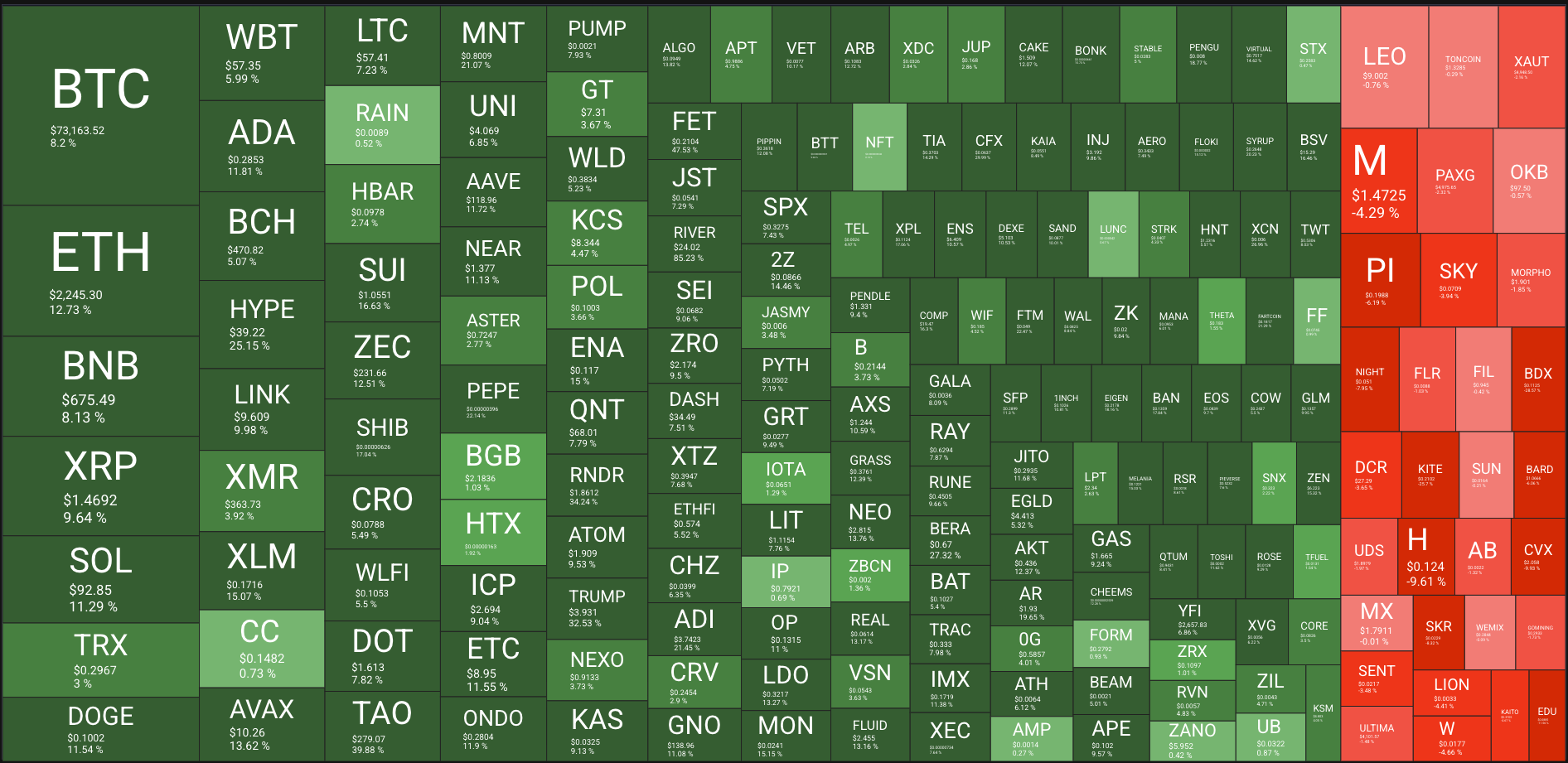
The Crypto Fear & Greed Index shows that last week, the market's panic index also moved out of the "Extreme Fear" zone. The current Fear & Greed Index is 39, nearing the "Neutral" sentiment zone. What factors have contributed to the improvement in market sentiment? What changes have occurred in crypto market liquidity? Is this rally a temporary rebound or a potential confirmation of a bottom? Odaily will provide a brief analysis in this article.
Hormuz Strait May Reopen; Fed Likely to Hold Rates Steady This Week
On a macro level, the primary catalyst for the crypto market rebound was likely President Trump's announcement on March 10th that the war with Iran was essentially over. He also announced several measures to stabilize oil prices, such as considering exemptions from certain energy sanctions to offset Middle East supply gaps and launching a large-scale strategic petroleum reserve release plan with other nations.
As shown in the chart below, international oil prices even fell below $90 per barrel on March 10th. There is a negative correlation between international oil prices and Bitcoin's price. The basic logic is that when oil prices fall, the threat of global inflation decreases. The market anticipates that global central banks, especially the Federal Reserve, are more likely to cut interest rates, leading to increased market liquidity. Bitcoin tends to rebound in anticipation of this scenario.
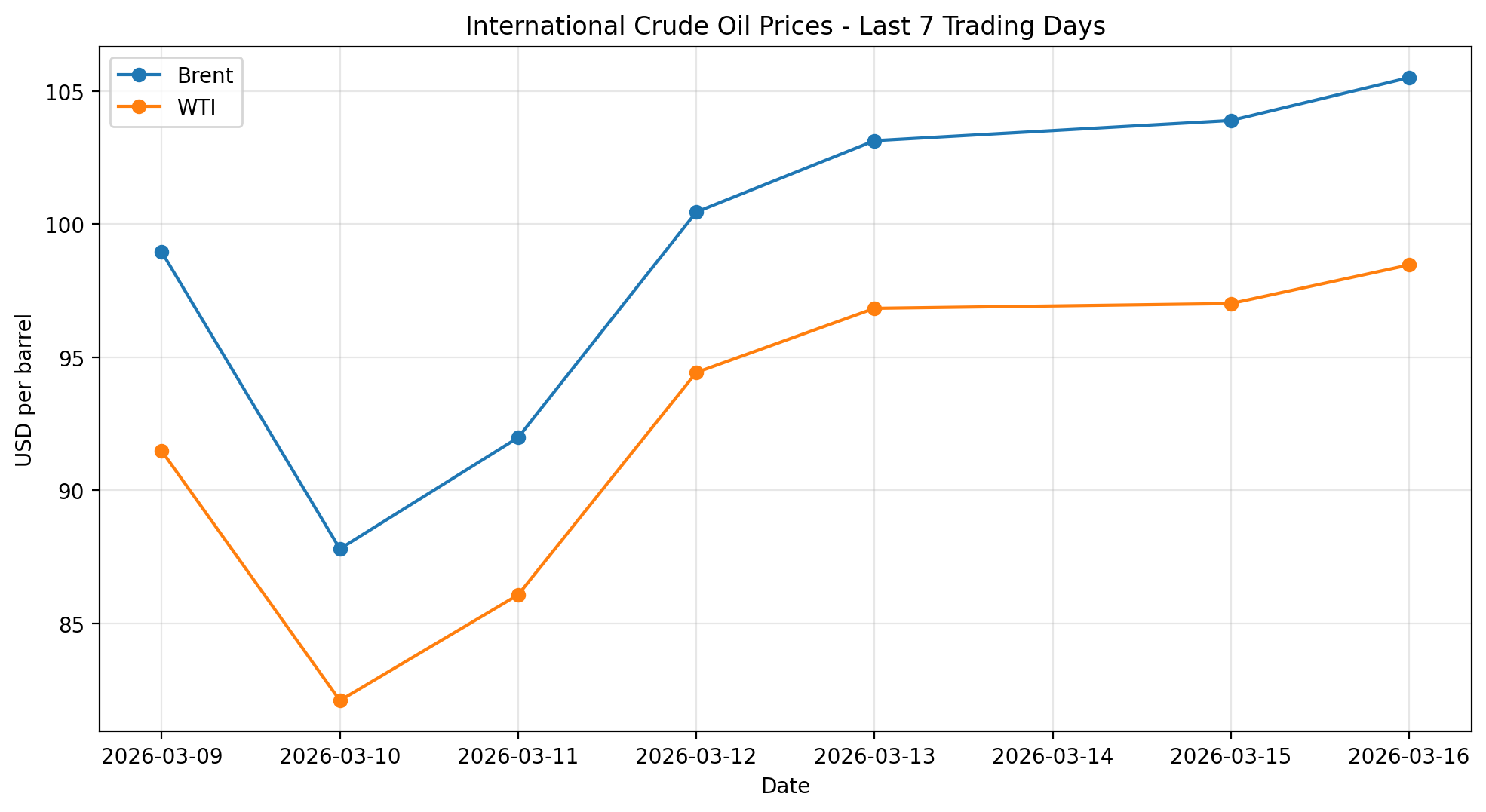
Brent Crude and WTI Crude Oil Price Trends Over the Past Week
However, since March 10th, crude oil prices have begun to rise again. The main reason is Trump's fluctuating stance on the war, at times saying the conflict could end "soon," and at other times threatening a "painful blow" to Iran. He even admitted he wasn't sure if he wanted a deal with Iran. Meanwhile, Iran's new Supreme Leader, Mojtaba Khamenei, vowed to close the Strait of Hormuz to oil tankers and ships from hostile countries and their allies.
Fortunately, Trump is still working to prevent the closure of the Strait of Hormuz. According to an Axios report on March 16th, Trump is seeking to form a multinational coalition to reopen the Strait of Hormuz, with an announcement expected later this week. Furthermore, four sources revealed that if the blockage of oil tanker traffic in the Persian Gulf persists, Trump is considering seizing Iran's key oil transshipment hub, Kharg Island. Located about 15 miles off the Iranian coast, Kharg Island handles about 90% of Iran's crude oil exports. Last Friday, Trump ordered strikes on military facilities on the island but spared the oil infrastructure.
However, last week's rebound in oil prices did not lead to a Bitcoin decline. Instead, Bitcoin continued its upward trend. The reason is that the market already expects the Federal Reserve to likely keep interest rates unchanged at this week's meeting. According to Polymarket data, the probability of the Fed holding rates steady on March 19th is close to 100%. CME's FedWatch Tool similarly shows traders assign a 99.1% probability to the Fed maintaining the current rate.
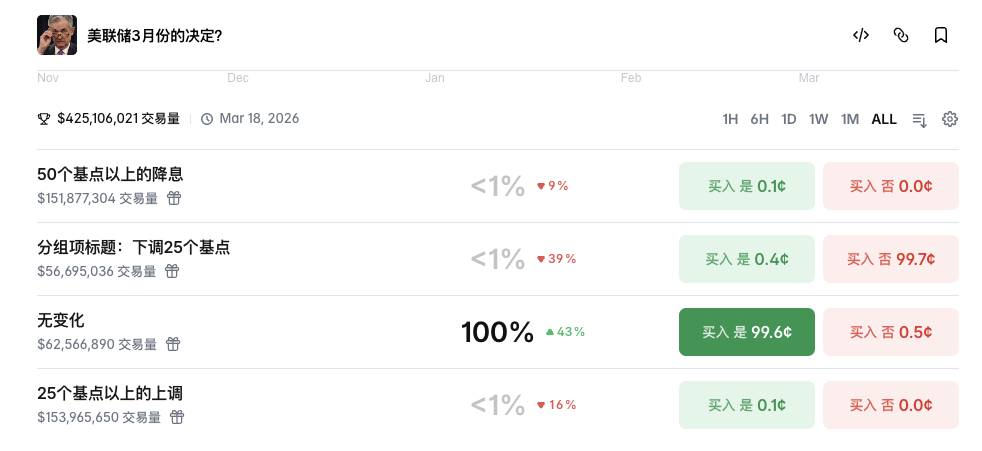
Although the Iran conflict and rising oil prices pose a new inflation threat to the Fed, policymakers need time to carefully assess how much the surge in energy prices will impact consumer prices and economic growth, and whether the impact is temporary or persistent. Therefore, amid the fog of war, "holding steady" has become the best strategy.
Economists at Morgan Stanley maintain their forecast that the Fed will cut rates by 25 basis points each in June and September. They believe rate cuts might be delayed, which could mean the Fed may have to act more aggressively later.
However, investors should not be blindly optimistic about rate cuts this year. While the Fed sets interest rates, it cannot reopen the Strait of Hormuz. The key determinant for policy is how long this conflict lasts and what Trump's next move will be.
James Eaglehoff, Chief US Economist at BNP Paribas Securities, stated he will watch whether Fed officials change their rhetoric during this week's meeting to signal plans for rate cuts or hikes in the coming months.
Nevertheless, some analysts believe the phenomenon of falling oil prices alongside a parabolic rise in Bitcoin's price is more of a short-term technical adjustment and "should not be overinterpreted."
Crypto ETFs See 3 Consecutive Weeks of Net Inflows; Whales/Institutions Continue Buying
Beyond the macro easing, on the capital flow front, mainstream cryptocurrencies like Bitcoin have also seen structural buying pressure. On March 15th, BlackRock's Head of Digital Assets stated in a live stream that although among the top 20 global ETFs by inflows, only the BlackRock Bitcoin ETF had a negative return, 90% of investors were buying more as the price fell. This phenomenon indicates Bitcoin is undergoing intense churn and a long-term accumulation phase.
Data supports this claim. According to SoSoValue data, both Bitcoin spot ETFs and Ethereum spot ETFs have achieved three consecutive weeks of net inflows. Bitcoin spot ETFs saw a combined net inflow of approximately $2.119 billion, while Ethereum spot ETFs saw a combined net inflow of about $265 million.
Furthermore, Bitcoin spot ETFs recorded their first five consecutive days of inflows in 2026 during last week's trading sessions (March 9th to March 13th, EST), with total inflows of $767 million. The last similar streak was in late November 2025, when spot Bitcoin ETFs saw five consecutive days of net inflows from November 25th to December 2nd, totaling $284.61 million.
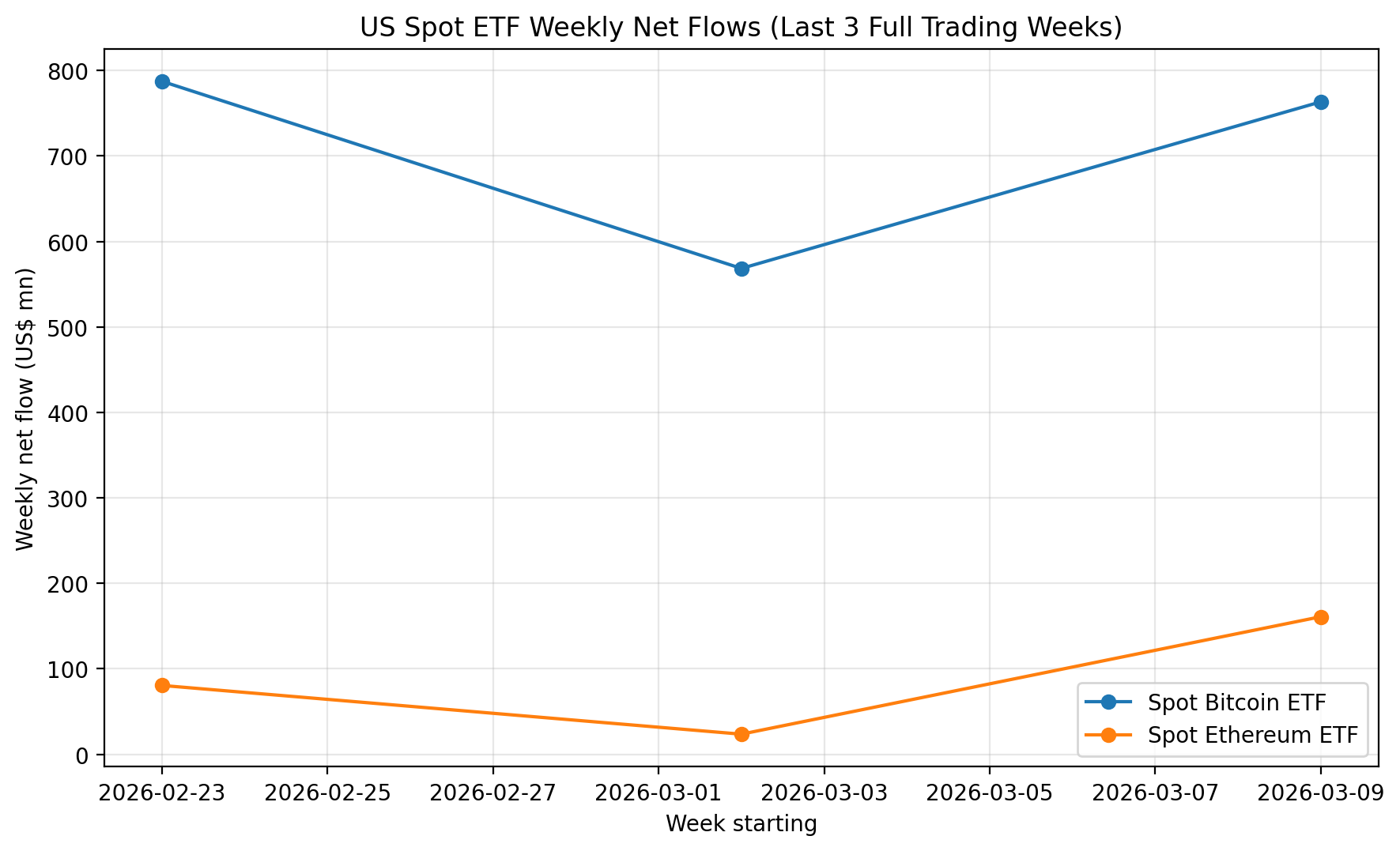
Bitcoin and Ethereum Spot ETFs See 3 Consecutive Weeks of Net Inflows
On-chain whales and institutions also began buying the dip last week, and besides Bitcoin, whales still favor purchasing ETH.
According to Arkham monitoring, a whale accumulated a total of $131.3 million worth of ETH last week, distributing it across two wallets. A whale address starting with 0x743d also spent $24.79 million last week to buy 11,985 ETH at an average price of $2,068. Another dormant whale address (0x2d85) that had been inactive for 6 months bought 5,003 ETH at $2,179, worth $10.9 million. Notably, this address had sold ETH near the peak around $4,300 six months ago.
Whales are still buying ETH today. The whale billΞ.eth (@0xbilly) bought 7,769 ETH at an average price of $2,248, totaling $17.46 million.
Has Bitcoin's Bottom Been Confirmed? Is the Uptrend Channel Open?
Facing this rebound, many analysts believe Bitcoin's bottom has been confirmed.
Analysts at Matrixport believe that although current crypto market sentiment is weak, with many traders shifting attention to assets like gold and crude oil, Bitcoin has fallen for five consecutive months, which is historically rare. Similar patterns have often preceded阶段性反弹. Meanwhile, the total market cap of altcoins has also retreated to levels from which multiple historical rebounds have launched. As stablecoin funds flow back into the market, liquidity conditions are continuously improving. Taken together, these signals indicate that the likelihood of a crypto market rebound is gradually increasing.
On-chain analysis models also show that Bitcoin's current network selling pressure has dropped to cycle lows, and the market is clearly in an accumulation phase. The Sell-side Risk Ratio measures the profit-taking activity of market participants relative to the network's cost basis. When the indicator exceeds the adaptive upper threshold, it triggers a distribution signal, indicating seller dominance. When it falls below the lower threshold, it triggers an accumulation signal, meaning selling pressure is extremely low.
Data shows the current selling pressure level has dropped to about one-sixth of the cycle average. Meanwhile, the 180-day rolling average of the Sell-side Risk Ratio has dropped from 3210 to 1913 over the past 60 days, a decrease of 1297 points, and continues to decline at a rate of about 20 points per day. Historically, the 1500 to 2000 range typically corresponded to selling pressure levels during the 2019 bear market (BTC ~$3,000–$6,000) and the mid-2022–2023 bear market (BTC ~$16k–$20k). However, the current BTC price remains in the ~$67k to $72k range, showing a clear structural divergence.
This means early low-cost accumulators have completed large-scale profit-taking in the $64k to $107k range. Those who did not sell in that range are now choosing to continue holding. Only if Bitcoin price re-establishes above $100k to $110k accompanied by large-scale profit-taking might a new distribution signal be triggered.
Therefore, many view this rally not as a short-term rebound but as a signal for a new uptrend.
A macro model combining the US 10-year Treasury yield and the China 10-year Treasury yield (US10Y×CN10Y) recently produced an "extremely precise" bullish crossover signal. Historical data shows this indicator issued similar signals before the 2013, 2017, 2020–2021, and 2023 bull markets, corresponding to Bitcoin gains of approximately 8700%, 1900%, 600%, and over 350%, respectively. Analysts believe that if Bitcoin stabilizes and rebounds from near its 200-week moving average, the price could test $100,000 around August. However, if it fails to break the key resistance level of $78,000, there remains a risk of forming a "bull trap."
Even now, some choose to ignore short-term volatility and focus on Bitcoin's long-term value, like Matt Hougan, Chief Investment Officer at Bitwise Asset Management. He stated that if Bitcoin can capture a larger share of the global store-of-value market currently dominated by gold and government bonds, Bitcoin could eventually reach $1 million per coin.
But the $1 million target is less a precise prediction and more a shorthand for Bitcoin maturing into a major global monetary asset, the outcome of which depends on long-term institutional adoption and the expansion of the store-of-value market.


