Spot Martingale Trading Bot Explained: Strategy, Use Cases, Risks, and XT Usage Guide



- Core Insight: The Spot Martingale trading bot is an automated strategy applied in the cryptocurrency spot market. It systematically buys in batches when prices fall to lower the average holding cost, aiming to profit from market rebounds. It is particularly suitable for traders with long-term conviction in an asset who wish to avoid the risk of liquidation associated with leverage.
- Key Elements:
- The core of the strategy is one-way buying: when the asset price falls by a preset percentage each time, it executes "safety orders" with increasing amounts to lower the overall average cost. It then sells all holdings for profit once the price rebounds to the take-profit target.
- Key advantages are automation and no liquidation risk: It overcomes emotional trading, operates 24/7, and because it operates in the spot market without using leverage, there is no risk of forced liquidation of margin.
- Main risks are capital lock-up and asset selection: Deep or prolonged downturns can tie up significant capital. If the asset's fundamentals deteriorate or the market enters a sustained bear market, the strategy may fail and lead to losses.
- Applicable scenarios are volatile or consolidating bull markets: It performs better during pullbacks of strong assets, range-bound fluctuations, or recovery phases after sharp declines. It is not suitable for one-way downtrends in a bear market.
- The core difference from Futures Martingale lies in the market and leverage: Spot Martingale directly holds assets without leverage; Futures Martingale trades derivatives using leverage, carrying liquidation risk.
- Best practices for risk management include: selecting high-liquidity, quality assets like BTC and ETH; setting reasonable price deviation and number of safety orders; allocating a portion of capital and setting stop-losses; and starting with small amounts for testing.
- Platform example (XT.com) offers AI strategy and manual modes, simplifying the parameter setup process and integrating risk management tools like stop-loss.
Automated trading has transformed how investors interact with the cryptocurrency market. Among the many tools available, trading bots employing specific strategies have gained significant popularity. One such strategy—the Martingale—has found its application in the volatile world of crypto. Spot Martingale trading bots offer a systematic approach to navigating market fluctuations, especially during downturns.
This guide will delve into Spot Martingale trading bots. We will explore their origins, mechanics, advantages, and inherent risks. We'll also compare them to other popular strategies and show you how to effectively utilize this powerful tool on XT.com. By the end, you'll have a clear understanding of whether this strategy aligns with your investment goals.
What is a Spot Martingale Trading Bot?
A Spot Martingale trading bot is an automated system that executes a cost-averaging strategy in the spot market. Its core principle is simple: the bot buys an asset at predetermined intervals as its price falls. Each time the price drops, it purchases a larger quantity, systematically lowering the average cost of the position.
The ultimate goal is to profit when the market eventually recovers. Because the average cost has been lowered, the asset price doesn't need to rebound to its original purchase price for the trader to become profitable. A much smaller price bounce is sufficient to turn the entire position profitable. This makes it a popular strategy for traders who believe in the long-term value of an asset and are undeterred by short-term price swings.
The Origin of the Martingale Strategy
The Martingale strategy did not originate in finance. Its roots trace back to 18th-century France, where it was a popular gambling system. The original concept was applied to a simple coin toss game. A gambler would bet a small amount on heads. If they lost, they would double their bet on the next toss. This process would continue—doubling down after each loss—until they finally won.
When victory finally arrived, the winnings would be enough to cover all previous losses and produce a profit equal to the initial bet. In theory, with infinite capital and no table limits, this strategy was foolproof. However, the real world has limits, which is why the Martingale strategy carries significant risk. Applying it to financial markets, especially crypto, requires careful parameter setting and risk management.
How a Spot Martingale Bot Works
Understanding how a Spot Martingale bot operates is crucial for using it effectively. The bot automates the buying and selling process based on a set of user-defined parameters.
Here's a detailed breakdown of its operation:
- Initial Buy (Base Order): The cycle begins with the bot executing the first buy order for a specific crypto asset (e.g., BTC). This is called the "Base Order."
- Monitor Price Drop: After the initial purchase, the bot continuously monitors the asset's price.
- Place Safety Order: If the price falls by a predefined percentage (e.g., 2%), the bot places a "Safety Order" to buy more of the asset. The key is that this safety order is for a larger amount than the previous order, typically multiplied by a specific factor (e.g., 1.5x).
- Scale In, Lower Average: This process repeats. Each time the price falls again by the set percentage drop, the bot executes another, larger safety order. This gradual buying of larger amounts effectively lowers the average cost of the entire position.
- Set Take-Profit Target: Simultaneously, the bot calculates a take-profit target. This target is a specific profit percentage set above the new, lower total cost basis.
- Execute Take-Profit Order: Once the market rebounds and the price hits the take-profit target, the bot sells all accumulated positions in one order. This sale concludes the cycle, realizing a profit. The bot can then start a new cycle with a fresh base order.
The bot's strength lies in its emotionless execution. It follows these rules without panic or hesitation, operating 24/7—a significant advantage in the never-sleeping crypto market.
Spot Martingale vs. Futures Martingale
While both bots use the Martingale strategy, they operate in different markets and have vastly different risk profiles.
- Market: A Spot Martingale bot operates in the spot market. This means you are buying and directly owning the underlying crypto asset (e.g., you own actual BTC). In contrast, a Futures Martingale bot trades in the derivatives market using futures contracts, which are agreements to buy or sell an asset at a future date.
- Leverage: This is the most critical distinction. Spot trading involves no leverage. Your potential loss is limited to the capital you invest. Futures trading, however, almost always uses leverage, which amplifies both potential profits and potential losses.
- Liquidation Risk: With a Spot Martingale bot, there is no liquidation risk. Your position remains open as long as the asset you hold has value. Even if the price drops 90%, you still own the asset and can wait for a recovery. For a Futures Martingale bot, the use of leverage introduces a liquidation price. If the market moves sharply against you, your entire margin can be wiped out, and the position will be forcibly closed, resulting in a total loss.
Spot Martingale is the better choice for traders who prefer a lower-risk approach and are comfortable holding assets through market dips. It eliminates the catastrophic liquidation risk associated with leveraged futures trading.
When to Use the Spot Martingale Strategy
The Spot Martingale strategy is not a one-size-fits-all solution. It excels under specific market conditions. The bot's ideal environment is a volatile, choppy, or consolidating market with an overall upward bias.
Consider using a Spot Martingale bot when you anticipate:
- Market Pullbacks: When a strong asset experiences a temporary price correction within a larger bull market. The bot can systematically buy the dip.
- Range-Bound Markets: In a market trading within a predictable horizontal range, the bot can profit from the oscillations between support and resistance.
- Post-Crash Recovery: After a major market crash, when you believe an asset is undervalued and poised for a slow but steady recovery. The bot allows you to build a position at favorable prices as the market finds its bottom.
Conversely, the strategy is less suitable for sustained, sharp bear markets where an asset's price keeps falling without meaningful rallies. In such a scenario, the bot would continuously accumulate a depreciating asset, tying up significant capital with little hope of a profitable exit.
Key Advantages of Spot Martingale Bots
Using an automated Spot Martingale bot like the one on XT.com offers several advantages over manual trading.
- Automated Dollar-Cost Averaging (DCA): The bot perfectly executes an enhanced DCA strategy. It automatically buys more as the price drops, eliminating the emotional guesswork and hesitation that often plague manual traders.
- Reduces Emotional Trading: Fear and greed are a trader's greatest enemies. The bot operates purely on preset logic, buying dips and taking profits without being swayed by fear of further drops or greed for higher gains. This disciplined approach is a cornerstone of long-term success.
- Profit Potential in Volatile Markets: Crypto markets are known for their volatility. Spot Martingale bots are designed to turn this volatility into an advantage, profiting from price swings and rebounds.
- No Liquidation Risk: As mentioned, because it operates in the spot market and uses no leverage, you can weather deep market corrections without the risk of being liquidated, provided you have confidence in the asset's eventual recovery.
- Time Efficiency: The bot works 24/7, scanning markets and executing trades. This frees you from constant screen-watching, allowing for a more passive management of your investments.
Risks of Spot Martingale Trading
No trading strategy is without risk, and Martingale is no exception. Understanding its potential drawbacks is crucial before committing capital.
- Significant Capital Requirement: The core of the strategy is increasing position size after each drop. This means a deep or prolonged market decline can tie up a substantial amount of your capital in safety orders, reducing your liquidity for other opportunities.
- Risk of a "Black Swan" Event: The strategy's greatest weakness is a catastrophic, long-term crash in the asset's price. If you use the bot on a poor-quality coin trending toward zero, the strategy will fail. The bot will keep buying, and you'll end up holding a large bag of worthless assets.
- Opportunity Cost: While your funds are locked in a Martingale cycle during a downtrend, you might miss other, more profitable trading opportunities in the market.
The key to mitigating these risks lies in selecting the right asset and implementing sound risk management measures.
Risk Management Best Practices
Effective risk management is what separates successful bot traders from unsuccessful ones. Here are some best practices for using a Spot Martingale bot:
- Choose Quality Assets: Use the bot only on cryptocurrencies with strong fundamentals, high liquidity, and a solid track record, such as Bitcoin (BTC) or Ethereum (ETH). These assets are far more likely to recover from pullbacks than speculative altcoins.
- Set Realistic Parameters: Don't make your settings too aggressive. A smaller initial investment, wider price deviations between safety orders (e.g., 3-5%), and a reasonable number of safety orders can help your strategy survive deeper corrections.
- Allocate Capital Wisely: Never "go all-in" on a single bot. Allocate only a small portion of your trading portfolio to the Martingale strategy. This ensures that even in a worst-case scenario, your overall portfolio won't suffer a devastating blow.
- Use Stop-Loss (If Available): Some advanced bots, including the XT Spot Martingale, offer a stop-loss feature. Setting a stop-loss price for the entire cycle provides a crucial safety net, automatically closing the position and preventing further loss if the market moves more adversely than expected.
- Start Small: If you're new to the strategy, start with a small amount to understand how the bot behaves in real market conditions. You can scale up as you gain confidence and experience.
Spot Martingale vs. Grid Trading
Grid trading is another popular automated strategy, and understanding how it differs from Martingale is helpful.
- Grid Trading: A grid trading bot places a series of buy and sell orders at predetermined intervals above and below the current price, creating a "grid" of orders. It profits from small price fluctuations by buying low and selling high within the range. It is most effective in sideways, range-bound markets.
- Spot Martingale: A Martingale bot is unidirectional. It is primarily a buying strategy designed to lower the average cost during price declines and sell the entire position on a rebound. It is most effective in markets that are pulling back but expected to recover.
Key Differences:
FeatureGrid Trading BotSpot Martingale BotPrimary GoalProfit from tiny price fluctuations within a range.Lower average cost during price drops, profit from a larger bounce.Market ConditionSideways, range-bound markets.Volatile, choppy markets expected to recover or trend upward.Order StructurePlaces both buy and sell orders simultaneously.Places buy orders on dips, one large sell order on the rise.Capital UsageCapital is spread across the entire grid.Capital is concentrated and deployed as the price falls.
In short, choose a grid bot if you want to profit from small, consistent oscillations. Choose a Martingale bot if you want to strategically buy the dip during a pullback.
How to Use the XT Spot Martingale Bot
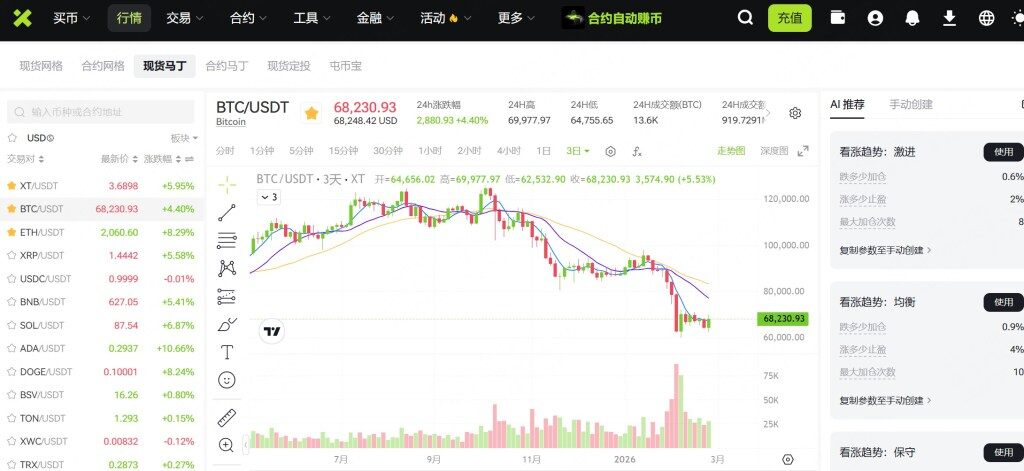
XT.com offers a user-friendly and powerful Spot Martingale bot. The setup process is straightforward.
- Navigate to the Trading Bot Section: Log into your XT.com account. From the main menu, go to "Trade" and then select "Trading Bots." Find and click on the "Spot Martingale" option.
- Choose Your Trading Pair: Select the cryptocurrency pair you wish to trade, e.g., BTC/USDT.
- Choose Mode (AI Strategy vs. Manual Setup):
- AI Strategy: This is the best option for beginners. XT.com provides pre-configured parameters based on historical data analysis. You simply decide the investment amount, and the AI handles the rest.
- Manual Mode: This gives you full control. You can set your own parameters, including:
- Price Deviation: The percentage price drop that triggers a safety order.
- Take-Profit Ratio: The profit percentage you wish to achieve per cycle.
- Max Safety Orders: The maximum number of times the bot will scale in.
- Safety Order Multiplier: The factor by which each new safety order amount increases.
- Set Your Investment Amount: Enter the amount of USDT (or other quote currency) you wish to allocate to the bot. The interface will show the capital required for the base order and all potential safety orders.
- Configure Advanced Settings (Optional but Recommended): XT.com offers advanced options like setting a Stop-Loss Price. This is a crucial risk management tool that can protect your capital from severe downturns.
- Create the Bot: Review all parameters carefully. Once satisfied, click the "Create" button. Your bot is now live and will immediately begin executing its strategy.
You can monitor the bot's performance, view current positions, and check your profit history directly on XT.com's trading bot dashboard. The intuitive interface makes it easy to track your automated trading activity.
Case Study: BTC Pullback and Recovery
Let's illustrate the strategy with a hypothetical scenario involving a Bitcoin pullback.
Assume Bitcoin is trading at $60,000, and you believe it will undergo a correction but ultimately recover and move higher. You decide to set up an XT Spot Martingale bot with the following parameters:
- Trading Pair: BTC/USDT
- Initial Investment (Base Order): $100
- Price Deviation: 5%
- Take-Profit Ratio: 4%
- Max Safety Orders: 4
- Safety Order Multiplier: 1.5x
Here's how the cycle might unfold:
- Base Order: The bot buys $100 worth of BTC at $60,000.
- First Drop: BTC price drops 5% to $57,000. The bot triggers the first safety order, buying $150 worth of BTC ($100 * 1.5).
- Total Investment: $250. Average Cost: ~$58,200.
- Second Drop