






The global market after a 43-day data vacuum: AI stalls, Crypto fluctuates, what's next in December?


- 核心观点:宏观风险主导市场,加密资产表现分化。
- 关键要素:
- 美国数据真空与央行摇摆,打压整体风险偏好。
- RWA赛道获机构增持,表现稳健成为避风港。
- 隐私币因需求与叙事爆发,短期涨幅跑赢大盘。
- 市场影响:资金轮动加剧,需关注赛道分化与宏观节奏。
- 时效性标注:短期影响。
November was supposed to be a month full of anticipation. The market was well-prepared, hoping for a smooth end to the year. AI concept stocks continued to lead the global risk appetite, and the crypto market was steadily hovering at high levels; everything seemed to be going according to plan.
The plot then took a sudden turn. The US government shutdown lasted for a full forty-three days, forcing a halt to key economic data releases. The market was suddenly left blindfolded, groping for direction in mid-air. Meanwhile, the statements from global central banks fluctuated wildly, making it impossible to grasp the rhythm. Pressure on China's real estate market resurfaced, reigniting investors' most dreaded anxieties. Even previously strong AI leaders began to show signs of fatigue in this atmosphere.
The crypto market was naturally not spared from this storm. Bitcoin and Ethereum no longer resembled independent assets, but rather highly volatile tech stocks, fluctuating wildly with changing sentiment. However, amidst this chaos, fund flows quietly revealed two winners. One was the RWA sector, which saw continuous institutional investment, and the other was the sudden surge in privacy coins, which experienced a rapid rise in a short period, even outpacing BTC and ETH at one point.
We've now reached the threshold of December. Ultimately, the market's future direction depends on central bank decisions, the direction of AI regulation, and the narrative flowing within the crypto industry. Whether it's a year-end rebound or continued correction, no one can give a definitive answer at this point. For XT users, the most important thing this month is to remain selective. Understanding the direction is more crucial than blindly chasing speed.

TL;DR Quick Summary
- The market in November was full of unexpected events. The US experienced a 43-day data vacuum, Powell's statements were contradictory, pressure on the Chinese real estate market intensified again, Japan's attitude suddenly hardened, and AI concept stocks encountered real resistance for the first time.
- BTC and ETH recorded their weakest performance in over a year, behaving more like highly volatile tech stocks than being influenced by factors within the crypto industry itself. The primary reason was a decline in global risk sentiment.
- RWA tokens continued to rise steadily, driven by favorable regulatory policies, while privacy coins staged one of the fastest rebounds in 2025, outperforming major market trends at one point.
- December is a crucial turning point. Central bank actions, macroeconomic data, AI policies, and the rotation of funds within the crypto space will all influence the year-end market performance.
- For XT users, it's crucial to focus on stable leverage, macroeconomic timing, and narrative selection. RWA and privacy coins are worth watching, but avoid blindly chasing rising prices.
Macro Calendar for December 2025 (Overview of Key Dates)
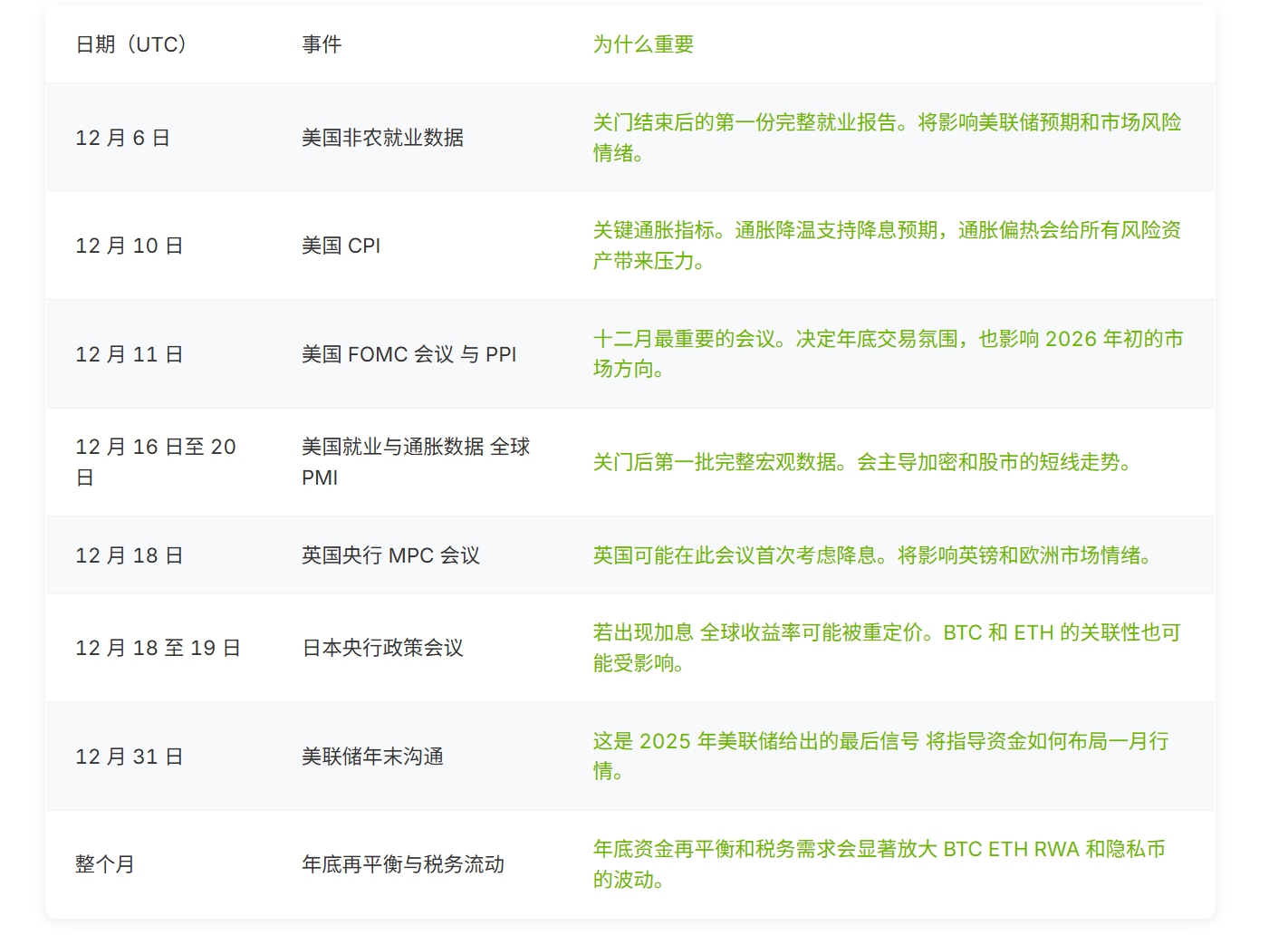
What November taught us: Macroeconomic trends, the decline of AI, and changes in risk sentiment.
The market started November with a generally optimistic atmosphere. AI concept stocks continued their strong performance, remaining the year's top performers. Bitcoin just touched a new high of $126,000, and Ethereum followed suit. Many believe that the global shift from interest rate hikes to cuts should proceed smoothly, and a traditional year-end rebound is quite likely.
As a result, things suddenly went cold in the United States.
The government shutdown left the market directionless. Key economic data updates were forced to stop for a full 43 days, with no non-farm payrolls or CPI figures, and the entire set of reference indicators that the Federal Reserve usually relies on was without data. Although the Beige Book provided some vague signals, saying that economic activity was stabilizing and that employment and consumption had cooled down, the lack of solid data left the market uneasy.
The Federal Reserve's stance appears more dovish on the surface, but internally there is no consensus.
Just after lowering interest rates to 3.75-4 percent at the end of October, officials began hinting in public speeches in November that there was still room for further rate cuts in the short term. New York Fed President Williams even directly stated that further easing of policy was possible. However, looking at the minutes of the October meeting, many members emphasized that inflationary pressures remained. With data gaps, the market is still betting on another rate cut in December, but this confidence could be shattered at any time.
 TradingEconomics.com
Europe performed much more steadily.
Compared to the chaos in the US, Europe is noticeably calmer. The European Central Bank maintained its deposit rate at 200%, indicating that the current level is appropriate and it will not make any rash moves. The situation in the UK is more nuanced. The interest rate decision on November 6th resulted in a narrow 5-4 vote to keep rates unchanged, but the UK's tight fiscal budget has led the market to believe that a rate cut might be possible on December 18th.
Japan was the real unexpected factor.
The biggest plot twist in November came from Japan. The Bank of Japan kept its interest rate unchanged at 0.5%, but its tone suddenly became hawkish. Kazuo Ueda hinted at a possible rate hike in December, citing significant wage increases and a return to no longer low inflation.
Meanwhile, new Prime Minister Sanae Takaichi unveiled a 21.3 trillion yen stimulus package, combining fiscal and monetary measures. As a result, Japanese government bond yields soared to their highest level since 2008, leading to market concerns that Japan might become an "amplifier" of the current global volatility. A slight tremor in Japan could potentially trigger similar fluctuations in other markets.
AI stocks are finally no longer leading the pack by a landslide.
The most surprising development for the market was the AI sector. After months of frenzied gains, November finally saw some signs of fatigue. Despite delivering strong earnings, Nvidia's stock price failed to continue its upward momentum, Palantir fell more than 30% from its peak, and the Nasdaq also cooled down. These signals indicate that even the hottest narratives can encounter valuation pressures and profit-taking.
 2025 NVDA Price Performance (TradingView.com)
Crypto Insights in November: BTC, ETH, RWA, Privacy Coins, and AI – Understanding Market Sentiment in One Chart
The crypto market absorbed all the macroeconomic storms of November. In short:
- The decline in BTC and ETH is mainly due to the macroeconomic environment, not structural problems.
- AI tokens have cooled down briefly, but the underlying logic remains unchanged.
- RWA continued to receive increased holdings from institutions, making it the most stable sector throughout the month.
- Privacy coins unexpectedly became a liquidity hotspot, exhibiting extreme volatility but also generating significant interest.
November had just begun, and the crypto market was riding high. The AI hype was driving up risk appetite, the dollar was weakening, and Bitcoin surged to a new high of over $110,000, with Ethereum close behind. At that time, everyone was on the same page: the path of interest rate cuts seemed clear, and the market was expected to steadily rise by the end of the year.
As a result, macro sentiment shifted rapidly, and Bitcoin and Ethereum behaved exactly like high-flying tech stocks. Throughout November, BTC retraced by more than 21%, falling from over 110,000 to just over 80,000. ETH also fell to just over 3,000. Various leveraged positions in the market were liquidated one after another, with liquidation amounts exceeding eight billion US dollars, and the market volatility was amplified wave after wave.
The encryption itself isn't the problem; the core issue is the macro-level repricing. A lack of US data, the Fed's fluctuating stance, amplified pressure on the Chinese real estate market, and finally, weakening AI stock prices have all contributed to this. Funds are naturally choosing to avoid risk, gold has hit new highs, and BTC's price action is almost entirely mirroring the Nasdaq.
But amidst this chaos, the choices made by capital have revealed a clearer picture of the market.
RWA: The most stable line in November
RWA was practically the "anchor" of November.
 RWA project TVL (DeFiLlama)
The on-chain market capitalization of RWA has risen to around $36 billion, an increase of 5% month-over-month, and the number of token holders has also increased by more than 11%. Institutional investors are also making continuous moves:
- Ondo has obtained licenses throughout the European Economic Area to directly offer tokenized shares.
- Centrifuge launches institutional tools; tokenization of credit and energy assets surpasses $1.3 billion.
- MakerDAO 's Sky Savings Pool continues to absorb large amounts of DAI.
- Banks in Singapore, South Korea, and Europe are all pushing forward with pilot programs for tokenized deposits and government bonds.
For investors, RWA has a clear logic, a steady pace, and is less susceptible to market sentiment, making it a typical core-driven sector. XT has also launched a dedicated RWA section .
Trading pairs like UPAL , SZRR, GSSG, GCF, MINT, and USTBL represent real assets or yield-generating products, more like "stable returns with a little extra upside potential." Compared to sentiment-driven cryptocurrencies, they are significantly more stable.
 RWA's total market capitalization (Artemis)
Privacy coins: The craziest market in November
If we were to choose the most dramatic sector in November, privacy coins would definitely be number one.
Zcash has surged more than sevenfold since the end of September. Monero and Dash have also seen triple-digit gains. At one point, six percent of the total market trading volume was even being used to speculate on privacy coins.
Why did it suddenly become so popular? The reason is quite simple:
- 1. There are real users: The usage of ZEC 's privacy pool continues to rise, and the demand is genuine.
- 2. The narrative just happened to fill the gap: When BTC and ETH were underperforming, the market naturally had to find a new story, and "digital cash" immediately became the substitute star.
- 3. Macroeconomic stimulus: Stricter global regulations and frequent news of asset freezes have led to privacy coins being seen as essential assets.
Regulatory complexities persist. The US quietly lifted sanctions on Tornado Cash contracts, but developers are still facing lawsuits. Europe plans to completely remove privacy coins from the compliant market by 20-70 years. However, the demand remains strong, making it difficult for the privacy sector to truly cool down.
 Privacy Coin Developer Activity Ranking (Santiment) (30-day period)
AI tokens and L2: A brief respite after a period of strength
The AI race finally cooled down briefly in November.
Despite Nvidia's strong earnings report, its stock price failed to rise, while Palantir plunged 30%, quickly cooling the AI hype in the US stock market. AI tokens in the crypto market also saw a synchronized correction.
- Slowdown in capital inflows
- Infrastructure tokens such as Bittensor ( TAO ), Fetch.ai ( FET ), Render ( RNDR ), and NEAR have seen significant pullbacks.
- Some short-term funds have flowed directly from AI to speculate on privacy coins.
But this doesn't mean the AI narrative is over. The demand for computing power, data, and AI agents continues to grow. The only change is that AI tokens are becoming increasingly intertwined with the sentiment of AI stocks, and their fluctuations are more synchronized.
BTC and ETH: Key Positions in December
Although November was brutal, the medium- to long-term logic remained intact.
- The US-based spot Bitcoin ETF has been launched, and in the long run, it will bring incremental funds.
- The political environment in the United States is more favorable compared to previous cycles.
- The Ethereum Dencun upgrade is underway, and a spot ETF may be available in 2026.
Institutions are generally focused on the $75,000 to $80,000 range for BTC and the support level of around $2,800 for ETH . If the Federal Reserve releases dovish signals in December, coupled with weaker CPI, a year-end rebound is entirely possible. However, if Japan suddenly raises interest rates, or if China experiences another financial crisis, the market may not have bottomed out.
What will the market do in December: Possible paths and XT trading guide
The market in December remains highly unpredictable. Macroeconomics, AI, BTC and ETH, RWA, and privacy coins are all in motion; this month could see either a reversal or a further decline.
If we take a more aggressive approach:
- The Federal Reserve cut interest rates by 25 basis points and expressed confidence that inflation is falling.
- The Bank of England followed suit, initiating its first easing measure of the year.
- The Bank of Japan kept its interest rates unchanged, without any sudden rate hike.
- No new negative news has emerged regarding China's real estate market.
Market Impact: A weaker dollar and lower risk premiums could lead to a year-end rebound for BTC and ETH, with some sectors supported by compelling narratives also likely to follow suit.
If we take the weaker route:
- The Federal Reserve may shift its tone to hawkish, or delay rate cuts.
- Japan's sudden tightening of monetary policy triggers a jump in global interest rates.
- China's real estate market is facing problems again, dampening investor sentiment.
Market impact: Risk aversion may intensify at the end of the year, potentially pushing BTC down to around $75,000 and ETH back to the $2,500 range, with high-volatility sectors bearing the brunt.
XT User's Trading Manual
- Closely monitor the meeting schedules of the FOMC, the Bank of England, and the Bank of Japan at key junctures.
- Before major events, maintain a light position and avoid trying to withstand market volatility.
- Treat the $75,000 to $80,000 range for BTC and the $2,800 range for ETH as a range rather than a death line.
- Portfolio management based on sector characteristics: RWA is relatively stable, privacy coins are more volatile, and AI follows the sentiment of the US stock market more closely.
Quick Links
- November 2025 Market Outlook: From FOMC to x402 Agreement, a Comprehensive Analysis of Global Hot Topics
- XT.com and Dash discuss: Instant settlement, blockchain mechanisms, and privacy innovation.
- How to invest 100,000 USDT? XT Simple Earn helps you achieve a stable passive income of 10%+.
About XT.COM
Founded in 2018, XT.COM is a leading global digital asset trading platform with over 12 million registered users, operating in more than 200 countries and regions, and boasting an ecosystem traffic exceeding 40 million. The XT.COM cryptocurrency trading platform supports over 1300 high-quality cryptocurrencies and over 1300 trading pairs, offering diverse trading services including spot trading , leveraged trading , and contract trading , and is equipped with a secure and reliable RWA (Real World Asset) trading market. We are committed to the philosophy of "Explore Crypto, Trust Trading," dedicated to providing global users with a safe, efficient, and professional one-stop digital asset trading experience.


