Who is Jane Street?


- Core Viewpoint: Jane Street is a top-tier quantitative trading firm that has built a massive advantage in core businesses like ETF market-making through algorithms and speed. Its astonishing profitability coexists with an elite culture and technological barriers. However, it has recently faced multiple lawsuits and regulatory scrutiny for allegedly leveraging information advantages and engaging in market manipulation, raising questions about the boundaries and ethics of its business model.
- Key Elements:
- Staggering Profitability: Achieved net trading revenue of $20.5 billion in 2024, surpassing giants like Citigroup and Bank of America, with only about 3,000 employees, demonstrating extremely high efficiency.
- Core Business & Market Position: Made early bets on ETF market-making and became a key piece of market infrastructure, holding significant market share in areas like the US ETF primary market and bond ETFs.
- Unique Technological & Cultural Barriers: Uses the niche OCaml language to build its core systems, creating a technological moat; the company has no CEO, employing a flat management structure and profit-sharing mechanism.
- Facing Major Regulatory Allegations: The Securities and Exchange Board of India (SEBI) has accused it of manipulating the spot and futures markets to profit on options expiry days and has suspended its trading privileges in India.
- Involved in Terra Collapse Lawsuit: Accused of obtaining information about Terraform Labs' divestment through an internal chat group, closing positions early to avoid risk, and attempting to acquire Luna at a low price.
- Elite Recruitment & Talent Output: Recruits high-salaried interns skilled in problem-solving; its alumni network has been deeply involved in core events in the crypto world, such as FTX.
Original author: CoolFish
A company of 3,000 people earns more than Citigroup and Bank of America. It doesn't advertise, has no CEO, and doesn't sign non-compete agreements. Its name rarely appears in the news, until it appears in the defendant's seat.
On February 24, Terraform liquidator Todd Snyder sued the high-frequency trading giant Jane Street. The lawsuit alleges that Jane Street used insider information to trade, profited illegally, and ultimately accelerated the collapse of Do Kwon's crypto empire.
Although Jane Street denied the allegations, calling them baseless, the market's gaze has begun to turn towards this company. Around the same time, a screenshot of a Jane Street internship posting circulated on Twitter.
The screenshot shows the company is hiring quantitative trading interns for a 4-month contract with a base salary of $300,000. The key point is that it doesn't require a finance background or programming experience, asking only one thing: Can you solve problems?
The salary and requirements are startling at first glance. Who exactly is this company? Are quantitative intern salaries really this high? How does it make so much money? And what role does it play in the global financial markets?
These questions deserve serious answers.
Because once you peel back the layers of its low profile and truly understand this company, you realize one thing: Jane Street's existence is itself an extreme experiment about information, speed, and the boundaries of rules.
Its name rarely appears in the news, until it appears in the defendant's seat.
A Windowless Room and Four Gamblers
1999, New York.
Three traders who left Susquehanna International Group (SIG), plus a programmer who jumped ship from IBM, rented a small windowless office and started a business most people looked down upon: ADR arbitrage.
ADRs, American Depositary Receipts, are certificates for foreign company stocks traded in the US market. Their price should theoretically match the underlying shares listed in their home country, but time zone differences, exchange rate fluctuations, and information delays create tiny gaps between the two. Jane Street's four founders—Tim Reynolds, Robert Granieri, Michael Jenkins, and Marc Gerstein—stared at these gaps, exchanging algorithms and speed for profit.
This business had almost no glamour: no grand narrative, no ambition to disrupt an industry, only an extreme sensitivity to numbers and a pathological pursuit of execution.
According to research by Alphacution, the company was initially likely registered under the name "Henry Capital" and renamed Jane Street in August 2000. Externally, they were secretive to the point of paranoia.
This paranoia seems to have been in the company's DNA from the start.
Of the four founders, three came from the same company and left to start their own venture. Susquehanna even sued Jane Street for "stealing proprietary information and poaching key talent"—though the lawsuit ultimately went nowhere. This sensitivity perhaps profoundly influenced how Jane Street later treated its own strategic secrets: no media interviews, no industry conference speeches, no unnecessary exposure.
They just sat in that windowless room, quietly solving problems.
ETFs: The Bet That Changed Everything
In the early 2000s, Jane Street made a decision that would later prove to change everything: they bet their main efforts on ETFs, which were still a niche product at the time.
ETFs (Exchange-Traded Funds) were relatively marginal products in the early 2000s. Thin liquidity, few participants, large institutions found them inconvenient to enter and exit, and basically stayed away. But it was precisely this "lack of interest" that made them Jane Street's ideal hunting ground.
Market making is the core logic of this game. Market makers simultaneously post bid and ask prices, ready to trade with any counterparty at any time, profiting from the bid-ask spread. It sounds simple, but doing it requires pricing assets accurately at the millisecond level, managing massive inventory risk, and maintaining continuous operation across global markets.
Jane Street did this with algorithms, and did it fast and accurately.
What followed is one of history's classic "picking the right track" stories.
ETFs experienced explosive growth over the next two decades. From a few hundred billion dollars to over ten trillion dollars in scale, institutions, retail investors, and pension funds rushed in. And Jane Street was already one of the most indispensable pieces of infrastructure in this market.
3,000 People, Outearning Citigroup and Bank of America
Here are some numbers to give you an intuitive sense of Jane Street's earning power.
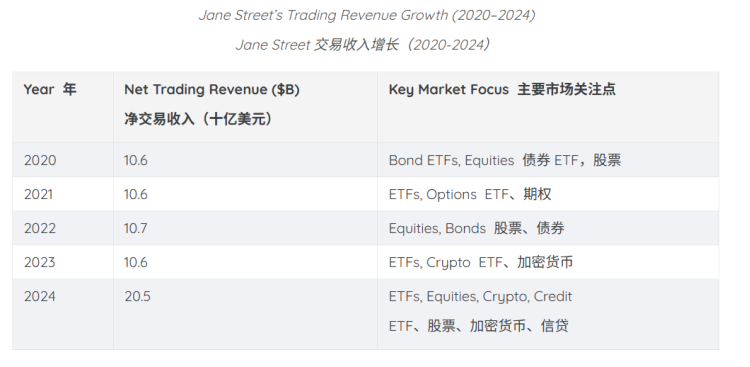
2024, Jane Street net trading revenue: $20.5 billion.
Same year, Citigroup trading division net revenue: $19.8 billion. Bank of America trading division: $18.8 billion.
Jane Street won, beating Citigroup by $700 million and Bank of America by $1.7 billion.
According to online data, Citibank has about 220,000 employees globally. Bank of America has about 210,000 employees globally, while Jane Street has over 3,000 employees.
This is an almost perverse level of efficiency.
Source: MSTIMES
By 2025, the data is even more staggering. According to Bloomberg and others, Jane Street's Q2 2025 net trading revenue was $10.1 billion, surpassing all major Wall Street banks. Total revenue for the first three quarters of 2025 was $24 billion, exceeding the full-year 2024 total...
Put these numbers in an industry context: Citadel Securities 2024 trading revenue was about $9.7 billion, Virtu Financial about $2.9 billion, Flow Traders about $500 million. Jane Street has at least a two-fold gap over its competitors.
Beyond scale numbers, some market share data can help you understand just how deeply this company has penetrated:
In 2024, Jane Street accounted for 24% of the US-listed ETF primary market, 41% of bond ETF trading volume, and 17% of the European ETF secondary market. Its average monthly equity trading volume reached $2 trillion, it accounted for about 8% of all Options Clearing Corporation volume in the US options market, and over 10% of North American equity trading.
In other words: You, your fund, your pension fund—every time you buy or sell an ETF, there's a significant probability the counterparty is Jane Street. And you don't even know it exists.
OCaml, Puzzles, and That Real War Machine
Jane Street's headquarters is at 250 Vesey Street in Manhattan's Financial District, New York. In the office, there's a real WWII-era Enigma encryption machine—the kind Nazi Germany used to encrypt communications.
This machine isn't decoration; it's a declaration.
This company loves encryption, loves puzzles, loves building its own world with languages only a few can interpret.

The programming language for Jane Street's core trading system is OCaml.
OCaml is a functional programming language known for its strong type system and logical rigor, but almost no other company in the finance industry uses it. As of 2023, Jane Street's OCaml codebase exceeded 25 million lines—the Financial Times noted this is about half the codebase of the Large Hadron Collider.
This choice seems odd but has deep engineering logic: In financial trading systems, a single line of buggy code can cause hundreds of millions in losses. OCaml's type system forces the elimination of many potential errors at the compilation stage, making it harder to write code that crashes at runtime compared to C++.
A side effect: Engineers who have worked at Jane Street often find it hard to be "absorbed" by other companies because of their OCaml expertise. As one headhunter described: "People stay at Jane Street because they love it there, but also because no one will poach you for your OCaml skills."
This creates an unexpected moat: the tech stack binds talent.
It's worth noting that Jane Street has no CEO.
No hierarchical bureaucracy, no management layers, no titles like "Vice President" or "Managing Director" that are commonplace in the finance industry.
The Financial Times described it as: "An extremely profitable anarchist commune."
The company is governed by 30 to 40 senior employees making decisions collectively, operating through management and risk committees. These 40 people hold about $24 billion in company equity. They run the trading desks and business units, but they aren't called "presidents"—they are just owners.
All employee compensation is tied to the company's overall profits, not individual trading performance. This means no one takes excessive risks for their own bonus, because losses are shared by all, and gains are shared by all.
In 2024, Jane Street paid its approximately 3,000 employees an average compensation of $1.4 million.
That Jane Street intern recruitment screenshot isn't a marketing gimmick; it's Jane Street's consistent self-perception: they're not looking for finance experts, but "people who enjoy solving interesting problems."
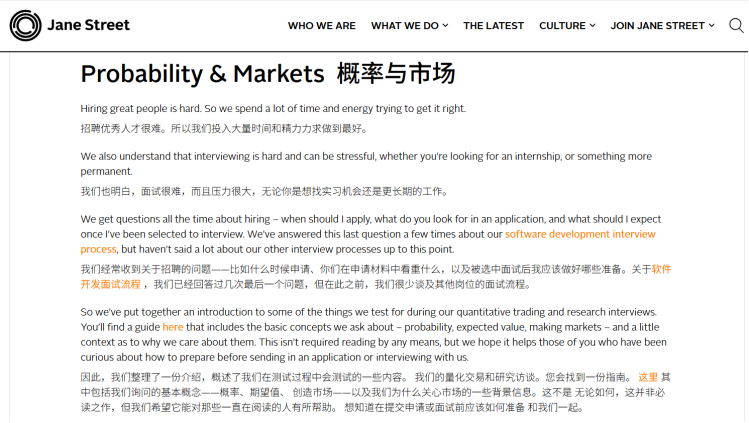
"The interview process is notoriously difficult." Candidates need to solve probability problems, game theory questions, and expected value calculations under pressure, testing underlying logical ability rather than industry knowledge. According to the company's own description, only a "tiny fraction" of applicants are invited to the interview stage.
The company does not use non-compete agreements—an extremely rare exception in a finance industry where signing non-competes for departing employees is almost standard. Jane Street believes its competitive advantage isn't a specific algorithm, but the entire system's culture and density of capability, which cannot be easily replicated.
A senior hedge fund quant analyst pointed out that Jane Street is a trader's paradise, while Citadel Securities is more suited for quantitative analysts and developers. "Jane Street is trader-oriented, Citadel Securities is more systematic," he explained. "Traders are more social, which is why Jane Street has a relaxed atmosphere and a prevalent poker culture."
Michael Lewis, author of the SBF biography "Going Infinite," recalled that when SBF was still at Jane Street, its trading floor retained a "sound system": different alert tones corresponded to different trading states. There was Homer Simpson's "D'oh!", the 1-Up sound from Mario, even the famous line from the 1998 strategy game StarCraft: "You must construct additional pylons."
Noise was everywhere. Some even thought the trader they were on a call with was playing a video game because the noise was so loud.
This relaxed and deliberately quirky atmosphere is a cultural marker they deliberately maintain while operating at full capacity.
SBF and the 2016 Election Night: From the Biggest Win Ever to the Biggest Loss Ever
In 2014, a young MIT graduate joined Jane Street with a first-year salary of $300,000.
His name was Sam Bankman-Fried, known as SBF.
He later built FTX and destroyed it himself, receiving a 25-year prison sentence. But before that, his three years at Jane Street left behind the most dramatic night in the company's history.
During his initial interview, SBF wasn't asked routine questions like "what did you do over the summer?" but was instead subjected to a series of game tests—which were essentially gambling games. He had to quickly answer math or probability questions, such as "What's the probability of rolling at least one three with two six-sided dice?" or "What's the probability of rolling two threes with two dice?" These questions were easy for SBF, and he thrived.
As the questions grew more complex and the pace faster, his performance improved. He "immediately realized the key to the game was making quick judgments about the expected value of bizarre situations and acting on them." He understood they were "testing his judgment and execution in chaotic situations—not getting hung up on questions he couldn't possibly know the answer to."
This game mode tests the potential of future traders. But the real payoff is applying these skills in actual combat. And actual combat came two years later.
During the 2016 presidential election, Jane Street traders believed that if Donald Trump were elected, global stock markets would plummet. According to Lewis, to gain a competitive edge, Jane Street put SBF in charge of a project to design a system that could predict the election outcome.
Their goal: Know the election results before CNN, then trade faster than everyone else.
SBF assigned different traders to analyze voting data from different states. The system worked astonishingly well—Jane Street predicted results in several key states minutes or even hours before CNN.
On election night, shortly before midnight, the system sent a signal: Florida voting data heavily favored Trump, his probability of winning jumped from 5% to 60%.
"We even had time to freak out, think there must be a number entered wrong, confirm there wasn't, and then say: Fuck it, sell." — SBF later told biographer Michael Lewis
According to Lewis's account in the book, Jane Street shorted the S&P 500 index with positions worth tens of billions of dollars, while also shorting stock markets in multiple countries globally, betting on a market crash after Trump's election.
By the time SBF went to sleep, the paper profit was $300 million. It was the company's single largest profit ever.
Three hours later, he returned to the trading desk to find the world had changed.
The market digested Trump's victory and then... started to rise.
The US market didn't fall but rose—because Trump was seen by many as a pro-business candidate.
Jane Street's short positions were squeezed in this rally.
"That trade, which had been Jane Street's single biggest profit ever, became its single biggest loss ever—a $300 million loss." — SBF
From +$300 million to -$300 million, a net swing of $600 million overnight.
Jane Street didn't punish SBF. They chose another way to evaluate it: SBF's prediction system was accurate, his model wasn't wrong; the error was in judging the market's reaction direction, which wasn't a pure math problem. Reportedly, he was even praised internally for the accuracy of the prediction machine itself.
Based on his exceptional trading performance, Jane Street paid SBF $300,000 in his first year, increased it to $600,000 in his second year, and awarded him a $1 million bonus in his third year. Estimates suggested that if he maintained this performance, his annual salary would reach $75 million after ten years.
But he chose to leave, to found Alameda Research and FTX—
And then, in another way, made history again.
The Jane Street Exodus List
After FTX's collapse, people were surprised to find that Jane Street's alumni network almost dominated the list of core figures in the entire event:
SBF himself (Jane Street trader, 2014-2017). Caroline Ellison (Alameda CEO, SBF's ex-girlfriend, former Jane Street trader). Gabe Bankman-Fried (SBF's brother, former Jane Street trader, but for a short time and in a somewhat awkward position). Lily Zhang and Duncan Rheingans-Yoo (SBF's former colleagues, later founded Modulo Capital, received about $400 million in investment from Alameda, with headquarters in the same building as SBF's Bahamas residence).
The density of this circle is hard to ignore.
Jane Street nurtured the most important person in the crypto world of this era, in whatever sense of "important."
*Part of the reason was that his older brother had just left and started poaching people from Jane Street to join his own competing trading firm. People familiar with the matter said the brothers didn't speak for a very long time.
A $1 Billion Secret
This story starts with a lawsuit, which unexpectedly ignited another, larger crisis.
In February 2024, two Jane Street traders—Douglas Schadewald and Daniel Spottiswood—suddenly resigned and jumped to hedge fund giant Millennium Management.
Jane Street promptly sued the two and Millennium in April, accusing them of stealing a "highly valuable" proprietary trading strategy.
What was the core of this strategy? An inadvertent detail in court made everyone realize: It was a short-term index options strategy specifically targeting the Indian options market—it generated over $1 billion in profit for Jane Street in 2023 alone.
More specifically, after the two traders took this strategy to Millennium, Jane Street's profits in the Indian market plummeted by 50% in March 2024. Meanwhile, Millennium's Indian business began expanding aggressively.
In December 2024, the case was settled with confidential terms, the specifics undisclosed.
But the "$1 billion Indian options strategy" disclosed by Jane Street in the lawsuit caught the attention of the Securities and Exchange Board of India (SEBI). Many Indian retail investors suffered heavy losses in options trading; why could a foreign company like yours earn such enormous profits?