






Q4 Loss of $667 Million, Yet Stock Price Soars 16%, Coinbase is Not a Buy Now


- Core View: Artemis analysts believe that although Coinbase has promising long-term market prospects and a dominant position in the US market, its business is highly cyclical. Short-term profits are insufficient to offset the risks, and investing in its stock is currently not recommended.
- Key Factors:
- Coinbase reported a net loss of $667 million in Q4 2025, with revenue missing expectations. However, its stock price surged the next day, indicating short-term market optimism for its 2026 business development.
- The company's revenue heavily relies on cyclical trading business (56%) and interest rate-sensitive stablecoin revenue (30%). The risk of earnings falling short of expectations for the 2025-2026 fiscal year is high.
- Analysts expect brokerage business to remain under pressure in 2026, with retail account assets potentially shrinking by nearly 10%, leading to earnings per share possibly being about 14% below market expectations.
- Although regulatory progress is a long-term positive, the process is slow and insufficient to offset short-term profit pressures caused by declining cryptocurrency prices and weak trading activity.
- The global market share of decentralized exchanges (DEX) continues to grow, posing a structural challenge to centralized exchanges. However, Coinbase maintains its leading position due to its regulatory credibility and fiat on-ramp advantages in the US.
Original Authors / Tiago Souza, Mario Stefanidis
Compiled by / Odaily Golem (@web3_golem)
Editor's Note: On February 13, Coinbase released its Q4 and full-year 2025 financial results.The report showed that while Coinbase had a strong full year with trading volume and market share doubling, and platform assets and USDC balances reaching all-time highs, it recorded a net loss of $667 million in Q4 2025, with a loss per share of $2.49 and total revenue of $1.78 billion, falling far short of analysts' expectations.
Consequently, several Wall Street investment banks, including JPMorgan and Canaccord,lowered their price targets for Coinbase stock. However, COIN still surged 16.46% at the close of U.S. markets on February 14, seemingly unaffected by the disappointing Q4 results, proving that the market remains optimistic about Coinbase's business development in 2026 in the short term.
But analysts at Artemis believe that in investing in this sector, timing is crucial. While Coinbase's market prospects are promising in the long run, its current returns are insufficient to compensate for the risks in the short term. Coinbase remains highly cyclical. Given the continued pressure on its brokerage business fundamentals and the lagged impact of the current market downturn, the market's consensus expectations for Coinbase in 2026 are still too high. Therefore, it is not advisable to buy its stock now.
The analysts systematically elaborated on Coinbase's business revenue composition, current advantages, and future challenges. Odaily has compiled and condensed the key analytical points as follows for investor reference.
Conclusion First: Not Recommended to Invest in Coinbase at Present
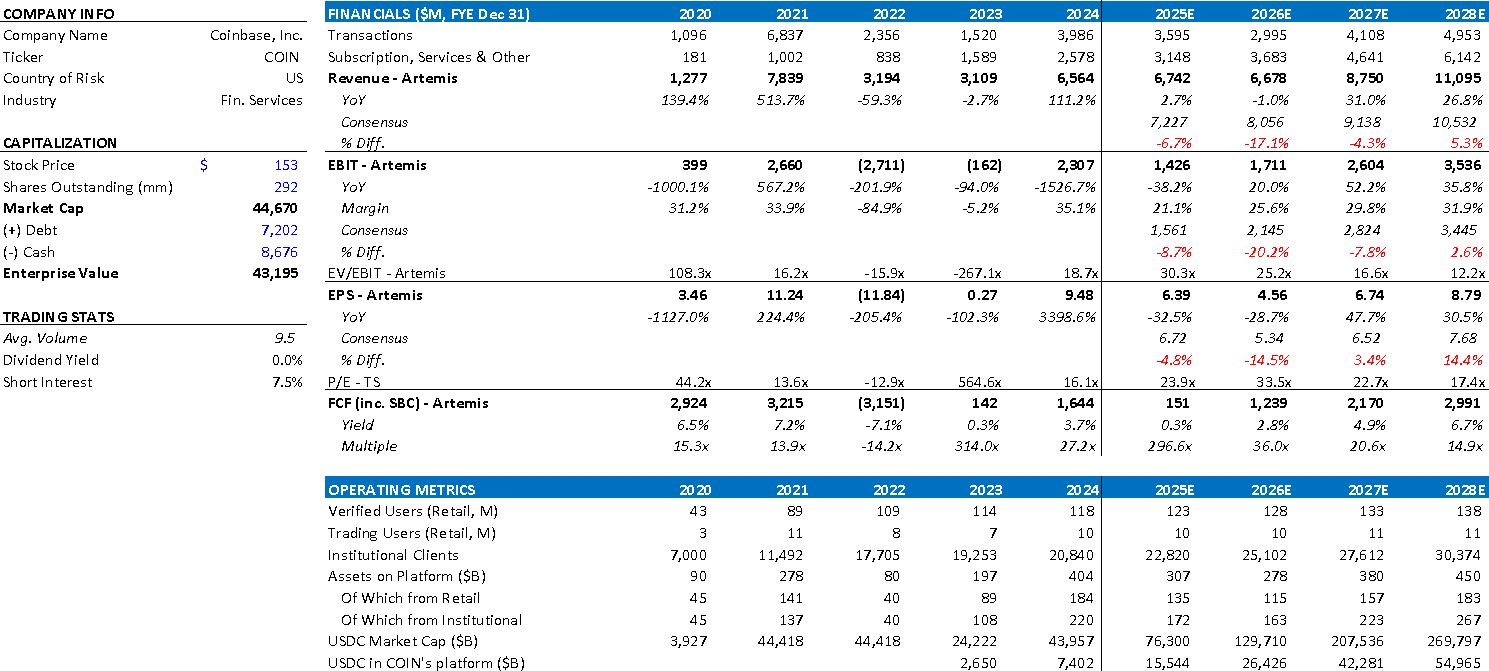
Coinbase's Core Financial Data Over the Years
We currently do not recommend investing in Coinbase because we believe its current returns are insufficient to compensate for the risks. Although Coinbase maintains a dominant leading position in the U.S. market, with a strong institutional client base, favorable regulatory standing, and solid domestic competitive advantages, timing is crucial for investors.
Looking back at previous cryptocurrency sell-offs, earnings estimate downgrades and P/E ratio compression typically persist for some time after the initial price correction, as declines in account asset sizes and weak trading activity lag behind financial performance. We expect a similar pattern in the current cycle.
Given the continued pressure on Coinbase's brokerage business fundamentals and the high likelihood of earnings falling short of expectations for FY 2025 and FY 2026, downside risks remain significant. Although Coinbase's long-term franchise value persists, short-term volatility and potential earnings misses lead us to conclude: at this stage of the cycle, the expected return is insufficient to compensate for the risk.
Overview of Coinbase's Business Revenue Composition
Coinbase is a centralized cryptocurrency platform whose primary revenue source is its brokerage business, providing digital asset trading intermediary services for retail and institutional clients. The platform matches client trades with liquidity providers, uses public blockchains to record and settle asset ownership, and integrates with traditional banking systems for fiat deposits and withdrawals.
Despite the competitive and cyclical nature of the trading market, Coinbase is actively expanding its scope beyond a pure trading economy model towards broader crypto financial infrastructure, embedding multiple initiatives directly into its core application. These initiatives include:
- Coinbase One, a subscription product offering zero-fee trading and enhanced services, aimed at boosting recurring revenue and customer retention;
- Prediction markets (in partnership with Kalshi), extending Coinbase's derivatives and event-driven trading capabilities;
- Tokenized stocks, enabling users to access traditional financial assets via blockchain.
Beyond existing businesses like institutional custody and prime brokerage, staking and on-chain yield, stablecoin distribution and payments, and derivatives, Coinbase is also building application and settlement infrastructure through its open-source, permissionless Ethereum Layer-2 network, Base.
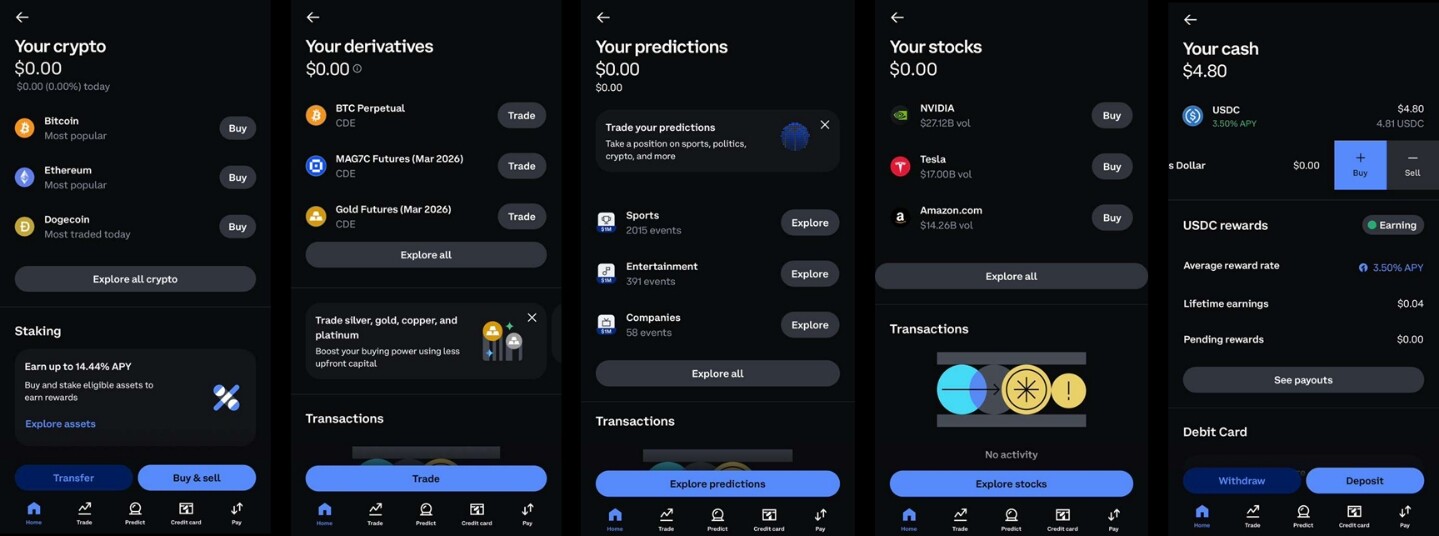
These initiatives aim to enhance customer engagement and retention, especially at the institutional level, diversify revenue towards more recurring and infrastructure-related income, and transform Coinbase from a trading-oriented broker into a platform and gateway connecting traditional finance with on-chain markets.
Trading Business Revenue
56% of Total Revenue | 6-Year CAGR 36% | Market Size: $270B (2024)
Trading revenue is the core of Coinbase's brokerage business, where the company holds approximately a 14% market share. Revenue comes from transaction fees and spreads charged on platform trading volume.
Trading volume is primarily driven by total platform assets, which stand at about $516 billion, with retail contributing 42% and institutional clients 58%. While institutional clients drive most asset growth, retail remains the primary profit contributor due to significantly higher spreads.
- Retail spread: ~154 basis points
- Institutional client spread: ~6 basis points
Institutional clients trade via Coinbase Prime, a standalone suite offering advanced execution algorithms, smart order routing, and over-the-counter (OTC) block trading services. These clients require more sophisticated infrastructure but generate lower revenue per dollar, highlighting the importance of retail participation for Coinbase's overall margins.
Subscription and Services Revenue
44% of Total Revenue | 6-Year CAGR 232%
This segment aggregates Coinbase's non-trading revenue sources, reflecting the company's strategic shift towards a recurring, infrastructure-driven profit model. It comprises the following parts:
- Stablecoins (30% of revenue)
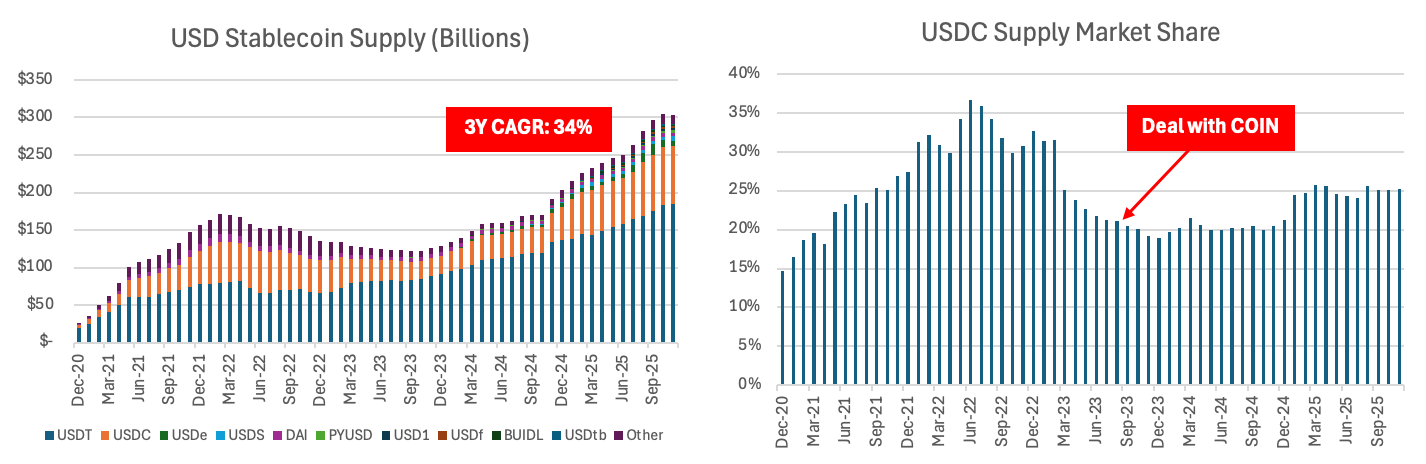
Stablecoin revenue is primarily driven by USDC adoption and the federal funds rate. Coinbase earns interest income from USDC reserves through a revenue-sharing agreement with its issuer, Circle.
Under the August 2023 agreement, Coinbase receives all interest income generated by USDC on its platform, while interest from USDC held off-platform is split 50/50 between Coinbase and Circle.
This structure makes USDC Coinbase's most significant non-trading revenue source, creating a scalable but interest-rate-sensitive income stream that helps reduce the company's reliance on more volatile trading volumes (which still accounted for 86% of total revenue in 2020).
Notably, the majority of the economic value from the Circle partnership accrues to Coinbase, reflecting Coinbase's control over distribution and user access. Data shows that USDC's market share stabilized after a period of decline and then began to recover following Circle's distribution agreement with Coinbase, highlighting the central role of large, trusted platforms in stablecoin adoption and reinforcing the strategic value of Coinbase's distribution advantage.
- Staking Services (10% of revenue)
Clients stake crypto assets through Coinbase, and the company earns a commission from staking rewards. In proof-of-stake (PoS) networks like Ethereum and Solana, staking involves locking assets to support network validation. Validators earn yield-like rewards, which Coinbase provides, taking a portion as a fee.
Key revenue drivers for this segment include crypto asset prices and overall blockchain activity.
- Other Services (4% of revenue)
This category includes several monetization initiatives launched post-IPO that are currently scaling:
- Coinbase One, a subscription service offering lower trading fees, enhanced rewards, and priority customer support;
- Base, Coinbase's L2 blockchain, enabling developers to build applications and services on-chain;
- Payments, including a prepaid debit card launched in partnership with Visa, allowing customers to spend fiat and earn crypto rewards. Transactions settle in fiat, but the user experience resembles native crypto payments.
Bull vs. Bear Debates Around Core Coinbase Questions
Can Coinbase Significantly Reduce Its Cyclicality, or Will Its Stock Remain a Leveraged Proxy for Cryptocurrency (Primarily Bitcoin) Prices?
Historically, COIN's stock price has been highly correlated with Bitcoin and broader crypto prices, reflecting its earnings being driven by spot trading volume.
- Bull Case: Management's push into subscriptions, stablecoins, derivatives, custody, and Base will diversify revenue and reduce cyclicality over time.
- Bear Case: Despite these initiatives, spot trading still dominates its economics, meaning declines in Bitcoin and major crypto prices will impact its stock price.
Sustained crypto asset declines directly lead to lower trading volume, margins, and earnings.
Can Stablecoins Significantly Improve the Company's Profit Profile?
- Bull Case: USDC-related revenue is a scalable, high-margin business tied to on-chain payments, treasury usage, and tokenized cash, providing a partial hedge against trading volatility.
- Bear Case: Stablecoin revenue is highly sensitive to interest rates, asset mix, and competitive dynamics, meaning rate cuts or changes in custody balances could significantly compress earnings. If stablecoin profits prove to be cyclical rather than structural, the perceived downside protection in Coinbase's earnings model weakens.
How Will Regulatory Changes Impact the Company's Profit Profile Over the Next 12-24 Months?
- Bull Case: Clearer rules will facilitate institutional participation and cement Coinbase's position as the most compliant platform in the U.S., solidifying its status as the default gateway to crypto markets.
- Bear Case: Regulation could also attract traditional brokers and financial institutions into crypto, accelerating fee compression and intensifying competition, especially in retail. Greater legitimacy may expand trading volume but could come at the expense of long-term pricing power.
Centralized Exchange Challenges and Coinbase's Unique Advantages
The Rise of DEXs in the Global Trading Market
Globally, the total addressable market (TAM) for both centralized exchanges (CEXs) and decentralized exchanges (DEXs) is the same underlying pool of capital: cryptocurrency trading activity spanning spot, derivatives, and on-chain asset swaps, with annual nominal volumes currently in the trillions of dollars.
For spot trading alone, industry data shows global CEX spot volume exceeded $18 trillion in 2024, while derivatives volume is significantly larger. In the U.S., the spot TAM is smaller but still substantial, with estimated USD-denominated spot volume around $1.5 trillion annually, reflecting the U.S.'s importance in fiat liquidity and price discovery. Historically, centralized exchanges (CEXs) captured the majority of this market due to deep liquidity, easy fiat on-ramps, and a more accessible user experience, especially for retail and institutional participants.
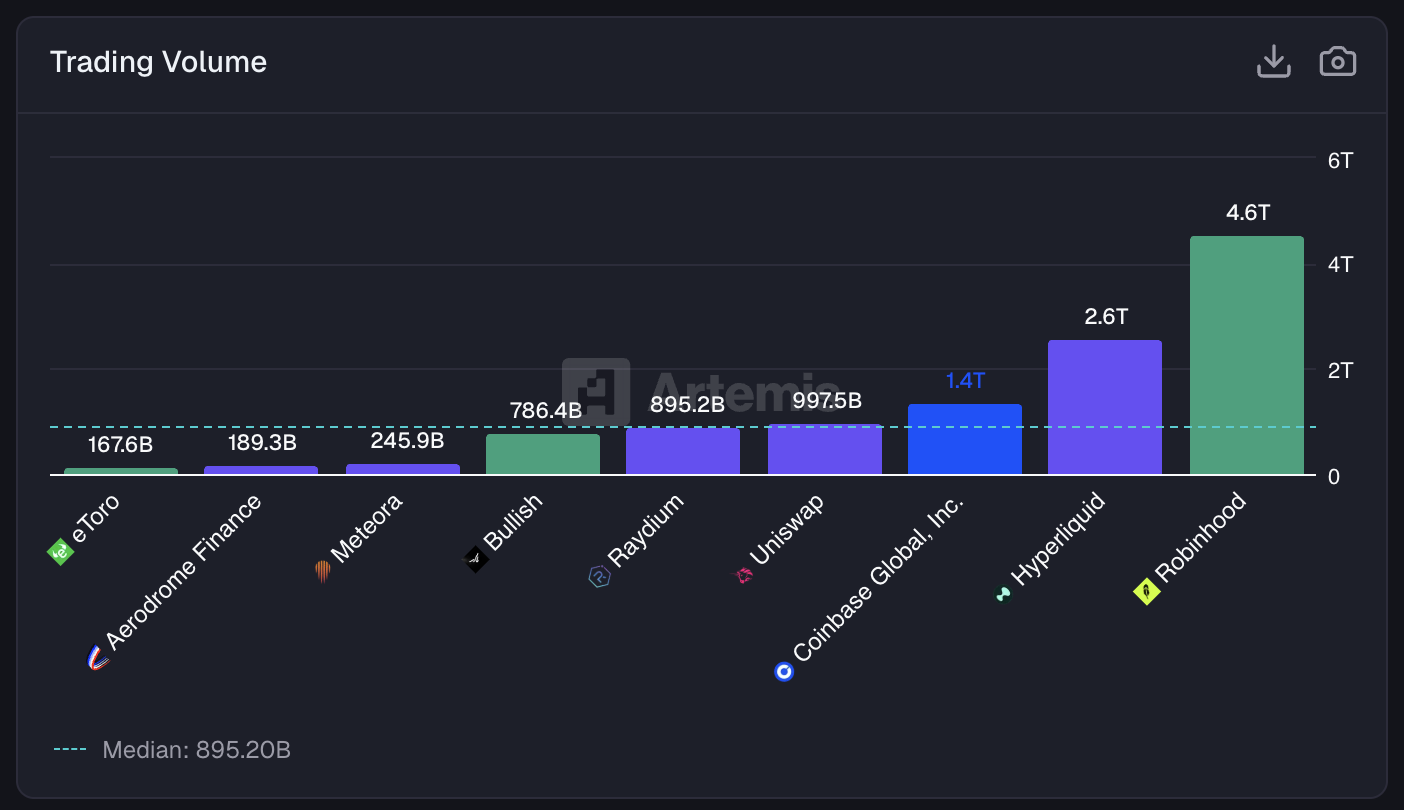
However, over time, decentralized exchanges (DEXs) have steadily grown their share of global trading volume, from low single digits a few years ago to the low twenties today. This shift is more pronounced outside the U.S., where DEX usage benefits from permissionless access, while U.S. market share remains notably lower, constrained by fiat dependency and regulatory friction.
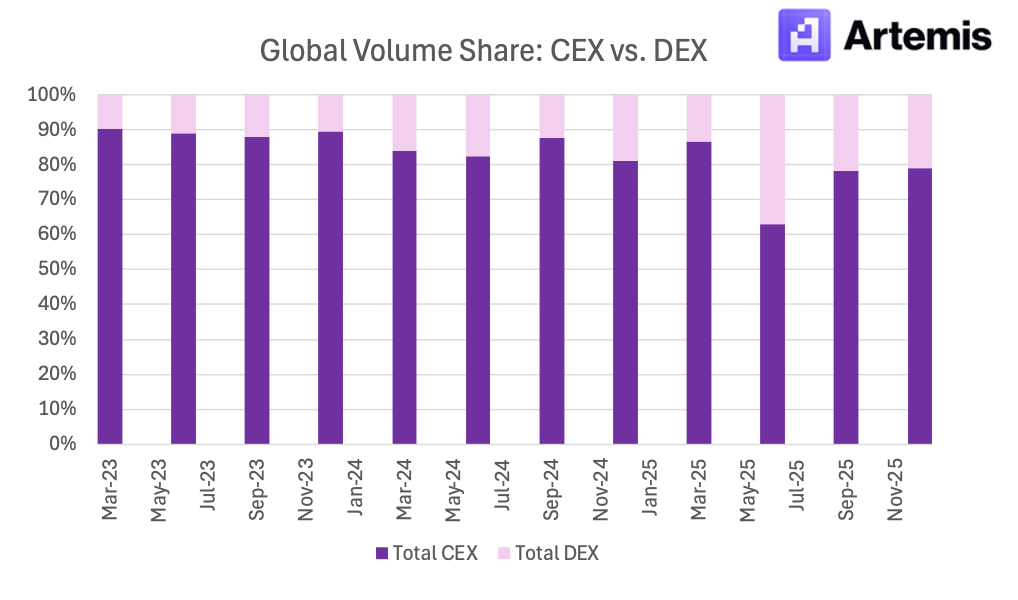
The underlying drivers are structural: L2 networks have reduced transaction costs and improved execution quality and liquidity depth, coupled with the rapid development of on-chain ecosystems where functions like trading, lending, and yield generation are increasingly native.
Simultaneously, increased regulatory and compliance burdens have limited product flexibility for CEXs in multiple jurisdictions, while DEXs remain globally accessible by design. Furthermore, it's worth noting that in the U.S., increased regulatory and compliance burdens have similarly limited product flexibility for CEXs in multiple jurisdictions, while DEXs are accessible globally without permission.
Therefore, while CEXs still dominate absolute trading volume and institutional flow, especially in the U.S., DEXs are capturing a growing share of the global trading market TAM, reflecting a gradual but persistent reallocation of trading activity.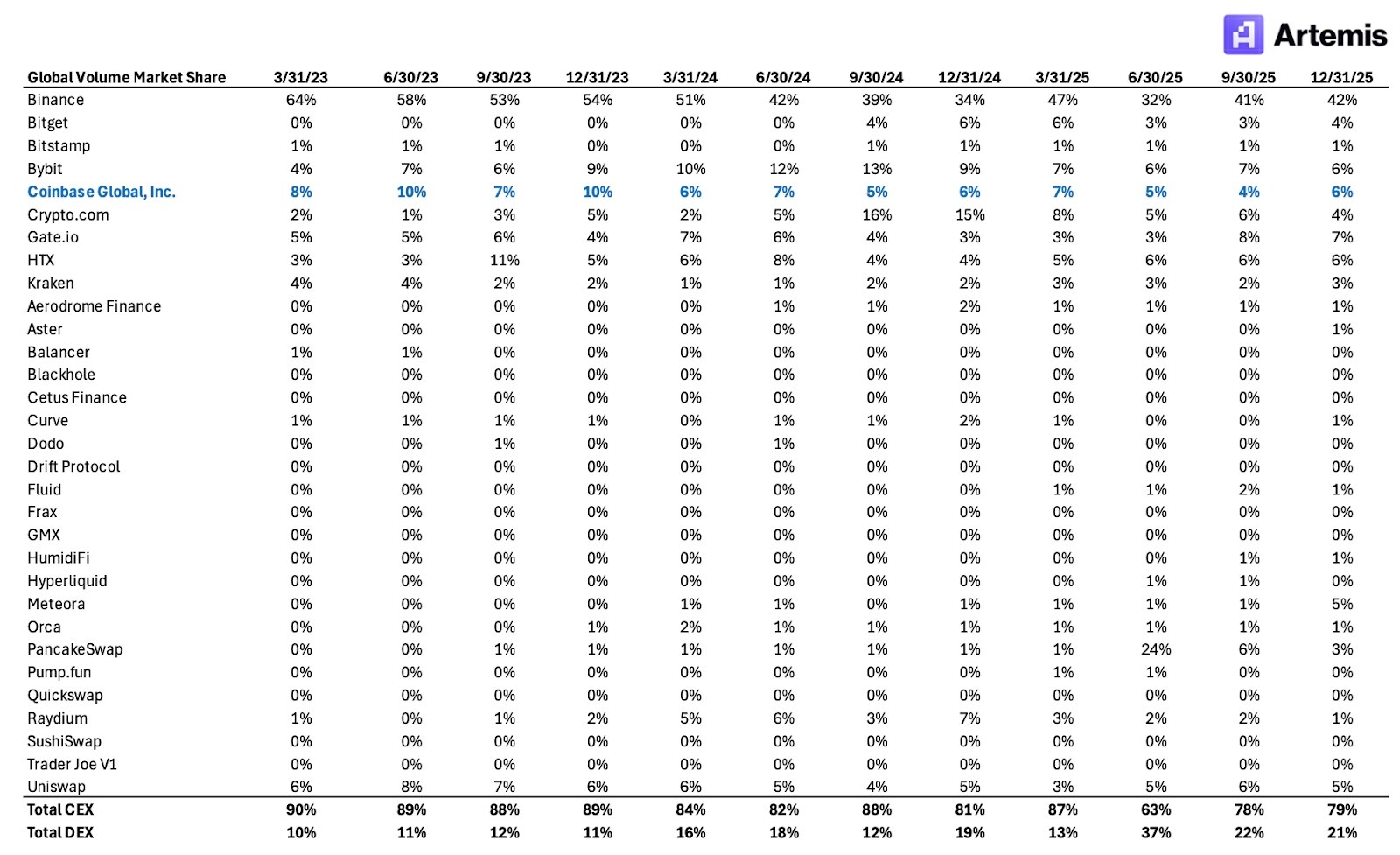
Coinbase's Advantages in the U.S. Market
In the global crypto market, trading fees vary widely across platforms, reflecting differences in regulatory regimes, cost structures, and competitive intensity. In this context, Coinbase has historically charged fees significantly higher than most global peers, primarily due to its U.S.-centric operational model.
Operating fully within the U.S. regulatory framework implies higher costs (covering compliance and custody standards, reporting and capital requirements, etc.), but it also offers users legal clarity and security unmatched by offshore platforms. For U.S. retail users, especially during periods of strong market growth, this trade-off has justified paying for convenience, trust, and regulatory certainty.
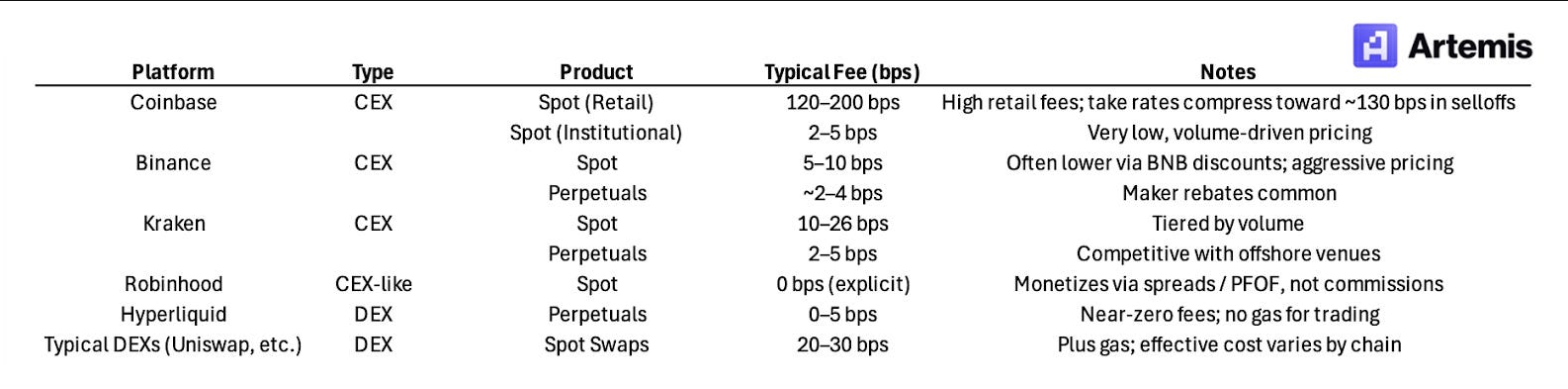
Fee Rates Charged by Different Exchanges
In the U.S., Coinbase holds a uniquely advantageous position as the largest and longest-standing regulated cryptocurrency exchange, particularly in USD-denominated spot trading.
Coinbase accounts for approximately 40% to 50% of U.S. spot crypto trading volume, with an even higher share during periods of market stress when counterparties prioritize balance sheet safety and regulatory clarity. Its core customer base includes U.S. retail users who value ease of use and reliable fiat on-ramps, as well as institutional clients (including asset managers, ETFs, corporates, and market makers) who value convenience and regulatory certainty.
This two-sided franchise benefits from deep banking relationships, integrated custody services, and a long-standing working relationship with U.S. regulators.
But the competitive landscape in the U.S. differs significantly from global markets. Coinbase's primary competitors include Robinhood (which aggressively competes on price in the retail market but offers a narrower range of crypto products), Kraken (which attracts more active traders with lower fees), and Binance.US (whose scale and product breadth remain limited relative to its global parent).
Unlike offshore platforms, these competitors operate under similar regulatory constraints, limiting fee arbitrage and product differentiation. Therefore, competition in the U.S. is not about who offers the lowest global fees, but about trust, compliance, and USD liquidity. Coinbase's regulatory credibility, institutional penetration, and dominant USD on-ramp position solidify its leadership in the U.S. crypto market, even as competitive pressures intensify at the margins.
Three Arguments for Anticipating Suboptimal Future Business for Coinbase
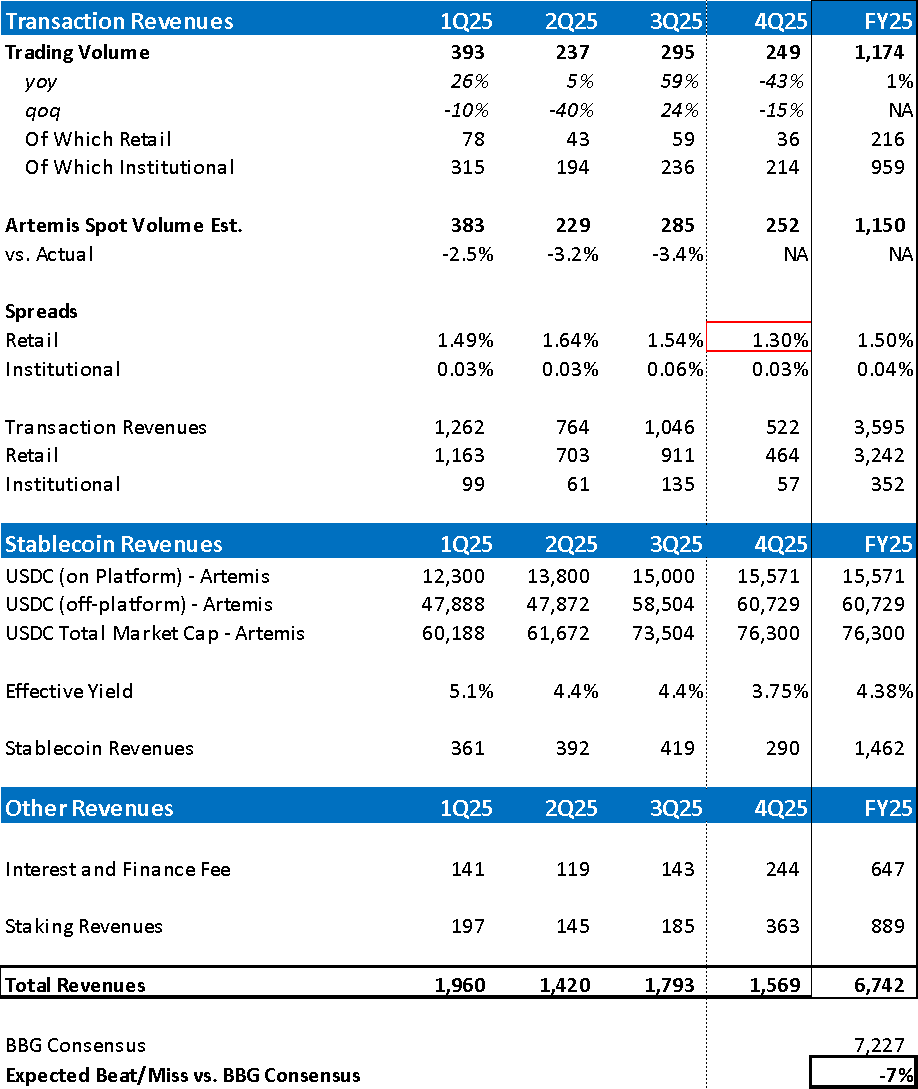
Argument 1: Coinbase's brokerage business is expected to face pressure in Q4 2025, potentially leading to FY 2025 revenue falling ~7% below market expectations.
Despite expanding other services on its platform, Coinbase's earnings remain highly dependent on two major segments: brokerage and stablecoin-related revenue. This anticipated earnings shortfall primarily stems from continued pressure on the brokerage business in Q4 2025. We estimate this using the Artemis terminal to track Coinbase's spot trading volume, which historically has an average error margin of ~2.5% for quarter-end volume estimates.
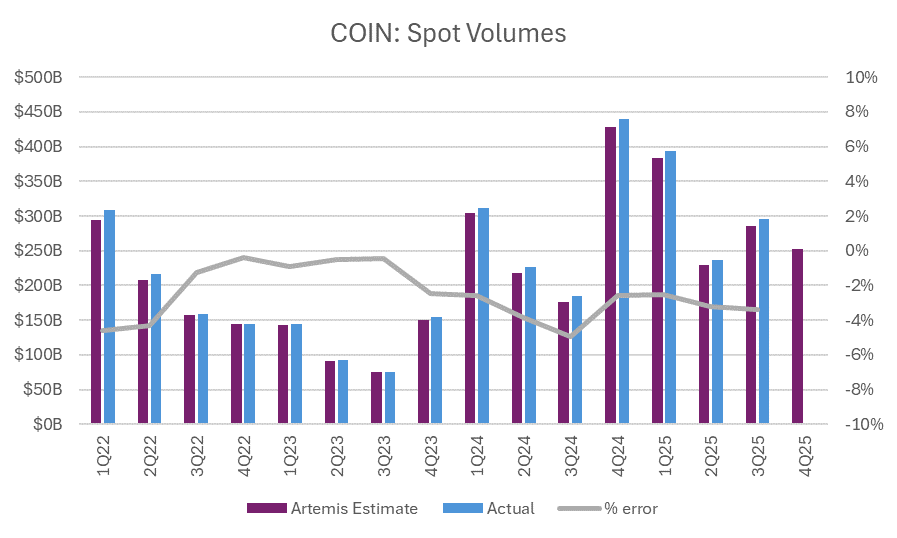
Current data shows a slowdown in trading activity this quarter, with Q4 2025 volume around $249 billion. We expect retail take rates to decline, consistent with patterns during past crypto sell-offs, where retail rates fell to ~130 bps due to reduced volatility and increased competition. Institutional take rates, already structurally low, are expected to remain below 5 bps, aligning with patterns from historical downturns.
Argument 2: Headwinds for the brokerage business are expected to persist into 2026, but due to changes in portfolio mix, the downside pressure will be less severe than during the 2022/2023 crypto winter.





