Escape the Leviathan: Epstein, Silicon Valley, and the Sovereign Individual


- Core Argument: By reviewing the evolution of methods for concealing wealth among the ultra-rich, the article reveals how elites represented by Jeffrey Epstein and Peter Thiel view cryptocurrencies as a new tool to escape national regulation and realize the fantasy of becoming "sovereign individuals." They attempt to shape the rules by influencing technological development with capital and infiltrating political power.
- Key Elements:
- The historical trajectory shows that wealth concealment hubs shifted from Swiss banks (lasting ~74 years) to Caribbean offshore centers (lasting ~50 years). Regulations (like CRS) have forced the lifespan of each generation's "safe haven" to shorten, creating demand for new tools.
- Through MIT Media Lab's "Digital Currency Initiative," Jeffrey Epstein anonymously funded and effectively controlled 3 Bitcoin Core developers, thereby influencing Bitcoin's technical development direction and ideological narrative.
- Silicon Valley elites like Peter Thiel view Bitcoin as a political tool to counter the power of nation-states. The ideological roots of this thinking can be traced back to the book "The Sovereign Individual," which predicted that digital cryptocurrencies would undermine state monetary authority.
- Elites engage in collusion through secretive circles like the Edge Foundation and are turning to political infiltration (e.g., funding campaigns, placing allies) in an attempt to influence or even "buy" regulatory rules from within.
- The Crypto-Asset Reporting Framework (CARF), set to take effect in 2026, signifies a global tightening of regulation. The anonymity of cryptocurrencies faces systematic challenges, but the elite's "escape" fantasy is shifting to new frontiers like anti-aging and space colonization.
Original Author: Sleepy.txt, Beating
For the past hundred years, the ultra-wealthy have been searching for the same thing: a place beyond the law where money can completely escape the scrutiny of sovereign nations.
In the early 20th century, they found Swiss bank accounts.
The 1934 Swiss Banking Act stipulated that banks must maintain client confidentiality, with violators facing criminal prosecution. The wealthy could stash their assets in accounts whose identities were known only to a handful of senior bank employees, evading taxes and legal oversight from their home countries.
This system operated for 74 years until 2008, when the U.S. Internal Revenue Service issued a "John Doe summons," compelling UBS Group to provide account information for approximately 52,000 U.S. clients.
The following year, UBS paid a $780 million fine and handed over a partial client list.
When the underground vaults were no longer safe, capital swiftly shifted its position, flooding into tax havens in the sun.
In the mid-20th century, offshore centers in the Caribbean began to rise. The Cayman Islands, Bermuda, the British Virgin Islands—these islands scattered across the blue sea, with their zero tax rates and lax regulations, became paradises for multinational corporations and the wealthy to register shell companies and hide wealth.
This system operated for about 50 years until 2014, when the Organisation for Economic Co-operation and Development (OECD) released the Common Reporting Standard (CRS), requiring global financial institutions to automatically exchange account information of non-resident clients. By 2024, over 170 million accounts were forced into the light, involving assets as high as 13 trillion euros. In the systems of national tax authorities, they became fully transparent.
Sunlight pierced through the Caribbean coconut groves, illuminating the treasures hidden in the shadows.
The lifespan of each generation of offshore havens is shortening. Swiss banks lasted 74 years; Caribbean offshore centers lasted about 50 years. As the regulatory net tightens, the wealthy urgently need a new hiding place.
In August 2019, Epstein died in his Manhattan jail cell. More puzzling than the mystery of his death, the legacy he left behind serves as a specimen of an era, precisely illustrating how the wealthy are switching to another vessel.
In the physical world, he owned Little Saint James Island. This island, equipped with a harbor, an airport, and an independent power grid, was a classic old-style refuge—a tangible place beyond the law. And indeed, on this small island, he made himself and many others into outlaws.
In the digital world, he had long begun new arrangements. From funding Bitcoin developers to investing in infrastructure and lobbying for regulatory policies, Epstein extended his reach into cryptocurrency. Clearly, in his eyes, this virtual refuge was a more worthwhile bet than that physical island.
The Bitcoin crisis of 2015, the regulatory tightening of 2026. Everything that happened in these 11 years is the latest round in this century-long cat-and-mouse game.
Dirty Money
In April 2015, the Bitcoin Foundation, an organization once seen as the central bank of the Bitcoin ecosystem, admitted in an open letter that it was effectively bankrupt.
Founded in 2012 by a group of early Bitcoin believers and evangelists, including Satoshi Nakamoto's "successor," chief scientist Gavin Andresen, and later known as "Bitcoin Jesus" Roger Ver, its mission was to fund core developer salaries, organize conferences, promote the technology, and provide a form of official endorsement for this wildly growing digital currency.
However, this centralized organization in a decentralized world disintegrated within just three years due to corruption, infighting, and management chaos.
Its founding board member and then-CEO of the world's largest Bitcoin exchange, Mt. Gox, Mark Karpelès, was imprisoned following the exchange's collapse and the disappearance of 850,000 bitcoins; Foundation Vice Chairman Charlie Shrem was sentenced to two years in prison for involvement in money laundering.
With the foundation's collapse, the livelihoods of five core developers became a major issue. The code they maintained supported a market cap of tens of billions, yet in reality, they couldn't get paid.
In April 2015, just as the Bitcoin community was worrying about this, the MIT Media Lab announced the launch of the "Digital Currency Initiative." They acted swiftly, recruiting all three key figures—Gavin Andresen, Cory Fields, and Wladimir van der Laan—into their ranks. This interdisciplinary lab, founded in 1985 and known for its forward-looking research and close collaboration with the business world and the wealthy, became the Bitcoin developers' "white knight."
But this white knight's money was not clean.
The director of the MIT Media Lab at the time was Joi Ito, the famous Japanese-American investor who had once been influential in Silicon Valley, with early investments in Twitter and Flickr.

According to a 2019 New Yorker investigative report, it was Joi Ito who decided to use Epstein's money to fund this "Digital Currency Initiative."
Between 2013 and 2017, Epstein directly donated $525,000 to the MIT Media Lab. But this was just the tip of the iceberg. According to Epstein himself, he helped MIT raise at least $7.5 million from other wealthy individuals, including $2 million from Bill Gates. These funds were cleverly marked as anonymous, completely hiding Epstein's influence in the process.
This money shouldn't have gotten in. Due to the 2008 sexual assault case, Epstein had long been on MIT's blacklist. But Joi Ito used a "gift fund" to open a backdoor, bypassing the university's layers of review and laundering the dirty money in. He even specifically emailed colleagues ordering that this money must remain anonymous.
Joi Ito understood the leverage of power all too well. In another email to Epstein, he pinpointed Bitcoin's Achilles' heel: while claiming to be decentralized, the life-and-death power over the code was actually in the hands of just five people. And MIT not only entered the game but recruited three of them at once.
Epstein's reply was brief and meaningful: "Gavin is a smart man."
The implication was that he had bet on the right person. By controlling the people, they quietly achieved control over the code.
This is the magic of top-tier institutions—they can plate the dirtiest money with the shiniest gold. A convicted sex offender transformed into the behind-the-scenes financier of Bitcoin's core circle. The "visiting scholar" cloak allowed him to enter the hall, move freely within the top lab, and rub shoulders with the world's brightest minds.
In 2014, Epstein also invested $500,000 in Bitcoin infrastructure company Blockstream. This company was co-founded by several other Bitcoin core developers, including Adam Back, Gregory Maxwell, and Peter Wuille.
Technology can be decentralized, but funding always has a source. To survive, the decentralized utopia had to accept centralized sustenance, but after all, he who takes the king's shilling sings the king's song.
Epstein's logic was simple: first, let Bitcoin survive; then, steer its development in the direction he wanted.
By funding core developers' salaries, he not only saved a technology on the brink of collapse but also bought influence over its development direction. Joi Ito used his money to persuade three developers to join MIT. In other words, Epstein's funds effectively controlled a majority vote on Bitcoin's technical decisions.
With influence comes the power of definition.
When Satoshi Nakamoto designed Bitcoin, the emphasis was on technical decentralization—no reliance on banks, no reliance on central servers.
But when people like Peter Thiel and Epstein intervened, it was imbued with a more radical ideological color—not just a technological innovation but a challenge to the power of nation-states, a tool for "sovereign individuals" to escape constraints.
When you fund the people who maintain the code, you gain the power to define what this technology "is." The technology itself is neutral, but whoever holds the discourse power decides whom it serves.
So, what was Epstein after by betting on cryptocurrency?
The Secret Silicon Valley Dinner
Epstein wasn't just making venture capital investments; it was more like he was sniffing out the scent of his own kind. He keenly sensed the vast network beneath the surface—a small circle of top elites. In August 2015, at a private dinner in Palo Alto, California, the faint traces of this small circle finally surfaced.
Arranged by LinkedIn co-founder Reid Hoffman, the attendees were star-studded: Jeffrey Epstein, Joi Ito, Elon Musk, Mark Zuckerberg, and Peter Thiel.
At that moment, only a few months had passed since MIT used Epstein's money to recruit Bitcoin developers. Every one of these individuals would later become believers in cryptocurrency. Clearly, this was no ordinary social gathering.
In this circle, Peter Thiel was the undisputed spiritual leader. As a co-founder of PayPal, Facebook's first external investor, and founder of big data company Palantir, he was already a Silicon Valley legend.
In 2017, when Bitcoin's price was still hovering around $6,000, Peter Thiel's Founders Fund had already quietly entered the market, investing $15 to $20 million. By the time they liquidated before the 2022 crypto bear market, this investment brought the fund an astonishing return of about $1.8 billion. In 2023, he bet another $200 million, purchasing Bitcoin and Ethereum separately. Every move he made precisely landed on the eve of a bull market.
Making money was just a side effect. What Peter Thiel was truly obsessed with was the political metaphor behind Bitcoin. In his view, this was the true heir to PayPal, finally realizing that wild dream of creating a new world currency not controlled by governments.
The root of this thinking can be traced to a book published in 1997, later regarded as a bible by Silicon Valley elites: "The Sovereign Individual."
Co-authored by James Dale Davidson and William Rees-Mogg, the book's core thesis is: the Information Age will be the twilight of the nation-state. The true "cognitive elite" will completely break free from the constraints of geographical boundaries, evolving into "sovereign individuals" above nations. It not only accurately predicted the emergence of "digital, encrypted currency" but also directly pronounced the death sentence on state power, asserting that this currency would completely dismantle the state's power to mint money.
For Peter Thiel, this was his spiritual totem. He confessed to Forbes that no book had reshaped his worldview like "The Sovereign Individual." In 2009, he wrote in an article: "I no longer believe that freedom and democracy are compatible."
Since he no longer believed in the existing system, the only option was to leave completely. This obsession explains why Thiel was so fascinated with any tool that could escape state power.
Before embracing Bitcoin, he heavily funded the "Seasteading" project. Initiated by the grandson of Nobel laureate Milton Friedman, this group attempted to build floating cities on the high seas, creating a utopia completely free from national jurisdiction, allowing people to choose laws and governments as freely as shopping in a supermarket. Though it sounded like a fantasy, Thiel didn't hesitate to invest $1.7 million. However, the project eventually stalled due to technical bottlenecks, funding shortages, and protests from locals.
Since the physical Noah's Ark couldn't be built, they had to search for a new continent in the digital world.
In 2014, through an introduction by Reid Hoffman, Epstein and Peter Thiel met. In 2016, Epstein invested $40 million in Thiel's other venture capital firm, Valar Ventures.
The same year, Peter Thiel made a risky move, publicly endorsing Trump at the Republican National Convention. This gamble propelled him directly into the core of the power transition. Overnight, he transformed from a Silicon Valley investor into a key bridge connecting the tech world and the White House.
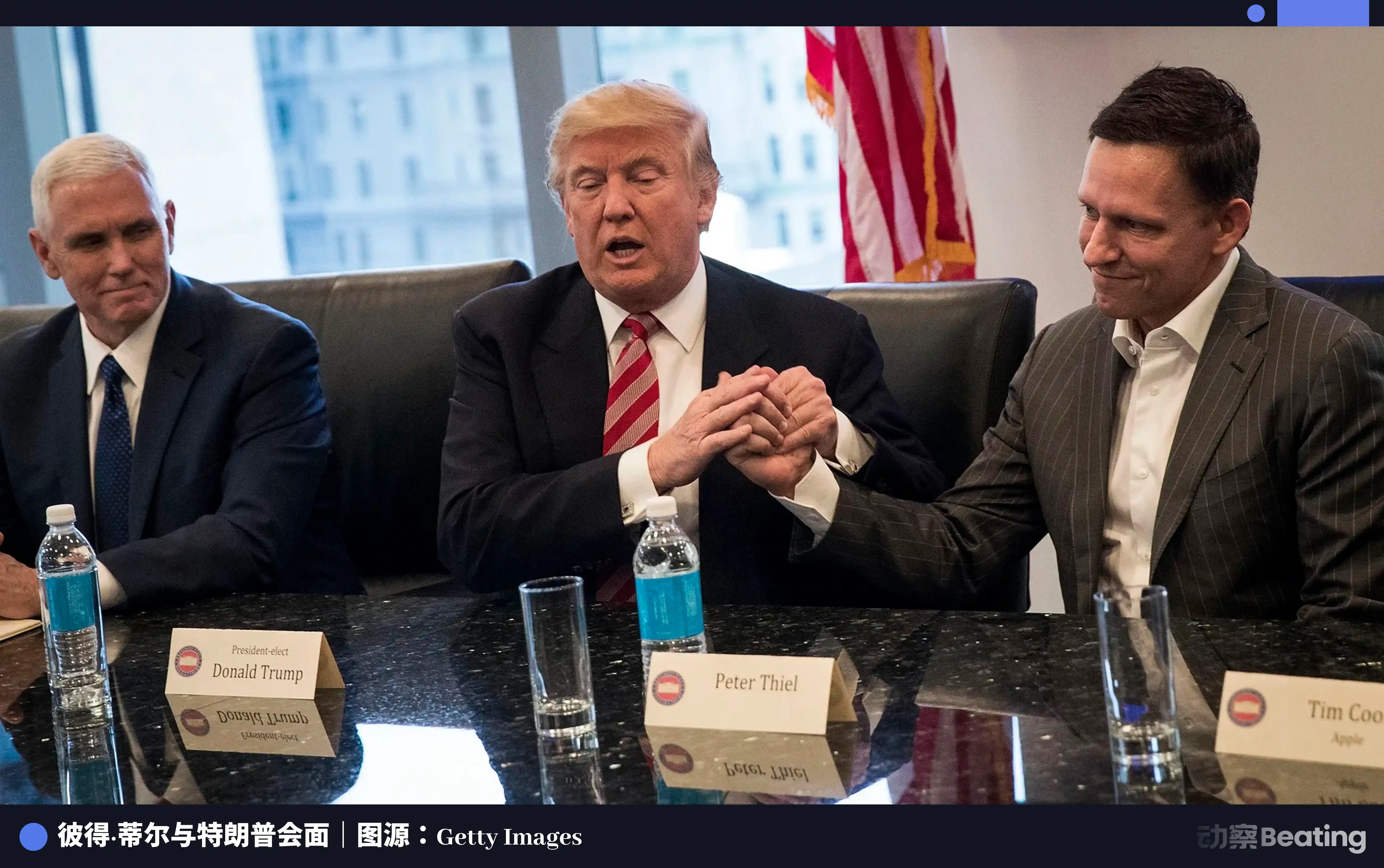
The mastermind behind these dinners and investments was a mysterious organization called the Edge Foundation.
Founded by John Brockman, this non-profit organization played a typical circle game. On an email list exposed in 2011, Epstein's name was赫然 listed alongside Bezos, Musk, the Google duo (Brin, Page), and Zuckerberg.
Under the banner of science and idea exchange, it corralled the world's top minds. But in reality, it was an exclusive elite club. Members exchanged intelligence, completed interest coordination, and unified positions through private emails and offline gatherings, away from public view.
If Davos is a show staged for the world, the Edge Foundation is the backstage. All technological bets and political positioning had already been internally communicated here. In their eyes, Bitcoin was not just an asset but a weapon.
Sovereign Fantasy
Whether it's a private island or Bitcoin, they are essentially manifestations of the same ideology in different dimensions: escaping the constraints of democratic nations. The former creates a place beyond the law in physical space, while the latter constructs a sovereign domain in digital space.
From Swiss bank accounts to Bitcoin public key addresses, the wealthy have been searching for new digital passwords to hide wealth. The privacy of Swiss bank accounts was guaranteed by banking secrecy laws and professional ethics, while the anonymity of public key addresses is guaranteed by cryptography and decentralized networks. Both promise privacy protection, and both were eventually caught up by regulation.
The "freedom" Peter Thiel talks about has nothing to do with you and me.
According to the "World Inequality Report" released at the end of 2025, the wealth controlled by the richest 0.001% of the global population (fewer than 60,000 people) is three times the total wealth of the poorest half of the world's population (about 4 billion people). Furthermore, in 2025, the wealth of global billionaires grew by 16%, a growth rate three times the average of the past five years, reaching a record $18.3 trillion.
This is the truth of the "freedom" they pursue—a world where wealth and power are infinitely concentrated in a few "sovereign individuals," leaving billions behind. They champion Bitcoin not to make ordinary people's lives better but to completely free themselves from any form of social responsibility and wealth redistribution.
This narrative of using technological frameworks as "anti-government tools" rather than "tools for public good" is widespread in Silicon Valley's libertarian circles.
In fact, blockchain technology could have had a different path. It could be a mirror, used to monitor how government budgets are spent and how votes are cast. But when these elites treat it as their private backyard, this technology, which should benefit the masses, is hijacked into a privileged channel for the few.
But reality soon dealt them a blow—complete escape does not exist. Whether hiding on the high seas or within code, the gravity of the real world persists. These smart people quickly realized that since they couldn't run away, they had to change their tactics. Instead of evading the rules, they would simply buy the rule-makers.
In February 2018, an email sent to Steve Bannon sounded the charge.
Steve Bannon, the former "White House strategist," though recently departed from Trump's inner circle, still held considerable sway in Washington.
Epstein approached him without any pretense, directly pressuring him in the email: "Will Treasury ever respond? Or do we need to take a different route?"
The reason for Epstein's urgency was that he had proposed a scheme that appeared to cooperate with regulation but was actually a covert maneuver: a voluntary disclosure form.
On the surface, he claimed this was to help the government "catch the bad guys," leaving criminals nowhere to hide. But in reality, it was a get-out-of-jail-free card custom-made for the powerful. He hoped that by voluntarily declaring income and paying back taxes, the massive amounts of dirty money hidden in cryptocurrency could legally obtain amnesty.
In another email, Epstein wrote in alarm: "Some bad stuff. Very bad."
He knew better than anyone how many shady transactions lay beneath his and this circle's wealth. He desperately needed a "voluntary disclosure" ticket to complete the final laundering for himself and his friends before the regulatory guillotine fell.
This move was not new in Washington. After the 2009 UBS case, the IRS launched the Offshore Voluntary Disclosure Program (OVDP). The program allowed taxpayers with undisclosed offshore accounts to avoid criminal prosecution by voluntarily declaring, paying back taxes, and a penalty. Between 2009 and 2018, approximately 56,000 taxpayers participated, recovering about $11.6 billion in taxes for the IRS.
Epstein's plan was to transplant this logic of paying to launder money, unchanged, into the crypto world. His voluntary disclosure scheme aimed to use tax payment as a bargaining chip to legitimize dirty money. This is the game the elite class excels at—as long as they can co-opt the rule-makers, any dark history can be washed into a white list.
Peter Thiel's level was clearly higher; he treated Washington like a Silicon Valley company to invest in.
In 2016, he bet $1.25 million in donations on Trump, successfully installing his protégé Michael Kratsios into the White House as Deputy Assistant to the President and Deputy Chief Technology Officer.
In 2022, he added another $15 million to send Vance to the Senate. This newly minted senator is not only Thiel's ally but also personally holds Bitcoin worth millions.
See the pattern? This has long transcended ordinary political donations. These tech elites, who believe in the "sovereign individual," are sending their own people into core positions one by one, gradually seizing control of the state apparatus.
However, the iron fist of regulation ultimately came down.
On New Year's Day