Space Recap|AINFT Fully Launches AI Service Platform, Building Next-Generation AI Infrastructure with "Flexible Aggregated Payment"


- Core Viewpoint: The article explores how, against the backdrop of rising AI usage costs, Web3-native solutions represented by the AINFT platform on the Tron TRON ecosystem challenge traditional subscription models through multi-model aggregation, flexible payment, and on-chain integration. It aims to transform AI into a more flexible and inclusive "digital infrastructure".
- Key Elements:
- The surge in AI costs stems from its evolution towards complex "chain-of-thought" tasks and "high-frequency productivity infrastructure", leading to a sharp increase in computing power and operational costs.
- Traditional single-model subscription models are disconnected from users' diverse and scenario-specific needs. Users often pay high fees for infrequently used cutting-edge capabilities, resulting in an imbalance between cost and benefit.
- The AINFT platform aggregates top models like ChatGPT and Claude, providing a unified entry point that allows users to flexibly call the optimal model based on their tasks.
- Its economic model adopts a points system and small on-chain top-ups (supporting multiple currencies), enabling flexible pay-as-you-go payment. Estimated monthly costs can be as low as $5-$15.
- The platform is deeply integrated with the TronLink wallet, enabling one-click login and on-chain payment for a seamless Web3 experience. It also provides a unified API for embedding into users' workflows.
- Using NFT tokens for top-ups offers discounts, creating a positive incentive loop aimed at aligning user sovereignty with the platform's long-term sustainable ecosystem development.
As artificial intelligence has evolved from a world-astonishing technological breakthrough to an "efficiency tool" permeating daily life, its usage costs have quietly become expensive. Behind this lies not only the maturation of business models but also reflects that AI is accelerating towards a critical stage of becoming "digital infrastructure." When a tool becomes a necessity, its cost structure, selection methods, and long-term sustainability become unavoidable practical issues for every ordinary user.
It is precisely against the backdrop of rising AI usage costs that the AINFT AI service platform within the TRON ecosystem recently launched comprehensively. This platform integrates top-tier large models like ChatGPT, Claude, and Gemini, providing unified conversational and API interfaces. It is deeply integrated with the TronLink wallet, supporting one-click login and on-chain payments. Its significant advantage is that new users can use AI model services for free, while also supporting small top-ups to obtain credits for paid services, with a 20% discount available when recharging via NFT tokens.
This is not only a direct challenge to existing paid models but also sparks a crucial reflection: as multi-model coexistence becomes a trend, do users still need to bear high costs for a single model? The emergence of AINFT may point towards a more flexible and sustainable future for AI usage. This edition of the SunFlash roundtable gathered several industry observers and practitioners. The focus of the discussion was not on comparing model capabilities but on delving into the underlying logic of rising costs, examining how ordinary users should establish long-term effective usage strategies in the present where AI has become a high-frequency tool.
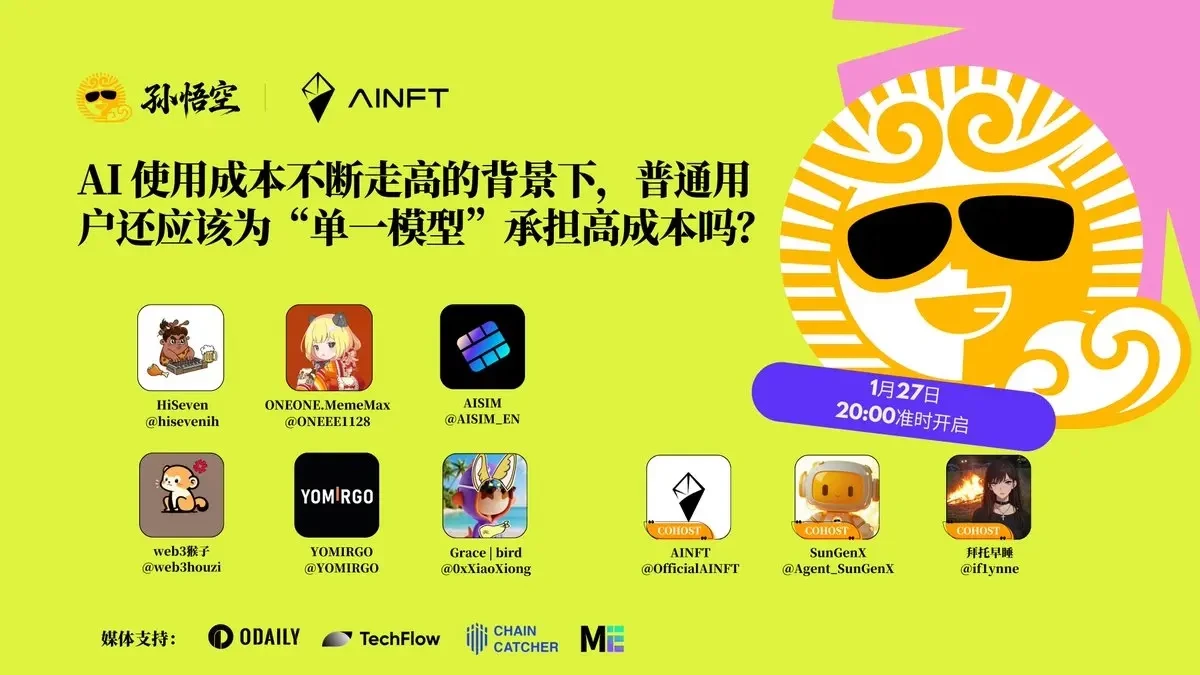
As AI Demands Diversify, Traditional Subscription Models Have Become Users' "Efficiency Shackles"
As AI rapidly evolved from impressive tech demos to an indispensable daily "productivity tool" across industries, a significant contradiction has emerged: on one hand, user demands are becoming unprecedentedly diverse and scenario-specific; on the other, mainstream service models remain stuck in expensive subscription plans. This deepening mismatch between supply and demand makes traditional subscriptions not only ill-suited for flexible, ever-changing needs but also transforms them into "efficiency shackles" for users pursuing high performance due to high fixed costs. In this SunFlash roundtable, multiple guests delved into the deep logic behind the continuous rise in AI usage costs from various dimensions including technological evolution, market supply and demand, and user behavior.
YOMIRGO pointed out that the rise in AI usage costs reflects two core trends: First, AI tasks have evolved from early single-turn Q&A modes to "chains of thought" processes for solving complex problems, involving multiple rounds of tool calls and reflection, leading to exponential growth in computational consumption. As requirements for output logic and quality increase, high-intensity reasoning capabilities have become a core cost component of AI services, driven by massive parameter counts, computational costs, and the global supply-demand imbalance for high-performance chips. Second, the continuous rise in AI usage costs also reflects AI's increasing "infrastructuralization", integrating into daily workflows like water and electricity, becoming an indispensable productivity pillar.
AISIM agreed with this view and added that the cost increase essentially stems from AI's transformation from an initial "novelty tool" to a current "high-frequency productivity infrastructure." The deeper the user dependency, the higher the requirements for all capabilities, naturally driving up the underlying compute and operational costs. Grace elaborated from a user experience perspective, noting that while users pay for better results, they also bear the cost of invisible, complex backend processes.
As the trend of rising usage costs becomes certain, a more urgent user-side question naturally arises: Are existing payment models still suited to the current demand landscape? On this, the roundtable guests formed a clear consensus: Traditional long-term subscription models tied to a single model are becoming significantly disconnected from users' real, varied, and increasingly refined usage scenarios.
Starting from practical usage scenarios, several guests pointed out that user needs are inherently diverse and scenario-specific. Both ONEONE and Grace mentioned that different tasks like writing, programming, and drawing often correspond to the strengths of different models; expecting a single model to be optimal in all areas is neither realistic nor economical. web3 monkey incisively noted that a large portion of the fees users pay for top-tier models may be for the 20% of cutting-edge capabilities they rarely use, while high-frequency needs are often met by basic capabilities, creating a clear imbalance in cost-effectiveness.
Furthermore, this model may limit user choice and adaptability in a rapidly iterating market. YOMIRGO emphasized that with AI technology advancing daily, long-term commitment to a single model is akin to self-imposed limitation, causing users to miss out on the technological dividends from the rapid evolution of other models. HiSeven also pointed out that users' core demand is shifting from "passively accepting fixed services" to "actively seeking optimal solutions." They increasingly prefer to flexibly call upon the most suitable tool based on real-time needs, rather than being locked into a single platform.
Ultimately, the discussion led to a clear conclusion: For the vast number of ordinary users with dispersed needs and varied usage scenarios, the economic and practical viability of models requiring long-term prepayment of high fees for low-frequency specialized capabilities is being severely tested. AISIM summarized that more flexible, cost-effective service models have become a critical market demand awaiting fulfillment.
AINFT's Solution: Flexible Payments Restructure Costs, Aggregated Gateway Reshapes Experience
Faced with the structural contradiction between single-subscription models and diversified demands, the guests unanimously agreed that the key to solving this dilemma may lie in a unified gateway capable of aggregating multi-model capabilities. The guests foresee that this is not merely a simple technical aggregation but will trigger profound changes from usage logic to the industrial ecosystem.
Several guests noted that a unified gateway would change the relationship between users and AI. AISIM discussed the existing "allegiance wars" among users regarding different models, stating that aggregation platforms would dissolve this unnecessary partisanship, shifting users from "paying for a model" to "paying for problem-solving." HiSeven and ONEONE added from an efficiency perspective that this could drastically reduce the time and cognitive costs of switching between multiple platforms, registering, and comparing prices, making AI service usage as smooth as switching browser tabs.
Moreover, a deeper transformation lies in the complete evolution of task execution methods. As Grace metaphorically described, in this new model, users will play the role of "General Manager," no longer passively accepting output from a single tool but holding overall command, directing the most suitable "AI employees" for collaborative work based on task characteristics. For example, one model could be responsible for generating a plan, while another specializes in review and optimization. This teamwork significantly enhances work reliability and output quality.
This means AI will shed its attribute as a specific tool and instead become infrastructure akin to water and electricity: highly standardized, available on-demand, and payable with precise metering. This is far more than an improvement in the user interface; it marks a fundamental evolution of the entire AI service paradigm from closed, rigid "tool provision" to flexible, inclusive "capability openness."
As an example aligning with this evolutionary direction, AINFT, a Web3-native AI platform within the TRON ecosystem, is a concrete implementation turning the aforementioned paradigm into reality. Combining firsthand usage experiences, the participating guests deeply analyzed its feasible pathways for achieving the dual goals of "low cost" and "superior experience."
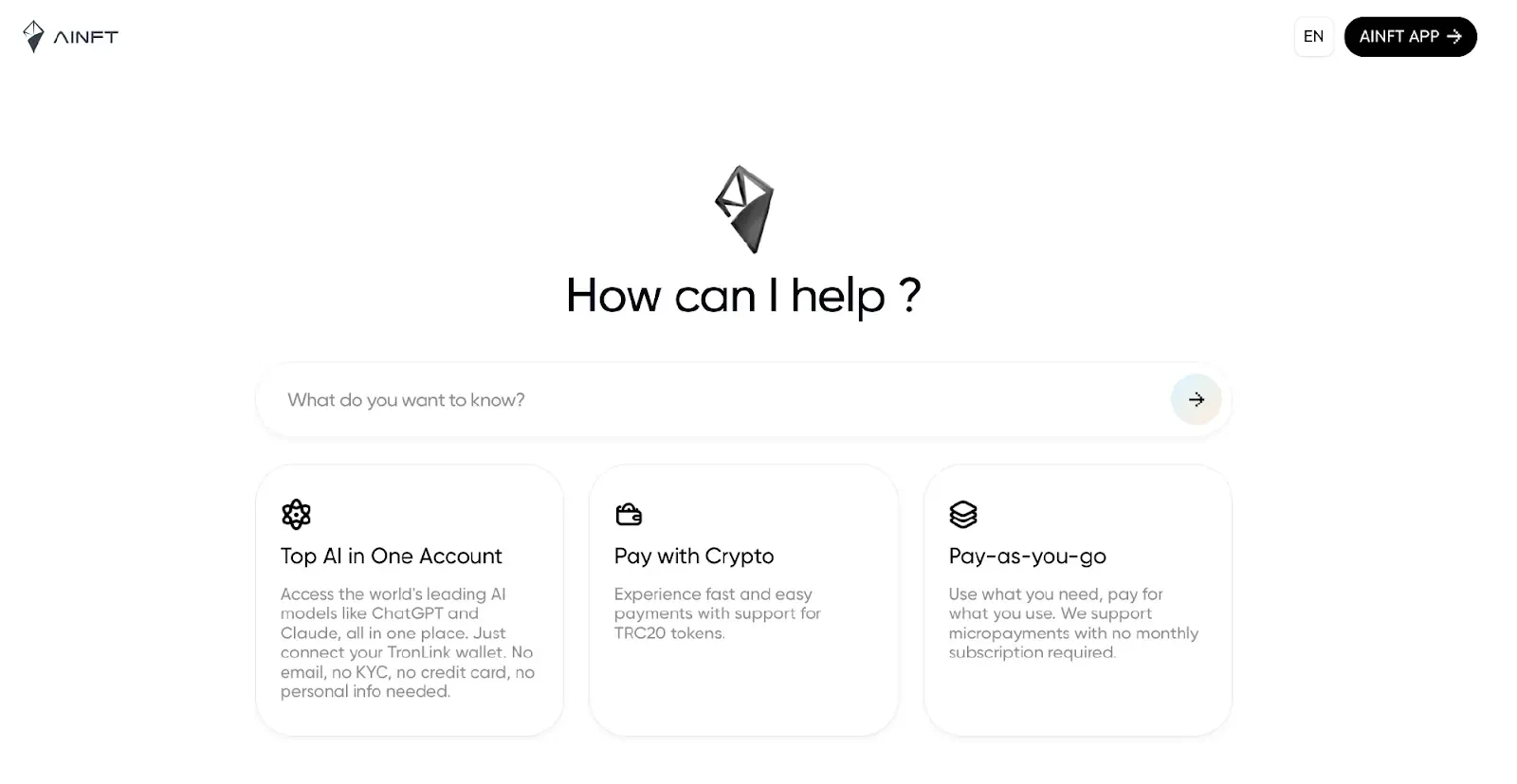
1. Revolution in Cost Structure: From Fixed Subscriptions to Flexible Payments
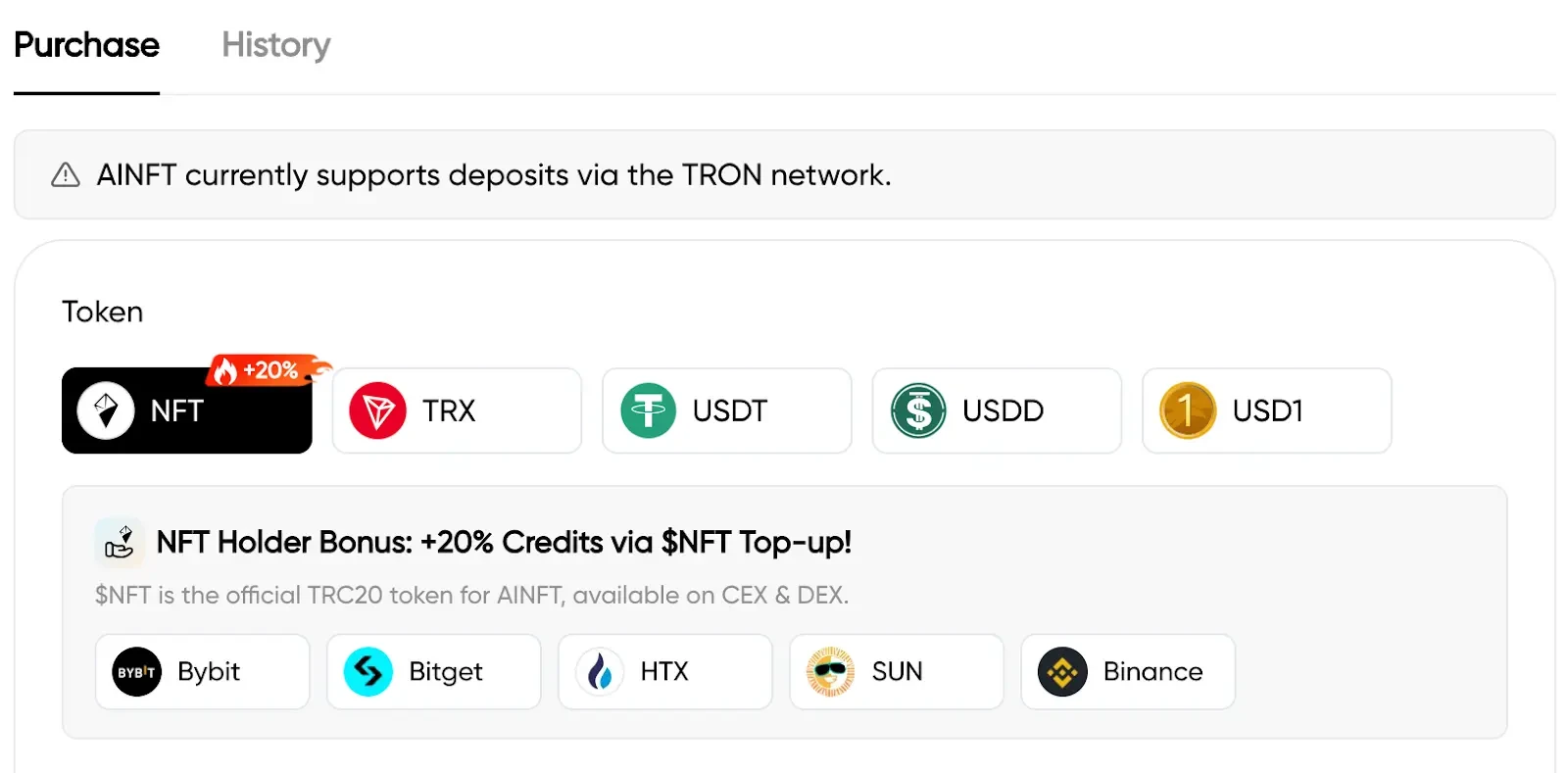
The guests believe AINFT's core innovation lies in its economic model. web3 monkey detailed its credit system and small on-chain top-up mechanism, which completely deconstructs the traditional fixed monthly fee model. For new users, free credits obtained via wallet login can satisfy basic needs. Currently, new users receive 1 million credits upon login, sufficient to cover daily low-frequency needs. For high-frequency users, the platform offers highly flexible top-up options, supporting multiple currencies including NFT, TRX, USDD, USDT, and USD1 for recharge. Using NFT tokens for recharge grants a 20% discount. Users can top up as needed, with estimated monthly costs potentially dropping significantly to the $5-$15 range, achieving a shift from the burden of a "fixed monthly fee" to "flexible, on-demand payment."
2. Reshaping User Experience: Seamless Access and Sovereign Control
On the experience level, AINFT allows one-click login via the TronLink wallet for immediate access to multi-model services. This design eliminates the hassle of repeated registration and verification, seamlessly integrating AI services into the smooth Web3 experience. Simultaneously, the platform's unified API interface allows users to flexibly embed this aggregated capability into their own applications and workflows, greatly expanding practical boundaries.
3. Integration of Ecosystem Value: Sovereignty, Incentives, and Sustainability
On a deeper level, AINFT's model design reflects attention to user sovereignty and long-term value. Its credit and recharge mechanisms are not simple payment channels but a positive incentive loop: users receive additional rewards for recharging with NFTs, enabling continuous optimization of costs for long-term participation and deep usage. This essentially returns choice and value rewards to users, aligning platform evolution with community interests, thereby building a more resilient and attractive sustainable ecosystem.
Faced with the dilemma of rising costs and limited choices in centralized AI services, Web3-native solutions represented by AINFT provide a key breakthrough approach. By restructuring the economic model through a credit system and flexible payments, and reshaping the user experience through multi-model aggregation and one-click access, its essence leverages the composability and incentive design of blockchain to transform AI from a "closed subscription service" into "open digital infrastructure."
As a core AI infrastructure within the TRON ecosystem, AINFT's practice transcends mere technical aggregation; it is attempting to build a new paradigm where AI Agents can collaborate and incentive systems can form internal loops. This foreshadows a future where users no longer pay for a single model but, as sovereign participants, enter a more inclusive, efficient, and community-driven intelligent digital ecosystem.