2026 Kaito Marketing Guide


- Core Viewpoint: Kaito achieves high-quality user growth through structured mechanisms.
- Key Elements:
- Yaps points transform content into long-term growth assets.
- The leaderboard mechanism identifies and incentivizes high-quality, consistent contributors.
- Introduces on-chain reputation weighting to combat fake traffic.
- Market Impact: Shifts project growth from traffic-driven to quality-driven.
- Timeliness Note: Long-term impact.
Over the past year, Web3 projects have increasingly converged on one approach to "growth":
Spending more and more money to buy shorter and shorter attention spans.
While most Web3 growth tools remain stuck in the task-driven model of "distribution → sharing → airdrop," user growth in practice is often reduced to a rapid scaling process: First, spend on distribution to create exposure; then, boost engagement through sharing and task completion; finally, use airdrops or points to drive conversion. This method may generate impressive data feedback in the short term, but it fundamentally revolves around one-off actions, with growth effects heavily reliant on continuous investment, making it difficult to build long-term accumulation.
In contrast, @KaitoAI is not merely optimizing efficiency within an existing task system. Instead, it has evolved into a highly structured User Growth Operating System (Growth OS). It goes beyond just scoring content or distributing points. Through a comprehensive mechanism for quantifiable, competitive, and compoundable attention allocation, it reorganizes the previously scattered user expression and interaction behaviors on Twitter (X) into a sustainable growth system.
This article will start from the internal mechanisms of Kaito, systematically deconstruct how it helps projects achieve user growth, and later use two exemplary cases—@Calderaxyz and @berachain—to validate how these mechanisms are applied to the projects themselves.
1. The Essence of Kaito: Not a Marketing Tool, but an "Attention Allocation System"
The first step to understanding Kaito is to move beyond the "marketing platform" perspective. Kaito's true positioning is: an InfoFi system that transforms "attention, content contribution, and user behavior" into calculable assets.
In traditional growth models, projects typically focus on three core metrics: impressions, clicks, and conversion rates. This framework itself isn't flawed, but it carries an implicit assumption: as long as users complete the specified actions, the system assumes growth has occurred.
In the Web3 context, this assumption often doesn't hold. Growth mechanisms based on task completion can only confirm "whether an action happened," but struggle to determine why users acted and whether they possess long-term engagement intent. This leads to growth data that is easily inflated by low-cost behaviors, creating a facade of activity but often showing limited results in retention and genuine affinity. Simultaneously, such mechanisms tend to attract efficiency-oriented participants more easily, such as airdrop farmers or Bots. To combat Sybil attacks, projects are forced to continuously increase task complexity and participation barriers, resulting in rising growth costs while potentially excluding truly valuable users with higher thresholds.
It is precisely against this backdrop that Kaito has redefined growth metrics. In the Kaito system, the focus shifts from immediate data from one-off actions to more long-term and structural indicators of participation quality. For example, whether a project is repeatedly mentioned in the long-term information flow, forming stable recognition (Mindshare); whether it can consistently reinforce the same core narrative instead of being diluted by fragmented noise (Narrative Control); and whether users are willing to continuously produce content with informational value around the same project over an extended period (Consistent Contribution).
This also means Kaito's goal is not to help projects create short-term data spikes, but to enable them to occupy a stable, cumulative position within the long-term information flow of Crypto Twitter.
2. How Kaito's Growth System Operates: Three Core Mechanisms
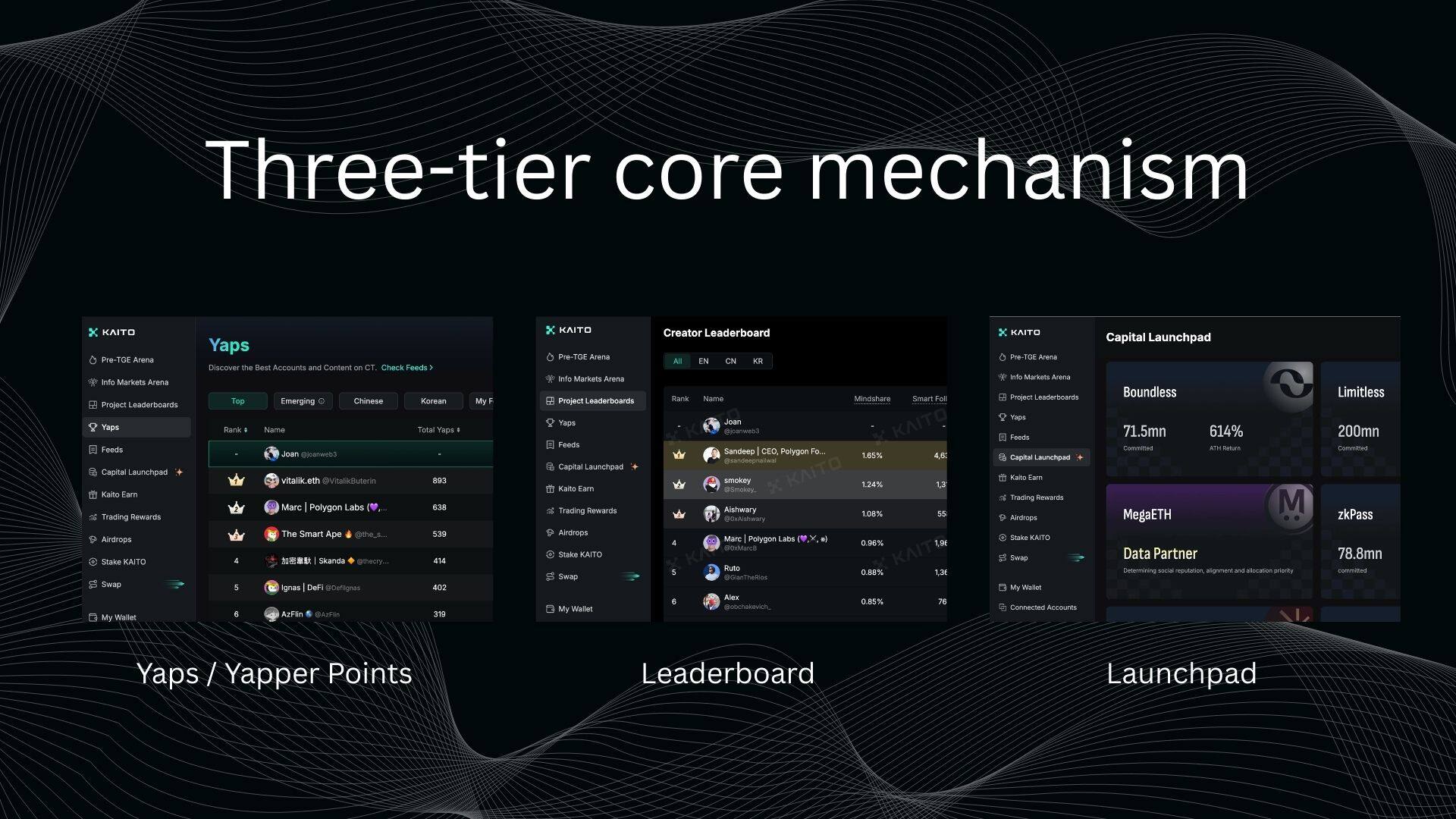
Kaito's first key design is Yaps / Yapper Points. Before Kaito, a high-quality tweet had an extremely short lifespan, generating little long-term value beyond likes and retweets. After Kaito, every piece of content output enters a user's long-term contribution record, continuously influencing their future earnings through points, rankings, and historical weight. This long-term accounting mechanism fundamentally changes the creator's objective function: they no longer just chase a "viral tweet," but begin cultivating a content identity verifiable over time.
Simultaneously, Kaito's algorithm does not treat all interactions equally. Yap scoring comprehensively evaluates whether content genuinely brings informational value to a project, considering semantic depth, originality, relevance to the project narrative, and whether interactions come from crypto users with real influence. This step performs a crucial correction at the growth level—prioritizing traffic quality over traffic volume, thereby systematically compressing the space for spam, farming accounts, and ineffective interactions. Content in Kaito is no longer just a one-time expression; it gradually evolves into a growth asset that can be valued over the long term.
If Yaps are responsible for "assetizing" content, then the Yapper Leaderboard is responsible for transforming this asset into a growth engine. Its value lies not in the ranking itself, but in guiding user behavior towards convergence in long-term, high-quality, and highly consistent directions through continuous competition and clear rules.
Rankings heavily depend on posting continuity, narrative consistency, and long-cycle contribution accumulation. This makes short-term ranking surges difficult to sustain, while those who truly understand the project and are willing to invest consistently naturally rise. Meanwhile, Kaito, through algorithmic weighting and incentive design, decentralizes amplification power from centralized operations to the community, systematically amplifying positive narratives and in-depth interpretations without losing control. Over time, this mechanism organizes scattered tweets into an identifiable content pool, enabling new users to quickly discern core voices, thereby providing a foundation for the continuous accumulation of Mindshare.
Finally, Kaito pushes growth towards a closed loop through Yapper Launchpad and Capital Launchpad. The core logic is simple: Give those who "speak up for the project" real weight in resource allocation. Content contributions are transformed into quotas and airdrops via the Leaderboard, ultimately materializing as tokens and participation rights. This turns attention into real benefits, making high-quality users long-term stakeholders.
3. Case Validation: When Kaito is Used as a "Growth System"
Among all of Kaito's success stories, Caldera and Berachain are highly representative not because of their scale or popularity alone, but because they have achieved a high degree of systemic coupling between growth objectives, content structure, incentive design, and platform mechanisms. This embeds Kaito into the project's own growth logic, rather than merely serving as a "traffic amplifier."
The following will deconstruct these two projects across three dimensions: mechanism adaptation, user behavior shaping, and growth outcomes.
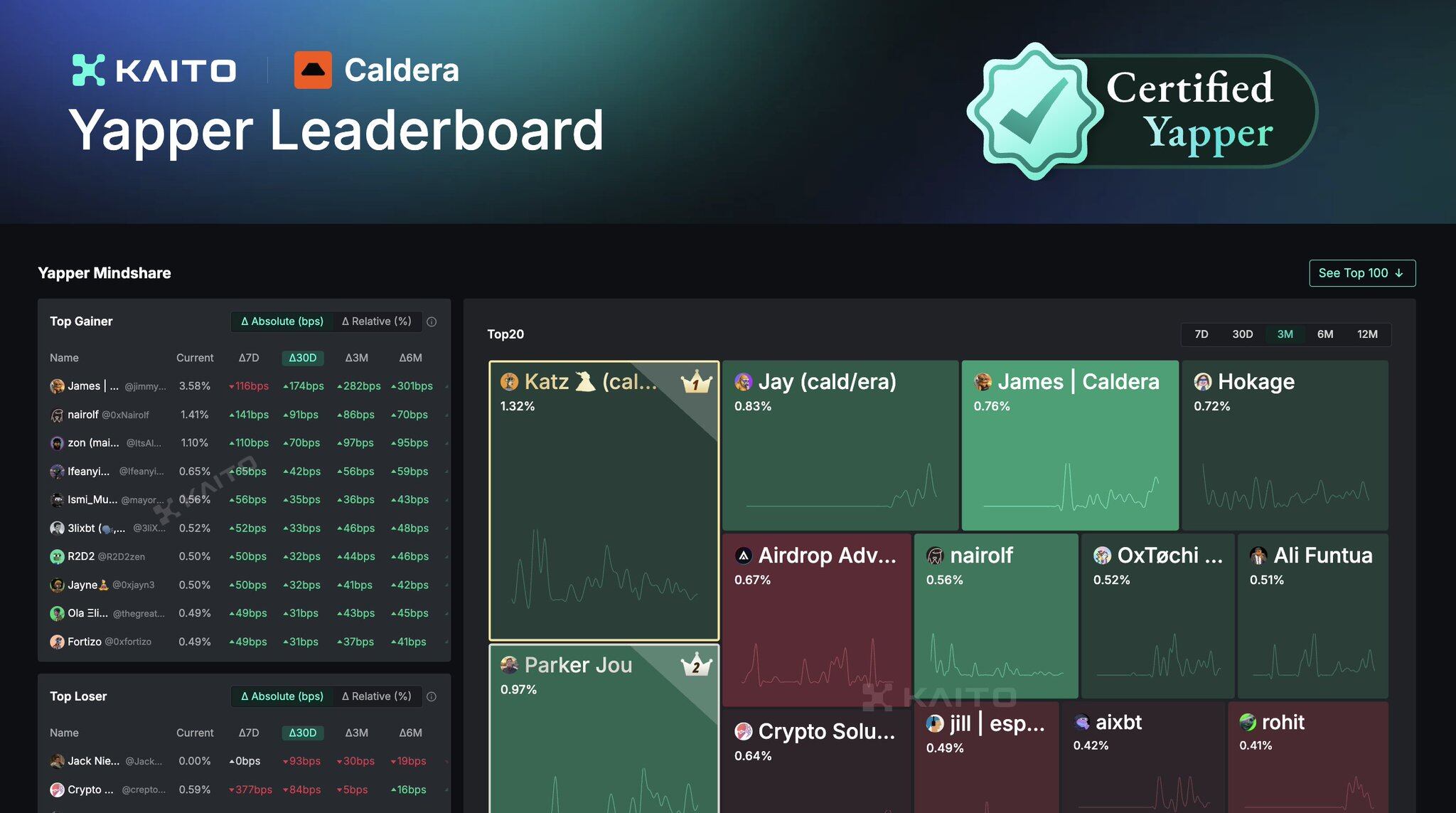
1. Caldera: Using Kaito to Filter and Accumulate High-Quality Users in the Pre-TGE Phase
The Caldera case is particularly useful for understanding: When a project itself has a complex technical narrative, how Kaito helps it achieve high-quality user growth, not just simple exposure.
Source: Kaito
Preemptive Understanding and Utilization of Kaito's Algorithmic Preferences: Before entering the Kaito ecosystem, Caldera clearly recognized a fact: Kaito's Yap Points and Leaderboard mechanisms do not inherently favor "propaganda-type content," but are more likely to reward content with high semantic density, strong narrative consistency, and long-term cumulative value.
Based on this understanding, Caldera did not guide the community to produce "project introduction" or "emotional mobilization" tweets. Instead, it consciously encouraged the community to create content around a series of highly structured topics, such as the architectural principles of Rollup-as-a-Service, its positioning within the modular Rollup ecosystem, and its technical relationships with EigenLayer, Data Availability (DA) layers, and execution layers. These topics not only have high information density and require creator comprehension but also naturally reduce the possibility of low-effort posts and simple copy-pasting.
From a growth perspective, the core of this step is: Proactively guiding community creation behavior into the "algorithm-friendly zone," rather than letting users exhaust their enthusiasm through trial and error.
Using the Leaderboard to Systematically Screen High-Commitment Users: Caldera's use of the Kaito Yapper Leaderboard was not as a mere results display tool, but as a user behavior shaping mechanism. During the Pre-TGE phase, Caldera intentionally extended the Leaderboard's operational cycle, making it difficult for any user attempting "short-term arbitrage" to secure a stable position on the chart. Conversely, only those creators willing to consistently output and gradually deepen their understanding over weeks or even months could steadily accumulate an advantage.
This created a clear filtering effect at the user level: low-patience, low-cognition users were naturally weeded out; high-cognition, high-commitment users gradually concentrated at the top of the leaderboard. From a growth system perspective, Caldera essentially used Kaito's Leaderboard to perform a "community quality filtration," concentrating limited incentive resources on the group most likely to convert into long-term users and ecosystem participants.
Structurally Binding Content Contribution with Real Usage: Unlike many projects that stop at content incentives, Caldera consciously avoided letting Kaito become a purely "talk arena." During the Leaderboard period, Caldera continuously integrated Testnet deployments, developer tool usage, and real interactions with ecosystem DApps into the core of community discussions and content creation. This bound "product participation" and "narrative participation" within the same incentive logic.
These behaviors were not always directly counted in Yap Points, but they were constantly referenced, analyzed, and reviewed at the content level, forming an implicit bonus mechanism: Users who actually used the product were more likely to produce high semantic-density content, which was more likely to be rewarded by the algorithm.
The final result was a highly positive feedback loop: Use the product → Gain understanding → Output high-quality content → Gain higher weight in Kaito → Receive more resources and attention → Deepen participation further. This allowed Caldera to accumulate a core user base that both understood the technology and possessed communication capabilities even before its TGE.
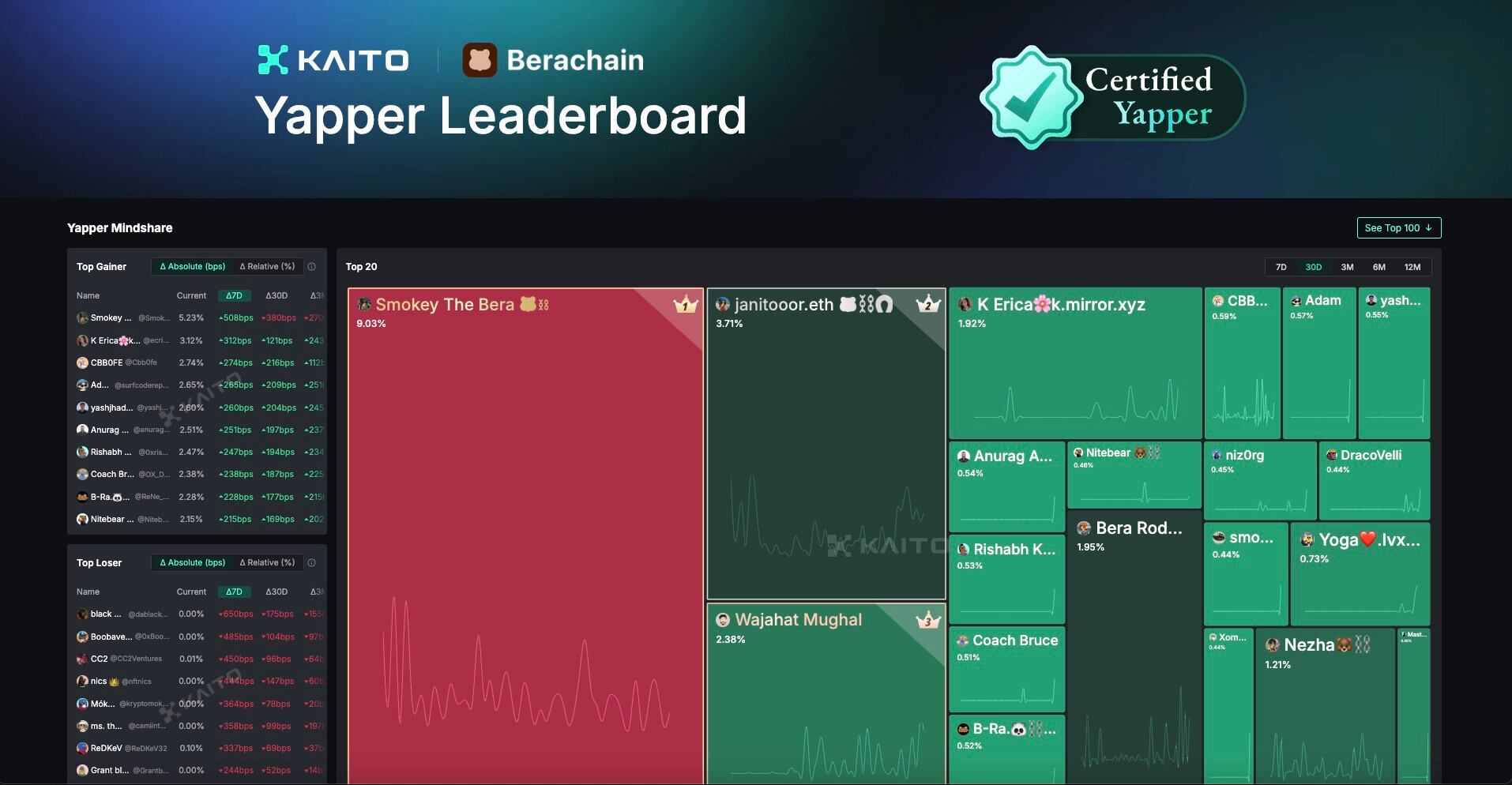
2. Berachain: How to Use Kaito to Maintain Long-Term Mindshare, Not One-Time Hype
If Caldera demonstrates Kaito's capability in "Pre-TGE growth for technical projects," then the Berachain case better illustrates: How Kaito can be used to maintain long-term Mindshare, rather than a one-time narrative explosion.
Source: Kaito
Treating Kaito as Long-Term Narrative Infrastructure, Not a Short-Term Campaign Tool: Berachain treated Kaito as a long-term operational narrative infrastructure. The project accepted the natural fluctuations of the leaderboard from the start, rather than trying to create ranking surges through short-term incentives. This design allowed community content to gradually form a division of labor structure: some creators focused on deep dives into the PoL (Proof-of-Liquidity) mechanism, some continuously tracked ecosystem projects and incentive changes, and others translated technical narratives into more viral culture and memes. Kaito's algorithm did not force a uniform content format. Instead, through long-term weight accumulation, it allowed different types of content that were equally "consistent and relevant" to find their rightful place in the system.
Leveraging Smart Followers Weight to Amplify Core Community Structural Advantages: Within the Berachain community, there already existed a network of core accounts that followed and interacted with each other frequently. Kaito's Smart Followers mechanism effectively amplified this structural advantage. Interactions from core crypto users and high-reputation accounts provided additional weight to content, pushing discussions about Berachain into more influential layers of the social network. Ultimately, this transformed the previously implicit "core community structure" into a growth resource that the algorithm could recognize and reward. This is also one of the key reasons Berachain was able to sustain high Mindshare across multiple time points.
Fostering Long-Term, Non-Speculative Participation Through Stable Incentive Expectations: Berachain did not promise explicit material rewards at every milestone. Instead, through a long-term, predictable Kaito incentive structure, it signaled to the community: Long-term participation in narrative building is systematically recorded and recognized in itself. Under this expectation, users' participation decisions became less dependent on single-campaign ROI and more akin to a long-term investment behavior. This psychological shift is crucial for building a highly sticky community.
3. The Common Logic Behind Both Cases
Despite significant differences in stage, narrative, and product form between Caldera and Berachain, they followed highly consistent principles when utilizing Kaito: Growth is not about "amplification," but "screening"; the algorithm is not an adversary, but something to be understood upfront and actively adapted to; the core role of incentives is to shape long-term behavior, not stimulate short-term participation.
4. Mechanism Evolution: The 2026 "Value Reassessment" and Reputation Pivot
At the beginning of 2026, Kaito officially initiated a paradigm-level evolution—formally transitioning from 'attention distribution' to a comprehensive upgrade towards 'reputation assetization.' The core of this upgrade lies in the system no longer merely focusing on "content generation," but beginning to define "what kind of participation deserves to be valued long-term."
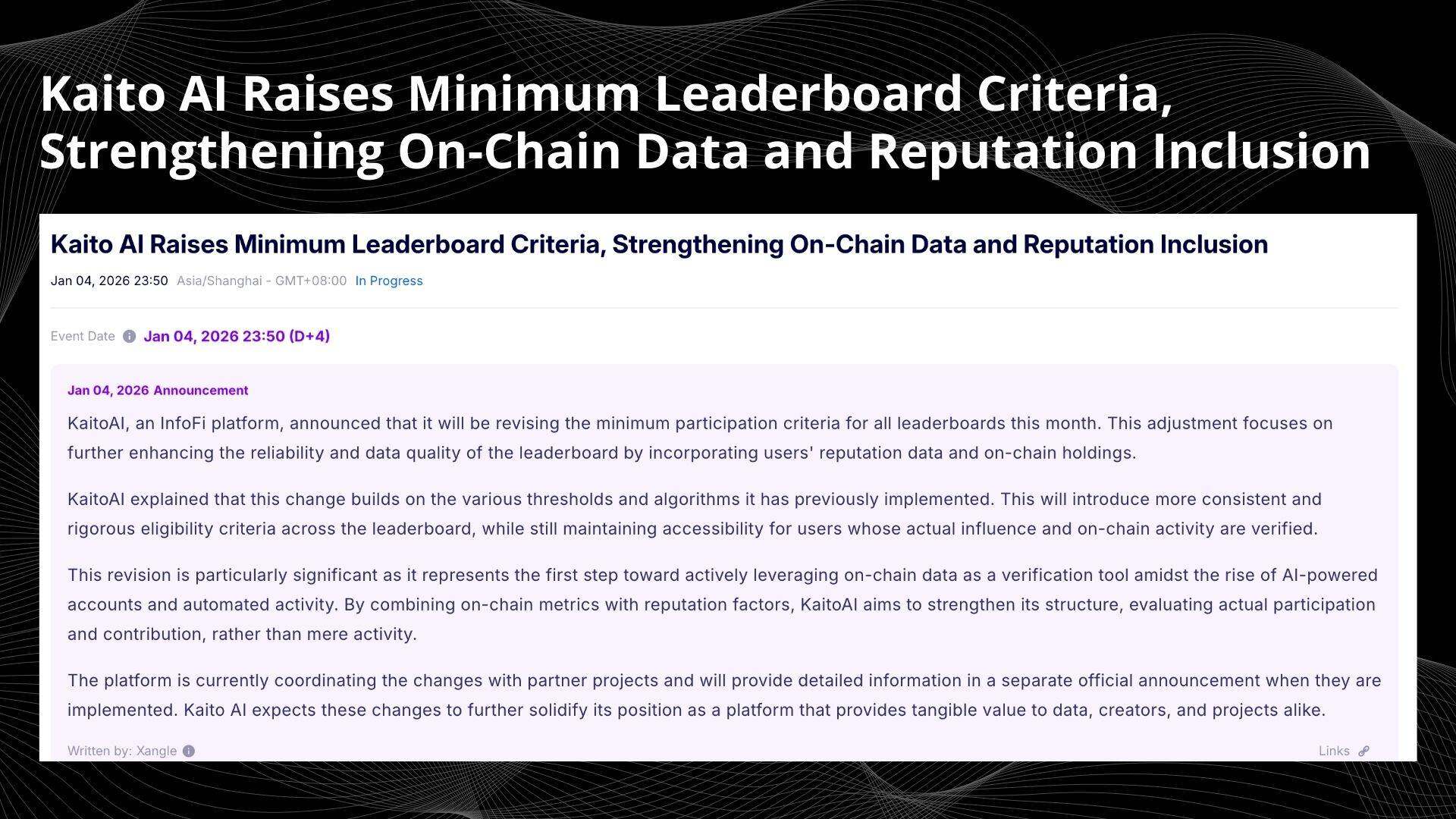
The most symbolic move occurred on January 4, 2026, when Kaito officially announced an upgrade to the entry criteria for all leaderboards. This update fundamentally restructured the logic of influence weighting by introducing Reputation Data and On-chain Holdings. This means that within Kaito's ecosystem, the "false prosperity" relying solely on AI scripts and automated posting has lost its viability. The system now filters out low-quality activity by combining on-chain metrics and social reputation weight, ensuring that every unit of influence output has genuine capital backing. Kaito is shifting from measuring "who is talking" to measuring "who deserves to be taken seriously."
Complementing this algorithmic reshuffle is the formal implementation of the gKAITO governance mechanism. This mechanism marks Kaito's evolution from a growth tool into a reputation-based governance system. Community members are no longer mere traffic contributors. Through a "five-dimensional model" assessing thought leadership, engagement, and cultural contribution, they now deeply participate in the quality control of token launches. Within the gKAITO framework, content production has completed the leap from "traffic behavior" to "reputation asset," with influence now deeply anchored to governance rights, profit rights, and investment priority.
On the product side, the Kaito Pro UI/UX refresh launched in Q1 2026 provides the效能支撑 for this evolution. The optimized interface significantly improves the processing efficiency of large-scale unstructured data. Project teams are no longer confined to the single dimension of Twitter (X); they can efficiently analyze deep information flows like podcasts and research reports. Coupled with the Mindshare heatmap, the competitive battlefield for projects has officially expanded to the entire cross-platform Web3 information layer. This signifies that Kaito has evolved into an infrastructure supporting "narrative sovereignty."
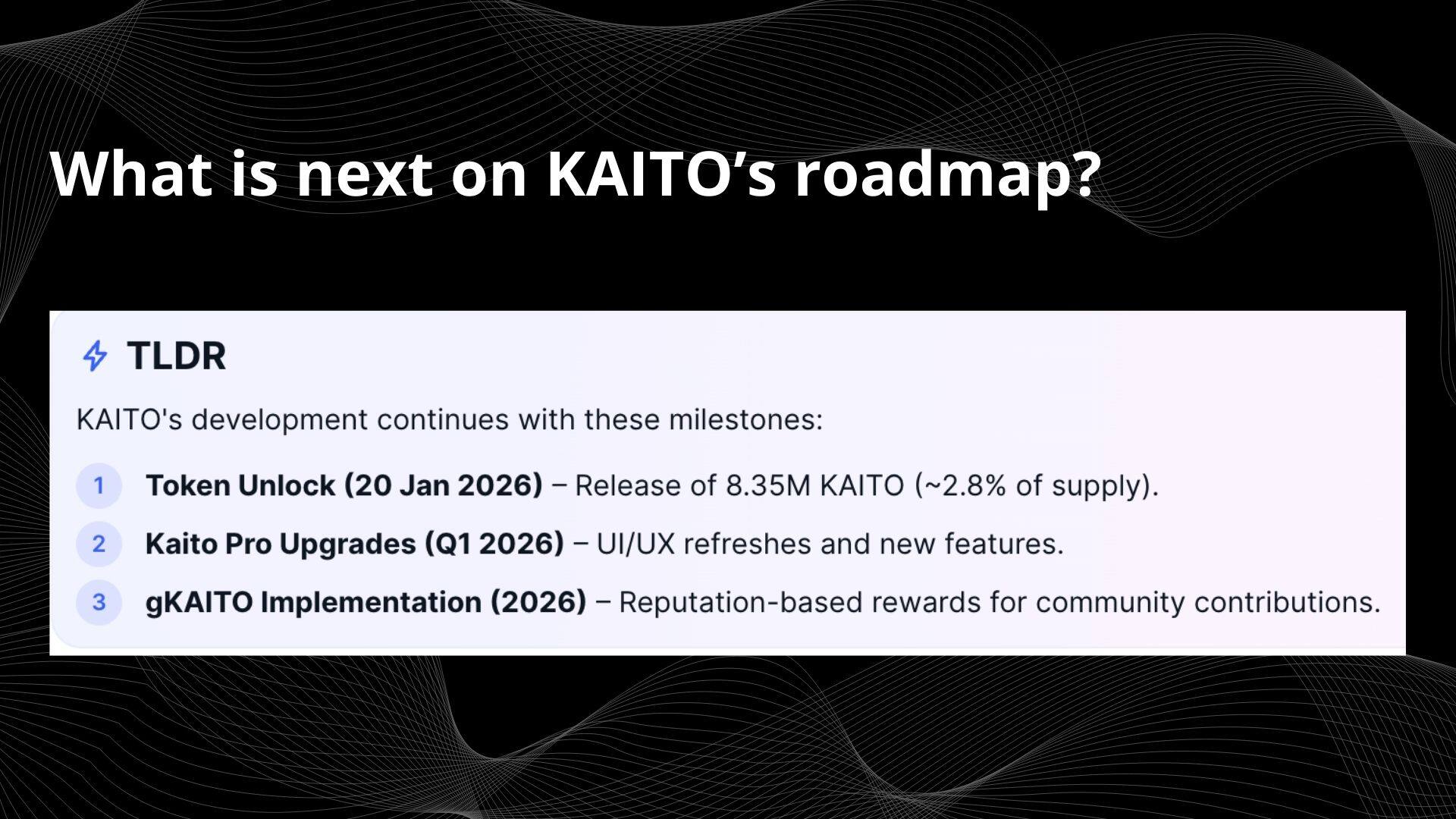
Behind these updates, three layers of logic have simultaneously migrated. Growth is no longer just about traffic; it now revolves around reputation and historical contribution accumulation. The algorithm no longer just judges content quality; it now verifies participant identity, on-chain behavior, and reputation structure. And with the launch of Kaito Pro's Mindshare heatmap, what projects compete for is no longer just exposure on a single platform, but cross-platform information and narrative sovereignty.
If Kaito's original mechanisms defined the "skeleton" of this system, then the 2026 updates have endowed it with a "financial soul" capable of driving capital, governance, and resource allocation.
5. The Growth Logic Underlying Kaito
From an operational methodology perspective, Kaito did not invent a new growth method out of thin air. It actually embedded a whole set of validated growth and community operation concepts into its own algorithms and rules.
In its underlying design, one can clearly see the影子 of "low marginal cost diffusion" from growth hacking. Yaps and the Leaderboard make users the primary producers of project narratives. Project teams no longer need to pay direct costs for each exposure. Instead, through rule design, they distribute the动力 for传播 to a large number of spontaneous participants. Over time, high-quality content and core creators form network effects, continuously driving down the marginal cost of diffusion.
Simultaneously