From Helium to Jupiter: Why Has Token Buyback Become an "Ineffective Remedy"?


- Core Viewpoint: Project teams reflect and halt inefficient token buybacks.
- Key Elements:
- Helium stops buybacks due to tepid market response.
- Jupiter spends $70 million on buybacks, yet token price continues to fall.
- Industry leaders debate fiercely, questioning the effectiveness of the buyback mechanism.
- Market Impact: Triggers widespread reflection on the efficiency of project fund utilization.
- Timeliness Note: Medium-term impact.
Original author: 1912212.eth, Foresight News
While some projects are forced to adopt token buyback strategies due to low token prices and loud investor demands, some project teams are now beginning to reflect on this practice.
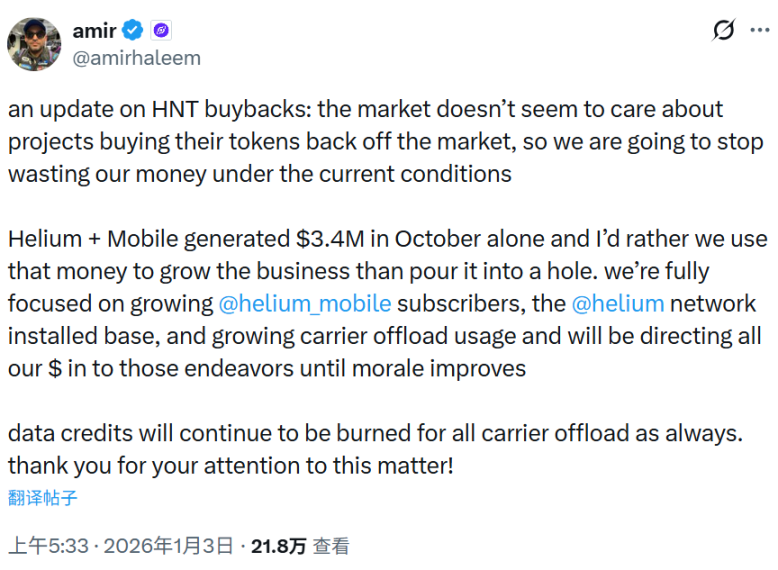
On January 3rd, Helium founder Amir Haleem tweeted that he would stop buying back tokens, giving a simple and direct reason: the market does not "care" about project buybacks. The implication is that buybacks have little effect on the token price. Therefore, he will "stop wasting funds."
Helium is a decentralized telecommunications infrastructure project. In March 2022, it completed a $200 million Series D funding round led by a16z and Tiger Global. Its token, HNT, is primarily used for network incentives and governance.
In October of this year, the project planned to implement a buyback mechanism, mainly using a portion of the revenue generated by the network (such as mobile service and data transmission fees) to purchase HNT from the open market.
Specific details included: allocating a fixed percentage (approximately 10-20%) of monthly revenue from businesses like Helium Mobile for buybacks, with funds sourced from real business cash flow rather than newly issued tokens; buyback operations executed via automated scripts on the secondary market, prioritizing exchanges with high liquidity; a portion of the purchased HNT would be burned to reduce circulating supply, with the remainder locked in the project treasury for future network incentives or ecosystem development. Haleem emphasized that the original intention of the buyback was to "reward holders and stabilize the price by reducing supply."
The project team originally planned to continue this until the end of 2026. However, the token price poured cold water on the project founder's plans.
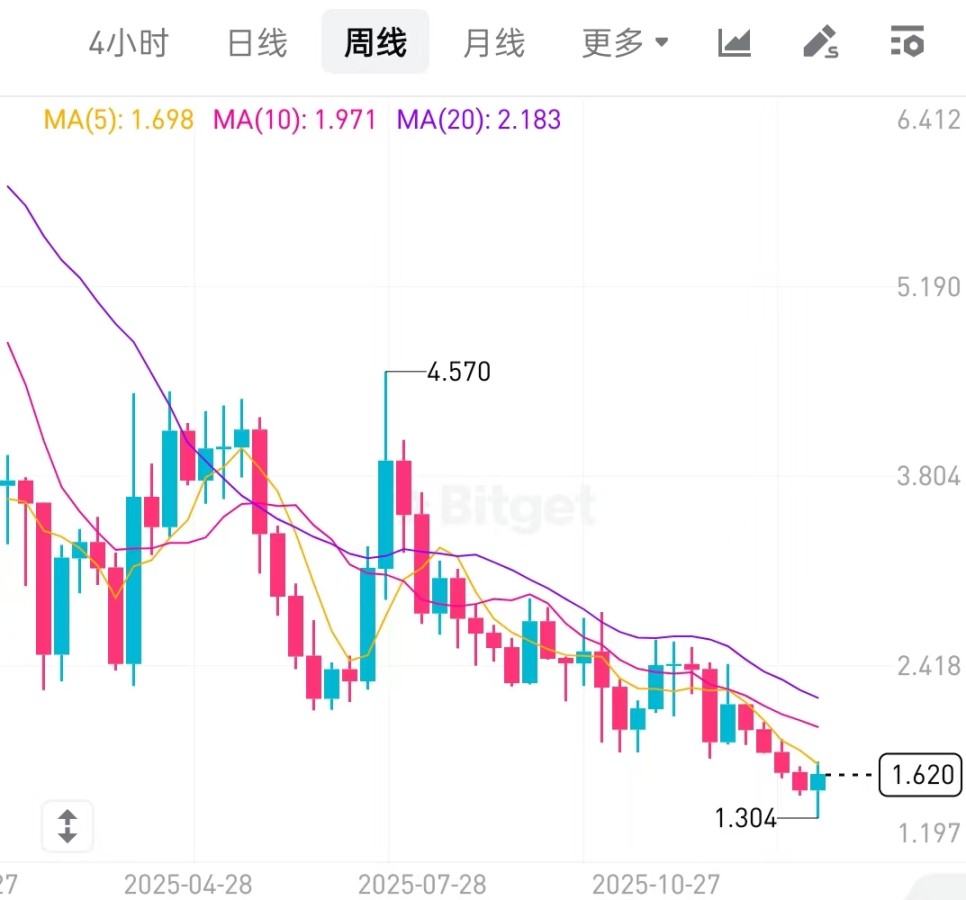
After reaching a local high of $4.57 in July this year, the price subsequently declined steadily, dropping to a low of $1.3. The utility of the buyback was minimal.
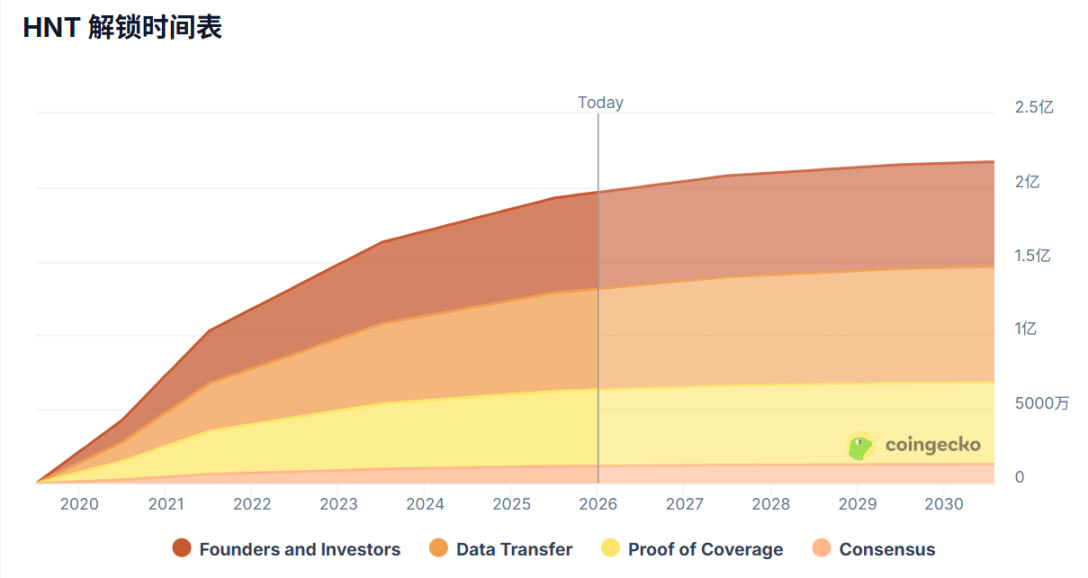
Haleem stated that in October this year, Helium + Mobile business revenue reached $3.4 million for the month. Currently, its token is almost fully circulating with no significant token unlocks. If 20% of the monthly business revenue were used for buybacks, the buyback funds would be approximately $680,000.
In a bearish crypto market, buyback funds of less than a million dollars seem like a drop in the bucket.
It's no wonder Haleem said, "We need to focus all efforts on developing Helium Mobile users, expanding its network installations, and increasing carrier offload usage. We will invest all funds into these areas until morale improves."
If the buyback by this "ancient" star project didn't spark heated discussion, then Jupiter co-founder Siong Ong pushed the buyback issue back into the spotlight of public opinion.
Jupiter's $70 Million Buyback Fails to Halt Token Price Decline
Jupiter is the largest DEX aggregator in the Solana ecosystem, and its token JUP is used for governance and incentives. On January 3rd, Jupiter co-founder Siong Ong posted asking the community whether to pause JUP buybacks.
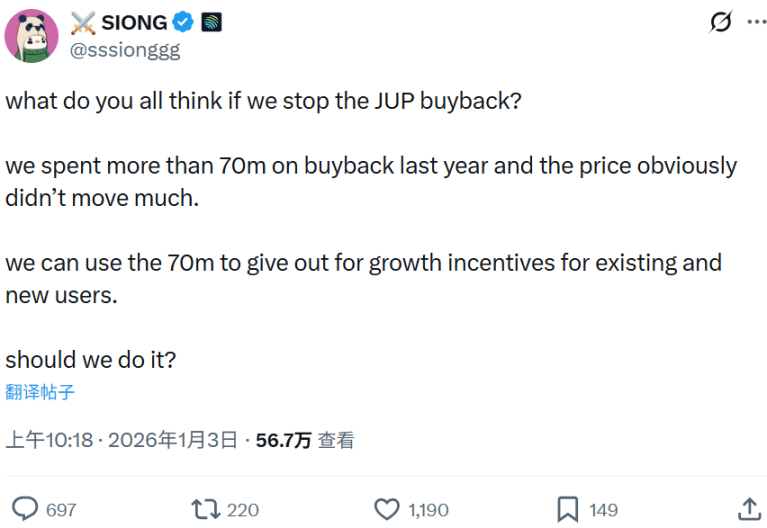
He stated, "We spent over $70 million on JUP buybacks last year, but the token price clearly hasn't changed much. We could use this $70 million to provide growth incentives for existing and new users." He concluded with a question: Should we do this?
In January 2025, Jupiter announced that 50% of its protocol fee revenue would be used to buy back JUP tokens and lock them for 3 years.
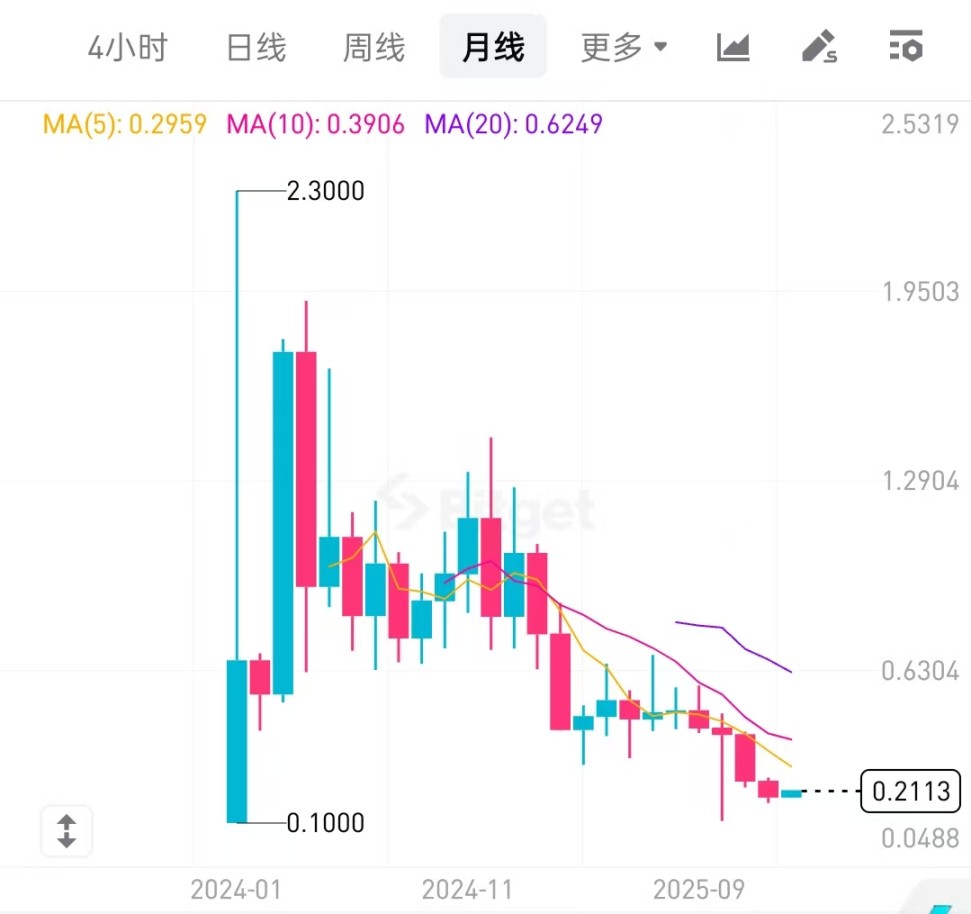
However, after Jupiter spent $70 million on buybacks over a year, its token price performance remained sluggish, continuing to decline steadily. It has now dropped to around $0.2, a 10x decrease from its high of $2 in 2024.
Despite Jupiter's meticulously designed buyback details, the token price trend shows its utility is almost zero.
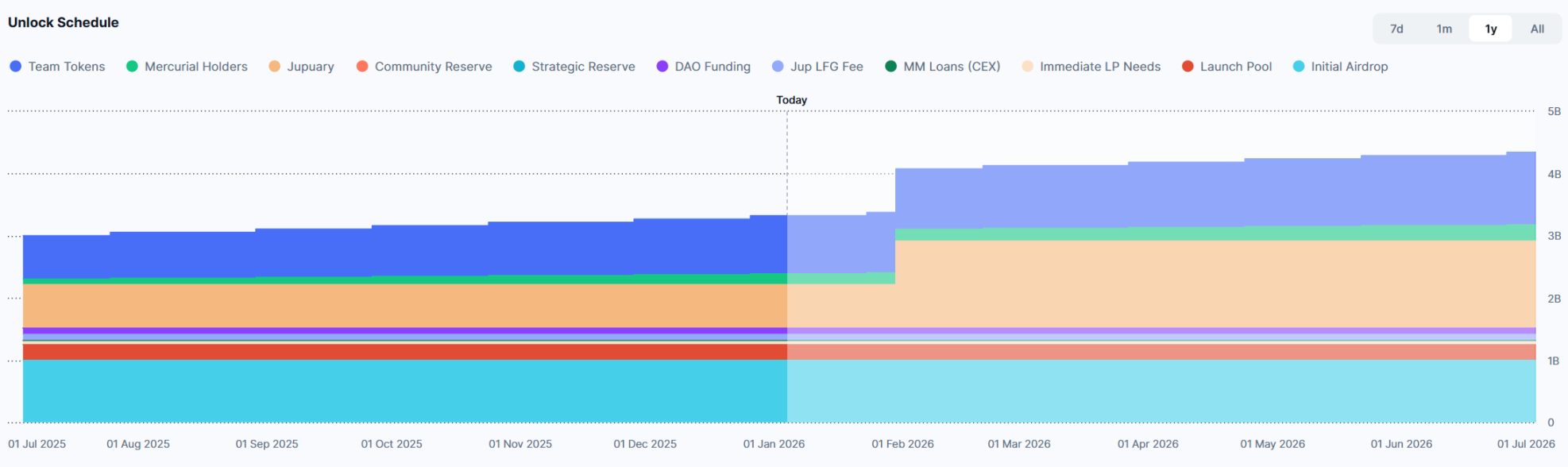
Making matters worse, on January 31st this year, 700 million JUP tokens (10% of the max supply) valued at $147.88 million will be unlocked. When buying power weakens and selling pressure is immense, the token price is predictable.
Staking? Continue Buybacks? Big Names Debate
The actions by Helium's and Jupiter's co-founders regarding buybacks have sparked considerable discussion. Solana co-founder Anatoly Yakovenko (Toly) explicitly opposes traditional buybacks, believing that "long-term capital formation takes years, not quarters." Toly suggests projects should build balance sheets and lock profits as claimable assets through staking mechanisms, similar to equity dilution in traditional finance. This incentivizes long-term holders rather than short-term speculators.
Toly's view was echoed by Multicoin Capital partner Kyle, who stated that crypto teams should ensure long-term holders receive disproportionate value returns, though specific mechanisms need improvement.
However, some have expressed opposing views.
Jito COO Brian Smith stated that during market downturns, buybacks can significantly increase equity value for token holders. He said, "Questioning buybacks versus growth investment is reasonable. However, using poor price performance as a reason is untenable. Without buybacks, what does the price even mean? The most important thing is, are you underinvesting in growth opportunities with positive ROI due to capital constraints? If so, you absolutely should not do buybacks. But most crypto projects are still well-funded, and DAO treasury allocation is a mess."
Selini Capital partner Jordi offered his perspective: the most successful projects this cycle have actually disrupted their price charts and confused users with automated buyback operations. Early popular projects like HYPE, ENA, and JUP spent millions on buybacks at absurdly high prices based on fair multiples. This led many retail investors to buy at highs due to FOMO (price driving narrative), resulting in significant losses. All founders of these projects became overly immersed in this self-reinforcing mindset, believing high multiples were justified. After months of decline with no clear path back to previous highs, some started blaming the buyback mechanism, saying it doesn't work. This is equally wrong. How many times must financial markets teach us basic economic truths over centuries?
Jordi stated that if funds are insufficient to pay developers for project building, then limited funds should not be used for token buybacks. But once a project succeeds and has sustainable revenue—as a holder, if the token offers no dividends, no buybacks, or at least no super-clear financial utility, then what's the point of holding it?
He also proposed a specific solution: determine the buyback amount based on price. Buy back more when the price is low, and slow down when the market is overheated. Additionally, buybacks could be adjusted based on the P/E ratio; for example, 100% buyback when below 4, and 75% buyback in the 4-6 range.