






Why did it take nearly 40 years for the market to explode?


- 核心观点:监管突破与合规化是2025年预测市场爆发的核心驱动力。
- 关键要素:
- 美国CFTC批准Polymarket作为合规合约市场。
- 合规后分销渠道覆盖全美,吸引机构投资超10亿美元。
- 诉讼胜利丰富事件品类,体育预测占主导交易量。
- 市场影响:推动行业主流化,吸引更广泛投资者群体。
- 时效性标注:中期影响
The rapid growth of prediction markets in the past year has attracted increasing attention from cryptocurrency enthusiasts and even those outside the crypto sphere. When discussing prediction markets with various friends, I often explain the differences between prediction markets and traditional gambling by focusing on the "differences in betting models" and the "financialization of information." However, as these conversations have become more frequent, I've found that these two points are still not intuitive enough for those unfamiliar with prediction markets. In fact, they've raised some very interesting and insightful questions, such as:
I can understand the difference between "betting against the house" and "player-versus-player (P2P) gaming," but in reality, both models still result in real-money betting. So why does the US government treat them so differently?
If the lenient attitude towards prediction markets is due to the numerous benefits of "financializing information," then why didn't such a good thing become popular before, but only took off in 2025?
There has been much discussion about the advantages and future prospects of prediction markets. Therefore, in this article, we will discuss prediction markets from more interesting perspectives.
Why is it predicted that the market will not explode until 2025?
Reports indicate that the overall market is projected to achieve a staggering 400% growth rate by 2025, with total transaction volume expected to grow from approximately $900 million in 2024 to $40 billion. The user base is also projected to grow 3-4 times, from approximately 4 million in 2024 to 15 million in 2025.
Retail investors familiar with prediction markets should be well aware of the hot topics in the prediction market over the past two years, such as the 2024 US presidential election and the 2025 League of Legends World Championship. One might subconsciously assume that these hot topics drove the development of prediction markets.
However, this is clearly not the only and most crucial factor. Traditional betting platforms also offer the same odds, and even compared to the binary "Yes/No" of prediction markets, traditional betting odds offer more variety, such as "handicap" and so on. Moreover, before the rise of Polymarket and Kalshi, there was already a precedent for prediction markets. The earliest available prediction market platform was Iowa Electronic Markets (IEM), launched by the University of Iowa in 1988 for predicting the 1988 US presidential election. Even among prediction market platforms that incorporate blockchain technology, Polymarket was not the pioneer; it was Augur on Ethereum in 2018.
Significant progress in regulation is a key factor, and the deregulation has contributed to the explosive growth of the forecasting market on multiple levels.
First, there's the expansion of distribution channels. On November 25th, the CFTC approved Polymarket's Amended Order of Designation, allowing it to re-enter the US market as a Designated Contract Market (DCM). Kalshi also directly integrated with Robinhood and Coinbase this year. More importantly, after achieving compliance, prediction markets have a wider distribution network in the US than traditional gambling, covering all 50 states, while traditional gambling distribution channels only reach about 30 authorized states.
More significantly, compliance clarifies the positioning of prediction markets as legitimate commodity derivatives rather than gambling, affirming their positive significance. This expands the distribution audience beyond traditional gambling enthusiasts to include investors and decision-makers. For ordinary people, seeing traditional media citing prediction market data or seeing internet search engines like Google directly indexing prediction market data provides a positive, mainstream perception—something the cryptocurrency industry has long desired for years.
Secondly, favorable policies have instilled strong confidence in institutional investors, leading to rapid growth in funding channels for prediction markets. Polymarket and Kalshi both completed three rounds of new funding in 2025, raising over $1 billion each. This has given them better conditions to offer better products and liquidity.
Finally, the types of events included in the prediction market have also been enriched. In 2024, Kalshi won its lawsuit against the CFTC, allowing it to list more types of event predictions, such as cryptocurrency-related events, and since January of this year, this has been expanded to include sporting events. The CFTC dropped its appeal in May of this year. Currently, sporting event predictions account for approximately 90% of Kalshi's trading volume. A report by Eilers & Krejcik suggests that, in the long term, sporting event predictions will account for 44% of the total trading volume in the prediction market.
Of course, whether it's Kalshi, which has always strictly adhered to compliance and an off-chain approach, or Polymarket, which took the path of first offshore and then compliant, and then on-chain, the improvement of prediction market products themselves, as well as the advancement of AI technology, which has provided the entire prediction market ecosystem with more comprehensive related tools, are all reasons why 2025 became the year of prediction markets. Augur, the earliest on-chain prediction market mentioned earlier, had previously been criticized for its poor user experience and, after four years of silence, announced its relaunch in March of this year, taken over by the Litus Foundation. The popularity of anything requires a confluence of favorable circumstances; fortunes change, and the prediction market finally saw its fruition in 2025.
Why does the US government treat "gambling" differently?
This is a very interesting question, and even I was initially confused by it myself—although the prediction market itself doesn't act as a house, doesn't offer odds, and doesn't bet against users, we can't say that betting between people isn't gambling. Otherwise, we could also say that playing poker isn't gambling, because the organizer doesn't actually play the game; they just take a cut, and the betting only happens between the players.
Meanwhile, traditional betting platforms, for their own benefit, also have professional teams to analyze various event betting scenarios and offer reasonable odds as much as possible. In the past, traditional media and institutional research reports have not been without citing the odds from traditional betting platforms for event reporting and analysis. Although prediction markets do reflect "collective cognition" better than traditional betting and are less susceptible to the bias of a single team, and unlike traditional betting platforms, they do not deliberately adjust odds to match the public's sentiment to increase overall betting volume by taking a cut of losses caused by unreasonable odds settings, and they do demonstrate higher real-time responsiveness and accuracy in certain events, they do not seem to constitute an overwhelming advantage over traditional betting platforms.
Whether for traditional betting enthusiasts or ordinary retail investors in the prediction market, our understanding and analysis of events are generally inferior to that of professionals, which means that losses are common.
So, isn't the US government worried about the harm that the gambling nature of prediction markets might cause to the public? Of course not, otherwise the path to compliance for prediction markets wouldn't have been so bumpy for so many years.
Internationally, some prediction markets operate directly under betting licenses, such as Betfair's political prediction market in the UK. Recently, Judge Andrew Gordon of the U.S. District Court for the District of Nevada overturned an injunction protecting prediction market company Kalshi from state regulation, ruling that Kalshi's sports predictions did not fall under the purview of the Commodity Exchange Act. The judge reasoned that these predictions were very similar to sports betting and therefore fell within the scope of Nevada's betting regulations. Based on this, the court determined that sports prediction markets cannot evade the regulation of the Nevada Gaming Control Board and the Nevada Gaming Commission.
However, the government's starting point is "positive externalities overall." Just as the stock market may cause most investors to "pay tuition" but can greatly promote the overall socio-economic operation, the prediction market, although essentially still gambling, also has crucial social benefits such as improving information efficiency and assisting decision-making. As long as the harms can be minimized by incorporating them into sound regulation, we should not throw the baby out with the bathwater.
Of course, you might still argue that the "positive externalities of the whole" is a weak argument, and that traditional betting can still achieve similar effects. However, one thing is undeniable: the very mechanism of prediction markets dictates that platforms can only "select topics," not "manipulate" them. Whether it's Polymarket or Kalshi, they can at most choose topics that are popular with the public to incentivize betting; they cannot manipulate the odds.
Moreover, apart from the United States, governments in other countries and regions around the world currently share your views. Only the United States has clearly distinguished between prediction markets and traditional gambling, and has issued "event contract" licenses for prediction markets. As the prediction market continues to grow, controversies surrounding gambling will persist, and whether the US government's attitude will change remains to be seen.
Or, how about we let the prediction market make a prediction...?
Is this a paradise for insider traders?
This is a very interesting question. If we were to ask whether insider trading in the stock market is good or bad, we would all say bad. But what if the subject of the question were market prediction?
My colleague believes this is where the value of prediction markets lies. While the existence of insiders certainly creates unfairness in betting, it also provides the most accurate information disclosure. Therefore, a true prediction market should be like Polymarket, built on-chain, requiring no KYC and thus possessing anonymity.
Such views are actually quite common; for example, @shafu0x's tweet received considerable support:
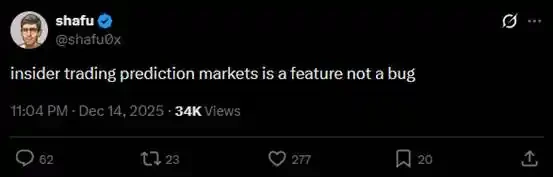
Insider trading is a characteristic of market prediction, not a vulnerability.
Players holding this view believe that insider trading is justified as long as the information leaked has a "positive externality overall." They also argue that prediction markets cannot function without these insiders, because without them, the accuracy of event predictions would plummet, leaving only those without accurate information to gamble.
This viewpoint has some merit, but I believe market prediction platforms themselves will resist such a positioning because, in the long run, it would damage retail investors' trust. The entire market would essentially transform from a platform that encourages individual research and insights and gathers collective wisdom into a one-sided "massacre" by insiders, hindering liquidity development. If this is what the prediction market is like, then it might as well be renamed an "information bounty platform."
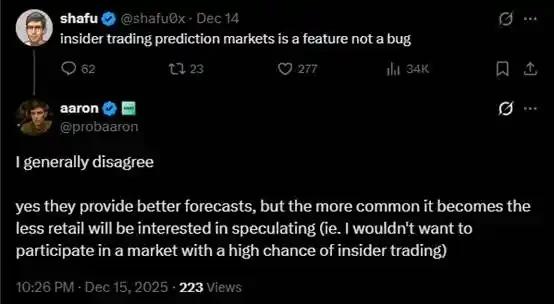
Kalshinomics founder @probaaron countered @shafu0x's viewpoint, stating, "I generally disagree with this argument. Yes, they do provide more accurate predictions, but as they become more prevalent, retail investors' interest in speculation decreases (for example, I wouldn't want to participate in a market where insider trading is highly likely)."
In summary, I believe that platforms like Polymarket, built on-chain, with transparent and anonymous activity, fulfill our expectations for decentralization—anyone can freely send signals through prediction markets without worrying about anything; the only concern is being responsible for their bets. The harsh reality is that there are countless instances of wealth transfer caused by information asymmetry in the world, and those occurring in prediction markets or the stock market are perhaps the most acutely felt.
As for whether prediction markets themselves should maintain a more acceptable position for the public in order to provide a relatively fairer environment for retail investors and achieve sustainable development, that is a question they should consider.
Conclusion
There are actually many other interesting questions, such as whether a prediction market will emerge in the future that can challenge Kalshi and Polymarket? If the compliance of prediction markets continues to advance worldwide, will each country and region develop its own leader (because these markets can do a better job of localization and provide prediction events that are more user-friendly for their respective countries and regions)?
Prediction markets aren't exactly new, but compliance with them is certainly a very novel and avant-garde endeavor. I believe that over time, the issues raised in this article will yield unexpected and interesting answers.


