






The Crypto Mega-App Revolution: When Coinbase and Others Break Financial Boundaries


- 核心观点:金融应用正从碎片化走向一体化整合。
- 关键要素:
- 代币化技术打破资产交易时间壁垒。
- 监管框架趋于明确,支持多资产产品开发。
- 移动钱包基础设施成熟,简化用户操作。
- 市场影响:提升资金效率,重塑平台竞争格局。
- 时效性标注:中期影响。
Original author: Nishil Jain
Original translation by Luffy, Foresight News
Last week, Coinbase launched a new product touted as the "future of finance." A single app offers five main functions: 24/7 stock trading, centralized exchange and on-chain cryptocurrency trading, futures and perpetual contract trading, prediction markets, and AI-powered financial analysts. All functions can be accessed via mobile phone, and users can instantly switch between different asset classes using their single account balance.
Robinhood has already taken the lead in this area: launching tokenized stock trading, 24/7 futures trading, and cryptocurrency interest-bearing services in Europe, and planning to launch Robinhood Social, a social trading feature, in 2026.
The prevailing narrative on the X platform interprets this trend as an evolution of "super apps," but people overlook a crucial point: this is by no means a simple addition of functions, but rather a breaking down of the boundaries of financial asset classes artificially defined by regulatory and technological restrictions.
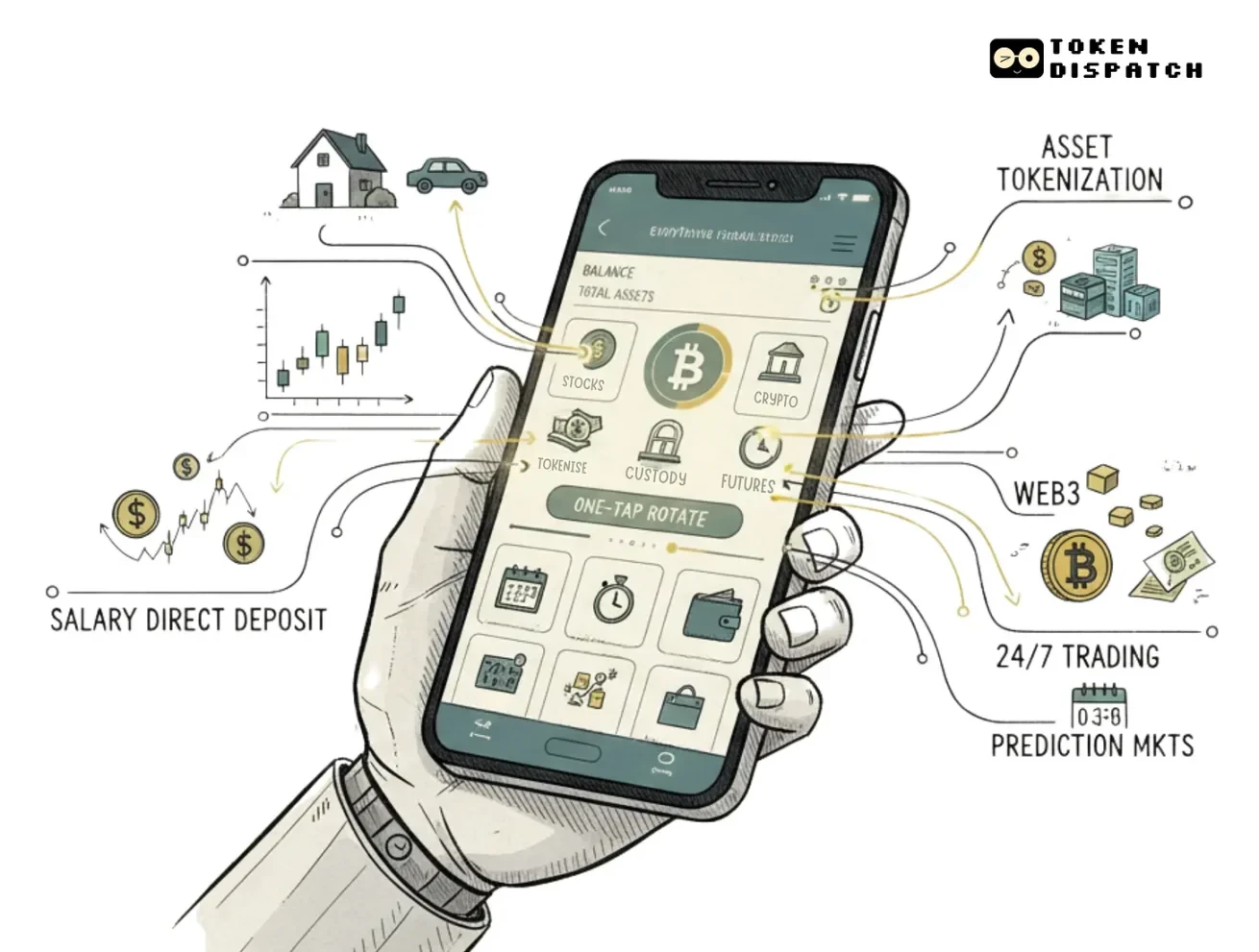
Why is the financial application industry facing a wave of consolidation after a decade of fragmented development? What does this mean for users and platforms involved? Let's get into the topic.
The pain points of fragmentation
Over the past decade, numerous fintech applications have emerged, but most only cover a single aspect of financial services, with functions such as stock trading, cryptocurrency, payments, and savings scattered across different applications.
While this model offers users more choices and allows companies to focus on refining a single solution, it presents numerous problems in actual use.
Want to sell stocks and buy cryptocurrency? Stock transactions need to be executed on Monday, with T+1 settlement only completed on Tuesday. After that, initiating a withdrawal takes 2-3 days for the funds to reach your bank account. Transferring the funds to Coinbase then takes another 1-2 days. From "deciding to adjust your asset allocation" to "funds actually being transferred," the entire process takes approximately 5 days. During these 5 days, the investment opportunity you initially considered may have already disappeared, while your funds remain stuck in this cumbersome process.
For example, you might want to buy Bitcoin for $86,000 on December 18th, but due to process delays, the transaction might be completed five days later for $90,000. For more volatile investment opportunities like memes, initial coin offerings (ICOs), or initial public offerings (IPOs), the losses from such delays can be even more severe.
The problem of fragmentation is not limited to a single region. An Indian investor who wants to buy Nvidia stock needs to complete multiple KYC verifications, open an account with a brokerage firm that supports Indian users investing in US stocks, and deposit additional funds just to buy this one stock.
We've all experienced this kind of operational friction, but only recently has the infrastructure to solve this problem begun to take shape.
The cornerstone of change: improved infrastructure
Three major structural changes have made the emergence of integrated financial platforms possible.
Tokenization breaks down time barriers
Traditional stocks can only be traded during trading hours on the New York Stock Exchange (NYSE) (9:30 a.m. to 4 p.m. Eastern Time, 5 days a week), while cryptocurrencies enable 24/7 trading. By tokenizing stocks on a Layer 2 network, it is demonstrated that, with the right technical mechanisms, stocks can theoretically be traded around the clock.
Robinhood's tokenized shares in Europe now support 24/7 trading, and Coinbase will follow suit.
The regulatory framework is becoming clearer
In recent years, Bitcoin spot ETFs have been successfully launched, the legalization of stablecoins has progressed, the regulatory framework for tokenization has entered the review stage, and prediction markets have received approval from the U.S. Commodity Futures Trading Commission (CFTC). Although the regulatory environment is not perfect, it is clear enough that platforms can confidently develop multi-asset products without worrying about being completely shut down.
Mobile wallet infrastructure is mature
Embedded wallets can now seamlessly handle complex cross-chain operations. Privy, acquired by Stripe, allows users to create wallets using their existing email addresses without needing to access their mnemonic phrases. The recently launched cryptocurrency trading app Fomo allows non-crypto users to trade on-chain tokens such as Ethereum, Solana, Base, and Arbitrum without manually selecting networks. It also supports Apple Pay deposits, with the backend automatically handling all complex processes. Users simply need to click "Buy Tokens" to complete the transaction.
The core logic of liquidity integration
The core driving force behind this change is that funds scattered across different applications are essentially idle funds.
In the integrated model, users only need to hold one account balance: after selling stocks, the funds can be used immediately to purchase cryptocurrencies, without waiting for the settlement window, withdrawal review period, or going through intermediaries such as banks. The original 5-day opportunity cost is completely eliminated.
Platforms that aggregate liquidity are more efficient. Because their liquidity pools are deeper, they can offer faster execution speeds; because all trading pairs share the same underlying liquidity, they can support more pairs; they can generate returns on idle capital, much like banks; and they also earn more transaction fees due to reduced friction and increased user trading volume.
Coinbase's integration blueprint
Coinbase is a prime example of this wave of financial consolidation. Founded in 2012, the company initially started as a simple cryptocurrency exchange, supporting only the buying and selling of Bitcoin and Ethereum. In the following years, Coinbase gradually added institutional custody, staking services, and cryptocurrency lending products, evolving into a full-service cryptocurrency platform by 2021.
Its expansion has not stopped: it launched Coinbase Card, which supports cryptocurrency spending, Coinbase Commerce, a payment solution for merchants, and also built its own Layer 2 blockchain, Base.
The new product launch on December 17th marks the full realization of Coinbase's "super app" vision. Coinbase now supports 24-hour stock trading and plans to launch Coinbase Tokenize, a real-world asset tokenization service for institutions, early next year. It will also integrate prediction markets in partnership with Kalshi, launch futures and perpetual contract trading, and integrate Solana's decentralized exchange trading functionality within the app. Furthermore, the Base app has expanded to 140 countries and enhanced its social trading experience.

Coinbase is gradually becoming the operating system for on-chain finance. By providing a single interface and a single account balance, it covers trading needs across all asset classes, aiming to allow users to complete all financial transactions without leaving the platform.
Robinhood is following a similar development path: starting with commission-free stock trading, gradually adding cryptocurrency trading, offering a gold subscription service with 3% cash back and 3.5% deposit interest, futures trading, and then launching tokenized stocks in Europe.
Both platforms are betting on the same core logic: users don't want to download separate apps for stocks, cryptocurrencies, and derivatives; what they need is a single account balance, a unified user interface, and the ability to adjust fund allocations instantly.
Social Transaction: An Emerging Competitive Advantage
Asset consolidation solved the liquidity problem, but it did not solve the problem of asset discovery for users.
With millions of assets available in the market, how should users select trading targets and build their own investment portfolios?
This is precisely where the value of social features lies. Coinbase's Base app has a built-in dynamic feed where users can view other people's buy orders; Robinhood plans to launch Robinhood Social in 2026; eToro has had social trading features since 2007, paying copy traders 1.5% of their holdings as commission.
A number of applications exploring social trading features have also emerged in the on-chain space, such as Fomo, 0xPPL, and Farcaster. These applications allow users to view their friends' investment targets, follow them, and copy their trading actions.

Fomo's leaderboard page
Social trading allows users to view others' trading activities in real time and copy them with a single click. This significantly reduces decision-making friction: no independent research is needed; users simply follow trading strategies they trust. Once a platform establishes a stable community ecosystem—where users follow experienced traders and build personal reputations—it becomes very difficult for users to migrate to other platforms. This creates a strong competitive barrier and high user stickiness for trading applications.
Centralized exchanges have offered copy trading functionality since 2022, but its usage rate has consistently remained below 2%. Mobile app platforms are betting on increasing the adoption rate of this feature by optimizing the user experience. Whether their judgment is correct will determine whether social trading functionality can become a true competitive advantage or simply become another ordinary feature.
Pessimistic Perspective: Potential Risks and Controversies
Let's be honest about the current situation: the original intention of cryptocurrency was to achieve financial decentralization, remove intermediaries, and allow users to control their own assets.
Today, however, we are rebuilding centralized platforms: Coinbase controls asset custody, trade execution, and social networks; Robinhood holds the private keys to embedded wallets; and users need to trust platforms to be solvency, secure, and sustainable. All of this conceals counterparty risk.
Robinhood's tokenized shares are essentially derivatives that track stock prices, not actual shares. If the platform collapses, users will only be holding a promissory note.
The problems brought about by gamification are becoming increasingly serious: 24/7 trading means you might trade impulsively at 3 a.m.; social feeds can trigger FOMO when you see others profiting; push notifications provide real-time alerts for every market fluctuation. This is essentially a scaled-up version of casino psychology, meticulously optimized by designers who are adept at triggering dopamine responses.
Is this progress in financial democratization, or just a repackaged system of exploitation? This is a philosophical question worth pondering.
The essence behind the phenomenon
We spent ten years dissecting financial services, based on the assumption that fragmentation would foster competition and bring more choices.
However, it has been proven that fragmentation has also led to inefficiency: idle funds and dispersed liquidity. Users have to hold more idle funds due to the cumbersome fund transfer process. The new era is changing this situation.
Coinbase and Robinhood are gradually becoming the new kind of banks: they control your salary, savings, investment, and spending patterns, manage trade execution, asset custody, and access permissions, and intervene in every transaction. Their only difference from traditional banks is: a more aesthetically pleasing user interface, 24/7 trading markets, and deposit interest rates 50 basis points higher.
Whether we are democratizing finance by lowering barriers and improving efficiency, or simply changing the gatekeepers while retaining the barriers themselves, the era of fragmentation is over. In the coming years, we will witness whether financial integration based on open underlying technologies will yield better results than the traditional banks we once fled, or simply a change of logo that locks in users.


