






Say Goodbye to Mnemonic Phrase Anxiety: Understand How Account Abstraction Can Refactor the Web3 Experience


- 核心观点:账户抽象技术将重塑数字资产管理。
- 关键要素:
- 支持通行密钥,实现无感登录与防钓鱼。
- 引入Paymaster,允许代币支付或免Gas费。
- 账户可编程,支持恢复、批量交易等功能。
- 市场影响:降低用户门槛,推动Web3大规模普及。
- 时效性标注:长期影响。
Foreword: Besides mnemonic phrases, how else can we manage our assets?
For a long time, mnemonic phrases were not only the only key to unlocking Web3, but also the biggest psychological burden for many users. We had to carefully copy, check, and save them because, in the traditional account model, losing a mnemonic phrase (private key) meant permanently losing ownership of the asset.
While these stringent rules establish a secure foundation for decentralization, they also constitute a barrier to the widespread adoption of blockchain technology. So, is there a technology that can retain the core advantages of decentralization while making accounts as easy to manage and recover as those in Web2 applications?
The answer is Account Abstraction (AA).
This technology is redefining how digital assets are managed. imToken Web is a next-generation wallet product built on AA technology, aiming to provide users with a more secure experience without requiring you to be a cryptographer. This article will explain the core logic of AA in simple terms, and how it will change your digital life.
The "impossible triangle" of traditional accounts
To understand the value of AA, we need to first look at the commonly used account model— Externally Owned Account (EOA), which is the account you currently generate in wallets such as imToken App.
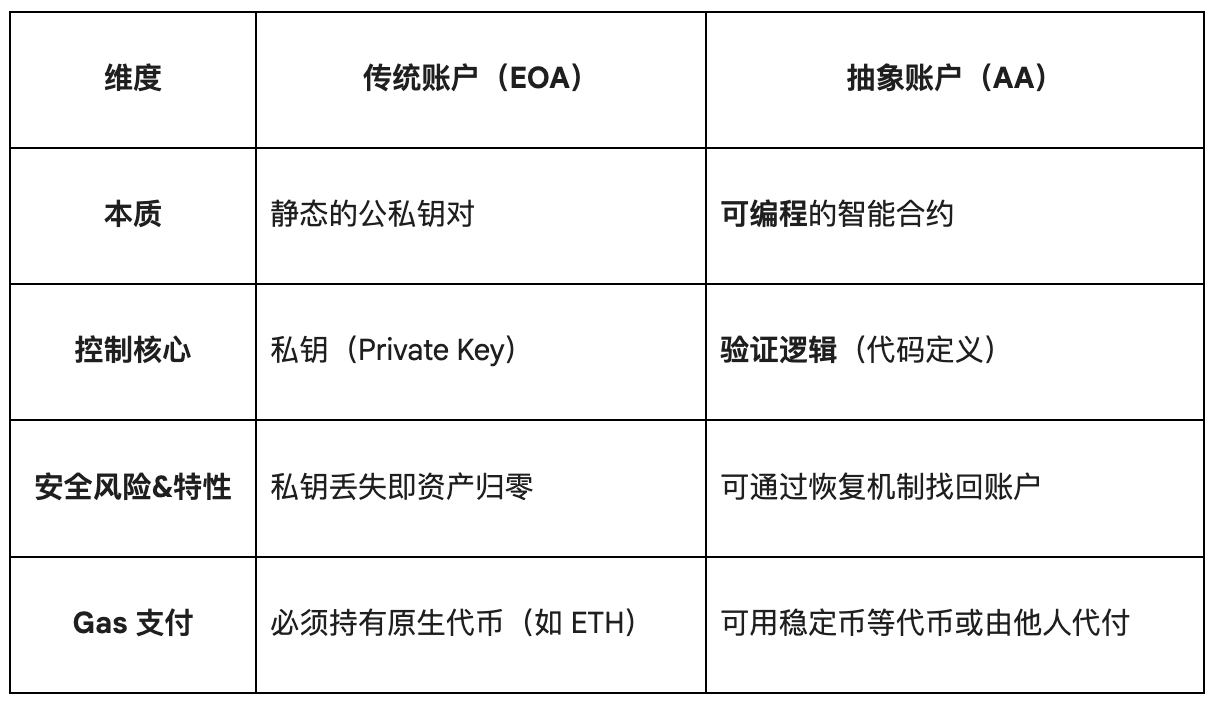
EOA's design is very low-level and rigid, with its core logic being "the private key is everything." Your private key is mathematically strongly bound to your account address. This architecture introduces an irreconcilable contradiction: to ensure security (offline, cold storage), we often have to sacrifice convenience ; but if we pursue convenience, we are prone to the risk of private key leakage. Even more cruelly, this type of account has no "password recovery" option, resulting in extremely low fault tolerance.
Furthermore, EOA accounts have many limitations in terms of interaction, such as the requirement to use native tokens like ETH to pay miner fees (Gas). This is often the first hurdle for new users who hold USDT but do not have ETH.
With the maturity of Layer 2 networks significantly reducing on-chain costs, and the finalization of the ERC-4337 standard and the implementation of the EIP-7702 protocol, AA technology has finally ushered in an opportunity for widespread adoption. It aims to break the aforementioned deadlock and liberate account control from the underlying cryptographic rules.
Basic Concepts: From "Keys" to "Smart Home Assistants"
If we were to define AA (Abstract Account) in one sentence, it would be: transforming the account from a "key" into a "smart manager".
In the traditional world of EOA, the rules are written at the blockchain protocol layer, and the transaction is executed once the private key signatures match. In the world of AA, however, the account itself is a smart contract deployed on the blockchain.
This means that account rules are no longer fixed, but programmable. You can write various logic into your account, such as: "Transfers can only be made when conditions A and B are met", "Maximum transfers per day: 1000 U", "If I lose my key, allow my guardian to reset it for me", and so on.
This shift decouples "ownership" from "signing rights." You still own the account, but the way you control it becomes more flexible and is no longer subject to a single private key.
How can AA change your user experience?
We can examine its advantages in detail from four dimensions: verification (how to log in), execution (how to transact), fees (how to pay), and evolution (how to grow).
1. Verification Logic: Say Goodbye to Mnemonic Phrases and Embrace a More Secure "Seamless" Login
The most noticeable change in AA is that it supports more advanced verification methods, freeing users from their reliance on mnemonic phrases.
Hardware-level security experience
In AA accounts (such as imToken Web), you can use a passkey to manage your assets. This is a technology based on the WebAuthn standard that uses the security chip inside your phone (iPhone/Android) or computer to generate and store the key.
In everyday use, you can simply sign transactions using Face ID or your fingerprint . This is not only more convenient than copying down a mnemonic phrase, but also more secure—because the private key is always stored in a hardware chip and never exposed to the internet. More importantly, the pass key has inherent anti-phishing properties. It strongly binds the key to the website domain name, so even if a hacker forges a website, they cannot trick you into generating a valid signature.
Account recoverability
Under the AA model, losing a device no longer equates to "digital death." Since an account is essentially a contract, we can change the "lock" through pre-defined logic. For example, you can set your EOA wallet, social media account, or family and friends as "guardians." When you lose access to your account, you can initiate a recovery request, which, after confirmation by the guardian, will reset control and allow you to recover your assets.
2. Execution Logic: From Cumbersome Instructions to Intent-Driven Execution
Traditional on-chain interactions are often cumbersome. For example, to buy cryptocurrency on-chain, you usually need to first initiate an "Approve" transaction and wait for it to be recorded on the chain; then you need to initiate a "Swap" transaction and wait again. This not only wastes gas but also provides a very poor user experience.
AA supports atomic batching . Simply put, it can package multiple actions such as "authorization" and "exchange" into a single data package. For the user, you only need to click "exchange" once, and the backend will automatically process all steps. These steps either all succeed or all fail on the blockchain, avoiding the awkward situation of "authorization completed but no token exchanged."
The extension of this capability is that Web3 will move towards intent -centricity in the future. Users only need to express the intent "I want to exchange A for B" without worrying about the underlying path and complex steps. The AA account, combined with the backend solver network, will automatically find the optimal path for you and execute it.
3. Fee Logic: Breaking Down Payment Barriers for Native Tokens
For new users, the most confusing thing is: "I have 1000 USDT in assets, but because I don't have any ETH in my account, I can't transfer a single penny out."
AA introduces a role called Paymaster , which revolutionizes the payment logic. It allows applications to deploy on-chain exchange rate calculation or subsidy logic.
- Pay Gas with Tokens: You can directly use tokens in your account (such as USDC) to pay gas fees. Paymaster will automatically exchange the tokens for ETH in the background and pay the Bundler (e.g., the miner) at the exchange rate. This makes the Web3 payment experience as natural as swiping a credit card, no longer limited to having to hold native tokens.
- Gasless: In certain scenarios (such as new user registration or participation in activities), the project team can even fully subsidize the gas fee, so users are completely unaware of the existence of gas during interaction.
4. Evolutionary Logic: A wallet that grows with demand.
Traditional wallets often have fixed functions, while the AA account is based on smart contracts, which gives it strong modularity . You can think of it as a butler that can continuously learn new skills and evolve according to your needs.
- Differentiated services: A beginner may only need the most basic transfer and payment functions, with a simple and easy-to-use interface.
- Feature expansion: As you gain experience, when you need to participate in complex interactions or manage large amounts of assets, you can "configure" new modules for your account, such as adding multi-signature protection or setting daily spending limits.
This modular design transforms the AA account from a static tool into a flexible, intelligent platform that meets users' needs throughout the entire lifecycle, from beginner to expert.
The Future of EOA: Can Existing Accounts Be Upgraded?
The innovative experiences mentioned above are primarily built on the ERC-4337 standard. It is currently the most mature AA (Agent Assistance) path, but it typically requires users to create a completely new AA account.
You might ask, "What if I don't want to give up my old address that I've used for years, and I don't want the hassle of moving my assets?"
Proposal EIP-7702 provides the answer—it allows existing EOA accounts to be upgraded in place.
The core mechanism of EIP-7702 lies in code delegation. Traditional EOAs can only passively execute instructions for signing with a private key, while EIP-7702 allows you to "attach" a piece of smart contract code to your EOA during a transaction through a special signature.
This means that you still hold the original private key and address, but the moment the transaction occurs, your account "transforms" into a programmable smart contract. This design cleverly breaks the limitation of the non-programmable EOA, allowing you to directly call the various AA logics mentioned above without changing your address, seamlessly integrating a more advanced interactive experience while maintaining asset sovereignty.
Conclusion: Make your wallet "invisible"
The best form of technology is often one where users are unaware of its existence.
In the EOA era, users were forced to understand obscure cryptographic concepts such as private keys, nonces, and gas prices, much like requiring everyone online to understand the TCP/IP protocol. The ultimate mission of AA technology is to make wallets both "invisible" and powerful.
With access keys, we no longer need to face unfamiliar mnemonic phrases; with Paymaster, we are no longer limited by gas fees; with modular design, wallets can grow with us. AA is not just a technological upgrade; it is an essential step for Web3 to move from the geek community to the masses.


