






Web3 without mnemonic phrases: AA × Passkey, how will it define the next decade of Crypto?


- 核心观点:助记词是当前加密资产安全的最大软肋。
- 关键要素:
- 助记词泄露即永久失窃,无法撤销或修改。
- 助记词是黑客攻击的核心目标,易受钓鱼。
- 助记词保管复杂,阻碍Web3大规模普及。
- 市场影响:推动无助记词钱包技术成为新趋势。
- 时效性标注:中期影响
If you've been around Web3 for a while, even if you're careful and lucky enough not to have experienced the darkest moment of having your assets stolen, you've definitely heard pleas for help like this in the community:
"I never took screenshots, nor did I give my mnemonic phrase to anyone. I just used my wallet normally, so why are my assets still gone?" The most despairing commonality in these cases is that the victims have no idea where their wallets were compromised.
Some people unknowingly installed compromised browser plugins; others stored their mnemonic phrases in their phone's notes, only to have them synced to unknown servers; some had their phones infected with malware, resulting in the silent uploading of clipboard content; and some even connected to fake websites, entered their mnemonic phrases, and within seconds, their wallets were empty...
This is not an exaggeration. It can be said that behind the vast majority of phishing scams in the crypto space, there is often a common vulnerability—mnemonic phrases. This article will also analyze why mnemonic phrases are becoming the biggest weakness in asset security, and how account abstraction (AA) and Passkey are expected to redefine asset sovereignty.
I. The Limits of the EOA Model: "Mnemonic Phrases" Become a Curse
We must acknowledge the fact that the problem with EOA accounts is not that they are "not secure enough," but that they have been burdened with too much from the very beginning.
As is well known, in the traditional EOA model, the mnemonic phrase is the cornerstone of the crypto world. A seed phrase of 12 or 24 words represents absolute control over on-chain assets and constitutes the most prominent feature of cryptocurrency security in the eyes of newcomers—"private key/mnemonic phrase is asset":
As long as you hold this key, no one, whether it's an exchange or a validator, can freeze, confiscate, or operate on your behalf. However, this complete decentralization is a double-edged sword, representing "absolute control" but also implying an unavoidable "single point of failure."
First and foremost, there's no going back. Once your mnemonic phrase is leaked (even if it's just a screenshot from years ago, as long as it's copied or synced), your wallet will never be safe again, and you can't reset your mnemonic phrase like you can "change your password" in a bank/Alipay/WeChat app.
The only solution is to abandon the wallet and transfer the assets, which also means that if the attacker is faster than you, you have no chance to "undo" or recover the assets.
Secondly, it is a "perfect honeypot" in the eyes of hackers. After all, the permissions of the mnemonic phrase are too great. Trojans, fake wallets, fake plugins, phishing websites, fake customer service, etc., hackers do not need to break through the blockchain's strong cryptographic defenses. They only need to break through your defenses. All attack routes eventually converge on the same goal, which is to induce you to hand over those 12/24 words.
Finally, for modern users accustomed to Face ID and fingerprint payments, understanding and securely storing a paper mnemonic phrase is a huge cognitive hurdle. This not only hinders the large-scale adoption of Web3, but also makes every interaction accompanied by the psychological burden of "Will I lose it?"
It's like guarding a door that can only be opened with "the same key," a key that is exposed to both the user's daily operations and the risks of all devices and system environments.
It is against this backdrop that, starting in 2022, mnemonic/plaintext-free private key wallets, which exceed the limits of EOA, have gradually become a popular field of study. From MPC technology to CA wallets, everyone is exploring a better solution—one that can both have Web3 asset sovereignty and be as simple and secure as unlocking a phone with Face ID.
Now, standing at this juncture, with the combination of Account Abstraction (AA) and Passkey technology, we may indeed have a chance to end the era of mnemonic phrase dominance in the next decade.
II. Passkey: Turning Yourself into a Key
If Account Abstraction (AA) liberates accounts from a "single private key," ushering in a new era of recoverability, upgradeability, and configurability (further reading: " From EOA to Account Abstraction: Will the Next Leap of Web3 Happen in the 'Account System'? "), then Passkey is the "ultimate key" that drives a qualitative change in user experience.
Many people may still be unfamiliar with the term Passkey. In fact, as a passwordless login technology based on the FIDO standard, it has long been the next-generation passwordless technology standard that tech giants such as Apple and Google are pushing hard for.
In the crypto world, its significance is especially profound.
Simply put, a Passkey is a digital key stored in the security chip of your device (such as a mobile phone or computer). It eliminates the need for you to remember, save, or enter a mnemonic phrase; you can simply use the biometrics (Face ID/fingerprint) on your device to log in and sign in.
In fact, many people have already unknowingly enjoyed the convenience of Passkey: when you log into an app on an Apple device or visit a website in a browser, you can complete the task that previously required a password simply by "scanning your face"/fingerprint/entering a PIN code.
This experience is so addictive because it's both seamless and secure. Therefore, if Web3 wallets support Passkey, theoretically users could completely avoid touching their private keys. Furthermore, by combining account abstraction, even the gas step could be abstracted away, creating an unprecedented "seamless" experience.
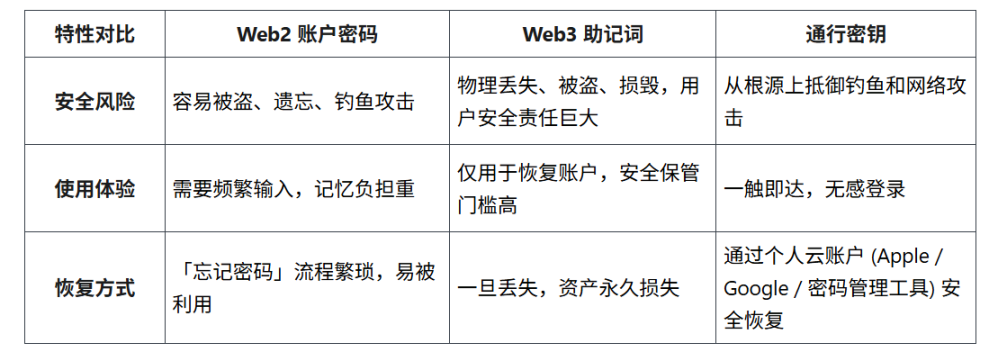
So why is Passkey inherently more resistant to phishing than the EOA mode? Because it possesses two superpowers that traditional mnemonic phrase modes can never have:
- Your private key will never leave the device and cannot be "scammed": The mnemonic phrase is a string of characters that you can send to others, but the Passkey is bound to your hardware device. The private key will never leave the main body of your device, and hackers cannot get you to "enter" your fingerprint or facial data through phishing websites or tampered browser plugins.
- Eliminating fake websites from the ground up: This is also one of Passkey's core killer features. Relying on the WebAuthn / FIDO2 binding mechanism, the Passkey protocol will force verification of the current website's domain name. This means that even if you accidentally enter a fraudulent website (such as many imToken fake fraudulent websites that send harassing text messages), your device will detect that the domain name does not match and refuse to perform biometric verification. This is a system-level defense that does not rely on your manual judgment.
At the same time, Passkey offers a smooth experience, requiring no mnemonic phrases, screenshots, or backups; login, signature, and authorization can be completed simply by touching your fingerprint or scanning your face.
This is precisely why Passkey, in conjunction with AA, can be seen in the Web3 world as a solution that simultaneously enhances both user experience and security, rather than a patch that makes users more cautious in learning how to use it.
III. Next-Generation Web3 Security and Experience Philosophy
From this perspective, when AA meets Passkey, we can finally build a more intuitive, secure, and future-oriented account model.
You can understand this new philosophy of safety and experience as follows:
- The person is the key: the account is protected by the device itself, and Face ID/fingerprint is your signature;
- Physical isolation: Security is at the hardware level, stored in a secure chip, and cannot be exported or read by Trojans;
- Cloud roaming: With syncing methods such as iCloud, your account can roam securely across multiple devices;
- System defense: It's not about making users work harder to distinguish between genuine and fake websites, but about making the system smarter and automatically block risks.
All of this constitutes a new paradigm, which is not about making users work harder to learn and defend, but about making the system smarter.
Take imToken Web as an example. It is a non-custodial, token-centric web application designed to allow users to quickly and securely create or log in to accounts without setting up or backing up private keys/mnemonic phrases, and enjoy a variety of token features anytime, anywhere.
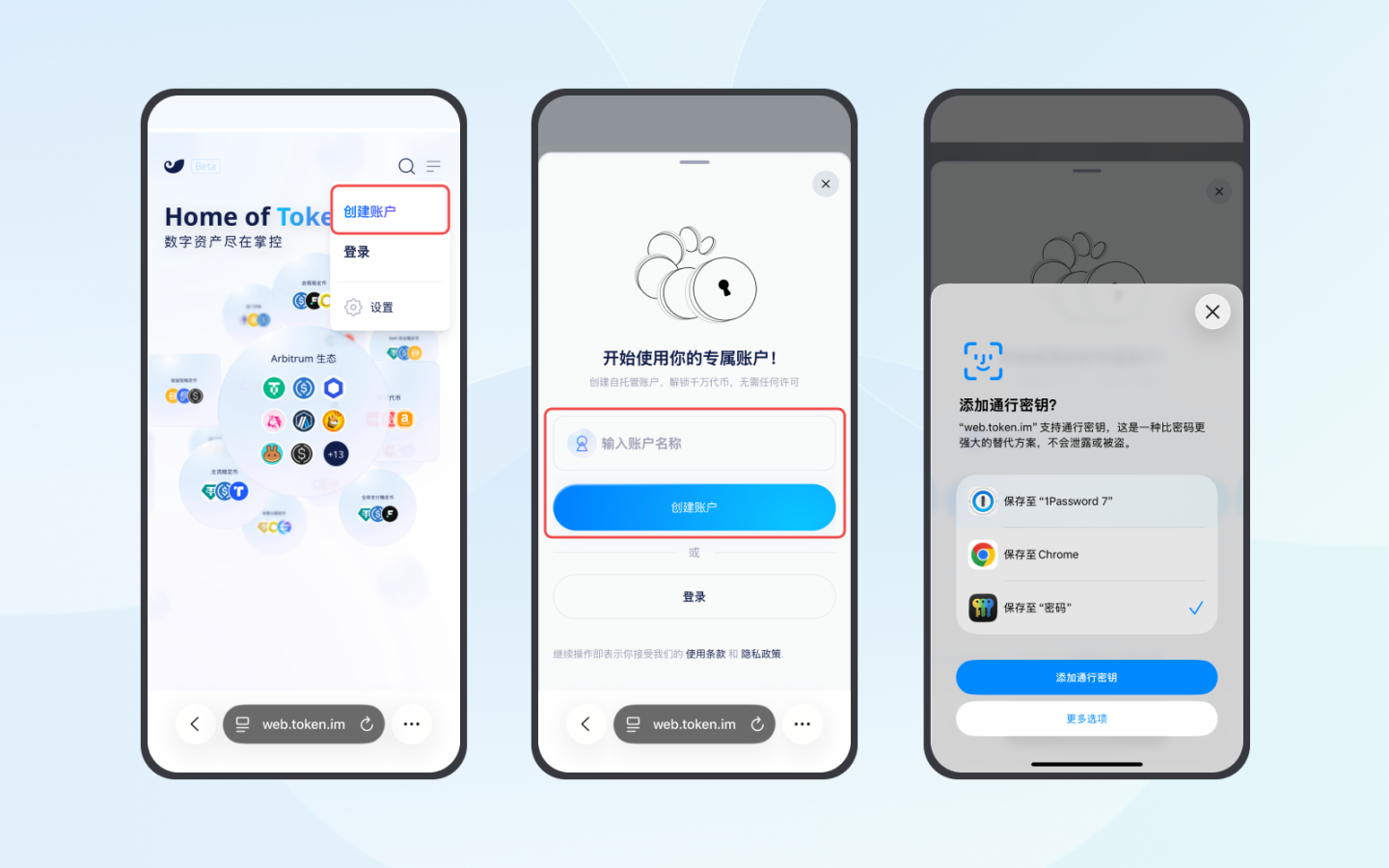
For example, using imToken Web, you will have a virtually barrier-free "four-no" experience:
- No barriers to entry: No need to find paper and pen to copy 12 words, and no need to worry about copying the mnemonic phrase incorrectly. Click to connect your wallet, verify Face ID/fingerprint, and your account will be generated instantly;
- Unaffected by phishing risks: Because login relies on a Passkey, fake websites cannot pass domain verification and therefore cannot invoke a signature, so your private key will never be exposed;
- No Gas Anxiety: As an AA wallet, imToken Web supports direct gas payments using USDT/USDC, so you'll never be stuck because you don't have ETH in your account again.
- Seamless device roaming: With system-level synchronization capabilities, your Passkey can be automatically synchronized across your Apple or Google ecosystem devices. Even if your phone is lost, you can simply log in to your system account (Apple ID / Google) on the new device, verify your biometrics, and your account will remain safe and recoverable.
What's even more interesting is that this low-barrier experience unlocks entirely new ways of interacting.
Based on this, you can even send tokens on imToken Web like sending red envelopes. For example, after selecting "Send via link," setting the "amount" and "link expiration," you can directly create a link and then send it to anyone (even if they don't have a wallet) through any channel such as WeChat, Twitter, or Telegram.
The recipient requires no prior setup; simply click the link to securely and conveniently create an account and claim assets using the "access key."
In conclusion
The future of Web3 shouldn't be limited to geeks.
In the uncertain world of Web3, wallets, which encapsulate the most robust security technologies (AA & Passkey) into the simplest user experience, thereby lowering the security threshold and experience for both new and existing users, are precisely what they should be doing to explore the next decade of traffic entry points.
So, if you're fed up with the anxiety of safeguarding your mnemonic phrase, if you're worried about becoming the next victim of a phishing attack, or if you just want to recommend a "no-brainer" crypto wallet to a friend, then this is for you.
So, it's time to look forward to or try out a future without mnemonic phrases.


