






HashKey's share price fell below its IPO price on its first day of trading; "Oriental Coinbase" is not yet established.


- 核心观点:HashKey上市首日破发,市场表现不及预期。
- 关键要素:
- 首日股价跌破发行价,收盘接近发行价。
- 招股获近400倍超额认购,与破发形成反差。
- 业务数据(用户、交易量)远逊于对标公司Coinbase。
- 市场影响:或影响市场对同类“合规加密股”的短期估值。
- 时效性标注:短期影响。
Original article by Odaily Planet Daily ( @OdailyChina )
Author|Golem ( @web3_golem )
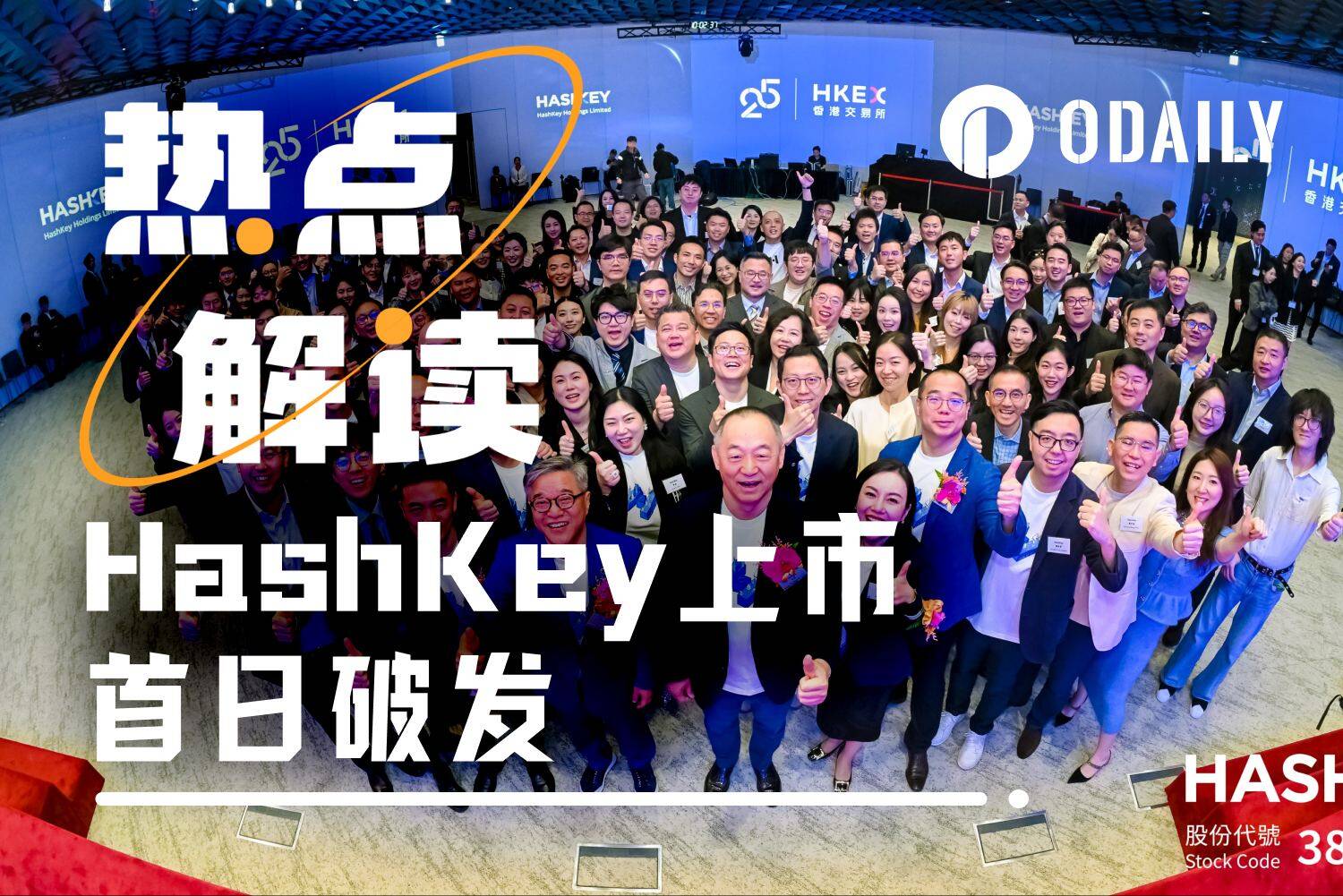
On December 17, HashKey Holdings (03887.HK) officially listed on the Hong Kong Stock Exchange. Unfortunately, the "first Hong Kong-listed cryptocurrency exchange" fell below its issue price of HK$6.68 within the first hour of trading.
According to Hong Kong stock market data, HASHKEY HLDGS' share price rose to a high of HK$7.12 during trading, before falling to a low of HK$6.12. The closing price on the first day was HK$6.67, close to the offering price.
This stock price performance contrasts sharply with the investment enthusiasm shown by the market during HashKey Holdings' IPO. On December 12, HashKey Holdings closed its IPO, selling 240.6 million shares at HK$6.68 per share, raising HK$1.67 billion (approximately US$206 million) for the Hong Kong IPO. The Hong Kong public offering was oversubscribed by 393.71 times, and the international placement was also oversubscribed.
Public opinion has become divided. On the one hand, some crypto practitioners praised HashKey for pushing the crypto industry toward the mainstream and becoming an important milestone in the development of Web3 in Hong Kong. On the other hand, Hong Kong stock investors who rushed to subscribe to IPOs were ultimately disappointed.
According to statistics, the rate of IPOs falling below their issue price in Hong Kong in 2025 is between 24% and 30%, and the first cryptocurrency stock was no exception.
"Eastern Coinbase," a self-indulgent exercise for crypto enthusiasts?
In early December, when HashKey Holdings completed its listing hearing and released its prospectus, Odaily provided an in-depth analysis of the numerous difficulties facing HashKey Holdings' businesses, such as four consecutive years of financial losses, poor performance in its exchange business, a lack of competitiveness in its on-chain ecosystem, excessive R&D and compliance expenses, and the increasing scarcity of compliance licenses. Odaily bluntly stated that investors should carefully consider their investment decisions. (Related reading: Four Consecutive Years of Losses, HSK's Slump, HashKey's IPO Against the Trend: Will the Capital Market Buy It? )
However, the enthusiastic subscription market for HashKey's IPO shows that the market still has high expectations for the "first Hong Kong crypto stock" and is not too concerned about HashKey's losses (the prospectus states that the losses are due to the trading platform still being in the early stages of development and a period of high investment) .
It should be noted that HashKey will still allocate 40% of the proceeds from this IPO to technology and infrastructure upgrades, another 40% to market expansion and ecosystem partnerships, and the remaining 20% to operations and risk management, working capital, and general corporate purposes.
The card clearly states, "Although I'm not making money now, I have growth potential. Put down your chips and let's gamble on the future together."
While the stock market values financial statements and corporate cash flow, there are many well-known companies with high growth potential but no profit, and investors are willing to pay for them. For example, Amazon lost money for three consecutive years before its IPO, but that did not prevent it from becoming an e-commerce giant. A more relevant example is Coinbase, which, like HashKey, followed a compliant path and also suffered losses before its IPO, but that did not prevent it from being sought after by capital after its listing.
However, those who compare HashKey to the Coinbase of the East often downplay the key issues, focusing instead on regional compliance as a commonality between HashKey and Coinbase, emphasizing HashKey's compliance premium and high growth potential.
In my opinion, the biggest difference between HashKey and Coinbase is that Coinbase's huge compliance expenses have brought substantial business returns, while HashKey's business data has not improved much despite obtaining a Hong Kong compliance license.
Prior to Coinbase's IPO in 2021, the company reported 56 million registered users, while HashKey currently has only 138,000. Before Coinbase's IPO, its daily trading volume reached the $1 billion level, while HashKey's daily trading volume remains at the million-dollar level. Furthermore, HashKey's on-chain services and asset management businesses are even less comparable, and these two business segments contribute very little to HashKey's revenue.
There are signs that secondary investors are not buying into the "Coinbase analogy" claim. HashKey Holdings' share price had already fallen below its initial offering price in yesterday's Futu grey market trading.
However, in this lackluster environment, discussing the significance of HashKey's IPO without considering its stock price performance happens to hit the sweet spot of the crypto industry's collective desire to expand its reach.
A special case? The first case?
Judging a hero by a single day is indeed short-sighted. Let's broaden our perspective. For the Chinese-language crypto community, HashKey's listing in Hong Kong is also significant because it symbolizes a further "loosening" and acceptance of the crypto industry by the Hong Kong capital market. HashKey's listing has fired the first shot, and in the future, more high-quality crypto projects may take root and flourish in Hong Kong, even triggering a bull market. The strategic significance of crypto represented by HashKey far exceeds its intrinsic value.
From this perspective, who has the opportunity to become the successor?
My assessment is that HashKey's IPO may be a unique case among crypto companies in Hong Kong, solely due to a single key figure.
Xiao Feng, a prominent figure in the crypto world, is not the largest shareholder of HashKey. The one who truly controls HashKey is Lu Weiding, chairman of Wanxiang Group, who stood beside him this morning to ring the bell.
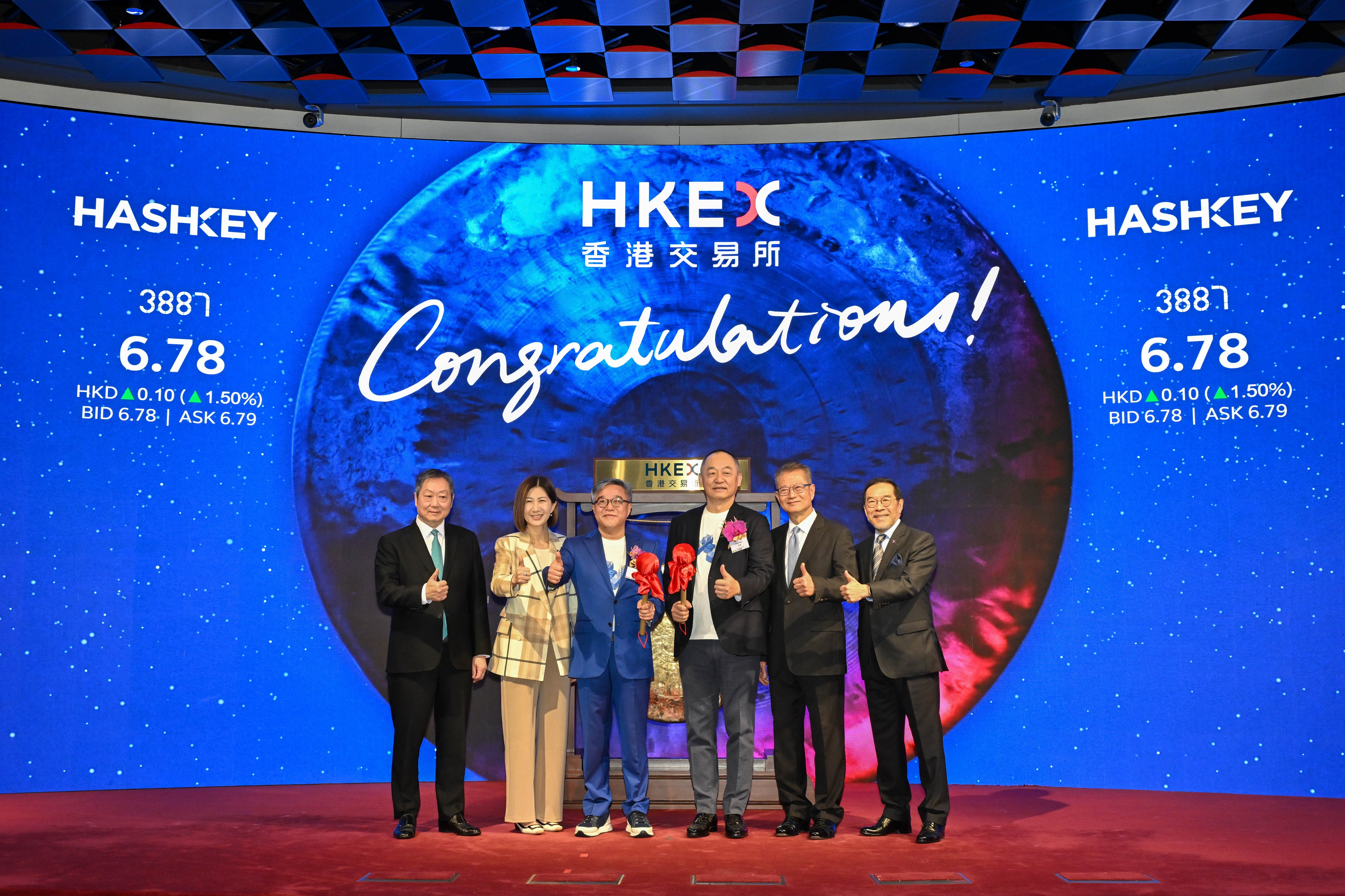
Lu Weiding (third from left) and Xiao Feng (third from right)
Lu Weiding is the major controlling shareholder of HashKey, holding 43.2% of the shares and exercising 22.9% of the voting rights through the employee shareholding platform. Xiao Feng, as the founder of HashKey, holds 16.3% of the shares; other investors hold a total of 17.6%. The shareholding structure clearly demonstrates Lu Weiding's absolute control over HashKey.
Lu Weiding succeeded his father, Lu Guanqiu, as chairman of Wanxiang Group after his death. Wanxiang Group was originally a large domestic manufacturing enterprise that started with the auto parts manufacturing industry and later expanded into real estate, tourism, agricultural products, finance, energy, and metal resources.
After Lu Weiding took over as chairman, he vigorously developed Wanxiang Group's financial industry, which now owns many financial companies such as Minsheng Life Insurance, Tonglian Payment, Zhejiang Merchants Fund, Puxing Juneng, Wanxiang Trust, Wanxiang Leasing, and Tonghui Futures, creating a Wanxiang financial empire.
Why is Lu Weiding so crucial to HashKey's IPO?
In addition to being the chairman of Wanxiang Group and the main controlling shareholder of HashKey, Lu Weiding also holds positions such as a representative of the 14th National People's Congress, vice chairman of the All-China Federation of Industry and Commerce, member of the Zhejiang Provincial Committee of the Chinese People's Political Consultative Conference, and a distinguished entrepreneur of Zhejiang Province. These identities and the resources they represent provide HashKey with greater support.
Given the current regulatory environment, how can other competitors replicate this advantage, and will their path to listing be smooth? Therefore, comparing HashKey to a "model of Hong Kong encryption" will mislead entrepreneurs and investors.
For a long time to come, HashKey will not only be the "first Hong Kong crypto stock," but more likely a lone runner who squeezed into the race in a split second by perfect timing, location, and circumstances.


