Can Almanak revolutionize DeFi through simulation-based optimization?



- 核心观点:Almanak通过模拟优化DeFi协议参数。
- 关键要素:
- 使用基于代理的模拟预测未来场景。
- 为协议创建数字孪生进行压力测试。
- 旨在实现从手动治理到自动化优化的转变。
- 市场影响:提升DeFi风险管理与资本效率。
- 时效性标注:长期影响。
The decentralized finance (DeFi) space is a complex and rapidly evolving ecosystem, with various protocols managing billions of dollars in assets. However, despite the significant risks, many protocols still set parameters based on guesswork, rudimentary backtesting, or community governance voting lacking rigorous data support. This inefficiency not only exposes users and liquidity providers to unnecessary risks but also results in subpar returns. Almanak emerged against this backdrop, aiming to change this paradigm in the blockchain world by introducing agent-based simulation and optimization mechanisms. But how exactly does it work? Is it the crucial missing link in building a mature, efficient DeFi market?
This article will delve into the core of Almanak, analyzing its technology, its necessity in the current market, and its potential to reshape our understanding of on-chain financial risk and optimization.

DeFi Optimization Challenges: Why Existing Methods Fail
To understand Almanak's value proposition, we must first confront the current state of DeFi governance. Most protocols rely on static parameters—such as interest rate models, collateral factors, and fee structures—which are rarely updated. Even when they are updated, the process is often reactive rather than proactive.
Imagine a lending protocol that sets the collateral ratio for a specific asset at 70%. If market volatility intensifies, 70% might be too risky, leading to bad debts. If the market is stable, 70% might be too conservative, suppressing capital efficiency. Currently, adjusting this parameter requires governance proposals, voting periods, and implementation delays—a process far too slow for the rapidly changing crypto market.
Furthermore, traditional backtesting methods used to validate these parameters have flaws. They rely solely on historical data, assuming the future will repeat the past. However, in the crypto space, "black swan" events are frequent, and historical data often fails to capture the complex and reflexive interactions between different market participants. This represents a critical gap in the industry: a lack of forward-looking, behaviorally-aware risk management tools.
What is Almanak?
Almanak is a simulation and optimization platform designed specifically for decentralized finance (DeFi). Unlike traditional analytics tools that only track past performance, Almanak uses Agent-Based Simulation (ABS) to simulate future scenarios. It creates digital twins of DeFi protocols and populates these environments with autonomous agents that mimic the behavior of real market participants (traders, liquidity providers, arbitrageurs, and liquidators).
By running thousands of simulations under various market conditions (bull market, crash, stagnation), Almanak can predict a protocol's performance and determine optimal parameters to maximize efficiency while minimizing risk. It effectively allows a protocol to "stress-test" its economic design before risking real user funds.
This platform primarily serves two functions:
- Risk Management: Identify vulnerabilities and recommend parameters that can protect the protocol from bankruptcy or bad debts.
- Profit optimization: Determine the fee structure and incentive mechanisms that maximize revenue for the protocol and its users.
Core Technology: Agent-Based Simulation (ABS) and Traditional Backtesting
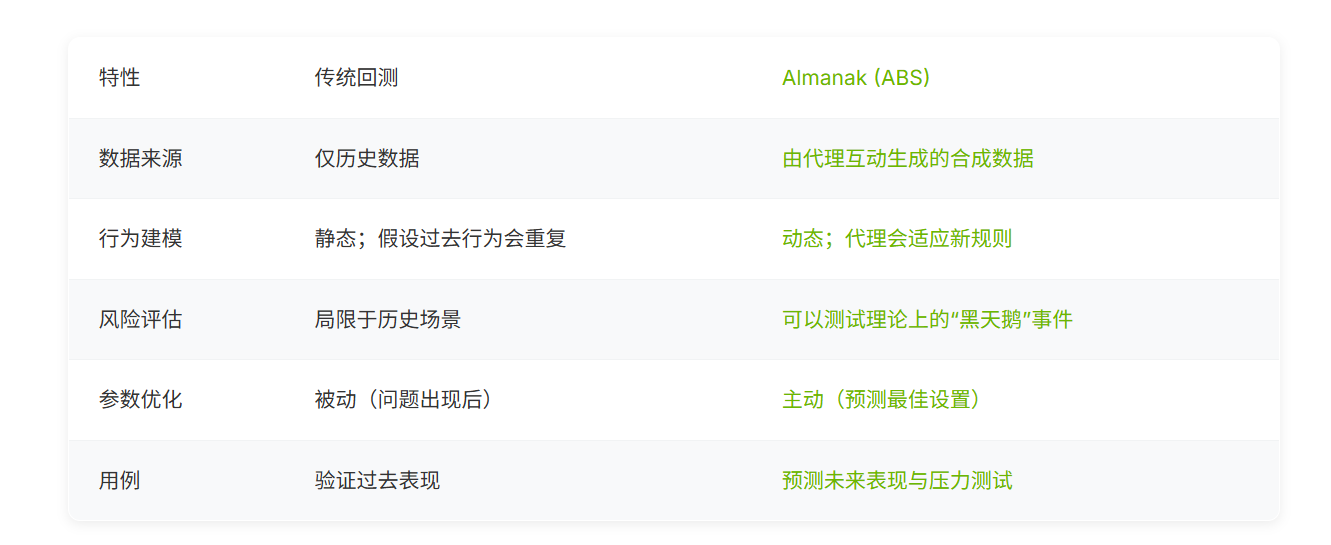
Almanak's core differentiating advantage lies in its agent-based simulation technology. To understand this, we need to distinguish it from standard backtesting.
Traditional backtesting:
- Method: Replay historical price data for a set of rules.
- Limitations: It assumes that market participants will behave exactly as they have in the past, even if the rules of the agreement change. It cannot explain "second-order effects" (e.g., interest rate changes may cause whales to withdraw liquidity).
Almanak's agent-based simulation:
- Method: Simulate a living ecosystem in which independent agents make decisions based on their own objectives (profit, risk aversion) and the current state of the simulation.
- Advantages: Captures complex feedback loops in the real economy. If the simulation changes the cost parameters, the "arbitrage agent's" response may differ from historical performance. This provides a more accurate prediction of future outcomes.
This approach is similar to how Formula One (F1) teams use wind tunnels and simulators to test and fine-tune their cars before races. Almanak provides a "wind tunnel" for DeFi economy designers.
How to optimize protocol parameters in Almanak
The optimization process within Almanak is a continuous cycle that includes simulation, analysis, and recommendations.
- Creating a digital twin: Almanak first builds a code-level copy of the target protocol (such as a clone of Uniswap or Aave).
- Scenario configuration: Users define the market conditions they want to test. This can be "normal market fluctuations" or "extreme decoupling events".
- Deploying Agents: The simulation is populated with agents trained on on-chain data to behave like real users. Some agents may be aggressive yield farmers, while others may be conservative holders.
- Simulation run: The system runs thousands of Monte Carlo simulations, fine-tuning the parameters each time to observe the changes in the results.
- Output optimization results: The platform determines a specific set of parameters (e.g., "set the interest rate slope 1 to 4%) that align with the protocol's objectives (e.g., "maximize total value locked while keeping the bad debt ratio below 0.1%)".
This output provides actionable intelligence that DAOs and protocol administrators can implement immediately, transforming decision-making from "intuition-based" to data-driven science.
The role of tokens and transactions in the ecosystem
While Almanak's primary focus is its B2B demo product, its broader ecosystem encompasses a variety of tokens used to facilitate governance, access, or represent value for the underlying protocols being optimized. Understanding the market dynamics of these tokens is crucial for investors looking to support DeFi infrastructure.
For those interested in the financial aspects of these technologies, XT.com offers a comprehensive portal. Users who track the market can view Almanak prices and analyze their performance relative to the broader industry.
Furthermore, XT.com offers robust trading pairs for the relevant assets. Traders can participate in highly liquid and fast-execution BEAT/USDT spot trading . For more advanced users, the platform supports automation tools, allowing you to set up a BEAT/USDT spot grid trading bot to automatically profit from market volatility. Additionally, users can explore BEAT/USDT trading strategies to optimize their positions in this evolving market.
Case Study: Who Needs Almanak?
Almanak is more than just a theoretical tool; it addresses the specific pain points of various DeFi participants.
Lending protocols: Lending markets like Aave or Compound constantly struggle with the balance between capital efficiency and solvency. If the loan-to-value (LTV) ratio is set too low, borrowers will leave. If it's too high, a price crash can lead to bad debts. Almanak can simulate millions of market crash scenarios to find the perfect "Goldilocks" LTV ratio for every asset on its platform.
Decentralized Exchanges (DEXs): DEXs need to attract liquidity providers (LPs). If trading fees are too low, LPs will leave. If they are too high, traders will leave. Almanak can simulate the elasticity of trader demand and LP supply to find a fee tier that maximizes both trading volume and revenue.
Stablecoin issuers: Stablecoins that rely on crypto collateral are always at risk of decoupling. Almanak can stress-test the liquidation mechanisms of these protocols to ensure they can withstand extreme volatility without breaking the peg, thus providing confidence to holders.
DAO and Governance: Governance fatigue is a real phenomenon. Token holders often lack the expertise to vote on complex parameter changes. Almanak can act as an "optimization oracle," providing objective, simulation-based recommendations attached to governance proposals, giving voters confidence to approve necessary changes.
The Future of "DeFi Self-Driving"
Almanak's long-term vision extends beyond providing implementation advice to humans. Its ultimate goal is to achieve "DeFi autonomous driving."
In this future state, the protocol will directly integrate Almanak into its smart contracts. The simulation engine will continuously run off-chain, monitoring market conditions and agent behavior. When it detects that parameters need adjustment (e.g., a surge in volatility necessitates an increase in collateral requirements), it can automatically generate on-chain transactions to update the protocol.
This will transform DeFi protocols from static, manual machines into dynamic, self-optimizing organisms capable of reacting to markets in real time. This shift is crucial for DeFi to scale up to the level of traditional finance (TradFi). Institutional investors need to be confident that risk management is proactive and automated, rather than relying on bi-weekly governance calls. Almanak provides the infrastructure to bridge this gap, potentially ushering in a new era of institutional DeFi adoption.
Conclusion: Is Almanak key to a mature DeFi ecosystem?
As the cryptocurrency market matures, the era of "fast action, breaking the mold" is coming to an end. Users and regulators alike are demanding robust, secure, and efficient financial infrastructure. Almanak represents a significant leap forward in meeting these needs. By moving away from reliance on historical data and towards forward-looking, agent-based simulations, it offers insights and levels of optimization previously unavailable on Web3.
Whether it's preventing the next major protocol failure or simply squeezing out an extra 1% of yield for liquidity providers, the impact of simulation-based optimization is tangible. While the concept of autonomous, self-optimizing protocols may still be on the horizon, the tools Almanak is building today are laying the necessary foundation. For investors, developers, and governance participants, understanding and utilizing these simulation tools may soon be not just an advantage, but a necessity for survival in the competitive world of decentralized finance.
Frequently Asked Questions (FAQs)
- How does Almanak differ from standard crypto analytics dashboards? Standard dashboards like Dune or Nansen show you what happened in the past (historical data). Almanak uses simulations to show you what might happen in the future (predictive data). It actively simulates "hypothetical" scenarios, rather than simply reporting statistics.
- In Almanak's context, what is an "agent"? An agent is a simulated software program that mimics a specific type of market participant. For example, a "whale agent" might be programmed to sell large amounts of tokens when the price drops by 10%, while an "arbitrage agent" would seek out price differences between exchanges. By combining thousands of such agents, Almanak simulates a real market economy.
- Can Almanak prevent hacking or exploitation? Almanak focuses on economic security and parameter optimization, not code-level security auditing. It can prevent economic exploitation (such as market manipulation attacks that lead to fund loss due to improper parameter settings), but it does not detect errors in the smart contract code itself (such as reentrancy attacks).
- Is Almanak only for developers? While its primary users are protocol developers and risk managers, the insights generated by Almanak are extremely valuable to DAO members and token holders. It empowers the community to make informed voting decisions based on data rather than guesswork.
- Why is "simulation" better than "backtesting"? Backtesting assumes the future will behave as it has in the past. However, in the crypto space, markets change rapidly. Simulation is better because it considers how people (agents) change their behavior in response to new rules or incentives, thus providing a more accurate picture of the actual effects of protocol changes.
About XT.COM
Founded in 2018, XT.COM is a leading global digital asset trading platform with over 12 million registered users, operating in more than 200 countries and regions, and boasting an ecosystem traffic exceeding 40 million. The XT.COM cryptocurrency trading platform supports over 1300 high-quality cryptocurrencies and over 1300 trading pairs, offering diverse trading services including spot trading , leveraged trading , and contract trading , and is equipped with a secure and reliable RWA (Real World Asset) trading market. We are committed to the philosophy of "Explore Crypto, Trust Trading," dedicated to providing global users with a safe, efficient, and professional one-stop digital asset trading experience.