Can Cysic's ZK hardware acceleration redefine blockchain scalability?



- 核心观点:Cysic通过硬件加速解决ZK证明计算瓶颈。
- 关键要素:
- 开发专用ASIC/FPGA加速NTT、MSM核心运算。
- 提供配套软件栈,降低开发者集成门槛。
- 其代币CYSIC用于支付网络加速服务费用。
- 市场影响:大幅降低ZK-Rollup成本,推动Web3规模化。
- 时效性标注:长期影响。
The world of blockchain technology is constantly evolving, driven by the demand for faster, more secure, and more efficient systems. As decentralized applications (dApps) become increasingly complex and user adoption grows, the limitations of existing blockchain infrastructure become more apparent. Scalability remains one of the biggest obstacles, with high transaction fees and slow confirmation times plaguing popular networks like Ethereum. Against this backdrop, zero-knowledge (ZK) proofs have emerged as a revolutionary solution, and Cysic is at the forefront of this innovation.
Cysic is a project dedicated to providing hardware-accelerated solutions for zero-knowledge proofs, aiming to significantly improve the performance of ZK computations and reduce associated costs. By focusing on the hardware layer, Cysic addresses a key bottleneck that could unlock the full potential of ZK technology for countless blockchain applications. This article will explore Cysic's core concepts, delve into the importance of ZK proofs, dissect its technical architecture, and examine its potential impact on the broader Web3 ecosystem.

What are zero-knowledge proofs? Why do they need to be accelerated?
Before understanding Cysic's contributions, we must first grasp the concept of zero-knowledge proofs. ZK proofs are a cryptographic method that allows one party (the prover) to prove to another party (the verifier) that a particular statement is true without revealing any additional information beyond the validity of that statement. Imagine being able to prove you possess a valid key to a room without having to show it. This powerful concept has profound implications for the privacy and scalability of blockchains.
In terms of scalability, ZK-rollups are a particularly promising Layer 2 solution. They bundle hundreds or thousands of transactions together off-chain and generate a single cryptographic proof (i.e., a ZK proof) for the validity of these transactions. This proof is then submitted to the main blockchain (Layer 1), such as Ethereum. The main chain does not need to process every single transaction; it only needs to verify this compact proof, thereby greatly improving throughput and significantly reducing gas fees for users.
However, generating these ZK proofs is an extremely computationally intensive process. It requires powerful processing capabilities, which translates to long waiting times and high operating costs for the ZK-rollup sequencer and provers. This computational bottleneck is precisely the main problem that Cysic aims to solve. Without efficient hardware to accelerate this process, the widespread adoption and economic viability of ZK-based solutions will be severely limited.
Cysic Overview: A hardware layer for ZK proofs
Cysic positions itself as a foundational infrastructure provider for the ZK ecosystem. The project's core mission is to design and build high-performance hardware optimized specifically for ZK proof generation. By offloading heavy computational workloads from general-purpose CPUs to dedicated hardware, Cysic achieves several orders of magnitude performance improvements.
The project is developing a multi-layered solution, including:
- Application-Specific Integrated Circuits (ASICs): These are chips that are custom-designed for a single purpose—in this case, to accelerate the core mathematical operations behind ZK proofs, such as number-theoretic transformations (NTTs) and multiscalar multiplication (MSMs).
- Field-Programmable Gate Arrays (FPGAs): FPGAs strike a balance between the performance of ASICs and the flexibility of GPUs. As the technology evolves, they can be reprogrammed and updated to support new ZK algorithms, making them a key part of Cysic's strategy.
- A comprehensive software stack: The quality of hardware depends on the software running on it. Cysic provides a suite of software tools, libraries, and APIs that enable developers and ZK-rollup projects to easily integrate their hardware acceleration solutions without needing to be hardware experts.
This integrated approach ensures that the benefits of hardware acceleration are not just theoretical, but are accessible and practical to the entire ZK ecosystem—from large rollup providers to individual developers building ZK-driven applications.
In-depth understanding of Cysic's technical architecture
Cysic's innovation lies in its specialized approach to the ZK computation process. Generating a ZK proof involves several complex stages, and Cysic has identified the most resource-intensive parts as acceleration targets.
The two main algorithms that form the backbone of many ZK proof systems are NTT and MSM. General-purpose CPUs are not designed for efficiently handling these specific types of parallel mathematical computations. Cysic's hardware, however, was built from scratch specifically to excel at these tasks.
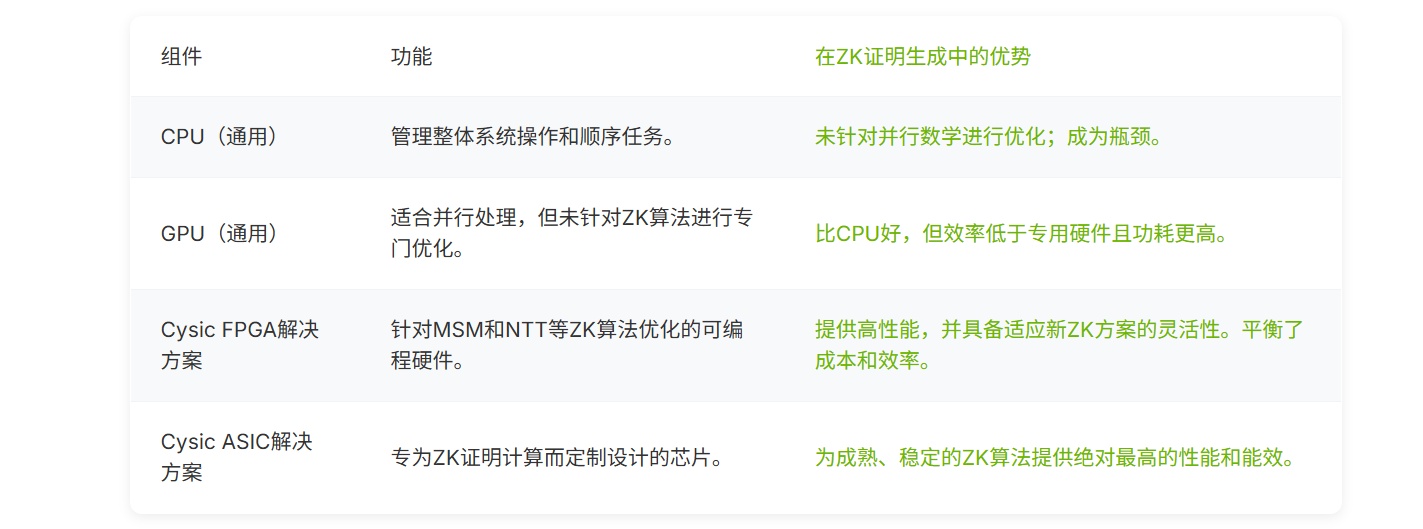
By creating a process where the CPU handles general-purpose logic, while its FPGA and ASIC handle the NTT and MSM computational burdens, Cysic can significantly reduce the time required to generate proofs. For a ZK-rollup project, this translates to faster final confirmation of user transactions and lower operating costs, making its service more competitive and scalable. This hardware-software co-design philosophy is what distinguishes Cysic from solutions that rely solely on software optimization or general-purpose hardware.
CYSIC token and its role in the ecosystem
The Cysic ecosystem is powered by its native utility token, CYSIC. This token is designed to facilitate interaction within the Cysic network and coordinate incentives for various stakeholders, including hardware users, developers, and community members. While its full utility will expand as the network matures, the CYSIC token is expected to play several key roles.
One primary function is as a medium of exchange when acquiring Cysic's ZK proof generation services. Projects looking to use Cysic's decentralized prover network to accelerate their ZK computations will likely use CYSIC tokens to pay for these services. This establishes a direct link between the need for ZK acceleration and the token's value.
For those interested in the CYSIC token, it is already listed on multiple trading platforms. The well-known digital asset exchange XT.com offers various ways to interact with CYSIC. Users can easily check real-time CYSIC prices and market trends. For traders, the platform provides a robust environment for CYSIC/USDT spot trading . Furthermore, XT.com supports automated trading strategies, allowing users to deploy spot grid trading bots for CYSIC/USDT to capitalize on market volatility or explore other advanced CYSIC/USDT trading strategies .
Impact on ZK-Rollups and the broader Web3 landscape
The impact of successful ZK hardware acceleration is far-reaching. By making ZK proof generation faster and cheaper, Cysic could become a catalyst for the entire Web3 industry.
For ZK-Rollups, Layer 2 projects like zkSync, StarkNet, Polygon zkEVM, and Scroll are direct beneficiaries. Faster proof generation allows them to further increase transaction throughput, reduce latency, and lower costs passed on to end users. This makes the experience of using dApps on these rollups instant and cost-effective, comparable to the user experience of traditional Web2 applications. It also enhances the decentralization of their prover networks, as more affordable hardware lowers the barrier to entry for individuals and small entities.
For dApp developers: A more efficient ZK infrastructure layer opens up new possibilities. Developers can build more complex applications and leverage ZK proofs to implement privacy-preserving features without worrying about high computational costs. This could give rise to a new generation of decentralized identity solutions, private voting systems, and confidential DeFi applications.
For the Ethereum ecosystem: Ethereum also benefits from being the primary settlement layer for most major ZK-rollups. By offloading execution tasks to Layer 2, which are made more efficient by hardware like Cysic, congestion on the mainnet is alleviated. This allows Ethereum to focus on its role as a secure, decentralized settlement and data availability layer, thus realizing its rollup-centric roadmap.
Essentially, Cysic is not just building hardware; it is laying a critical infrastructure that can help the entire blockchain industry scale to accommodate a billion users in the future.
Conclusion: Powering the future of scalable and private blockchains
Scalability and privacy are no longer distant goals for the blockchain industry; they are pressing needs for its continued growth and relevance. Zero-knowledge proofs stand out as one of the most promising technologies to address both of these challenges simultaneously. However, the computational intensity of ZK proof generation has remained a major obstacle to its full realization.
Cysic enters the field with a clear and powerful value proposition: breaking down barriers through dedicated hardware acceleration. By developing a suite of ASICs, FPGAs, and supporting software, Cysic aims to make ZK computations several orders of magnitude faster and more cost-effective. This effort is more than just an incremental improvement; it's a fundamental shift that could allow ZK-rollups to reach their full potential, empowering developers to build innovative privacy-preserving applications and ultimately helping the entire Web3 ecosystem scale to global adoption. As Cysic continues to develop and deploy its technology, it promises to become an indispensable engine driving the future of a more scalable, efficient, and private decentralized world.
Frequently Asked Questions (FAQs)
- What is the main problem Cysic is trying to solve? Cysic is addressing the issue of slow and costly zero-knowledge (ZK) proof generation. This process is computationally intensive, creating a bottleneck for ZK-based blockchain scaling solutions. Cysic is developing specialized hardware (ASICs and FPGAs) to accelerate this process, making it faster and more economical.
- How does Cysic's hardware differ from standard CPUs or GPUs? CPUs are used for general-purpose tasks, GPUs for parallel graphics rendering, while Cysic's hardware is custom-built for the specific mathematical operations (such as NTT and MSM) required in ZK proofs. This specialization allows its hardware to perform these calculations more efficiently and with less power than general-purpose hardware.
- Who are the main customers or users of Cysic technology? The main users will be projects and platforms that heavily rely on ZK proofs. This includes Layer 2 ZK-rollup projects (such as zkSync, StarkNet, etc.), dApp developers looking to integrate privacy features, and infrastructure providers operating prover networks.
- What are the uses of the CYSIC token? The CYSIC token is the native utility token of the Cysic ecosystem. Its primary purpose is as a means of payment for accessing Cysic hardware acceleration services through its decentralized prover network. It helps to harmonize incentive mechanisms and promote economic activity within the ecosystem.
- Why is hardware acceleration so important for the future of ZK technology? For ZK technology to be widely adopted, it must be both economically viable and performantly. Hardware acceleration directly addresses both of these issues. By significantly reducing proof generation time and cost, it makes ZK-rollups more competitive and spurs a wider range of ZK-driven applications that would otherwise be too slow or too expensive to run.
About XT.COM
Founded in 2018, XT.COM is a leading global digital asset trading platform with over 12 million registered users, operating in more than 200 countries and regions, and boasting an ecosystem traffic exceeding 40 million. The XT.COM cryptocurrency trading platform supports over 1300 high-quality cryptocurrencies and over 1300 trading pairs, offering diverse trading services including spot trading , leveraged trading , and contract trading , and is equipped with a secure and reliable RWA (Real World Asset) trading market. We are committed to the philosophy of "Explore Crypto, Trust Trading," dedicated to providing global users with a safe, efficient, and professional one-stop digital asset trading experience.