What is Stable (STABLE)? A Layer 1 blockchain specifically designed for USDT payments.



- 核心观点:Stable推出专为USDT支付优化的Layer 1区块链。
- 关键要素:
- 底层架构针对速度与可预测费用优化。
- 技术栈覆盖共识、执行、存储与RPC。
- 使用USDT作为原生Gas代币,EVM兼容。
- 市场影响:提升稳定币支付效率,挑战现有公链。
- 时效性标注:中期影响。
As stablecoins evolve from trading instruments into everyday financial infrastructure, the limitations of existing blockchains become increasingly clear. While USDT has become the dominant digital dollar—powering exchanges, DeFi protocols, and cross-border payments globally—the underlying network it relies on was not designed for high-frequency, low-cost, and reliable stablecoin settlements.
Stable (STABLE) was created to fill this gap. As a Layer 1 blockchain specifically designed for USDT payments, Stable rethinks the blockchain architecture from the ground up, optimizing each layer for speed, predictability, and real-world availability.
The STABLE token is now available for spot trading on XT.com, providing users with a safe and seamless way to acquire this digital asset.
Spot trading: STABLE/USDT
More related information: STABLE/USDT price

Quick Summary
- Stable is a Layer 1 blockchain built specifically for USDT payments, offering sub-second finality and predictable fees.
- Its vertically optimized technology stack covers consensus, execution, storage, and RPC, supporting high-throughput and reliable stablecoin settlement.
- Stable serves businesses, everyday users, and developers through USDT's native features, EVM compatibility, and scalable payment infrastructure.
- As the network enters its expansion phase in Q4 2025 and beyond, the STABLE token will power governance and ecosystem collaboration.
What is Stable (STABLE)?
Stable is a Layer 1 blockchain built specifically for stablecoin payments. It provides a settlement layer that enables value to flow in USD₮, maintaining consistent performance, predictable fees, and sub-second final confirmation.
Globally, USDT boasts a circulating supply exceeding $190 billion and over 350 million users, placing it at the forefront of the stablecoin market and supporting centralized exchanges, decentralized finance (DeFi), and international payments. However, current infrastructure struggles to meet the growing demand for lower costs, higher speeds, and greater reliability. Stable addresses these needs with a scalable, secure, and user-friendly blockchain specifically built for USDT's real-world use cases. Whether serving retail users in emerging markets or financial institutions handling large transaction volumes, Stable provides a superior environment for faster, cheaper, and significantly more efficient transactions.
How Stable Works: Understanding the Core Mechanisms
From its state database, execution, and consensus mechanisms to specific optimizations for USDT, Stable's design focuses on performance, scalability, and reliability. Every component of its technology stack is optimized to support high-throughput workloads and enable seamless native USDT operations across the network.

StableBFT
In its initial phase, the Stable blockchain employs StableBFT—a customized Proof-of-Stake (PoS) consensus protocol built on CometBFT—to ensure high throughput, low latency, and strong reliability across the network. To further optimize consensus performance, Stable plans to decouple data propagation from the consensus process and implement a mechanism that allows transactions to be directly broadcast to the block proposer.
To significantly accelerate the consensus process, Stable also plans to upgrade its protocol to a DAG-based Autobahn architecture. StableBFT, built on top of Autobahn, will implement:
- Parallel proposal processing is achieved by eliminating the single-leader constraint;
- By separating data propagation from final sorting, faster final confirmation is achieved;
- Leveraging a robust BFT mechanism, it provides enhanced resistance to attacks and interference in complex network environments.
Stable EVM
Stable EVM is Stable's Ethereum-compatible execution layer, enabling users to seamlessly interact with the chain using existing Ethereum tools and wallets. To bridge the gap between Stable EVM and StableSDK, Stable EVM introduces a set of precompiles, allowing EVM smart contracts to call the core logic of the underlying chain in a safe and atomic manner.
In terms of performance, Stable plans to maximize the execution efficiency of the EVM by introducing StableVM++. StableVM++ will integrate alternative EVM implementations such as EVMONE and combine them with a Block-STM-based OP parallel execution engine to significantly improve execution performance.
StableDB
Stable improves overall performance by addressing a key bottleneck in blockchain—slow disk storage after each block is written. Its core idea is to separate state commits from the storage process, freeing blocks from the latency of disk writes during processing.
With the help of mmap-based MemDB and VersionDB, the latest data can be processed efficiently in memory, while historical data is efficiently persisted, thereby significantly improving the overall throughput.
High-performance RPC
Even if the blockchain itself is fast enough, a slow RPC layer can still severely disrupt the user experience. Stable addresses this issue by redesigning the traditional monolithic RPC architecture—an architecture that typically suffers from severe resource contention and insufficient scalability.
Stable introduces a split-path architecture, which breaks down operation processes according to different functions and deploys lightweight, dedicated RPC nodes to achieve faster response times. Future updates will include RPC nodes optimized for EVM view calls and integration of a native indexer to further accelerate data access for dApps.
Application scenarios of Stable
Stable uses USDT as its core asset and builds its infrastructure around stablecoins, aiming to serve businesses, ordinary users, and developers simultaneously. As a blockchain specifically designed for USDT settlement, Stable provides a reliable, high-performance, and cost-effective underlying foundation, helping to comprehensively improve financial efficiency across various scenarios.
For enterprises: Reliable USDT native infrastructure
Stable is deeply optimized for USDT issuance, settlement, and high-frequency, high-value transactions, providing institutions with a secure and efficient payment and clearing solution. Enterprise-level features include:
- Guaranteed block space (coming soon) will maintain stable transaction latency even during network congestion;
- High-throughput transaction processing capabilities achieved through transfer aggregation;
- A robust and secure architecture for critical financial operations.
The upcoming confidential transfer feature will help institutions protect transaction privacy while meeting regulatory requirements such as anti-money laundering (AML) and auditing.
In addition, Stable supports a variety of practical institutional applications, including stablecoin-based payment solutions and merchant terminals, enabling merchants to accept USDT payments directly with predictable performance and extremely low operating costs.
For everyday users: a fast, simple, and low-cost payment experience
Stable makes everyday USDT transactions faster and easier with sub-second final confirmation and low fees. Through an intuitive and user-friendly interface, users can easily send, receive, and manage assets; meanwhile, integrated debit and credit card support makes spending even smoother.
Cross-chain USDT transfers via USDT0 and LayerZero further enhance flexibility, making Stable a practical solution for cross-border payments and everyday financial activities.
For developers: Highly optimized EVM Layer 1
Stable provides developers with a USDT-optimized, EVM-compatible Layer 1 blockchain designed for scalable stablecoin applications. Leveraging sub-second block finality, the StableBFT consensus mechanism, and full compatibility with the Ethereum toolchain, developers can build dApps and payment infrastructure using familiar tools, while benefiting from a blockchain engineered for high-performance stablecoin settlement.
STABLE Token Economic Model: Supply, Distribution, and Economic Design
Stable is a high-performance Layer 1 blockchain optimized for stablecoin settlement, enterprise-grade payments, and USDT-based infrastructure. This token economic model will systematically explain the total supply, distribution structure, and overall economic design of the STABLE token.
Token Overview
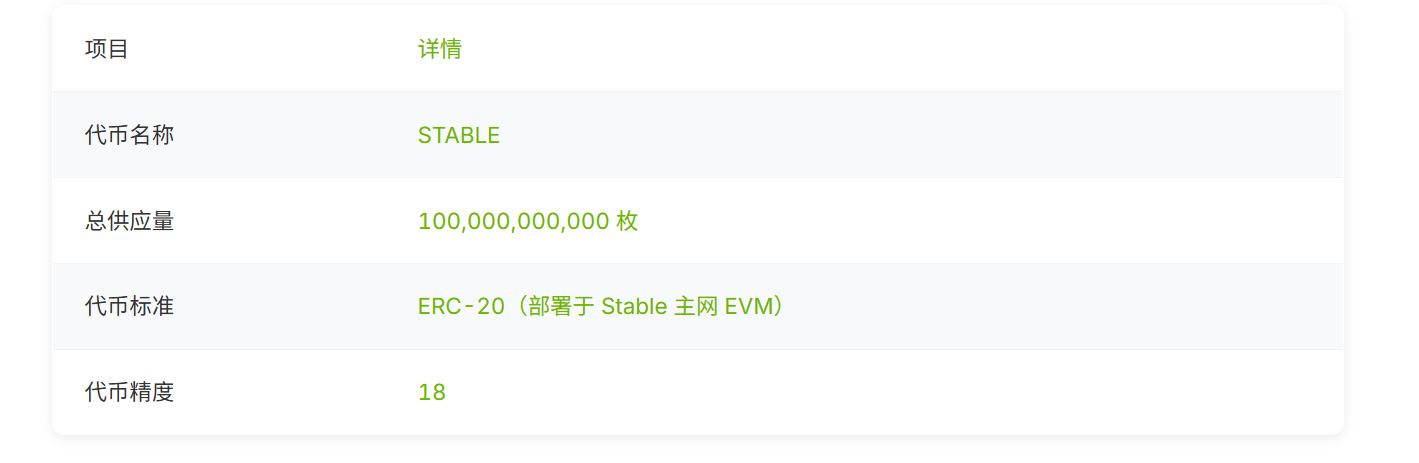
STABLE is the governance token of the Stable mainnet and its ecosystem, designed to establish long-term economic incentive consistency among validators, developers, and users.
Token distribution
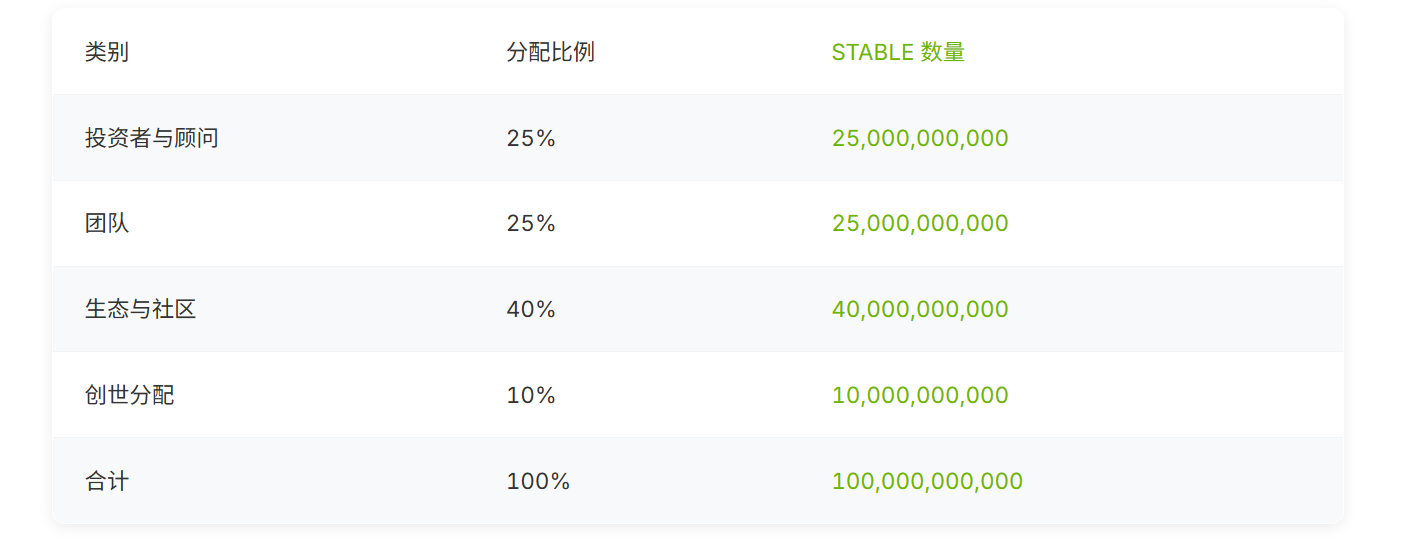
Issuance Model and Supply Plan
- The total supply of STABLE tokens is fixed at 100,000,000,000.
- When the Stable mainnet launched, only a portion of the tokens entered circulation.
- The token allocation for the team, as well as investors and advisors, will adopt a 4-year linear unlocking mechanism with a 1-year lock-up period (cliff) to ensure consistency between long-term commitment and incentives.
distribute
Genesis Distribution – 10% of the total supply
- Used to initiate network usage and provide liquidity to the market.
- For airdrop activities
- Incentivize early supporters
- Jointly conduct marketing and promotional activities with exchanges and ecosystem partners.
Ecosystem & Community — accounting for 40% of total supply
To support the long-term development of ecosystems and communities, including:
- Support the continuous development of Stable software and its entire ecosystem.
- Developer Funding Program
- User guidance and incentive mechanisms
- Payment Partner Integration
- On-chain activity rewards
- Hackathons, Community Ambassador Programs, etc.
Teams – accounting for 25% of total supply
- Distributed to founding team members, engineers, researchers and other core contributors
- The aim is to ensure long-term alignment of interests between the team and the Stable ecosystem.
Investors & Advisors – accounting for 25% of total supply.
- Allocation related to funding rounds and advisory support
Uses of STABLE tokens
STABLE is an ERC-20 governance token deployed on the Stable mainnet EVM, with primary uses including:
- Election Validator
- Vote on upgrading the agreement
- Processing and implementing governance proposals
- As proof, obtain the gas fee allocation from the validator.
In the Stable network, all transactions use USDT0 as the native gas token. These USDT0 gas fees are collected in a vault managed by a smart contract. When token holders stake STABLE with validators, validators can choose to distribute the gas fees in the vault to the stakers proportionally.
How to Purchase $STABLE | Participation Guide
STABLE tokens are now available for spot trading on XT.com, providing users with a safe and seamless way to participate in one of the most stable and reliable assets in the digital economy. Through the new STABLE/USDT trading pair, users can experience a more transparent, efficient, and value-stable trading environment.
Spot trading: STABLE/USDT
More related information: STABLE/USDT price

In addition to spot trading, users are encouraged to explore further opportunities for participation within the STABLE token ecosystem. As the network continues to expand, community events, liquidity programs, and ecosystem incentive mechanisms are expected to provide additional ways to earn rewards. By staying tuned for upcoming programs, users can not only experience new features and participate in ecosystem building, but also unlock additional benefits designed specifically for early supporters and active participants.
STABLE token's competitive advantages
STABLE's core advantage lies in its native stablecoin design—it doesn't simply deploy stablecoins on general-purpose blockchains, but is built around USDT from the outset. Through comprehensive optimization of consensus, execution, storage, and RPC layers, Stable achieves sub-second final confirmation, predictable fees, and stable, consistent performance in real-world payment scenarios.
Features such as USDT as the native gas token, high throughput, and guaranteed block space and confidential transfers for enterprise applications set Stable apart from traditional Layer 1 public chains. With the gradual implementation of scaling upgrades, STABLE was designed from the outset to balance speed, reliability, and compliance, giving it a unique position to support global USDT payments, institutional-grade settlements, and everyday transactions.
Key Risks and Challenges of STABLE Tokens
While Stable is designed with a strong focus on USDT payments, its long-term performance will depend on continued adoption within the ecosystem and changes in the overall stablecoin market environment. As the protocol is continuously upgraded and scaling solutions are implemented, ensuring network stability and reliability during system evolution will place higher demands on execution capabilities.
Furthermore, Stable occupies a crucial position at the intersection of payments, enterprise applications, and regulatory frameworks, and different regions may introduce certain complexities in terms of compliance and coordination. Overall, the value of the STABLE token is highly dependent on the continued growth of network usage and the long-term participation of validators, developers, and users, and will gradually materialize as the ecosystem matures.
Stable's Future Outlook: Entering the Scale-Up Phase
Entering the fourth quarter of 2025, Stable has completed its initial launch phase and is actively moving into the scaling phase of its roadmap. After successfully deploying the world's first blockchain mainnet with USD₮ as its native asset—achieving sub-second final confirmation and using USD₮ as its native gas—the network's current focus has shifted to the continued expansion of throughput and execution capabilities.
The parallel execution mechanism of OP and the launch of StableDB are key steps in significantly improving overall performance while maintaining a fast and predictable settlement experience. Looking ahead to 2026, Stable plans to introduce a DAG-based consensus mechanism to increase network throughput to over 10,000 TPS and maintain enterprise-grade reliability, thereby solidifying its strategic position as the core settlement and execution layer of next-generation stablecoin-driven financial infrastructure.
About XT.COM
Founded in 2018, XT.COM is a leading global digital asset trading platform with over 12 million registered users, operating in more than 200 countries and regions, and boasting an ecosystem traffic exceeding 40 million. The XT.COM cryptocurrency trading platform supports over 1300 high-quality cryptocurrencies and over 1300 trading pairs, offering diverse trading services including spot trading , leveraged trading , and contract trading , and is equipped with a secure and reliable RWA (Real World Asset) trading market. We are committed to the philosophy of "Explore Crypto, Trust Trading," dedicated to providing global users with a safe, efficient, and professional one-stop digital asset trading experience.