






RWA Weekly Report | The US CFTC launches a pilot program for digital asset collateral, and spot cryptocurrencies are now available for trading on CFTC-registered exchanges (December 3-9).


- 核心观点:RWA市场企稳,监管与机构动态积极。
- 关键要素:
- RWA链上总价值企稳于184.4亿美元。
- CFTC允许数字资产作为衍生品保证金。
- SEC结束对Ondo Finance的调查。
- 市场影响:增强机构信心,推动合规化进程。
- 时效性标注:中期影响。
Original article | Odaily Planet Daily ( @OdailyChina )
Author | Ethan ( @ethanzhang_web3 )
RWA sector market performance
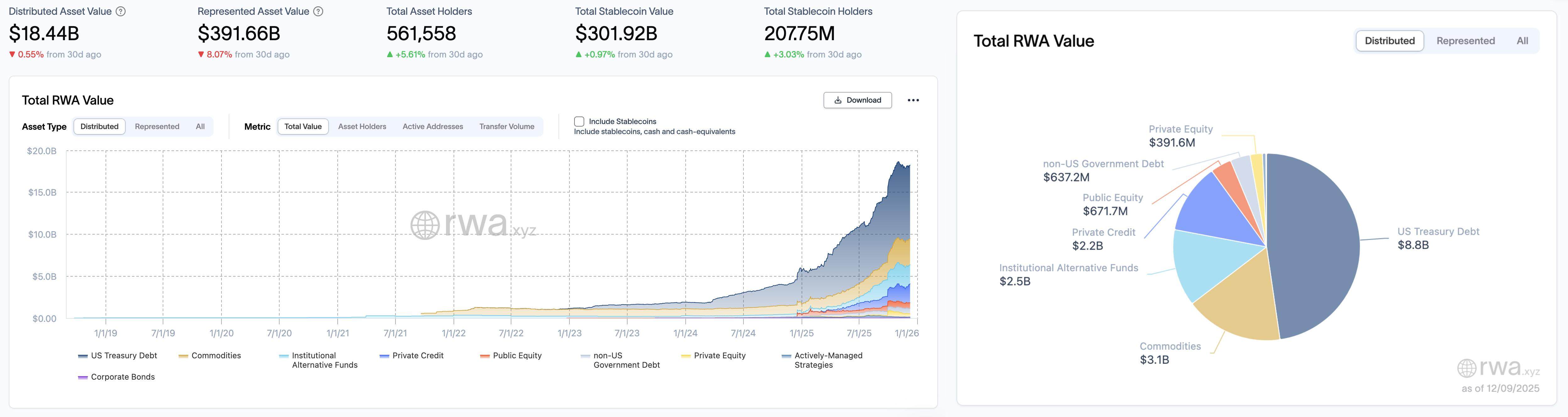
According to the rwa.xyz data dashboard, as of December 9, 2025, the total on-chain value (Distributed Asset Value) of RWA stabilized significantly this week after experiencing sharp fluctuations last week due to adjustments in statistical methods. Data shows that the total value slightly increased from $18.41 billion on December 2nd to $18.44 billion, an increase of approximately $0.3 billion, a very small rise. Simultaneously, the represented asset value increased from $391.55 billion to $391.66 billion, indirectly confirming the resilience of the broader RWA market. User growth remains strong, with the total number of asset holders jumping from 555,428 to 561,558, an increase of 6,130 in a single week, representing a growth of approximately 1.1%. In the stablecoin market, the total market capitalization further increased from $300.99 billion to $301.92 billion, an increase of $930 million; the number of stablecoin holders surged by 2.06 million, from 205.69 million to 207.75 million, providing extremely abundant potential purchasing power for on-chain assets.
In terms of asset structure, the US Treasury bond sector, which has been a key support recently, saw a slight decrease in size from $8.9 billion last week to $8.8 billion, a reduction of $100 million. Conversely, the private lending sector, which saw a significant contraction last week, showed signs of rebounding, with its size increasing from $2 billion to $2.2 billion, a weekly increase of $200 million. Institutional alternative funds continued to be under pressure, further shrinking from $2.6 billion to $2.5 billion. Commodity assets maintained extremely high stability, remaining at the $3.1 billion level for two consecutive weeks. Among other sectors, publicly traded equity performed strongly, increasing from $655.8 million to $671.7 million, while non-US government debt rose slightly to $637.2 million, and private equity declined slightly to $391.6 million.
Trend Analysis (Compared to last week )
This week, ignoring the impact of last week's "data adjustment," the RWA market saw stable overall growth. While the total market capitalization didn't experience a sharp rebound, the recovery in the private lending sector may be a positive signal for the market. Fund flows have shifted from being led by US Treasuries to more risky credit and equity assets. The massive growth in the stablecoin user base remains the biggest macroeconomic highlight this week, suggesting that off-exchange funds are accelerating their entry and positioning. Although this hasn't fully translated into increased RWA assets, the reservoir effect is already quite evident.
Market keywords: stabilization and recovery, credit return, liquidity replenishment.
Key Events Review
Acting Chair Caroline D. Pham of the U.S. Commodity Futures Trading Commission (CFTC) announced the launch of a digital asset collateral pilot program, allowing digital assets such as BTC, ETH, and USDC to be used as compliant margin in regulated derivatives markets in the United States. She also issued regulatory guidance on tokenized collateral and repealed outdated rules that had become invalid due to the GENIUS Act.
The CFTC stated that this move is a significant milestone in advancing the use of tokenized assets in regulated markets, providing a clear regulatory framework for the futures and swaps markets, including: the availability of tokenized assets, legal enforceability, custody and segregation requirements, valuation and risk management, and operational risks. For the initial three months, FCMs (Futures Commission Merchants) will be limited to accepting BTC, ETH, and USDC as collateral and will be required to report their positions to the CFTC on a weekly basis, account by account.
At the same time, the CFTC granted "no-action" protection to FCMs that accept digital assets as collateral, providing regulatory clarity to these institutions and requiring them to maintain robust risk controls. The CFTC also revoked Staff Circular 20-34, citing the GENIUS Act and recent rapid developments that rendered its contents inapplicable.
Several industry companies welcomed the move. Coinbase's Chief Legal Officer stated that the CFTC's decision proves stablecoins and digital assets can improve payment efficiency. Circle's president said this move will reduce settlement friction and strengthen the dollar's dominance. Crypto.com's CEO called it "a significant moment in US crypto history." Ripple executives pointed out that explicitly including stablecoins in eligible margins will lead to higher capital efficiency.
The CFTC stated that the action was based on feedback from market participants, public comments, Crypto CEO Roundtable feedback, and recommendations from its Global Markets Advisory Committee.
Acting Chair Caroline D. Pham of the U.S. Commodity Futures Trading Commission (CFTC) announced that spot cryptocurrency products will be permitted to trade on CFTC-registered regulated futures exchanges for the first time.
Pham stated that this move is part of the Trump administration's plan to make the United States the "crypto capital of the world," aiming to address the lack of security at offshore exchanges by providing a regulated domestic market.
In addition, as part of the “Crypto Sprint” initiative, the CFTC will also promote the use of tokenized collateral (including stablecoins) in the derivatives market and revise rules to support the application of blockchain technology in infrastructure such as clearing and settlement.
US lawmakers are urging regulators to implement stablecoin regulations by the July 2026 deadline.
The GENIUS Stablecoin Act, passed in the US this summer, is entering the implementation phase, with federal regulators pushing forward with the development of supporting rules, aiming to complete them by July 18, 2026. Representative Bryan Steil urged regulators at a hearing to "complete it on time" to avoid prolonged delays in the legislation. The FDIC stated it will release a draft of GENIUS-related rules this month, while the NCUA indicated the first rule might be the stablecoin issuer application process. GENIUS requires stablecoins to be fully backed by the US dollar or highly liquid assets and mandates annual audits for issuers with a market capitalization exceeding $50 billion. During the hearing, Democratic Representative Maxine Waters also questioned President Donald Trump's potential conflicts of interest in crypto projects.
In an article titled "Why Has China Resolutely Halted Stablecoins?" published on its official WeChat account, Wang Yongli, former vice president of the Bank of China, pointed out that China's policy orientation of accelerating the development of the digital yuan and resolutely curbing virtual currencies, including stablecoins, is now fully clear. This is based on a comprehensive consideration of factors such as China's leading global advantages in mobile payments and the digital yuan, the security of RMB sovereignty, and the stability of the monetary and financial system. The space and opportunities for developing non-USD stablecoins are limited, as USD stablecoins already account for over 99% of the global fiat currency stablecoin market capitalization and trading volume. He emphasized that with USD stablecoins already dominating the cryptocurrency trading market, China's attempt to follow the path of USD stablecoins in developing RMB stablecoins would not only fail to challenge the international status of USD stablecoins but could even turn RMB stablecoins into appendages of USD stablecoins, posing a serious threat to RMB sovereignty and the stability of the monetary and financial system.
Ten European banks, including BNP Paribas, ING, and UniCredit, have formed a new company, Qivalis, which plans to launch a euro-pegged stablecoin in the second half of 2026 to counter the dollar-dominated digital payments market. Qivalis is headquartered in Amsterdam, with former Coinbase Germany CEO Jan-Oliver Sell as CEO and former NatWest chairman Howard Davies as chairman.
South Korea’s ruling Democratic Party has asked the government to submit a new bill by December 10 to regulate stablecoins pegged to the won.
Kang Jun-hyun, convener of the Democratic Party's Political Affairs Committee, stated that the draft bill would only allow consortia with at least 51% commercial bank ownership to issue fiat-backed tokens. Kang Jun-hyun said this move aims to reconcile the positions of the Bank of Korea, the Financial Services Commission, and the banking industry.
If the government fails to act, Kang Jun-hyun stated that Congress will lead and advance legislation. The proposal would restrict stablecoin issuance to consortia with commercial banks holding at least 51% ownership, aiming to resolve long-standing disputes regarding the eligibility of issuers. However, the Financial Services Commission subsequently issued a statement saying, "Nothing has been finalized regarding the consortium proposal."
The International Monetary Fund (IMF) has stated that stablecoins have the potential to broaden individuals' access to financial services, but this could come at the expense of central banks.
In a 56-page report released Thursday, the international organization noted that “currency substitution” is a potential risk posed by stablecoins, and stated that this trend could gradually erode national financial sovereignty.
Historically, individuals wishing to hold US dollars typically needed to possess physical cash or open a specific type of bank account. However, the IMF emphasizes that "stablecoins can rapidly penetrate a country's economic system via the internet and smartphones."
The organization added, "Especially in cross-border scenarios, stablecoins denominated in foreign currencies could lead to currency substitution, which could potentially undermine monetary sovereignty, especially in the presence of uncustodial wallets."
The IMF stated that if a large amount of economic activity no longer relies on the domestic currency, central banks will find it difficult to effectively control domestic liquidity and interest rate levels.
The report points out that if foreign-denominated stablecoins gain a foothold in payment services, domestic alternatives such as central bank digital currencies (CBDCs) may face competitive pressure. Unlike privately issued stablecoins, CBDCs are digital forms of sovereign currency issued, regulated, and managed by central banks.
WLFI Co-founder: A series of RWA products will be launched in January 2026.
According to Reuters, World Liberty Financial, a crypto company backed by the Trump family, announced at an event in Dubai on Wednesday that it will launch a series of Real-World Asset (RWA) products in January, at the start of the first quarter of 2026. World Liberty Financial's stablecoin USD1 was used this year by MGX, an Abu Dhabi-backed company, to pay for its investment in Binance.
Trending Projects
Ondo Finance (ONDO)

In short:
Ondo Finance is a decentralized finance protocol focused on the tokenization of structured financial products and real-world assets. Its goal is to provide users with fixed-income products, such as tokenized US Treasury bonds or other financial instruments, through blockchain technology. Ondo Finance allows users to invest in low-risk, highly liquid assets while maintaining decentralized transparency and security. Its token, ONDO, is used for protocol governance and incentive mechanisms, and the platform also supports cross-chain operations to expand its application within the DeFi ecosystem.
Latest news:
On December 8, it was reported that the U.S. Securities and Exchange Commission (SEC) had concluded its investigation into tokenized asset company Ondo Finance and did not recommend any charges.
The investigation, initiated in October 2023 by former SEC Chairman Gary Gensler, primarily examined whether Ondo complied with U.S. securities laws in its tokenization of U.S. Treasury products and whether ONDO tokens should be classified as securities. An Ondo spokesperson stated that the company received formal notification in late November that the two-year SEC investigation had concluded. Since the pro-cryptocurrency SEC Chairman Paul Atkins took office, the agency has concluded most cryptocurrency-related investigations. Ondo stated that the resolution of the investigation clears obstacles for its expansion in the U.S., having previously registered as an investment advisor and acquired SEC-registered broker-dealer, ATS operator, and transfer agent Oasis Pro Markets. Ondo is scheduled to hold its annual Ondo Summit in New York on February 3, where it is expected to announce new tools and products for tokenizing real-world assets.
Previously, according to official news from Ondo Finance, more than 100 tokenized stocks and ETFs launched by Ondo have been officially launched on Binance Wallet based on BNB Chain, opening up investment opportunities to 280 million users.
MSX (STONKS)
In short:
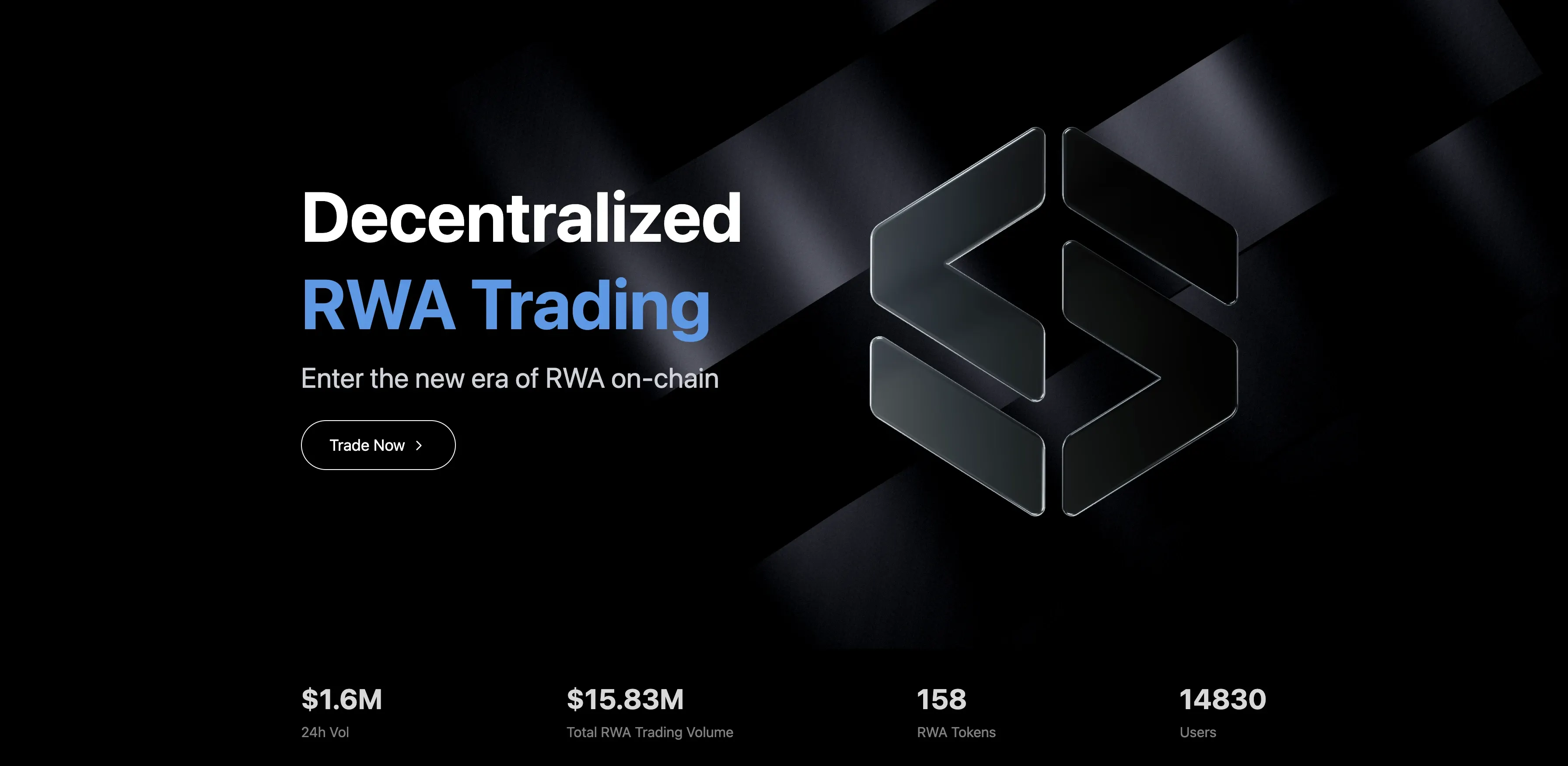
MSX is a community-driven DeFi platform focused on tokenizing and trading RWA (Retail Assets and Services) such as US stocks on the blockchain. Through a partnership with Fidelity, the platform achieves 1:1 physical custody and token issuance. Users can mint stock tokens such as AAPL.M and MSFT.M using stablecoins like USDC, USDT, and USD1, and trade them 24/7 on the Base blockchain. All trading, minting, and redemption processes are executed by smart contracts, ensuring transparency, security, and auditability. MyStonks aims to bridge the gap between TradeFi and DeFi, providing users with a highly liquid, low-barrier-to-entry on-chain investment gateway to US stocks, building a "Nasdaq for the crypto world."
Latest news:
On December 3rd, data from MSX's official website ( msx.com ) showed that the platform's trading volume reached $2 billion in the past 24 hours, setting a new single-day record. As of the time of writing, the platform's total trading volume has exceeded $20.6 billion, surging by over $7.5 billion in the past five days, representing a cumulative increase of over 57%. Furthermore, MSX concluded its Season 1 points competition on December 2nd, and the M-Credit earned by users will be directly used for future MSX token distributions.
On December 5th, Bruce, founder of MSX, posted on X that Nasdaq has submitted its application for a stock token, and MSX is ready to be exchanged for the "official" token. He stated, "Nasdaq submitted its stock token application to the SEC in September of this year, and if all goes well, it will officially launch in Q1 of next year. The launch of Nasdaq's stock token will impact all 'unofficial stock tokens,' and MSX is ready to be exchanged for the 'official' token at any time."
Related Links
We've compiled the latest insights and market data for the RWA sector.
Seven Chinese financial industry associations jointly issued a risk warning, explicitly defining Real-World Asset Tokenization (RWA) as an illegal activity related to virtual currencies for the first time, placing it alongside stablecoins and worthless cryptocurrencies. Attorney Liu Honglin authored a detailed analysis of the legal risks of RWA, the joint liability of service providers, and the regulatory penetration of the "overseas entity + domestic personnel" model, providing an authoritative reference for understanding the current direction of financial regulatory policies.
Led by Xiao Sa's legal team, this in-depth analysis of the first "default" incident in the RWA industry not only details the course of events but also systematically dissects the risk transmission mechanism, revealing the core vulnerabilities of RWA projects from three dimensions: underlying assets, technical architecture, and legal compliance.


