Trump's tariff policy has wreaked havoc on the financial markets. What do Wall Street bosses think?


Bill Ackman, the billionaire founder of Pershing Square, issued a warning to world leaders: "Don't wait until war breaks out to negotiate. Call the president now."
Ackerman’s warning was more than just hyperbole—it sounded like a plea.
A few days ago, President Trump's tariff plan was like a bombshell, which caused chaos in the global market. The US stock market lost $6 trillion in market value in a week, and the Dow Jones Index recorded its largest intraday fluctuation of 2,595 points in history on Monday. Oil prices fell, interest rates were lowered, but inflation concerns lingered. Trump confidently declared on Truth Social that "tariffs are a wonderful thing", but the giants of Wall Street could not sit still and took to the microphones, forming a tariff symphony on Wall Street.
On April 6, 2025, Ackman posted on Twitter: "By imposing massive and disproportionate tariffs on our friends and enemies, we are waging a global economic war on the entire world simultaneously. We are heading towards a self-induced economic nuclear winter."
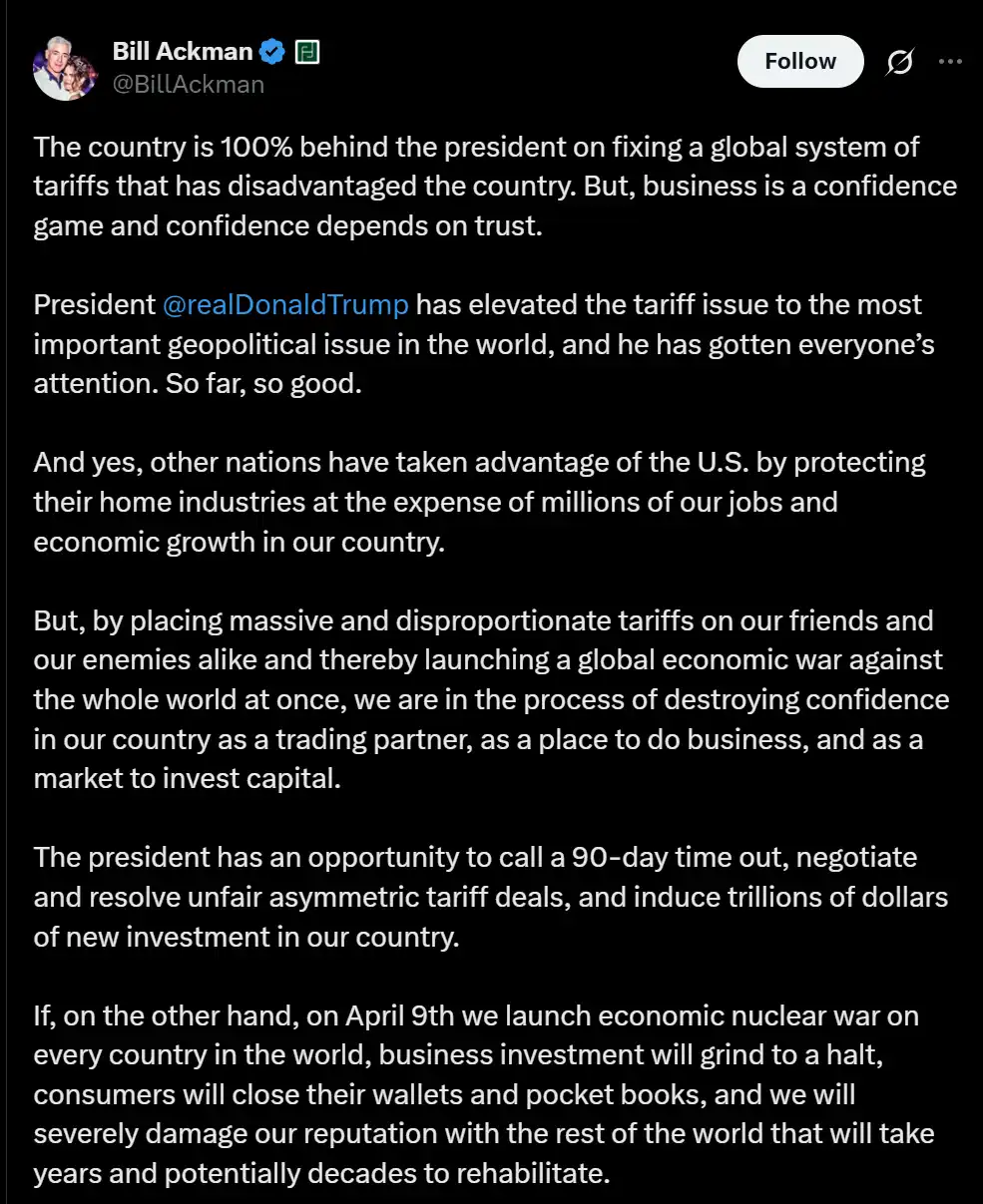
Ackman is not the only one sounding the alarm about the Trump administration's escalating tariffs, with many Wall Street bigwigs speaking out against expansionary tariffs, even if they once supported him or hoped for deregulation and economic growth under his administration.
Lloyd Blankfein, former CEO of Goldman Sachs, also asked: "Why not give them a chance?" and suggested that Trump should allow countries to negotiate "reciprocal" tariff rates.
Boaz Weinstein, Gerber Kawasaki CEO and President Ross Gerber and JPMorgan Chase CEO Jamie Dimon also spoke out.
Boaz Weinstein predicted that "the avalanche has really just begun." Dimon said bluntly: "The sooner this problem is resolved, the better, because some of the negative effects will accumulate over time and will be difficult to reverse," warning that the United States' long-standing economic alliances may be catastrophically broken. Gerber called US President Donald Trump's tariff policies "destructive," saying they could cause an economic recession.
It is obvious that even financial giants who are accustomed to market fluctuations and even once supported Trump are now beginning to worry that this tariff war may trigger an uncontrollable chain reaction.
The growing criticism comes as Trump has offered no sign that he is prepared to roll back punitive trade reforms set to begin on April 9. The market can tolerate uncertainty, but it cannot tolerate "policy speculation" based on power. And Wall Street's collective voice this time just shows that capital is unwilling to pay for political gambles.
Howard Marks, co-chairman of Oaktree Capital, pointed out in an interview with Bloomberg that tariff policies have changed the existing pattern of global trade and economy, making the market environment more complicated. Investors need to consider a series of unknown variables, such as inflation that tariffs may trigger, supply chain disruptions, retaliatory measures from trading partners, and the potential impact of these factors on economic growth and asset prices.
Max's warning actually reveals the anxiety of the entire professional investment circle. When policy dominance overrides market rules, traditional analysis frameworks are becoming ineffective, and even the most experienced fund managers must relearn how to bet in a global economic game.
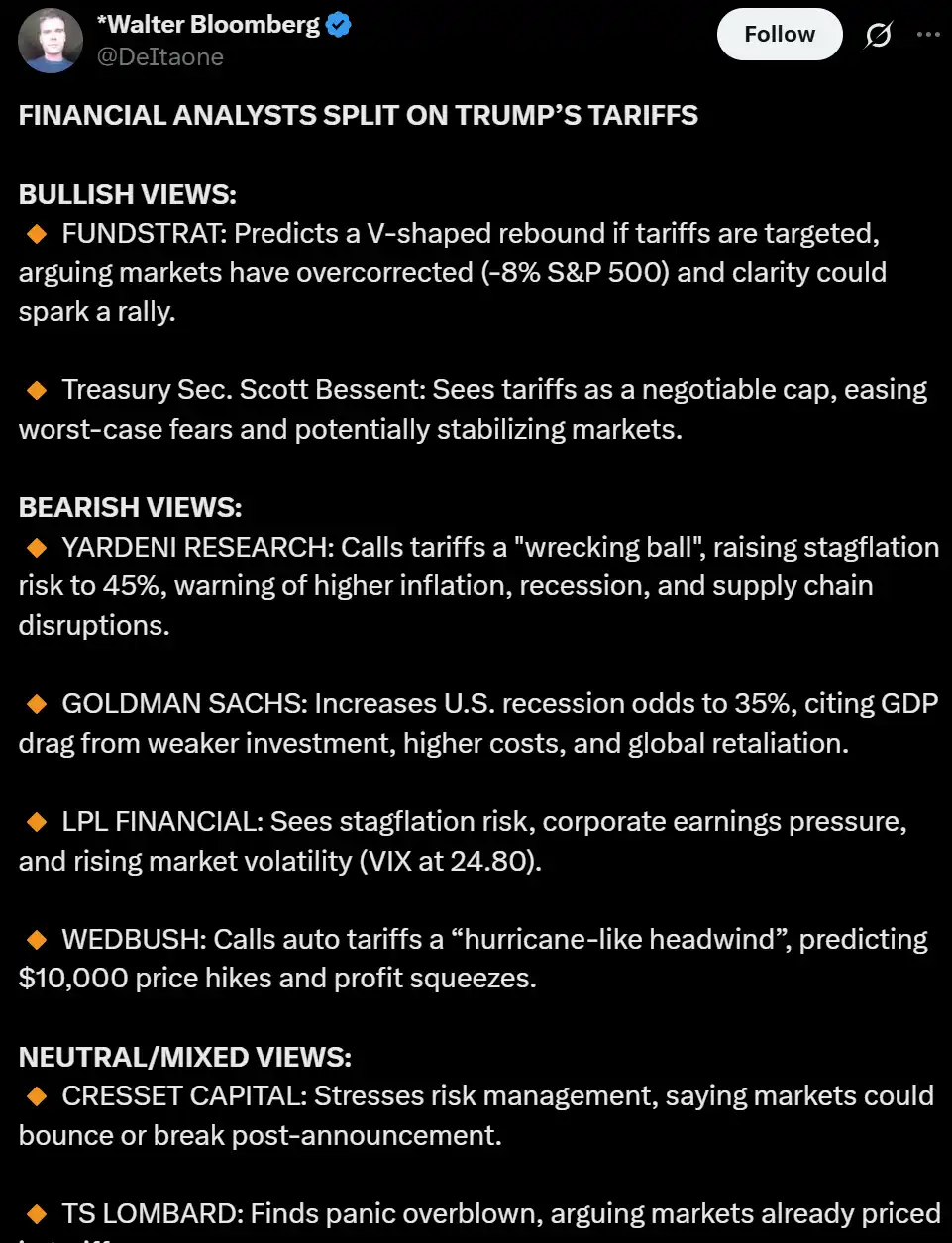
On April 3, 2025, Wall Street's stance on Trump's tariff policy was still divided. Bulls such as Fundstrat and Treasury Secretary Scott Bessant believed that the market's previous adjustment was oversold, and once the policy direction became clear, it might trigger a "V-shaped rebound." Bears warned of increased risks, with Yardeni Research comparing tariffs to a "wrecking ball," Goldman Sachs raising the probability of a U.S. recession to 35%, and LPL and Wedbush worried about the shadow of stagflation, corporate earnings pressure, and a heavy blow to the auto industry.
At the same time, the neutral faction emphasized risk management, pointing out that some negative factors have been priced in by the market, and the subsequent trend depends on the implementation of tariffs and the actual resilience of the manufacturing industry. However, as the market fluctuated violently and panic sentiment intensified, the voices that were originally on the sidelines began to turn, and the voices questioning Trump's tariff policy were significantly strengthened.
Although Ken Fisher mercilessly criticized Trump's tariff plan launched in early April as "stupid, wrong, and extremely arrogant", he still maintained his usual optimism. He believed that "fear is often more terrible than reality" and that this storm might just be a market correction similar to 1998, which could eventually bring an annualized return of up to 26%.
Steve Eisman, the prototype of The Big Short, who is famous for shorting the subprime mortgage crisis, warned that the market has not yet truly reflected the worst-case scenario of Trump's tariff policy, and it is not appropriate to "play the hero" at this time. He bluntly said that Wall Street is too dependent on the old paradigm of "free trade is beneficial" and is inevitably at a loss when faced with a president who breaks with tradition.
He admitted that he also suffered heavy losses due to long positions, pointing out that the market is full of "resentment from losers." Eisman also emphasized that the current policy attempts to repair the neglected groups under free trade, and Wall Street should not be surprised by this because Trump "has long said he would do this, but no one took it seriously."
Amid the uproar, US Treasury Secretary Scott Bessent stressed that tariffs are essentially a bargaining chip to "maximize leverage" rather than a long-term economic barrier. He asked, "If tariffs are so bad, why are our trading partners also using them? If it only hurts American consumers, why are they so nervous?" In his view, this is a counterattack against China's "low-cost, slave labor and subsidy" system.
However, in reality, Bessant does not seem to play a key role in decision-making. He is more like a "spokesperson" within the government to appease the market. The drastic fluctuations caused by tariffs have actually aroused vigilance within the White House.
The tariff storm exposed the impact of policy uncertainty on market confidence, and Wall Street rarely "collectively complained". Regardless of their stance, most voices questioned or even criticized the radical and hasty nature of the policy. Behind the differences, there is actually a general dissatisfaction with the policy logic and execution rhythm. What should really be discussed is perhaps how to rebuild confidence in the chaos?