


Deep Dive into the Bitcoin Landscape: Does BTC Need Liquidity Staking to Improve Capital Efficiency?


Original article by Mikhil Pandey
Original translation: TechFlow
Introduction
This article is the result of a “deep dive into the rabbit hole of today’s Bitcoin landscape” written by Mikhil Pandey , co-founder and chief strategy officer of Persistence Labs.
Through this article, Mikhil Pandey attempts to lead everyone to understand Bitcoin’s role in cryptocurrency, the current Bitcoin landscape, the role of BTC liquid staking, and where he thinks it will go next.
Learn about Bitcoin
Is Bitcoin a store of value? The largest peer-to-peer payment network? The world's remittance system? Digital gold? A tool for hedging traditional finance? The first proof-of-work blockchain in history?
What exactly is Bitcoin? Which of the above describes Bitcoin? In short, I think it is all of them, and more.
Bitcoin is a layer-one blockchain originally designed for the trustless and transparent flow of monetary value, the idea for which emerged during the 2008 global financial crisis.
The native digital asset that powers this network, Bitcoin, has grown from one of the boldest financial experiments of our time to the largest cryptocurrency.
Today, Bitcoin, both the network and the asset, has become a playground of finance, mechanism design, and hope.
The smartest minds are driving Bitcoin toward a more useful, capital-efficient, and programmable future
The world’s largest institutions are offering BTC ETFs to provide exposure to ordinary people
A new generation of builders are finding unique ways to utilize Bitcoin blockspace, including Ordinals, NFTs, BRC-20, Runes, Staking, and more
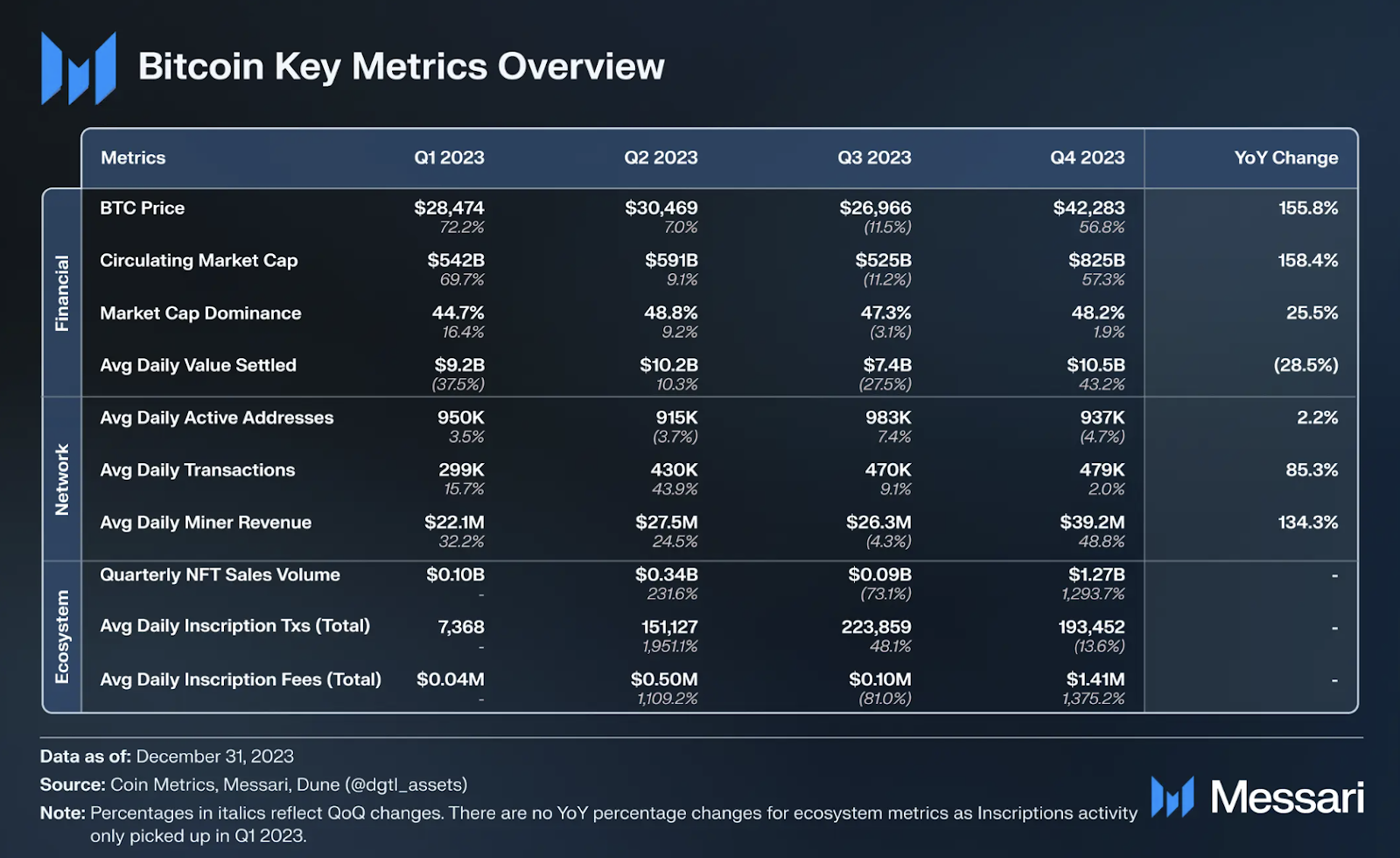
Bitcoin network activity is at an all-time high and generating more value (fees) for miners than ever before
Bitcoin is for everyone. The best part is that BTC’s varying perceptions are a feature, not a bug.
Two pillars built on Bitcoin
To the public, Bitcoin is gradually transitioning from a “network” to an “ecosystem.” Recently, the ecosystem built on top of Bitcoin has seen exponential growth.
But this is not uncommon, in addition to community network improvements, multiple stakeholders have attempted to build on top of Bitcoin. In fact, it was part of Satoshi’s vision.
Satoshi Nakamoto once said: "This design supports every possible type of transaction I designed a few years ago. Secured transactions, margin contracts, third-party arbitration, multi-party signatures, etc. If Bitcoin becomes popular, these are all things we want to explore in the future, but they all have to be designed in at the beginning to ensure that they are possible later."
Since 2012, there have been attempts to expand Bitcoin into more than just payments:
Decentralized Domain Name Service (Namecoin)
Wider asset representation (Colored Coins, MasterCoin, Counterparty)
Scaling the Bitcoin network through sidechains, Rollups, and L2 (Taproot, Stacks, Liquid Network, Merlin, Urbit, Lightning, bitVM, etc.)
Expanding BTC functionality (Memes, NFTs, BRC-20, BRC-420) and revenue through Ordinals and Runes ( Babylon , BounceBit , Stroom Network , Trustless Machines , etc.)
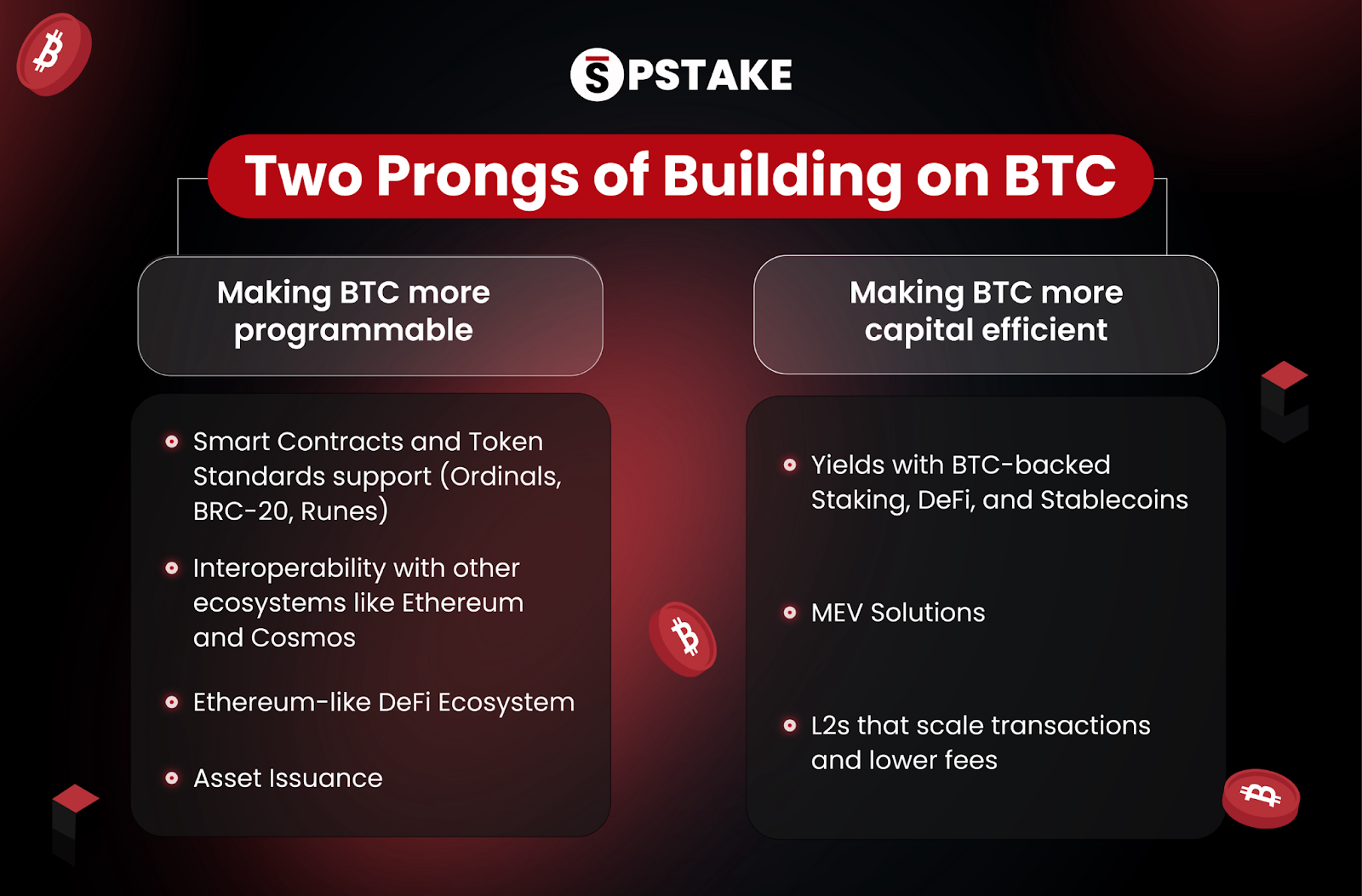
But where do these developments lead Bitcoin? Portal Ventures’ article on Bitcoin’s perspective sums it up best:
Make Bitcoin more programmable, addressing smart contracts and scaling limitations to deploy on the Bitcoin network
Making BTC more capital efficient, building hyper-financialization with BTC
Where does BTC Liquid Staking apply?
Bitcoin is a proof-of-work network where miners contribute computing power to solve the mathematical puzzle of block production and are rewarded with new bitcoins.
So how did staking come to the market, let alone liquid staking? Let’s understand some blockchain basics.
Consensus involves the ongoing agreement on the state of the network (data, transactions, balances, etc.). While PoW relies on computing power (mining) to achieve and maintain network consensus, PoS includes the concept of security guarantees. Staking involves locking up tokens to participate in consensus, contributing to overall network security, and receiving staking rewards.
When we need to trust that another person/counterparty will behave well, we often set up a security deposit to guarantee good behavior. A typical example is a landlord collecting a security deposit from a tenant.
In short, PoS is driven by trust in the economic security of an asset. What’s better than an asset with billions of dollars of economic trust? And what’s better than Bitcoin?
By "locking" BTC, its economic security can be exported to almost any crypto application. Imagine a world where financial applications, including blockchains of all shapes and sizes, can leverage BTC, adding vitality and security to each application.
Trustless BTC staking (hence liquid staking) opens up the possibility for a thriving BTC-led DeFi, making BTC more capital efficient. Money markets, stablecoins, economic security, insurance, and more. The applications are endless.
What is the future of Bitcoin?
One could argue that BTC is already capital efficient in terms of market cap growth, adoption, and premier store of value status among cryptocurrencies?
This brings us to the question: what exactly is capital efficiency? Wall Street defines it as “how effectively a company uses capital to operate and grow.” In this context, BTC is essentially sitting idle most of the time with retail holders, miners, and institutions.
This can be attributed to several factors:
Lack of sustainable revenue opportunities
Friction for risk-averse holders to “move” BTC
Lack of institutional-friendly income products
Unknown security risks of moving BTC off the Bitcoin network
Opposition from some OG Bitcoin holders
Recently, the entire industry has been working hard to address the various obstacles mentioned above that BTC faces in order to unlock its liquidity and capital efficiency in the crypto world.
While the Bitcoin community seems a bit split (which is always for the best), keep an eye on important developments in the Bitcoin ecosystem like Bitcoin L2, trust-minimum BTC staking, Ordinals and Runes, the VM, and more.
BTC liquid staking is more than just a saying. It’s coming and could determine crypto returns. With simple BTC-led financial products expected to bring much-needed liquidity and utility to today’s DeFi landscape, the future of Bitcoin has never been more exciting.
We’ve seen the exponential growth of Ethereum liquid staking and the subsequent burgeoning progress in on-chain finance. When the same thing happens to assets that first created the “crypto” asset class, one can only imagine the possibilities and the doors that open.





