






Solana MEV Guide: Another Dark Forest Outside of Ethereum


Original author: Ryan Chern
Original compilation: Luffy, Foresight News
This article is intended to give you a basic understanding of how MEV works on Solana. in short:
MEV on Solana isnt going away.
Not all MEVs are bad.
Profitable front-running is possible not only in AMMs, but also in DEX liquidity venue structures.
Solana’s constant block production and lack of an in-protocol mempool changes the default behavior and social dynamics of the blockchain.
Others might fork or otherwise try to replicate Jitos off-protocol memory pool to extract more MEVs, but this would be difficult both technically and socially.
Many validators support the decision to remove the Jito mempool and give up sandwiching revenue to support the long-term development and health of Solana.
introduce
In a proof-of-stake network, when you are designated as the leader of a specific block, you have the power to determine the content of that block. Maximum Extractable Value (MEV) is the value gained by adding, removing, or reordering transactions within a given block.
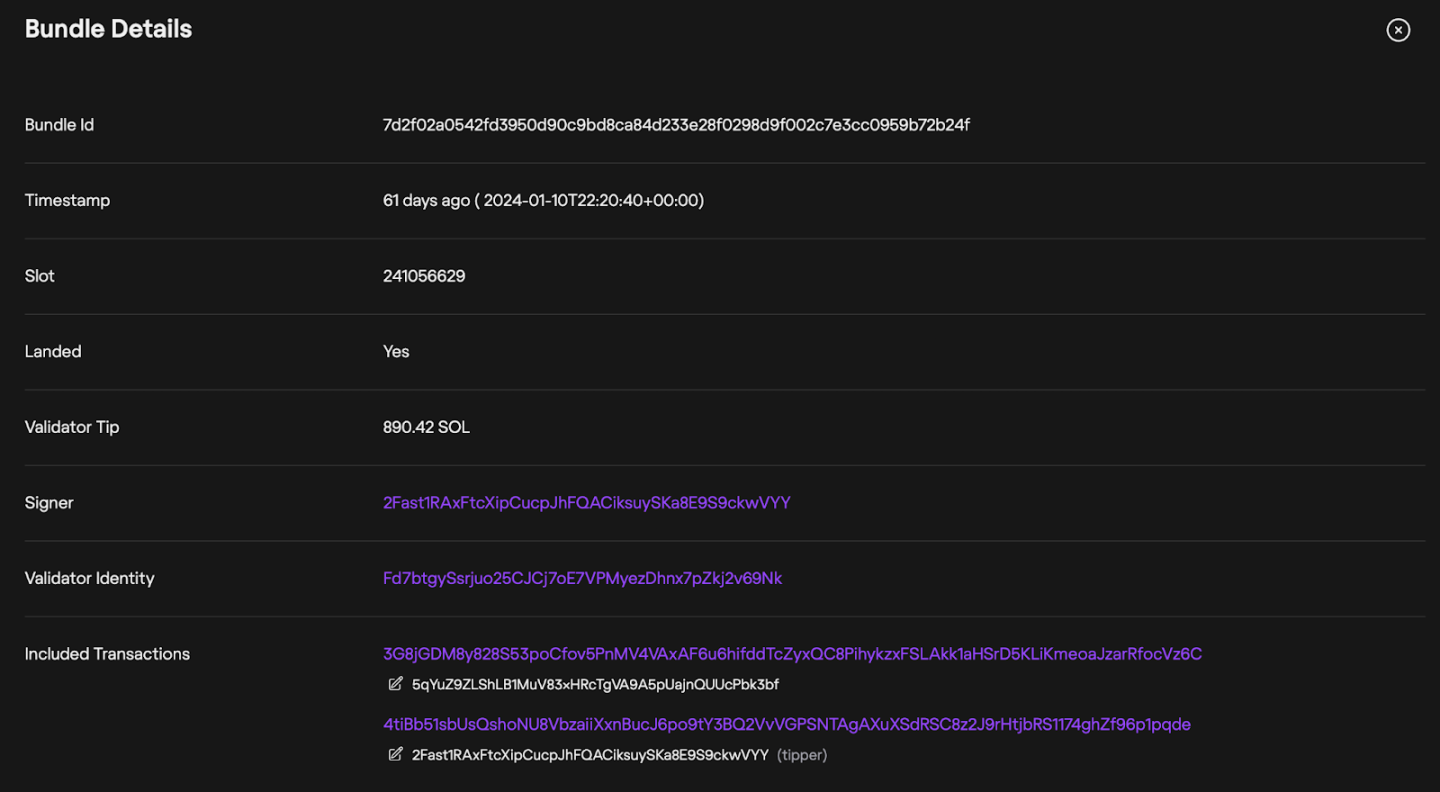
As activity and interest on Solana increases, MEV is becoming an increasingly interesting topic. On January 10, 2024, a searcher rewarded the verifier with 890 SOL, which was one of the largest rewards in Jito’s history:
In the week ending March 12, 2024, Solana validators received over $7 million in Jito tips for block space. Today, more than 50% of Solana trades are failed arbitrages, and since transaction costs are very low, the expected returns are still positive. In the long run, traders will profit from such trades.
Solanas MEV structure
Overview
MEV on Solana is different from other chains in that it encourages searchers to run their own nodes and integrate with high-staking nodes to get the latest view of the blockchain (because Solana is latency sensitive). This is due to Solanas continuous state updates and stake-weighted mechanisms, such as Turbine (for reading updated state) and stake-weighted QoS (for writing new state).
One of the most significant differences is the absence of traditional mempools like those common on other chains such as Ethereum.
Solanas continuous block production does not require any additional or extra-protocol auction mechanisms, thereby reducing certain types of MEV (especially front-running).
MEV transactions
MEV opportunities arise in different categories. The following are some common MEV transaction types that currently exist on Solana:
NFT Minting: MEV generated by NFT minting occurs when participants attempt to acquire rare or valuable NFTs during public minting events, including blue-chip NFTs and long-tail NFTs. The MEV opportunities in NFT minting activities will suddenly increase. Block x-1 has no NFT MEV opportunities, while block x has a large number of MEV opportunities (block x here refers to the block when the casting went online). The massive congestion caused by the minting of these NFTs is one of the reasons for Solanas frequent outages in 2021/2022.
Liquidation: When a borrower fails to maintain the required collateralization rate for a loan, their position will likely be liquidated. Searchers scan the blockchain for such undercollateralized positions and perform liquidations to repay some or all of the debt and receive a portion of the collateral as a reward. Liquidations occur in protocols that use tokens and NFTs as collateral. Liquidation is necessary for the protocol to remain solvent and beneficial to the wider ecosystem.
Arbitrage: Arbitrage involves taking advantage of price differences for the same asset on different markets or platforms. These arbitrage opportunities exist within chains, between chains, and between CEX and DEX. In-chain arbitrage is currently the only form of arbitrage that guarantees atomicity, since both transactions are executed on the same chain, while intra-chain arbitrage requires additional trust assumptions. As long as it does not lead to an increase in harmful order flow, arbitrage can keep the price of an asset consistent in different markets.
Jito
Jito is an out-of-protocol block space auction mechanism for partial blocks, different from MEV-boost which builds complete blocks (Jito and mev-geth are similar in spirit, but very different in implementation). Jito provides off-chain inclusion guarantees for a set of specific transactions called bundles. Bundles are executed sequentially and atomically (either all or none). If the searcher wins the auction and pays the tip, the searcher submits the bundles that were previously guaranteed to be executed on the chain. Jito tips exist outside of the agreement and are separate from the priority fees within the agreement.
This approach aims to reduce spam and increase the efficiency of Solanas computing resources by running the auction off-chain, by only guaranteeing that bundles will publish a single winner of the auction into a block. Searchers can use bundles to implement one or both of the following properties: fast, guaranteed inclusion, and frontrun/backrun transaction bidding. This is especially important considering that a large portion of the network’s computing resources are currently consumed by failed transactions.
memory pool
Unlike Ethereum, Solana does not have a native in-protocol memory pool. Jitos now-deprecated memory pool service effectively created a canonical off-protocol memory pool, as ~65% of validators run the Jito-Solana client (rather than the native Solana-Labs client).
After going online, transactions will stay in Jitos pseudo memory pool for 200 milliseconds. During this period, searchers can bid for the opportunity to preempt/backtrack or sandwich pending transactions, and the transaction package with the highest bid will be forwarded to the validator for execution. Sandwich trades account for a large portion of MEV revenue, measured in tips paid to validators.
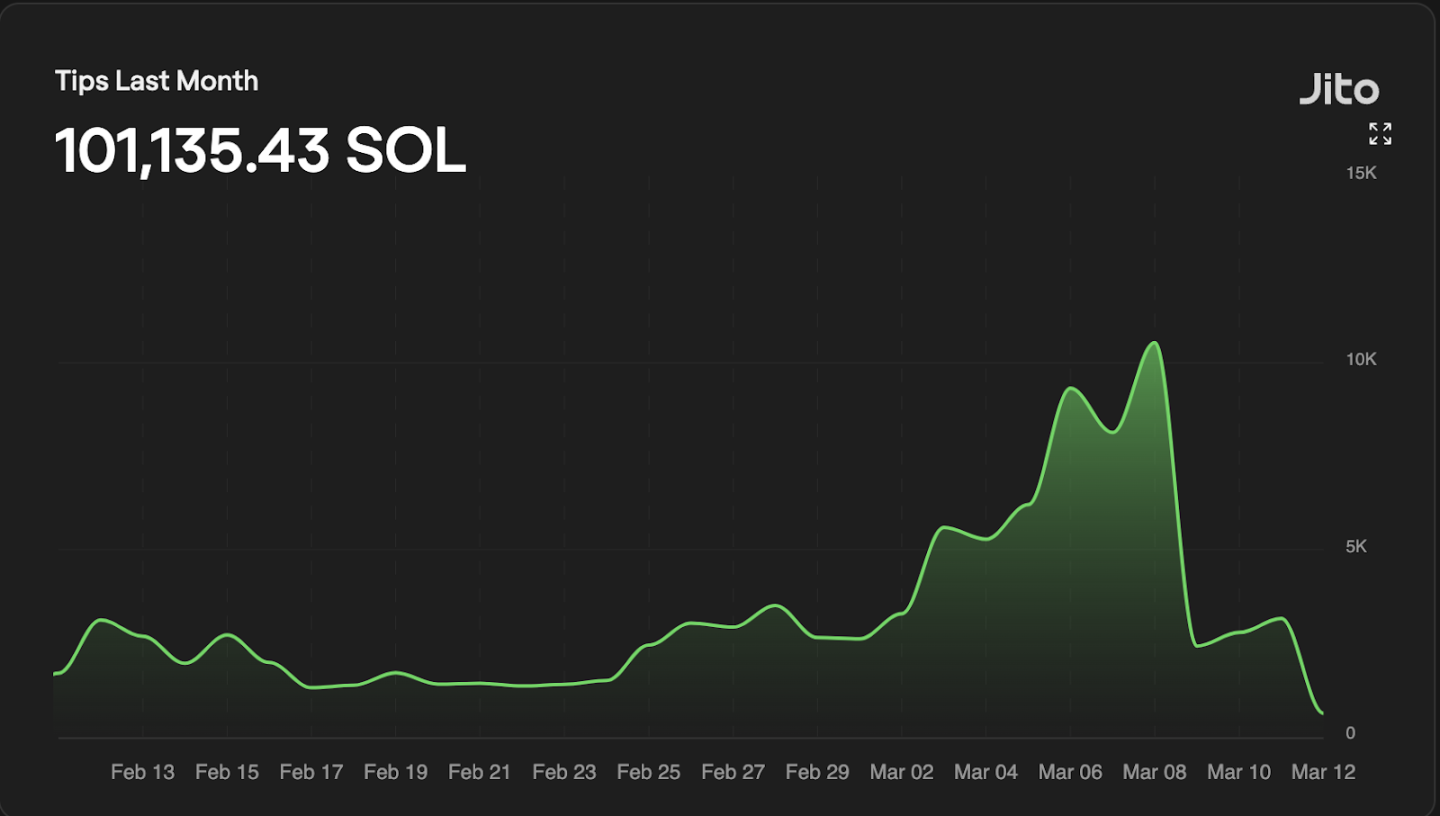
Jitos memory pool service shut down on March 8
No one likes to talk about sandwich trading (especially on Ethereum) because it imposes a strictly negative externality on the end trader: that user trades at the worst possible price. For reference, in the past 30 days, sandwich transactions on Ethereum alone generated approximately$24 million profit. When users set a maximum slippage, they almost always trade at that price. In other words, if the order is filled, the users actual slippage is almost always equal to the maximum slippage they set.
Jito seekers can still submit other types of MEV trade packages that do not rely on mempool order flow, such as arbitrage and liquidation trades (which require observing the transaction in the block and taking the opportunity in the next Jito auction).
supply chain
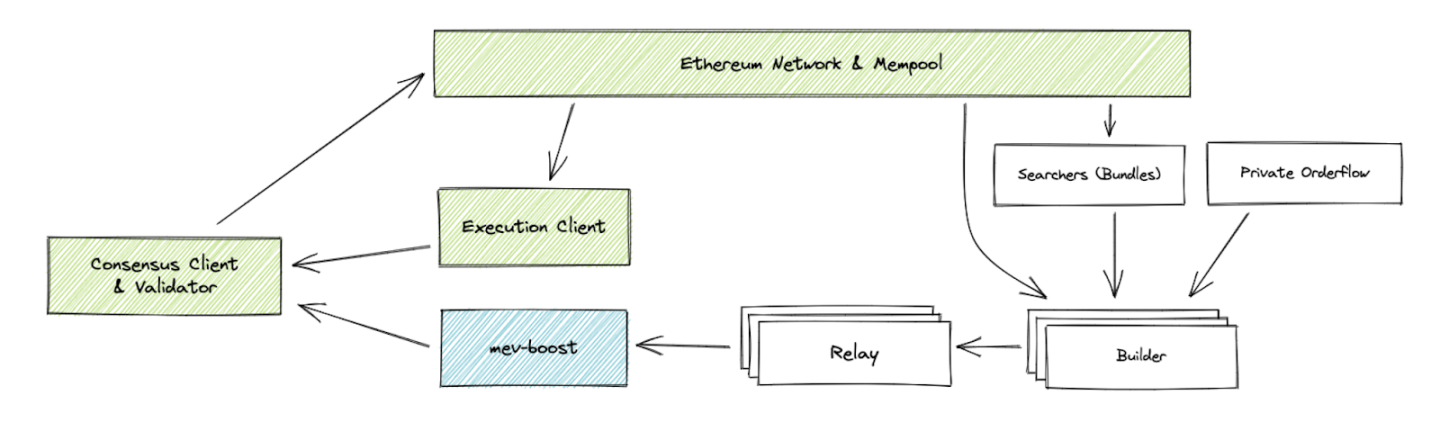
For reference, the current Ethereum block building supply chain looks like this:
The block building supply chain on Solana (for validators running the Jito-Solana client) looks like this:
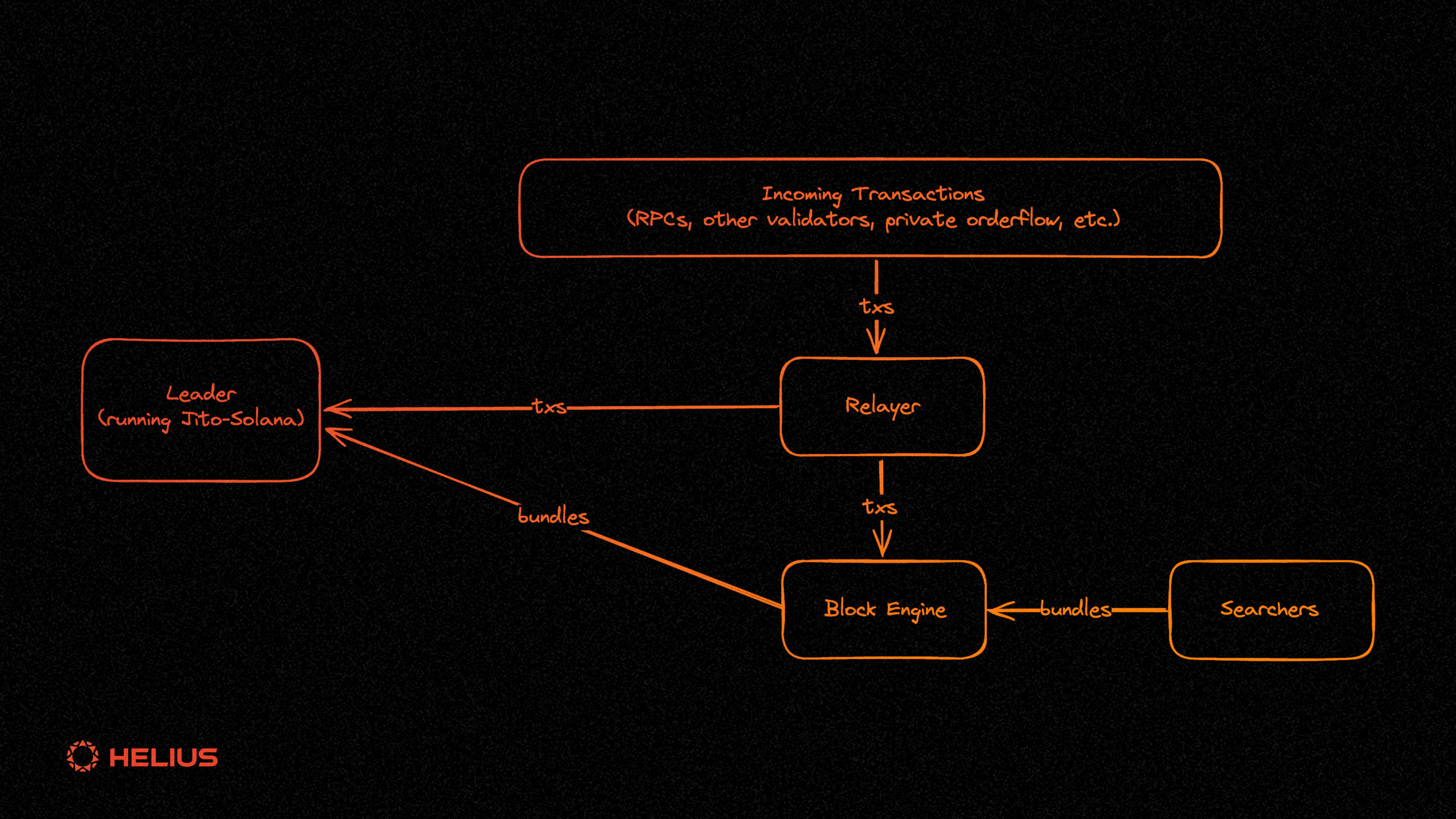
Incoming Transactions: The scheduled status of transactions currently awaiting execution. This can come from RPC, other validators, private order flow, or other sources.
Relayers: Relayers on Solana are different from those on Ethereum. On Ethereum, a relayer is a trusted entity that connects block builders and proposers (builders trust the relayer not to modify their blocks). On Solana, relays are responsible for relaying incoming transactions, performing limited TPU operations such as packet deduplication and signature verification. The relay forwards the packets to the block engine and validators. There is no need for an equivalent relay on Ethereum because Ethereum has a mempool and Solana does not. The repeater logic isopen source, anyone can run their own repeater (Jito makes repeater instances a public resource). Other known Solana network participants also run their own relays.
Block Engine: The Block Engine simulates transaction combinations and runs off-chain block space auctions. The MEV-maximized transaction package is then forwarded to the leader running the Jito-Solana client.
Seekers: Seekers seek to exploit price differences by inserting their own transactions into a given block. They can leverage sources such as Jitos ShredStream (and previously MempoolStream).
Validator: Validators build and generate blocks. Jito-Solana blocks are constructed by the scheduler, which reserves 3 million CUs, accounting for the first 80% of the block, for transactions routed through Jito.
These parties are not necessarily separate entities, as entities can be vertically integrated. As mentioned before, validators have full authority over their blocks. Validators themselves can look for economic opportunities by inserting, reordering, and censoring transactions for a given block while becoming leaders.
Regardless of whether the leader is running Jito-Solana, searchers can also submit transactions via the RPC method (standard intra-protocol routing). Due to Solanas relatively low fees and uncertain scheduler, sending transactions remains a common method of acquiring MEV opportunities. Some MEV opportunities may exist longer than expected, anywhere from one to dozens of blocks.
MEV distribution among participants
While Solana can speed up transaction execution and reduce the opportunity for certain types of MEV, it may exacerbate the potential for latency-driven centralization, where validators and searchers seek to integrate their infrastructure to Gain a competitive advantage. We are still far from a competitive stable equilibrium state of infrastructure and related mechanisms.
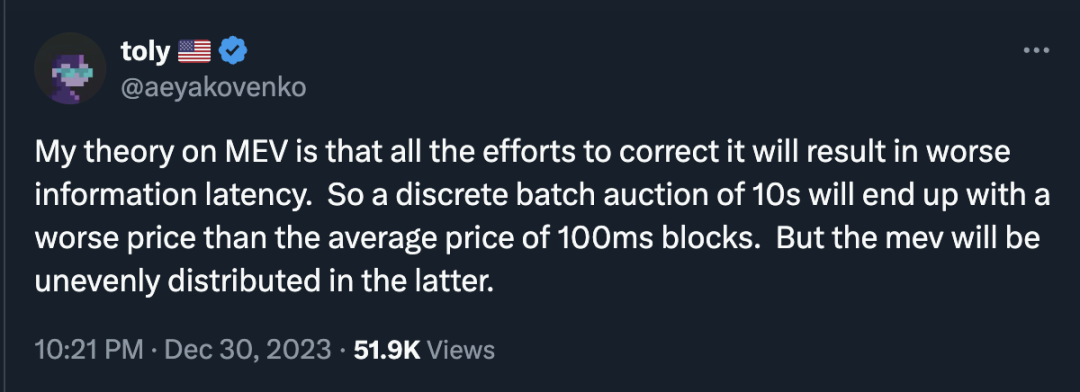
source:Twitter
In a world where block times are below 200 milliseconds, this provides a comparative advantage to senior players with the infrastructure and expertise to optimize the system. So far, Ethereum has strayed away from this balance, creating solutions outside of the protocol to give searchers a democratized opportunity to compete.
How to mitigate MEV
Common off-protocol mechanisms are being made into the protocol to reduce MEV opportunities on the Solana chain. These mechanisms include:
RFQ systems: RFQ (request for quote) systems (such as Hashflow) have made their way into Solana and are growing in popularity (cumulative transaction volume across the entire ecosystem exceeds $10 billion). Orders are fulfilled by professional market makers (Wintermute, Jump Crypto, GSR, LedgerPrime) rather than through on-chain AMMs or order books, and signature-based pricing allows for off-chain calculations. This effectively moves price discovery off-chain, with only completed transfer transactions going on-chain.
MEV-protected RPC terminals: These terminals allow users to receive a portion of the revenue from their order flow as rebates. Searchers bid for the right to backdate transactions and bid for associated rebates, which are returned to users. Such terminals are typically managed by trusting the counterparty running the terminal to ensure that front-running or sandwich trading practices do not occur.
The MEV mitigation/redistribution mechanism is a combination of users capturing part of the value from the order flow and moving price discovery auctions and related mechanisms off-chain. These mechanisms involve trade-offs between cryptocurrency properties, such as censorship resistance, auditability, and trustlessness.
in conclusion
This article introduces the key players in the MEV supply chain on Solana, the latest developments, and common forms of MEV on Solana.
Research in the Solana MEV area has focused on investigating the impact of different MEV mitigation/redistribution mechanisms. Ethereum has invested significant resources in infrastructure, and Flashbots are designed to provide democratized MEV opportunities, but also impose other designs to deal with possible negative externalities.
Solana has the opportunity to explore new models at the forefront of MEV and block production supply chains.


