






Monad Labs: The new generation of "Ethereum killer", the ultimate solution for EVM?


Original author: Frank, Foresight News
I am an Ethereum killer, making money. With the era of easy land acquisition, financing, and hype for new public chains from 2018 to 2020, the era has gone forever. In recent years, few people have mentioned Ethereum killer. ” narrative of large financing.
However, on March 12, Fortune Magazine cited sources and disclosed that Monad Labs, an EVM-compatible blockchain project founded by Keone Hon, the former head of research at Jump Trading, is negotiating to raise more than US$200 million at a valuation of US$3 billion, and Paradigm It may lead the investment, saying it plans to invest US$150 million.
Monad was also officially launched on Devnet last night, stating that it achieved 10,000 real TPS on EVM. At a time when the Dencun upgrade has made the Ethereum/L2 narrative look sexy again, it undoubtedly sounds a bit confusing.
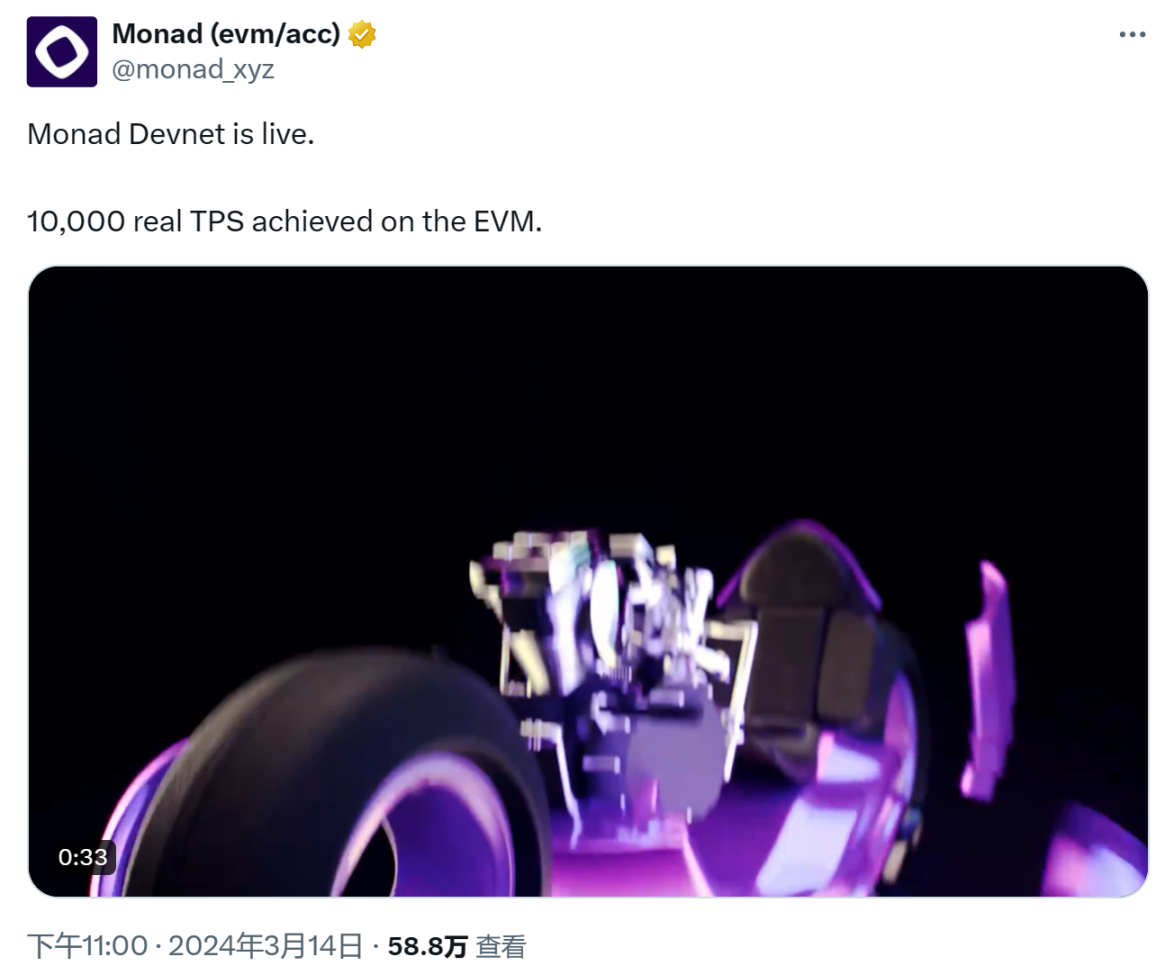
As a former Crypto venture capital tycoon, what kind of blockchain project is Monad Labs, which Paradigm dares to bet so heavily on, and what is special about EVM-compatible blockchain compared to other EVM-compatible networks? Will Monad be a new generation of Ethereum killer seed player?
Monad Labs: High-performance L1 compatible with Ethereum
Monad’s official documentation defines itself as an “EVM-compatible high-performance L1” using the PoS mechanism, aiming to create a new paradigm of public chain possibilities through the pipeline execution of Ethereum transactions.
The first half of the sentence compatible with Ethereum means that Monad provides seamless compatibility for both application developers (fully compatible with EVM) and users (compatible with Ethereum RPC API), supports all Ethereum opcodes, and supports any Ethereum operation code. The contracts deployed on the forum are directly applicable to Monad.
Therefore, existing Ethereum tools and cryptographic environments can be seamlessly plugged into Monad, while benefiting from improved throughput and running costs compared to running on Ethereum. In general, this scope of application includes:
Application (any DApp built for Ethereum);
Development tools (e.g. Hardhat, Apeworx, Foundry, etc.);
Wallet (any EVM compatible wallet such as MetaMask)
Analysis/indexing (e.g. Etherscan, Dune, etc.);
And how high-performance is the high-performance L1 in the second half of the sentence? 10,000 TPS means 1 billion transactions per day (for comparison, Ethereum currently handles approximately 1 million transactions per day). This is also the most impressive labeled information on the Monad Labs official website.

On this basis, Monad also provides a block time of 1 second and a single slot finality of 1 second, thereby supporting more users and a better interactive experience than existing blockchains, while providing a cheaper cost per transaction.
How to achieve 10,000 TPS?
Specifically, Monad mainly achieves the ultra-high performance of 10,000 TPS by introducing Parallel Execution and Superscalar Pipelining into the EVM.
Parallel execution
Parallel execution is not a new concept. Solana, Sui, Aptos, etc. have all adopted parallel strategies before. The biggest advantage is that it allows a single blockchain system to process a large number of transactions at the same time, and multiple transactions can run in parallel and independently, thus Improve overall performance.
To give a simple example, Ethereum is like a high-speed toll station with only one gate channel. You can only use the expressway one by one. Once you encounter peak passenger flow, congestion will occur; and a blockchain network that uses parallel execution can be compared to The high-speed toll station with multiple gate passages can handle the expressway needs of N cars at the same time, speeding up the processing speed.
However, unlike Solana, Sui, and Aptos, Monad is currently the only blockchain network that introduces parallel architecture in EVM L1.
superscalar pipeline
Superscalar pipeline refers to the practice of creating different work stages and processing different stages in parallel. To put it simply, it is a pipeline with two or more parallel work to optimize transaction processing and further improve network performance.
To put it simply, it is the logic of doing multiple things at the same time such as cleaning and cooking while boiling water. Monad introduces this logic into parts such as state storage, transaction processing, and distributed consensus to solve current problems. There are performance bottlenecks.
Specifically, the optimization logic of the superscalar pipeline is introduced in four main areas:
Delayed Execution: Separate the transaction execution from the consensus part;
MonadBFT: A high-performance consensus mechanism built with Rust, focusing on the consensus part;
Parallel execution: Focus on the transaction execution part and can handle a large number of transactions at the same time;
MonadDb: High-performance state backend, all active states are stored in MonadDb;
In a nutshell, Monad puts execution and consensus into separate pipelines, allowing nodes to first agree on transaction ordering before executing them, thus improving performance by separating consensus and execution, allocating more time to actual transaction processing.
In addition, MonadBFT is derived from the Hot Stuff consensus mechanism and emphasizes linear communication. Compared with another popular consensus mechanism, Tendermint, Monad BFT has lower communication complexity and allows a larger network scale.
The above design comprehensively improves the performance and throughput of EVM, allowing Monad to provide up to 10,000 transactions per second. However, it should be noted that this also makes the hardware requirements for building a full Monad node higher (it is recommended to use 2 TB SSD, 16-core CPU, 32 GB RAM, 100 M bandwidth), twice the size of the Ethereum main chain.
From this perspective, it may be regarded as Ethereum with faster speed, lower cost, but higher hardware threshold.
Investment, Financing and Project Team
Keone Hon, CEO and co-founder of Monad Labs, joined Jump Trading (the parent company of Jump Crypto) as a quantitative analyst in 2021, focusing on the field of high-frequency trading (HFT), and left Jump Trading in early 2022, along with two other people. Co-founded Monad Labs (one of whom also has a Jump background).
It is for this reason that Monad is regarded by many as a member of the Jump Gang. However, according to Fortune disclosure, after Do Kwon was indicted in early 2023, Jump Trading gradually withdrew from the encryption field, including terminating its partnership with Robinhood, Exited spot Bitcoin ETFs and cut ties with crypto incubation projects (Pyth, Wormhole, Monad, etc.).
Perhaps because of this, Paradigm has emerged as the new Prince Charming, and if the US$200 million in financing disclosed by Wenchu Wealth is successfully completed, it will undoubtedly be one of the largest crypto financing events so far in 2024, and will also be one of the largest crypto financing events in the history of Web3 investment and financing. Relatively rare.
A year ago in February 2023, Monad Labs completed a $19 million seed round of financing, led by Dragonfly Capital, and 70 other investors participated, including Placeholder Capital, Lemniscap, Shima Capital, Finality Capital, and angel investor Naval Ravikant , Cobie and Hasu et al.
future roadmap
As mentioned at the beginning of the article, Monad’s first testnet has been launched, but the official stated that it is only “an internal private environment” and mainly uses the recent Ethereum history to benchmark 10,000 TPS. “It is a step towards an open public testnet. The first step, there is no specific roadmap for the mainnet launch.
Overall, in the context of the market’s interest in practicality gradually overpowering pure high-performance narratives, the prospect of a “better Ethereum” with Monad compatible with EVM and 10,000 TPS is indeed exciting. As for what is new in the end? The solution is to turn over the sesame seed cakes, which is worth looking forward to.





