A review of 5 potential fully homomorphic encryption projects worth paying attention to


Original author: Degen Maker
Original compilation: Luffy, Foresight News
Fully Homomorphic Encryption (FHE) is quickly becoming a buzzword, and do you know why?
FHE allows calculations to be performed on encrypted data without leaking any information, opening up a variety of possibilities for Web3, including but not limited to:
Confidentiality RWA Tokenization
On-chain identity
MEV protection
Private on-chain medical data
Making DeFi compliant with data protection and privacy laws
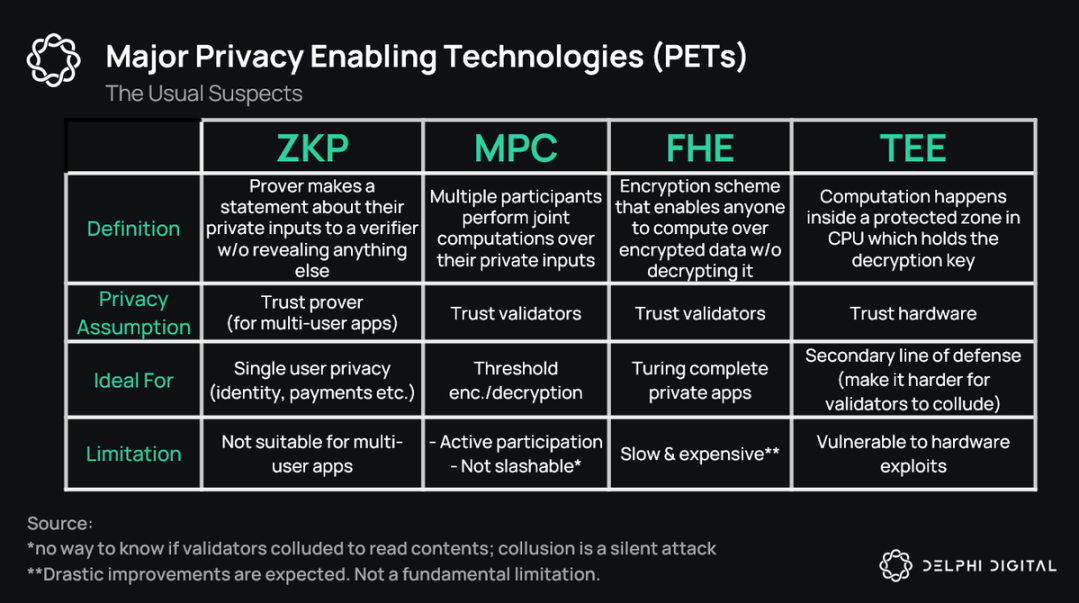
In addition, FHE can also play a role in the field of combining Web3 with artificial intelligence and zero-knowledge proof.
AI models can now leverage data and generate results without accessing the actual input data, ensuring user queries remain private and secure. This also means that data training can be performed without direct access to the data.
While debate continues about the closed-source nature of the major big language modeling companies, FHE has emerged as a potential game-changer in the field of artificial intelligence.
Many people are debating whether FHE will replace zero-knowledge proofs (ZKP); however, they can coexist. ZKP can be used to generate private proofs, while FHE can handle data processing in smart contracts.
FHE is still in its early stages of development, and I will briefly introduce 5 FHE projects with potential.
1) Inco
IncoIt is a modular confidentiality-as-a-service blockchain that is EVM-compatible L1 and fully supported by FHE.
Inco previously completed a $4.5 million seed round led by 1kx.
Catalysts and takeaways:
Providing privacy at the base layer is a strong value proposition that can attract many privacy-focused DApps.
The introduction of the data availability layer revolutionized the ecosystem of modular projects like Celestia. Layers of secrecy are expected to have similar, if not greater, appeal.
Working with Zama, for which the Polygon co-founder is an advisor, will borrow Ethereums security through EigenLayer (actually AVS).
2) Mind Network
Mindis a Zero Trust Layer that provides security and data privacy, designed to facilitate true CrossFi scaling.
Mind completed a $2.5 million seed round led by Binance Labs.
Catalysts and takeaways:
Build internet infrastructure that empowers citizens around the world to control their data.
The testnet is online and there may be incentives for the testnet.
Powered by Zama.
The first use case is MindLake, a groundbreaking data storage rollup designed to perform computation on encrypted data on a decentralized platform.
3) Fhenix
Fhenixis the first Rollup-based FHE architecture designed to address the challenges of performing FHE computations on L1 due to extensive execution requirements and scalability limitations.
Catalysts and takeaways:
Optimistic FHE Rollup can be built on Ethereum without modifying the base layer, which means every smart contract in Ethereum can have enhanced privacy through the FHE Rollup solution.
Launched fhEVM infrastructure in partnership with Zama.
The testnet will be launched soon.
In my opinion, Fhenix simplifies the deployment of confidential smart contracts, which is critical for developer adoption.
4) Privasea
PrivaseaIt is a network that uses FHE to ensure privacy and security in the AI computing process.
Privasea has completed a $5 million seed round led by Binance Labs.
Catalysts and takeaways:
Details of the Genesis NFT will be announced soon, and holders will be able to receive airdrops.
Providing a private computing FHE solution for DePIN+AI combines all hot spots into a legitimate and promising project, and the project tokens may bring high returns.
Another DApp is being developed for secure and private user verification, ensuring privacy in the KYC process without exposing personal details but remaining auditable when necessary.
Powered by Zama.
5) Optalysys
OptalysysThe next generation of computing processing capabilities is being built. I think this is a very promising project and a shovel in the FHE field.
Optalysys focuses on the DePIN project, which has a cloud-native technology stack tailored for high-intensity FHE workloads, helping to scale FHE in the compute layer.
Catalysts and takeaways:
Potential as a shovel.
Coprocessors (GPU, CPU) address fundamental limitations of electronic systems.
Optalysys has developed a unique optical computing system that delivers processing power and energy efficiency from the data center to edge computing, supporting all major FHE libraries.