


Aperture: Giving DeFi Operation Instructions to Chatbots


This article will mainly introduce Aperture and touch on the growth difficulties currently facing the DeFi industry.
Aperture’s goal is to challenge and move beyond traditional transaction methods that have hindered mass adoption of DeFi and move closer to an “intent-based” future.
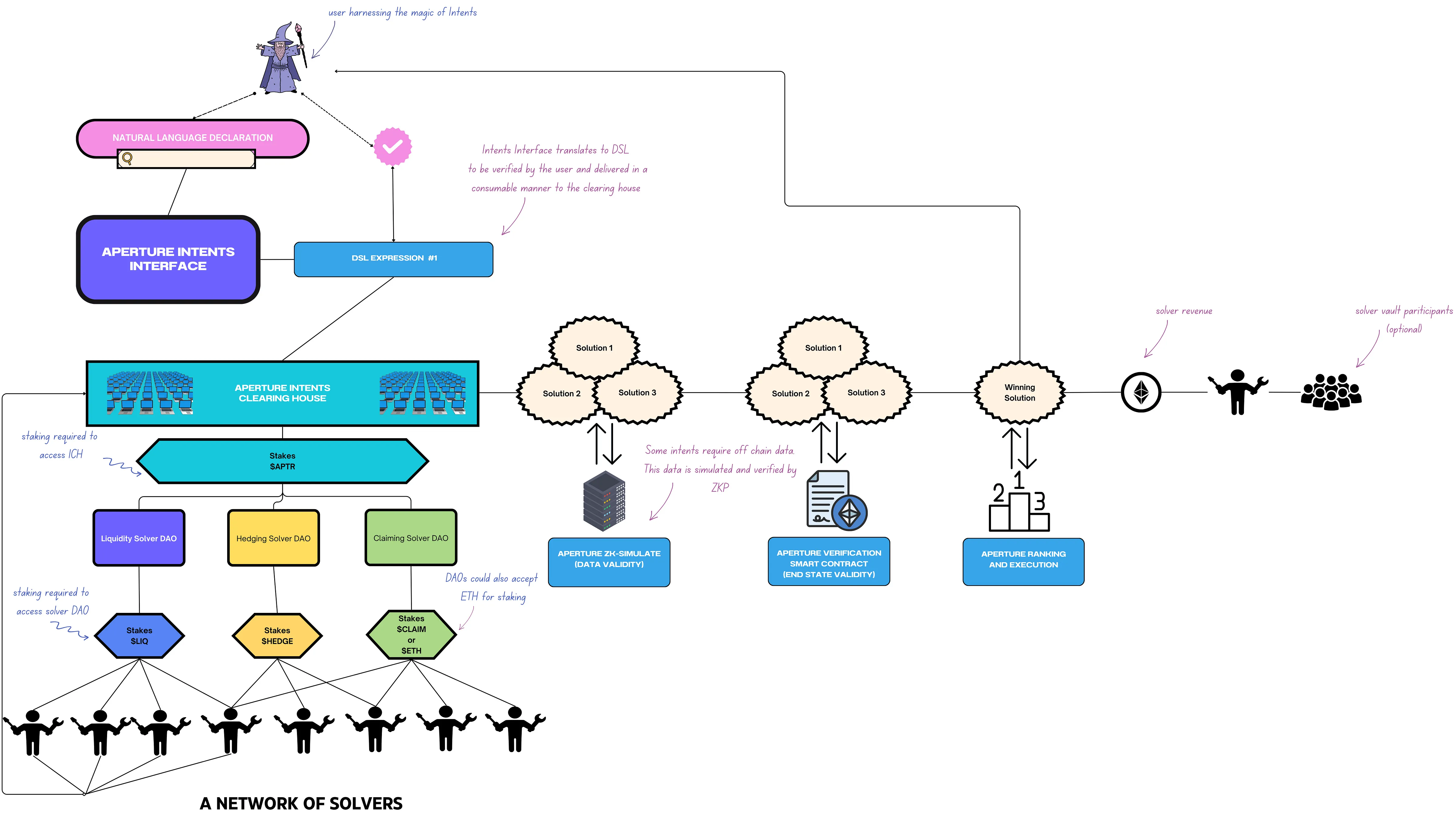
In short: ten times the execution efficiency, one-tenth the workload
Aperture is building a new chatbot experience for users, powered by an underlying intent infrastructure that enables users to express their goals in natural language and leverage a network of solvers to achieve comparisons Better execution and better pricing under the current trading paradigm.
User Experience: Aperture LLM Powered by Intent DSL
First, Aperture will start with the foundation for any mass adoption: user experience (UX).
The current DeFi UX is centered around transaction methods that require users with varying levels of technical understanding to sign off on state changes, which also changes the “end state” in users’ minds. Through intent, Aperture puts the “end state” at the heart of the user experience.
Leveraging the power of modern LLM and a proprietary intent-oriented programming language, Aperture is designed to empower the expression of user intent. This will enable users to articulate their trading goals and preferences more intuitively and efficiently, making it easier and more precise to harness the potential of blockchain.
Imagine a user who does not understand the principles of blockchain technology, facing a lot of knobs and buttons on the traditional DeFi interface. Obviously, Apertures approach of supporting users to express their intentions in natural language is simpler. Behind this is the need to convert natural language into blockchain code - this is where Domain Specific Languages (DSLs) come into play.
Unlike the GPL (General Purpose Language), which is applicable to a wide range of fields, DSL is a specialized computer language targeted at a specific application area. The design and utilization of DSLs is an integral part of domain engineering and often involves creating new DSLs or adapting existing DSLs to facilitate more effective expression of problems and solutions within a specific domain.
In Aperture, the DSL is designed with human reading and language habits in mind, which is critical to supporting clear and intuitive expression of intent. Other DSLs may prioritize aspects such as programming efficiency or machine-level optimization.
On Aperture, LLM bridges the gap between technical functionality and user-friendly interfaces by allowing users to express their intent in natural language and feedback that intent back to the user in the form of a highly readable DSL. This DSL can then be provided to the resolver as a statement of truth for that user.
To use a real-world analogy: the LLM to DSL translation user experience is similar to – a customer placing an order at a pizza parlor over the phone. A customer might place an order in very colloquial terms: “Give me your largest, all-meat pizza.” The operator on the other end might respond to them with: “You want our carnivore pizza, XL? ? Its easy for users to understand this transition and agree: Yeah, I dont know the name of it, but thats what I want.
On-chain, this interaction will occur in a similar manner. Users may start by stating their ultimate goal—
“Can you rebalance my ETH-GMX LPs across all my EVM chains so that 80% of the funds are concentrated in the best performing pool, and the remaining 20% of the LP funds are evenly distributed among the remaining pools? ?”
The parsing of the DSL may be fed back to the user——
● Eligible assets: ETH-GMX trading pairs on mainnet, Arbitrum and Avalanche;
● Allowed operations: bridging, removing liquidity, trading ETH or GMX, adding liquidity;
● Ultimate Goal 1: Rebalance liquidity positions to focus 80% of eligible asset capital on positions with the highest spot APR, according to APY Vision;
● Final Objective 2: Rebalance liquidity positions to focus 20% of capital in eligible assets into existing pools not used in Final Objective 1;
● Sign the Statement of Intent (if correct).
Converting an LLM codifies spoken language into standardized terms for DSL, which solvers utilize in a predictable and replicable way.
underlying infrastructure
Intent infrastructure can be broken down into several parts:
● Intent clearing center (memory pool): serves as a preliminary staging area for user intentions. It is designed to efficiently organize these intents for processing, using a prioritization algorithm based on various criteria such as urgency and resource requirements. The clearing house ensures that intentions are managed securely and orderly before they are submitted to the blockchain.
● ZK simulation of data validity: This is the resource needed to verify certain intentions and their corresponding solutions, which will rely on off-chain data. Zero-knowledge proofs can be used to verify the validity of this data. Leveraging advanced encryption tools such as Brevis or Axiom, Aperture can generate ZKPs for historically on-chain data that are part of the solution proposers proposals. This approach allows for rigorous validation of the solution’s output, ensuring that it is accurate, complete, and conforms to specified constraints and intent, without compromising the confidentiality of transaction data.
● Validate smart contracts: Each intended use case will require a smart contract to simulate, validate and govern the proposed solution.
● Ranking and Execution Engine: Each set of validated intents needs to be ranked based on results and solver scores, and then subsequently executed. The key aspect of this execution engine is its accountability execution capabilities. If any malicious activity occurs, such as reversed transactions or other malicious events, the execution engine is designed to punish the responsible resolver by reducing rewards or other means. This not only protects the integrity of the transaction, but also prevents potentially malicious behavior by the solver.
Application layer: Solver DAO
The Solver DAO network is a unique application layer built on top of the intent infrastructure. The Aperture intent infrastructure enables Solver DAO to focus on enabling and solving unique intent-based use cases without worrying about underlying execution requirements.
The Solver DAO gains access to user intent in Aperture Clearing House by staking the necessary amounts of $APTR and $ETH. A Solver DAO can be associated with a large specialized solver with proprietary solutions or a network of smaller solvers.
New intent solutions can come from Aperture or third-party Solver DAOs. Solver DAOs add value by enabling new intent use cases. This requires committing the necessary business logic to accommodate Apertures modular design. Once built, the use case can now be claimed from the Aperture intent interface or a third-party interface created by the resolver DAO.
Aperture DAO will fund Solver DAO with $APTR to enable new intent use cases.
How will solvers compete, and what types of solvers might exist?
On-chain and off-chain
In the highly competitive Aperture intent ecosystem, Solver stands out through his approach to delivering solutions. Although not mandatory, smart contracts are preferred due to their scalability and speed. However, off-chain scripts are equally good at releasing solutions quickly, providing an alternative path. Some declared intents may even have characteristics that enable solvers to submit solutions manually. (For example, the seller wants to schedule a large off-market sale and sets a 3-day bidding window.)
maintain alpha
For solvers with a truly “alpha” or proprietary solution generation method, they can avoid using smart contracts to generate solutions and instead can rely on Aperture’s zero-knowledge verification process to establish trust in their off-chain script-enabled solutions. This will enhance the positive cycle effect of attracting solvers (sustainable business solutions, attracting more revenue, attracting more solvers).
Solver library
Although not explicitly required in a given ecosystem, Solvers may also choose to raise security deposits through crowdfunding, through a vault mechanism, in return for a portion of the solvers proceeds. Each Solver DAO can open source a reward sharing vault contract for its solvers to implement if they wish to receive initial funding support.
Example: Intent Airdrop
For ease of understanding, take the “airdrop claim intention” proposed by Aperture in its first blog post as an example. How do users declare intent? How would a dedicated Solver DAO leverage Aperture’s Solver DAO marketplace?
The user first declares in natural language:
“Claim all eligible airdrops on my behalf, don’t forget the gas fees associated with claiming, and in exchange pay 1% or less.”
The chatbot may ask clarifying questions to further tease out the users statement.
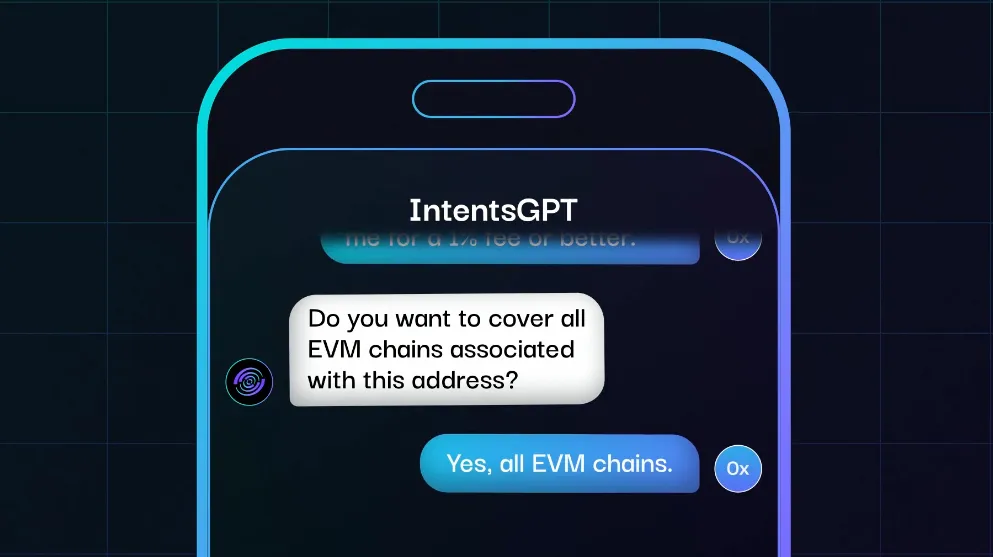
Once this clarification is complete, the intent is translated from natural language into an encoded intent DSL and sent back to the user in a readable format for verification. Next, the expression of intent is published to the intent clearinghouse, where any eligible solver can view the users statement.
Solvers can now view a users address and cross-reference it with claimable airdrops or rewards. The permission function supported by the Account Abstraction Wallet allows solvers to claim airdrops on behalf of users. Solvers will compete against each other on finder fees and their overall knowledge of the airdrop. Now, the difference in intent is that if solver A covers a Dymension airdrop and solver B covers a Celestia airdrop, both solvers can earn finder fees from our users.
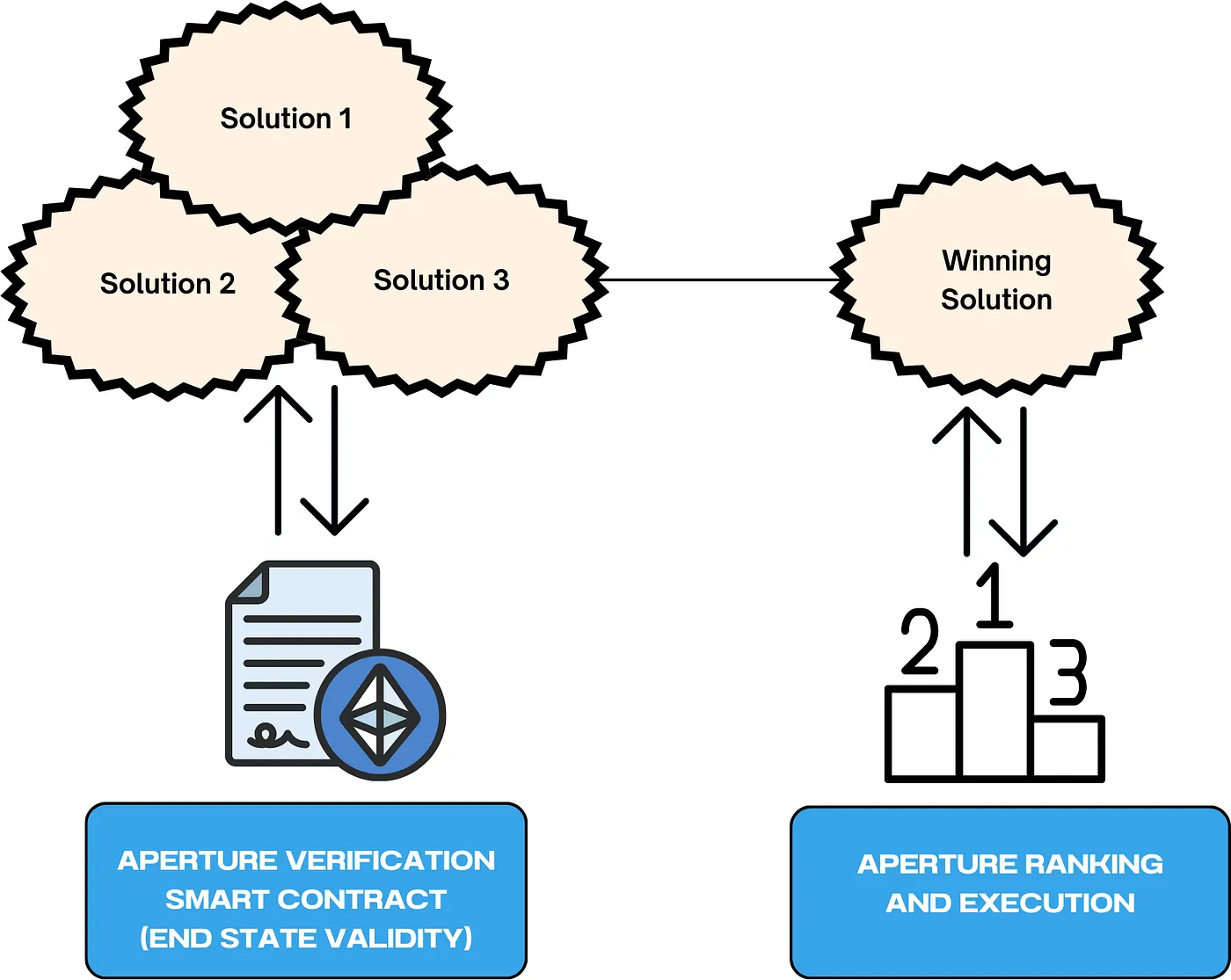
Proposed solutions will all be simulated by Aperture’s smart contracts to verify the proposed outcomes, and then all verified solutions will be ranked. Aperture will then execute on behalf of the user, returning all airdrops.





