






To explore new revenues, Grayscale is accelerating its layout of arbitrage and gaming behind altcoins


Original author: Frank, Foresight News
In the crypto world, Pixiu and Bull Market Engine, Grayscale was in the limelight before 2021. Until January 10 this year, the good days came to an abrupt end.
SoSoValue statistics show that since January 11,GBTC has experienced cumulative outflows of more than 10 billion U.S. dollars, and its total net asset value has dropped to 27 billion U.S. dollars. It is the only product among the 10 spot Bitcoin ETFs with constant net outflows.
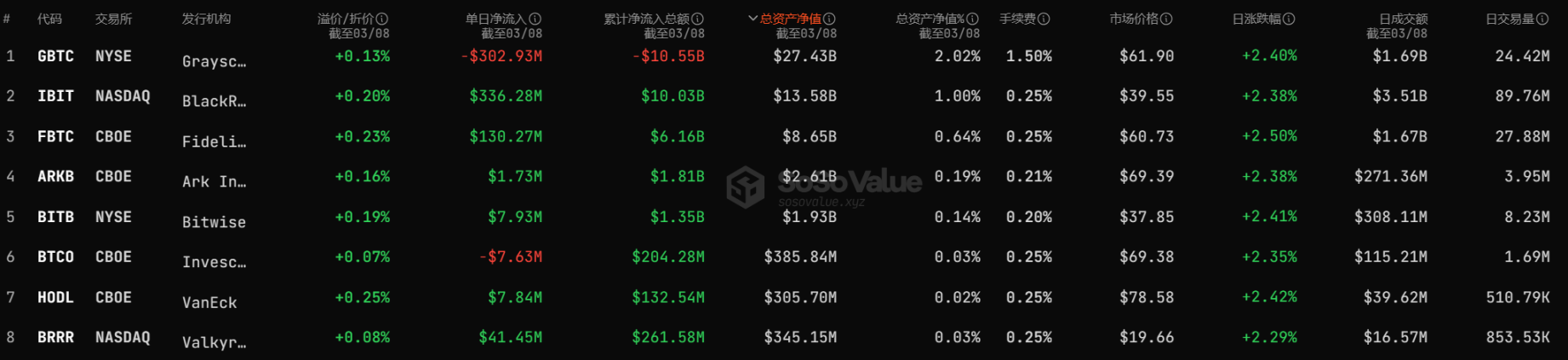
The positive factors in tailwinds will be amplified, and only the choices made when the tide ebbs are more representative. In the two months of this dramatic change in the landscape, Grayscale has obviously accelerated its pace and begun to accelerate the launch of new products and layouts. This article is about The purpose is to briefly sort out this and find out what it is.
Open trust private placement of 5 altcoins
On February 15, Grayscale email notification showed that the private placement subscription of some cryptocurrency trusts has been opened to accredited investors, including Grayscale Bitcoin Cash Trust, Grayscale Chainlink Trust, Grayscale Litecoin Trust, Grayscale Solana Trust, and Grayscale Stellar Lumens Trust. Subscriptions will be made at net asset value (NAV).
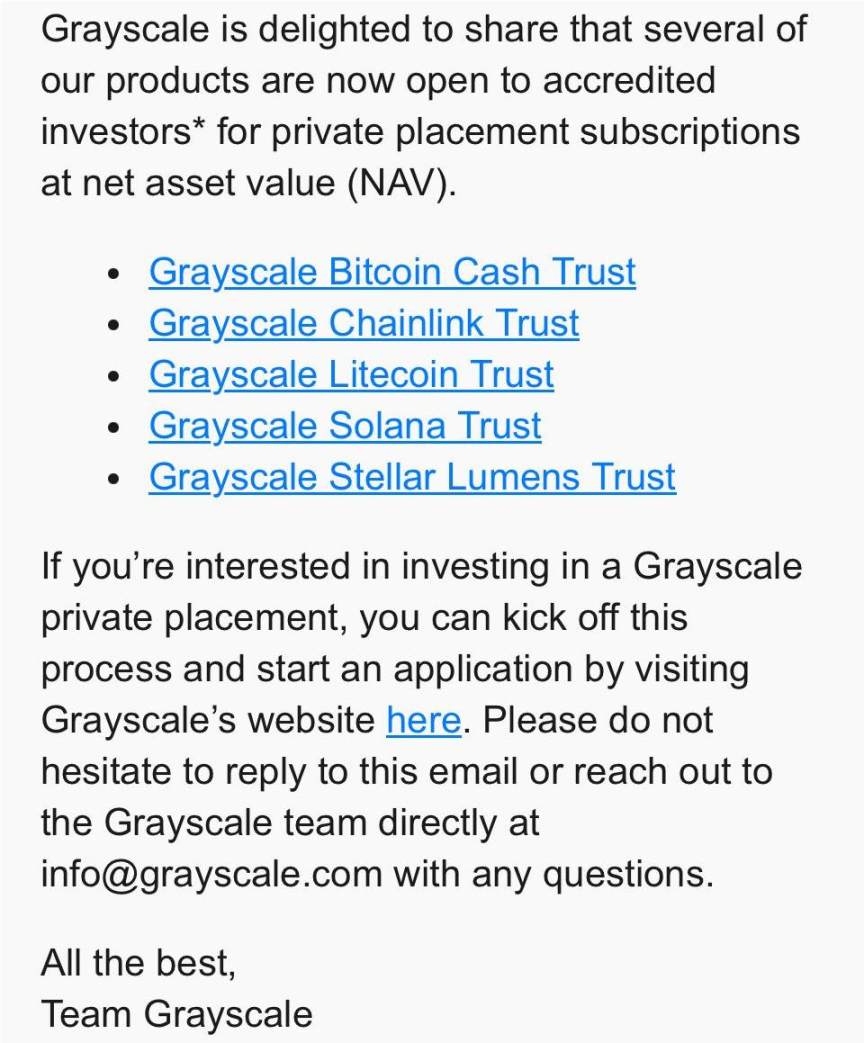
In one sentence, it isOpen private placement of five cryptocurrency trusts, BCH, LINK, LTC, SOL, and XLM, for subscription by qualified investors——According to the process disclosed on Grayscale’s official website, the current product life cycle of its trusts includes four stages: private placement, public quotation, U.S. Securities and Exchange Commission (SEC) quotation, and ETF type, that is to sayAt present, except for the Bitcoin Trust GBTC, other crypto trusts are only closed-end funds and cannot be redeemed in both directions in the market.
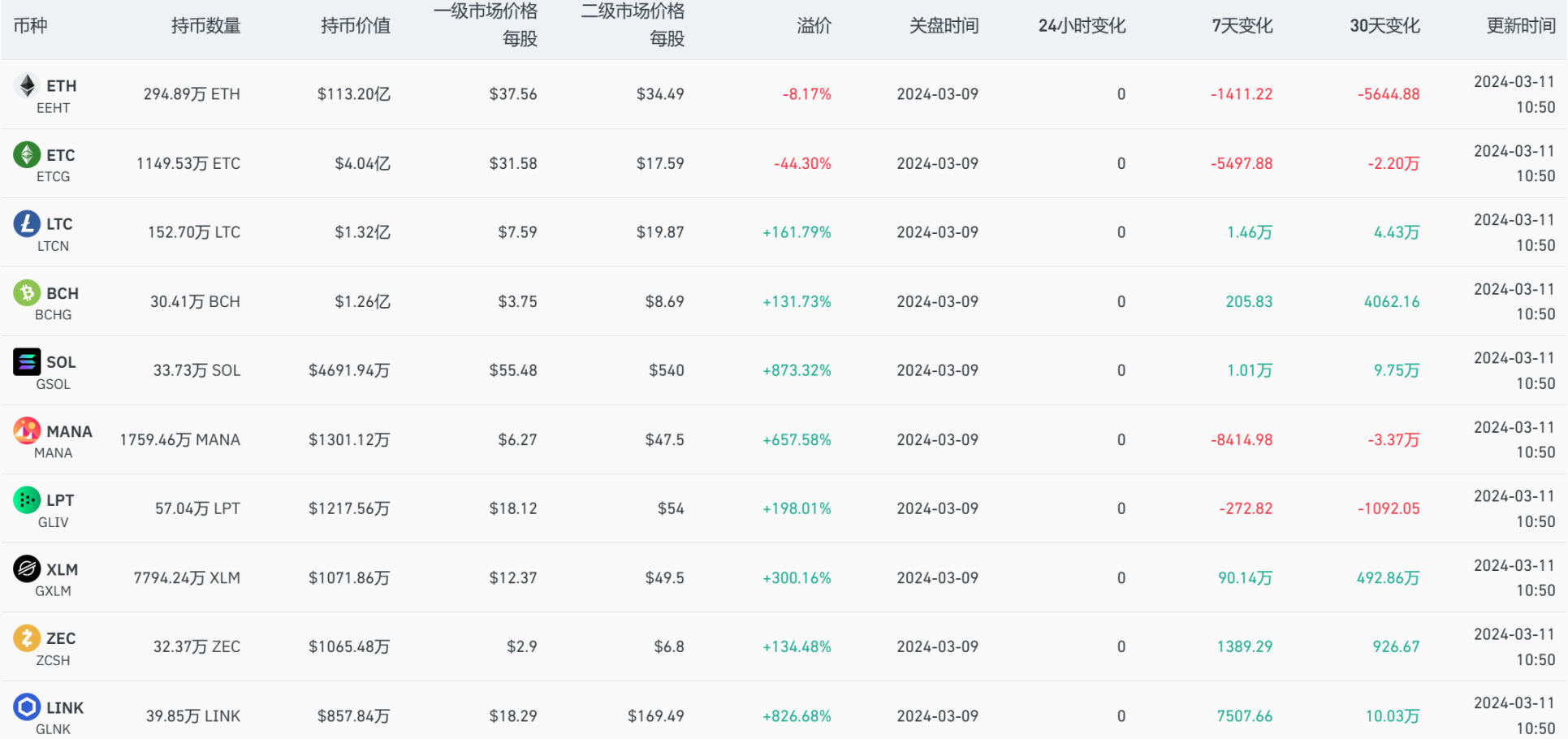
However, Coinglass statistics show that after the private placement subscription was opened on February 15,In less than a month, these five crypto trusts have shown obvious net inflows among all Grayscale fund holdings:
Among them, the net increase of LTC exceeded 44,300 pieces (over 3.5 million U.S. dollars), the net increase of BCH exceeded 4,062 pieces (about 1.6 million U.S. dollars), the net increase of XLM exceeded 4.92 million pieces (about 680,000 U.S. dollars), and the net increase of LINK exceeded 100,000 pieces ( approximately US$2 million).
Only SOL is out of stock - with a net increase of over 97,500 pieces and a value of over US$13.5 million.
Obviously only GBTC has been converted into an ETF, so why did a large number of OTC funds participate in the private placement subscription of these five altcoin crypto trusts after the private placement was opened?
Arbitrage and gaming behind subscription
The reason isThe large premium in the primary and secondary markets + the unique arbitrage space created by the special redemption mechanism.
High premium of over 130%
As shown in the figure above, it can be clearly found that the above five altcoin crypto trusts all have large positive premiums - the premiums of old PoW currencies such as LTC and BCH are generally more than 130%, SOL has a premium of more than 870%, and LINK also has a premium of more than 870%. As high as 830% (of course the total holding volume of LINK Trust is only US$8 million).
This premium is specifically the difference between the index currency (which can be regarded as the primary market) and the corresponding U.S. share price (the secondary market price).Taking LTC as an example, the positive premium of 161.79% refers to the secondary market transaction price of each share of ETCG, which is 161.79% of the actual value of the corresponding ETC share represented behind it.
Therefore, under this background, combined with the naked multi-trust mechanism of Grayscale Crypto Trust, it perfectly constitutes an arbitrage path that smooths out the positive premium space.
Naked Multi-Trust Mechanism
Here we need to briefly introduce the creation/redemption mechanism of Grayscale Crypto Trust, which is almost a naked multi-trust.
Taking GBTC before the switch to ETF as an example, Grayscale Cryptocurrency Trust cannot directly redeem its underlying assets - there is no clear exit mechanism, and there is no redemption or holding reduction for the time being.
This means that these crypto trusts themselves are naked multi-trusts - they can only get in and out in the short term (but Grayscale currently charges management fees according to a proportion, and the form is currency-based, which is why its positions will be reason for periodic small reductions).
To be more specific, lets still take ETCG as an example: the channels for investors to obtain ETCG shares, in addition to direct purchase on the US stock secondary market, areDeposit the corresponding ETC tokens through private placement subscription, and after the lock-in period, you can unlock and get the corresponding proportion of ETCG shares.(According to public information, the lock-in period is 12 months).
Then there is actually an opportunity for arbitrage. For example, investors can participate in the private placement of ETCG with ETC in the primary market, obtain an equal share based on the net value of the submitted assets, and at the same time open an equivalent ETCG short order in the contract market for hedging ( If the bet is still at a positive premium after 12 months, even the short hedging step can be omitted).
ThatsAfter waiting for 12 months, the unlocked ETCG shares in your hand can be sold in the US stock secondary market. At the same time, the corresponding short orders are closed, and the difference between the net value of Grayscale ETCG trust and the ETCG on the US stock secondary market is net profit. , complete the entire arbitrage process.
To sum it up in one sentence, it is equivalent to arbitrageurs buying ETC spot in the crypto market and selling ETHG in the US stock market. So from a market perspective,The current high premium of ETCG and others is like a 12-month call option.
Of course, this call option with huge arbitrage potential may be just an asymmetric game - ETCG is open to institutions and qualified investors in the primary market through private placement, allowing it to acquire shares in the secondary market Sold, and those who took over at such a negative premium in the US stock secondary market are undoubtedly ordinary US stock investors with imbalanced information.
In fact, from 2020 to 2021, Grayscales Bitcoin Trust GBTC and Ethereum Trust ETHE have experienced similar positive premiums and arbitrage situations. However, with the bankruptcy of Three Arrows Capital in 2022, the DCG crisis and other series of impacts, GBTC Not only did the premium turn from positive to negative, but the negative premium even exceeded 50% at one point, completely blocking this arbitrage path.
However, with the renewed hype of spot Bitcoin ETF news in mid-2023 and the advancement of GBTC switching to ETFs, the negative premium of GBTC has created the opposite arbitrage space:Buy GBTC with a negative premium in advance, bet on the adoption of the ETF, and wait for GBTC to be converted into an ETF in the future to smooth out the negative premium, thereby obtaining the premium income during this period.
Grayscale accelerates its shift to altcoins?
In addition, on March 5, Grayscale also launched its first actively managed fund, Dynamic Income Fund (GDIF).
The fund earns revenue by staking cryptocurrencies and will initially support nine blockchain assets: Aptos (APT), Celestia (TIA), Coinbase Staking Ethereum (CBETH), Cosmos (ATOM), Near (NEAR), Osmosis (OSMO), Polkadot (DOT), SEI Network (SEI) and Solana (SOL), and plans to distribute staking rewards in USD quarterly.
And according to the officially disclosed GDIF fund asset proportions, the top ones are OSMO accounting for 24%, SOL accounting for 20%, DOT accounting for 14% and the remainder accounting for 43%. This is undoubtedly outside the circle. Institutional investors eliminate the need to participate in PoS investments.
To a certain extent, it can be called Grayscale’s biggest “product innovation” in recent years, which is equivalent to gradually turning to active participation in obtaining crypto-native returns, providing institutional investors with a simple way to obtain PoS rewards.
If you are poor, you will want to change, and if you change, you will be successful. You must know that Grayscale has been an important representative of buying institutions in the crypto world since its birth in 2019, and is also one of the largest crypto “big whales”. The greatest narrative value over the years is undoubtedlyProvide investors with compliant cryptocurrency investment channels in the form of trust funds.
However, after the spot Bitcoin ETF was approved on January 10 this year, Grayscale’s role as an “institutional investor channel” encountered continuous capital outflows due to its high management fees and other factors, creating the largest market in the short term. Selling pressure.
According to crypto trader Fred KruegermonitorIt shows that as of the last trading day, the BTC holdings of another 9 spot Bitcoin ETFs have just completed the reversal of the grayscale GBTC holdings:
The BTC holdings of 9 spot Bitcoin ETFs reached 405,000 BTC, surpassing the 396,000 BTC holdings of GBTC. The rapid growth in 2 months overturned GBTCs leading position in the past 5 years.
summary
Perhaps because of this, Huidu’s new actions in the past two months have beenFocusing on the layout of altcoins other than Bitcoin, Jitu hopes to tap new big profits by shifting its focus to other Crypto trusts in addition to Bitcoin Trust, which has fallen to the first place:
Recreating GBTCs status as the only compliant entry channel back then, it enjoys the compliance premium that institutional investors are willing to pay, and continues to make a fortune silently.
The good days when there is a tailwind are always missed by people, but for Huidu, it is still unknown whether the good days of making money in 2020 can come back.





