






Wall Street Bet on Bitcoin: Bull Market Fence-Sitters or Crypto True Believers?


Original source: Bloomberg
Original text compiled by: BitpushNews Yanan
Now, traditional finance has been married to the crypto world, forming a community of interests (for better or worse).
For JPMorgan Chase CEO Jamie Dimon, cryptocurrencies are nothing more than “pet rocks.” s stone, maintained as a fun pet), worthless. For Charlie Munger, the old partner of stock god Warren Buffett, cryptocurrency is a stupid thing. U.S. Senator Elizabeth Warren believes that only terrorists, drug dealers and fraudsters will be happy with cryptocurrencies.
The truth may be what they say. But there’s something else you need to know about Bitcoin: It’s not going away anytime soon. Instead, Wall Streets resistance to it is dissipating over time.
Recently, the crypto market has rebounded strongly, and the price of Bitcoin has soared. It first broke through the US$40,000 mark, and then broke through the US$50,000 and US$60,000 marks successively, much to the dismay of senior financial people who had previously been skeptical about the performance of the crypto market. be surprised. This wave of strong gains has ignited new optimism. Many experts firmly believe that the underlying demand for Bitcoin is strong and lasting - whether it is young players, older investors, or institutional leaders with strong financial strength. Even ordinary retail investors and extensive participation from all circles have provided strong support for Bitcoin’s market prospects. Even the expected increase in U.S. interest rates, which was considered the biggest threat to Bitcoin in the past, has not dampened investors current enthusiasm.
No matter what Jamie Dimon or his good partner Elizabeth Warren says, Michael Novogratz, founder and CEO of crypto investment institution Galaxy, said in an interview, many people still believe that Bitcoin has value. So does Michael Novogratz One of the strongest supporters of Bitcoin.
This constant demand for Bitcoin creates a pressing dilemma for the investment industry. Even if Bitcoin takes on the mantle of a regulatory-friendly ETF, traditional investment giants could still choose to continue avoiding an asset class known for its volatility and susceptibility to scandals. For example, the ultra-conservative Vanguard Group (Translators Note: Vanguard, the worlds largest public fund company) has adopted this approach to avoid Bitcoin assets.
Another option is to cater to customers crypto needs, even if that means taking on a set of risks. Firms such as Bank of America Merrill Lynch and Wells Fargo have recently joined this camp, allowing some brokerage clients to invest in new Bitcoin exchange-traded funds (ETFs), but prohibiting financial advisors from recommending such products to clients.
Bitcoin’s rise after ETF listing
Bitcoin prices have risen strongly in recent days, thanks in part to the successful launch of nearly a dozen related funds.
Wall Street will chase anything that makes money, but that doesnt mean its good or bad, said Michael Rosen, chief investment officer at multi-asset investment firm Angeles Investments. He added that he believes belief in cryptocurrencies borders on delusion.
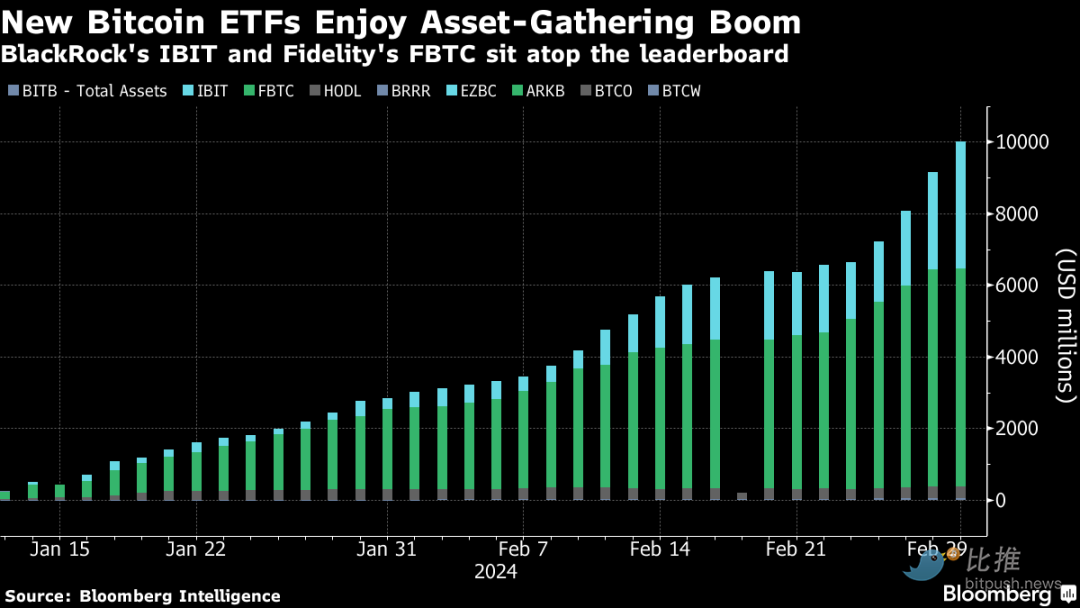
However, the influx of huge amounts of money has become a fact that cannot be ignored. The ten spot Bitcoin ETFs currently traded in the U.S. market have attracted a cumulative net inflow of approximately US$8 billion, with funds managed by investment giants Fidelity and BlackRock dominating the list. According to Bloomberg Intelligence data, BlackRock’s iShares Bitcoin Trust Fund accumulated up to $10 billion in just seven weeks. The speed is not only unprecedented in ETF history, but even surpasses 2004. This achievement was achieved only two years after the first gold ETF was listed. This fully proves the attractiveness and market potential of Bitcoin as a new investment tool.
Newly launched Bitcoin ETF sees record inflows
BlackRock’s Bitcoin ETF continues to lead other similar funds, with capital inflows far ahead.
However, the influx of ETF funds requires buying Bitcoin in a market known for “holding (HODL)”. These hodlers are often happy to hoard Bitcoin and wait to see the price rise. Of course, everyone has an expected price, and the sudden surge in demand for Bitcoin has also reinvigorated retail traders in the crypto market. As prices continue to climb and trading activity surges, Coinbase, the largest cryptocurrency exchange in the United States, experienced a series of outages last Wednesday, with some user account balances even temporarily showing $0.
However, this massive rally fueled by new money may also amplify the inherent risks of crypto assets, and these risks may now affect established investment firms. Binance chief security officer Jimmy Su warned that bullish sentiment could lead to a surge in rug pulls scams. In this scam, a developer exaggerates a crypto project to attract funding, and then the entire team runs away with the money.
Just as worthy of attention as the rise in Bitcoin prices is a seemingly mundane but crucial factor - market risk. Those who call themselves degens - (Translators Note: Degen is short for Degenerate, often used to refer to those who participate in high-risk, speculative crypto transactions without conducting proper research and due diligence) Investors, while chasing the rally, are borrowing funds on a large scale in an attempt to amplify profits through leveraged trading. Although the collapse of crypto lending platforms such as Celsius two years ago brought leveraged trading to a near standstill, these traders appear to have been undeterred and are instead more actively seeking opportunities to amplify trading profits.
According to the latest data from CCData, total open interest in Bitcoin derivatives on centralized exchanges (which support trading with up to 100x leverage) has risen significantly by nearly 90% since October last year, reaching a level not seen since the last time cryptocurrencies were traded in early 2022. Highest since the bull market crash. Data shows that open interest on major cryptocurrency exchanges such as Binance, OKX and Bybit has surged to levels not seen since the peak of the bull market in 2021. Mauricio Di Bartolomeo, co-founder of Ledn, said that the company’s lending business, which is provided by collateralizing Bitcoin, has returned to the scale before the collapse of the FTX exchange at the end of 2022.
As a result, many are predicting that the recent rally will see some retracement sooner or later—it’s not a question of “if” but “when.” Meanwhile, as Wall Street investors seek traditional ways to avoid risk, CME Group of crypto asset products are experiencing unprecedented trading volumes.
Be prepared to lose everything
“Investors holding highly leveraged and high-risk cryptocurrency positions should be aware that an inevitable correction is coming,” said Campbell Harvey, a finance professor at Duke University who studies the crypto asset market. “When trading with leverage, you need to do a good job Be prepared to lose everything.”
Only time will tell whether holders of emerging ETFs are prepared for a potential market downturn. As an asset class with no source of revenue and lack of large-scale implementation scenarios, Bitcoin’s inherent volatility and susceptibility to industry sentiment make it more vulnerable to shocks.
Although there is fierce debate about whether the next key price of Bitcoin is US$70,000 or US$50,000, many people are convinced that the opening of the ETF market will completely change the rules of the game and have a profound impact on both traditional financial markets and the crypto world. .
“This definitely pushes Bitcoin on the path to legalization,” said Stephane Ouellette, CEO of digital asset platform FRNT Financial. Today, when you talk to hedge funds, they say: I was worried about adding Bitcoin to my list of tradable assets and instruments, but now that BlackRock is on board, its no problem. Its like keeping up with the times, he said, adding that last Wednesdays rally was so strong that he couldnt leave his desk as he was busy taking calls and responding to messages.
The latest launch of a Bitcoin ETF makes this crypto bull run very different from previous boom and bust cycles. Previous cycles were often driven by risk-seeking speculators and crypto projects that eventually collapsed, such as cryptocurrency lending that was not backed by physical assets and the ICO craze.
Now, the investor base driving this rally has changed, with individual investors starting to buy ETFs in large quantities. Novogratz said in an interview with Bloomberg TV on Thursday that Bitcoin is welcoming a new army of buyers. He further added in another interview: This is a big deal because in the 11 years Ive been involved in this field, the baby boomers (Translators Note: Baby Boomers, usually refers to those born between 1946 and 1964) generation, the baby boomers of the mid-20th century) and seniors for the first time had a convenient way to purchase cryptocurrencies.”
Of course, hope and hype have always been important drivers of the crypto bull market. Now, people are hoping that this new group of crypto investors will bring about a new beginning. Bitcoin’s prospects will grow even more as financial advisers and money managers direct more of their deep-pocketed clients — whether they are individual investors, institutional investors or sovereign wealth funds — to a suddenly investable asset class. bright.
“I think Wall Street is only 10% complete on the road to transformation because traditional financial institutions are inherently resistant to change and slow to move,” said Edward Chin, co-founder of Parataxis Capital, whose clients include pension funds and other investments. mechanism. “Given the huge profit opportunities that asset management brings to Wall Street, I think every large institution will eventually have to develop a crypto-asset investment strategy or launch a related product, if only because of customer demand. Not offering related products means that risk losing market share and revenue.
However, it’s hard not to notice the many ironies of this new era of crypto, which makes one think about how this will all impact the future of crypto assets.
On the one hand, former FTX empire head Sam Bankman-Fried was convicted on fraud charges related to the collapse of the FTX exchange he founded and is awaiting final sentencing. His former rival Changpeng Zhao, who once served as the head of Binance exchange, also pleaded guilty to violating anti-money laundering regulations and will be sentenced next month.
Another irony is that this bull market is almost entirely due to Securities and Exchange Commission (SEC) Chairman Gary Gensler. Previously, he was once regarded as the top opponent of the crypto industry as the SEC took a series of enforcement actions against crypto companies and refused to approve a spot Bitcoin ETF for years. However, in January this year, he finally compromised and cast a key vote in the SEC’s motion to approve a Bitcoin ETF.
What would Satoshi Nakamoto think?
Yet beneath all the excitement and doubts, perhaps the most thought-provoking is the nature and future of the crypto industry as a whole. Bitcoin was created in 2008 by anonymous founder Satoshi Nakamoto to provide an alternative to Wall Street and the government-dominated financial system.
“The whole idea of Bitcoin is to be an alternative to the mainstream financial system, free from restrictions such as central regulation,” said Michael O’Riordan, founder of ETF consulting firm Blackwater. “However, with the emergence of Bitcoin ETFs, the opposite is true. Satoshi Nakamoto would probably jump out of his grave.
In fact, the sentence itself is full of irony: It has been 15 years since Satoshi Nakamoto created Bitcoin, but no one really knows who he/she is or even whether he/she is still alive. But no matter what, Satoshi Nakamoto’s invention, Bitcoin, is still alive and well.





