


Aperture:初探意图架构(Intents)


Original author: Aperture Finance
The following is the first in a series of articles on Aperture Finance demystifying the field of intents (Intents). In this article, we will introduce intent narrative and the problems it can solve in the current DeFi field, and highlight the characteristics of Aperture as a leading project in intent architecture. It will be helpful whether it is a newcomer to the field of intention for the first time, or an investor or practitioner who is already familiar with products such as Anoma and has followed reports from Binance Research, Paradigm and Delphi Digital.

Start with a simple scenario
Imagine a future user experience for Aperture where users can explicitly specify the end state they want to achieve from a transaction (and get the best solution through a bidding model):
Hedging the volatility risk of 50% of my ETH position,Maintain for 30 days, by any means, as long as the cost is locked in at 2% APR per ETH;
Receive all available airdrop rewards for me,Require agency fees to be no higher than 1% (including related fuel fees);
Adjust positions for all my liquidity positions on all chains and all DEXs(Uniswap, Maverick and Sushiswap) to ensure that 60% of the funds are concentrated in the pool with the highest APR, 30% of the funds are concentrated in the pool with the second highest APR, and 10% are concentrated in the pool with the third highest APR.
Under the current transaction-based model, each of the above intentions can give birth to a complete protocol, from financing to development, and then building its own community. But developing a protocol for every case would take too long. And users are always limited by the front end and smart contracts. In fact, there is a better solution, but first, we must get out of the transaction-based model.
Intent > Transaction
In the current DeFi model, people often use a well-known but very limited transaction method to obtain the desired results, that is, users interact with the dApp interface, trigger operations, and then expect the results. This approach is largely similar to the dilemma of the health care system - patients are faced with endless choices and they want to achieve specific medical goals, but there is no guarantee of efficacy, and even the ultimate cost cannot be controlled.
To give a simple example, Xiao Wang suffers from neck pain. He has the following goals when seeking medical treatment:
Overall pain reduction of 40% to 100%;
Spend less than $500 (at your own expense);
Remission occurred within 3 months.
Similar to browsing solutions on the chain, Xiao Wang may directly look for surgical solutions, and the solutions he can think of at this moment will be directly limited by his cognitive level. He may encounter a surgeon who claims he can relieve his pain through surgery while claiming the cost will not exceed $500. However, the results are often unsatisfactory. It may be that the postoperative pain is not relieved much, but the actual cost is much more than $500.
In contrast, “intention-based” can revolutionize the entire process. In the same example, patients can express their needs directly through natural language:
Relieve neck pain by at least 40% in 3 months for less than $500. Prioritize pain relief, cost, then time. Healthcare providers must have a 99% trust rating. Regardless of channel.
Consider a healthcare platform based on intent architecture that would allow healthcare providers (solvers) to compete with each other to provide optimal solutions. These providers can differentiate themselves by competing on a technical level, offering innovative treatments, or making more competitive offers.
In the end, the best solution for Wang may have been a two-month course of daily sauna baths plus fortnightly rehab from a provider with a 100% trust rating, which ultimately reduced his pain. 90% off for less than $200. (This article does not constitute medical advice. If you have neck pain, it is recommended to seek medical advice as soon as possible.)
Of course, in reality this analogy has its limitations because of the inherent unpredictability of the medical field. Costs and treatment times can be estimated, but outcomes vary widely for each individual. However, in our blockchain world, the situation is very different: advanced process simulations, the application of zero-knowledge proofs (ZKP), and other technological advances allow DeFi users to no longer be subject to this uncertainty.
So, what conditions must be met to make intention-based a reality? Rhetoric aside, what functionality and features does an intent solution actually need to have?
Core components of intent architecture
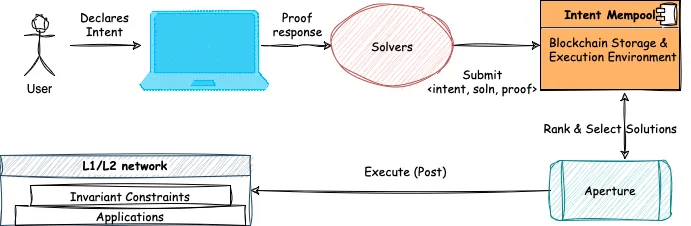
From an end-user perspective, a true intent-based user experience (Intents UX) has three key components that most DeFi dApps (execution level) currently do not have, namely:
1. A completely new user interface,Allows users to clearly express trading goals. Instead of just being faced with a bunch of options to choose “yes” or “no,” users can clearly describe their desired end state.
2. A Solver Network,Choose the best way for users through competition and achieve their goals flexibly.
3. Arbitration executor,Solutions provided by individual solvers can be accurately ranked and the selected final solution executed. The solver network is responsible for selecting solutions based on ranking, enabling solver accountability, and ultimately executing transactions between the dApp and the blockchain (“global composability”).
Building a new user interface requires a domain-specific language (DSL) through which the front-end can translate intents into intents that can be executed and verified on the blockchain. It is necessary to establish a solver network so that through competition, better rates and results can be brought to users.
In addition to these user-facing parts, any intent architecture must deal with abstracting away some set of issues from the user, such as:
1. Verifiability (global composability):The architecture requires a way to verify that the solution is truly true to the users intent. Standardizing verification methods is the innovation that truly unleashes “global composability”. In other words, if there is a standardized way to verify the final state via a quorum executor, no matter which chain or dApp is available, then users can get a truly global composability intent network.
2. Ranking (zero-knowledge proof):In addition to cross-chain and dApp validation, simulations and ranking of solutions are also required. Certain types of verification can be complex and unsuitable for on-chain proofing. Faced with this situation, zero-knowledge proofs (ZK) can reduce computational costs. This type of ZK solution does not have to be built from scratch, there are modular solutions such as Axiom or Brevis that can be used.
3. Privacy (Special Permissions Solver):Certain intents may reveal sensitive information that users wish to hide (e.g. fear of front-running attacks). A complete intent architecture can solve this problem by enabling special permission solvers. Special permission solvers are designed to handle privacy-related intents. These solvers have special trust credentials. Their privileged nature allows them to handle transactions that require stricter security and confidentiality.
4. Solver behavior that deviates from intention (punishment mechanism):To ensure that the solver fulfills the transaction as expected and does not engage in any malicious behavior, the system needs to implement a penalty system. A key point of the intent architecture is its enforcement liability system. If any malicious behavior occurs, such as reversing a transaction or other malicious events, the intent architecture has the right to punish such behavior. This not only protects the integrity of transactions, but also deters potentially malicious behavior by penalizing solvers.
Aperture’s universal intent architecture
Back to the example above:
Adjust positions for all my liquidity positions on all chains and all DEXs(Uniswap, Maverick and Sushiswap) to ensure that 60% of the funds are concentrated in the pool with the highest APR, 30% of the funds are concentrated in the pool with the second highest APR, and 10% are concentrated in the pool with the third highest APR.
This example describes an intention that is universal to all chains and DEXs. In the next article, we will explain Aperture’s grand vision for intent, a network of solver DAOs powered by a unified interface. In subsequent articles, we will continue to analyze Aperture’s 2024 roadmap and describe how we will build a universal intent architecture bit by bit from blueprint to implementation.





