






概览Rollup市场现状:正统性、主权性、模块化和Restaking争雄


Original author: NingNing (X: @0xNing0x)
One of the themes of the 23-year scalability competition market is that Rollup devours Alt L1’s TVL, users and ecological Dapps. Arbitrum, Optimism, Zksync, Starknet, etc., as the Knights Templar that protect the Ethereum ecosystem, have made great contributions to the Ethereum ecosystem.
But when Arbitrum tried to build a hub-and-spoke structure of L1-L2-L3 Rollup scalable route to consolidate its Rollup leading position and vested interests, things started to go wrong.
Fortunately, neither Optimism nor Zksync followed Arbitrums brutal actions, but chose the Stacks parallel structure and demoted themselves to the first instance of the Stack structure.
Moreover, even the Ethereum sidechain Polygon, which is not Ethereums sidechain, did not choose Arbitrums route. Instead, it chose to follow the route of Optimism and Zksync and launch the Stacks-like parallel structure Polygon CDK. However, the settlement layer of Polygon CDK is the Polygon PoS main network, not the Ethereum main network.
However, most of the Rollups deployed using Stacks SDK need to share data availability and settlement layers with it, and do not achieve true parallelism and sovereignty.
This is still far from the decentralized scalability architecture of 1024 shards + 1 shard to n Rollups in the Ethereum DankSharding sharding vision.
In the 24th year, stimulated by new primitives such as modularization and restaking, Rollup began to differentiate into four types: orthodox Rollup, sovereign Rollup, modular Rollup, and Restaking Rollup:
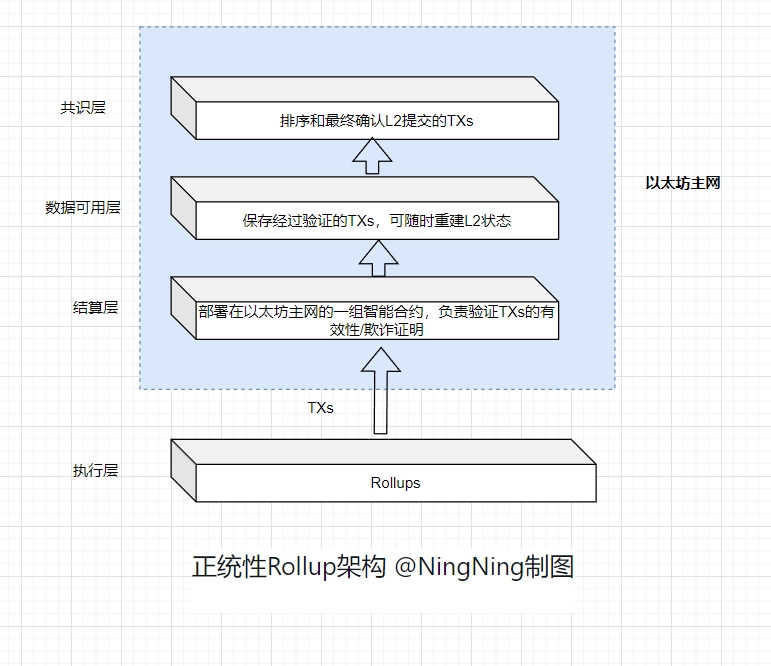
Legitimacy Rollup
Legitimacy Rollup actively pursues being one of the outsourcers of the Ethereum execution layer, pursuing EVM equivalence or even Ethereum equivalence. Optimism, Linea, and Scroll fall into this category. Arbitrum has the same architecture as them, but is less aggressive in pursuing Ethereum equivalence than the above three and is more developer-centric.
Sovereignty Rollup
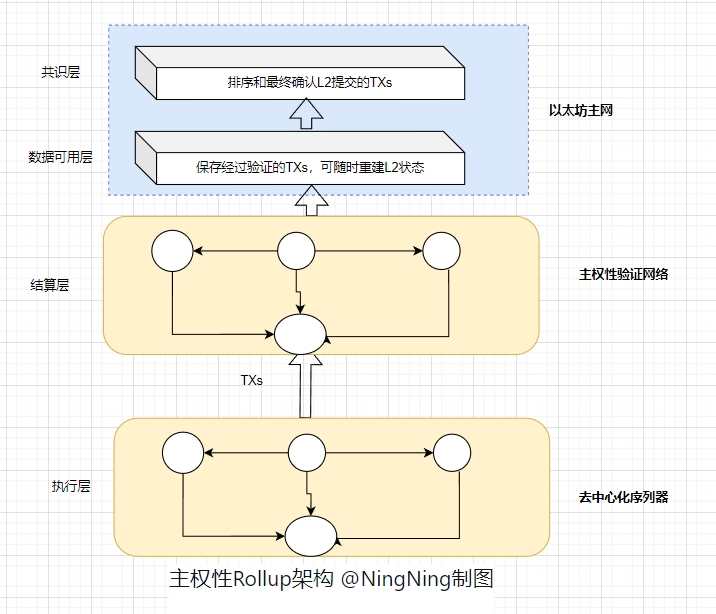
Sovereign Rollup is represented by Starknet jointly launched by Metis, Vitalik and Eli.
Their common architectural feature is a decentralized sequencer network and a sovereign verification network (settlement layer)
Because Metis uses the Op Rollup mechanism and Starknet uses the Zk Rollup mechanism, although their sovereignty verification network architectures both adopt the design idea of PBS (separation of block submitters and block builders), there are differences: Starknet’s sovereignty The verification network architecture adds some node roles, such as Prover (prover) responsible for generating ZKP (zero-knowledge proof)
And because the cost of submitting ZKP validity verification to the Ethereum main network is lower than fraud proof, Starknet still uses Ethereum as the consensus layer and data availability layer.
Metis, on the other hand, simply goes the distance and only uses the Ethereum mainnet as a memo storage or bulletin board. Its relationship with the Ethereum main network is similar to the current relationship between most Bitcoin L2 and the Bitcoin main network, which can be said to be full of sovereignty.
Modular Rollup
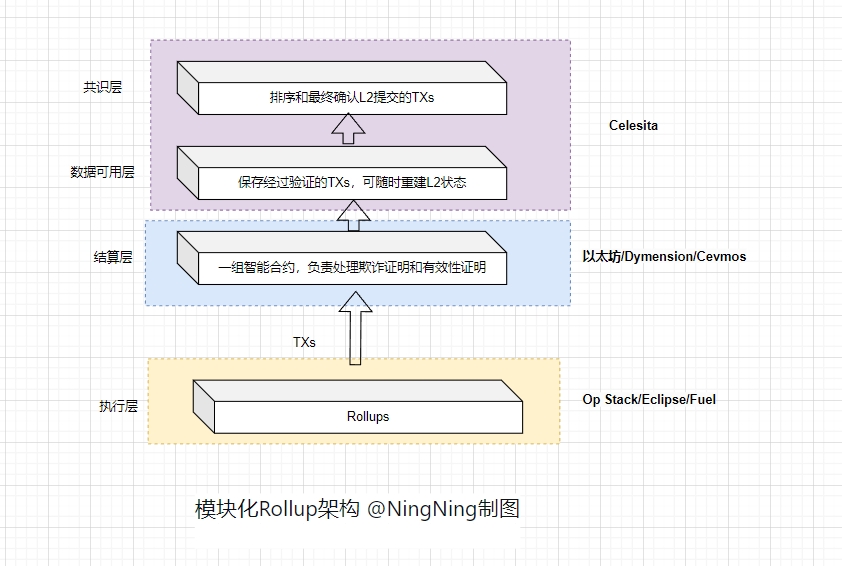
Modular rollups are currently divided into two sub-types: universal rollups such as Manta and Dapp rollups such as Aevo and Lyra.
The current state of modular Rollup makes people feel that it is just changing the DA layer from Ethereum to modular blockchain DA such as Celesita and Avail.
But such an idea ignores the deeper meaning of modular rollup, that is, modular rollup is an innovation and challenge to the current mainstream rollup hub-and-spoke structure.
Modular Rollup gives Dapp developers the ability to escape from the control of Ethereum and universal L2, which can alleviate the current strange phenomenon of building Rollup for the Ethereum Foundation and VC, and return to the user-centered product paradigm.
Restaking Rollup
Restaking Rollup is a new primitive jointly launched by Raas service provider AltLayer and EigenLayer.
Compared with Metis in sovereign Rollup, its verification network and consensus network are guided from the EigenLayer AVS node network, and its economic security comes from Restakings ETH and LST, and its security is higher than that guaranteed by L2 native protocol tokens.
Restaking Rollup inserts a relay layer named AltLayer Vital before the settlement layer, and inserts a relay layer named Altlayer Mach before the consensus layer and data availability layer, which carry the settlement layer, consensus layer and data respectively. Some features of the available layers.
Such an architecture can improve Rollups security, final confirmation, and reduce data availability verification costs.
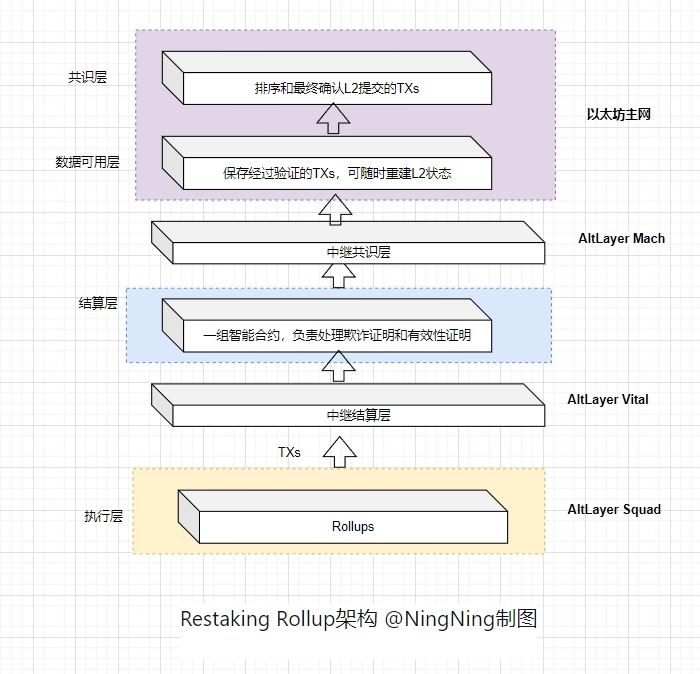
Restaking Rollup also significantly reduces the threshold and cost of deploying Rollup. Currently, Altlayer supports deploying one Rollup in 5 minutes with zero code.
Among the above four types, the orthodox rollup and the sovereign rollup are dominated by the general rollup, occupying the majority of the market share. However, their deployment and operation costs are very heavy and are not suitable for Dapp developers.
The modular Rollup and Restaking Rollup of the light protocol paradigm gave Dapp developers new choices in 2024.


