






一文速览LRTFi的原理、生态和玩法


Original author: Biteye core contributor Louis Wang
Original editor: Biteye core contributor Crush
Original source: Biteye
1. Ethereum staking wave
After Ethereum entered the 2.0 era, staking ETH to run nodes became a new business. Qualified node operators can obtain about 4% of the ETH currency standard income every year. If you are bullish on ETH in the long term, it is a very good financial choice.
But in fact, the threshold for running a node is not low. It requires not only a capital threshold of 32 ETH, but also technical and hardware thresholds for the node to run stably. If you accidentally go offline, you will be fined.
As a result, a number of staking projects such as Lido and Rocketpool came into being to help users solve financial and technical problems.
The number of ETH pledges continues to rise. Currently, there are more than 29M ETH pledged in the beacon chain, with the total locked position value reaching $71B. The pledge ratio has increased from 2.4% in January 21 to 24.4% now.
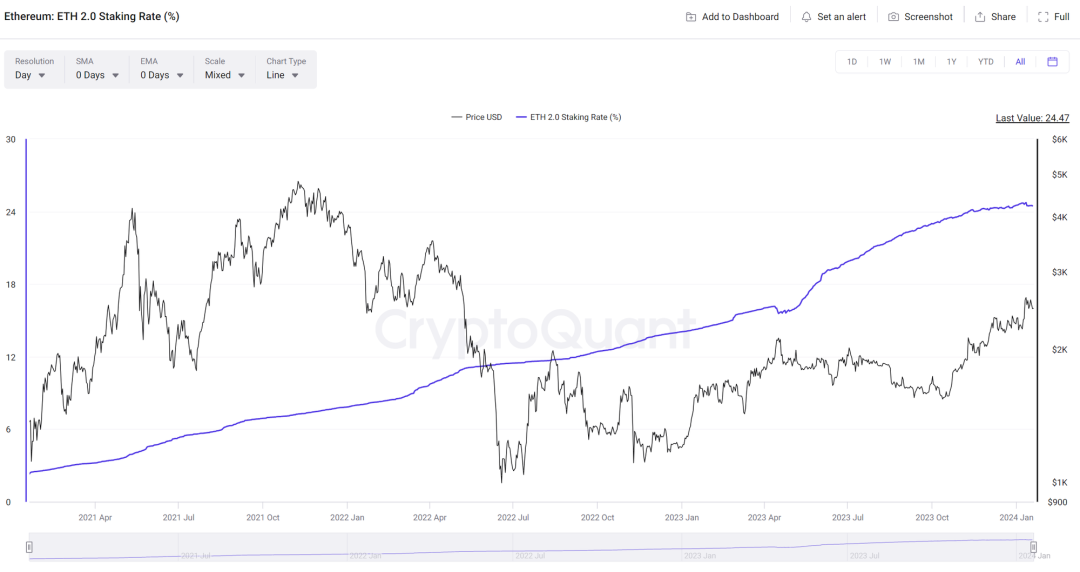
(Source:https://cryptoquant.com/asset/eth/chart/eth2/eth-20-staking-rate-percent)
2. Liquid Staking Token (LST) and LSD (Liquid Staking Derivatives) Fi
When users use a staking protocol, such as Lido, they will receive a liquid staking token (LST), such as stETH.
LST itself is an ERC 20 token, so it is easy to build a liquidity pool to reactivate this part of the locked liquidity and continue to invest in LSDFi projects, such as Frax and Origin, to obtain more Matryoshka income.
(Source: https://facts.frax.finance/frxeth)
LSDFi is a DeFi project built on the basis of LST and LST derivatives, such as Pendle. After depositing stETH, you can obtain principal tokens and income tokens, thus deriving income strategies based on different risk preferences.
3. From pledge to re-pledge
Node staking essentially allows users to pay deposits to run nodes and maintain project security. Nodes that perform their duties conscientiously will receive benefits, while those who fail to perform their duties or commit evil will forfeit their deposits.
Therefore, not only public chains need nodes, but also cross-chain bridges, oracles, DA, such as Chainlink, the Graph, Celestia and other various projects, all require pledges to ensure the stability and security of their nodes.
The number, quality and huge capital investment of Ethereum nodes make it the most reliable public chain.
However, any module that cannot be deployed or verified on the EVM cannot take advantage of the trust of the Ethereum network and requires someone to run the node and provide Active Verification Service (AVS).
And running nodes requires users to spend real money to ensure safety, which is bound to be difficult under the premise of limited liquidity.
The solution proposed by EigenLayer is to allow other AVS to inherit and share the security of Ethereum through re-pledge.
(Source:EigenLayer)
Essentially, EigenLayer provides a pool security mechanism and a security market, that is, multiple projects can share the Ethereum security pool, and users need to weigh the benefits and risks provided by each project to choose to join or exit in EigenLayer The re-pledge module built on.
The economic benefits of re-pledge are obvious.
For users, they can eat more with one fish, staking a share of Ethereum, and reap the staking rewards of multiple projects, including airdrop expectations for unissued currency projects (especially EigenLayer);
For the project side, while reducing the pressure to obtain pledged funds, it can also inherit some of the security of Ethereum.
Of course, this is not a completely risk-free win-win outcome.
For the project side, the pledged token is Ethereum instead of its own token, which reduces its ability to capture the value of the token;
Users have an additional layer of EigenLayer trust in their pledge, adding a layer of risk.
For Ethereum, it is even less satisfactory. It is equivalent to one employee working multiple jobs. And due to the additional staking income, without restrictions, users are definitely more willing to pledge Ethereum into EigenLayer instead of directly pledging Ethereum. If the employee is slashed for any reason in another company (perhaps due to a violation of discipline or wrongful punishment by the company), this will in turn affect his or her pledge in Ethereum and even cause the node to become invalid. , shaking the security of the Ethereum network. Therefore, V God previously issued an article stating that not to overload the consensus of Ethereum, just click on EigenLayer.
4. Liquid Restaking Token (LRT) and LRTFi
For users, staking to EigenLayer is a good choice with multiple benefits, but it faces several problems:
Pledge does not go into EigenLayer. Because EigenLayer is so popular, the types and amounts of LST that are allowed to be pledged are currently very limited, so it is difficult for users to squeeze in;
After depositing ETH or LST, the liquidity is locked again;
The selection of node operators, risk management of participating projects, etc., all increase the complexity of strategy research exponentially.
Therefore, the emergence of the LRTFi project mainly solves these problems and lowers the threshold for re-pledge.
LRTFi will return liquidity to users in the form of LRT from the ETH/LST pledged into EigenLayer;
As for the points of EigenLayer, they can either be mined by the project itself before the transfer, or mined through EigenPod (EigenLayer allows re-pledge directly on the beacon chain, with no quota limit);
Better risk management strategies, such as Puffer’s anti-Slashing mechanism (preventing nodes from being slashed).
The income of LRT is built on top of LST, and there will obviously be higher returns. At the same time, LRT projects will also have higher risks. The main risks are as follows.
The contractual risks of multiple agreements are matryoshkas, so be sure to choose audited LRT projects carefully;
LRT projects also involve many assets, so they also include the risk of pledgeable LST;
Participating in more AVS for high returns will lead to increased margin penalty risk exposure;
In addition, there is the liquidity risk of LRT itself. Like LST, there will also be phenomena such as de-anchoring. These are the risks of participating in the LRT project.
5. LRT project
Currently, LRT projects have been launched including EtherFi, Renzo, Swell and KelpDAO, and nearly ten more are on the test network. There is not much difference in the gameplay of the projects. The difference is mainly in the ability to mine EigenLayer points and exit liquidity. The next step is Let me introduce to you these four projects that have been launched.
Ether.Fi
EtherFi completed a $5.3 million seed round in February last year and currently has a TVL of over $330 million.
Users can get $eETH by depositing ETH, and by participating, they can get EigenLayer points and EtherFi’s own loyalty points at the same time, which are both reference standards for subsequent airdrops. It is also very convenient to withdraw from liquidity. Currently, the unstake function is online, and withdrawal friction is small.
(Source:https://defillama.com/protocol/ether.fi)
Furthermore, $eETH can be deposited into Pendle to split PT and YT. Currently, YT has a high premium. If you sell it immediately, you will get 10% profit. The remaining PT can be redeemed for the entire principal after maturity. gold.
For specific operations, please see:
Eat three fish with one fish: use Pendle to get ten times EigenLayerPoints Tutorial
(Source:https://app.pendle.finance/trade/markets)
Renzo
Renzo, which has previously disclosed less information, has jumped on the news last week after announcing a $3.2 million seed round led by Maven 11, which now stands at $100 million.
In addition to ETH, Renzo also supports LSTs such as rETH, cbETH, and stETH. Renzo’s LRT token is $ezETH, and it has launched a points program called Renzo ezPoints. The way to obtain points is to mint $ezETH. There is currently no way to withdraw from liquidity.
(Source: https://defillama.com/protocol/renzo)
KelpDAO
KelpDAO is launched by the old project Stader. Similarly, after staking, you can get LRT $rsETH and you can get KelpDAO points.
After EigenLayer opens deposits on January 29, all coins currently deposited will be transferred to EigenLayer and double points will be obtained.
Compared to other projects, there are fewer airdrop expectations, and Stader’s token $SD is already available. Moreover, KelpDAOs pledge is through EigenLayers LST open pledge, so there is an upper limit on the funds that can be accommodated, but it cannot be withdrawn temporarily.
(Source:https://defillama.com/protocol/kelp-dao)
Swell
Swell is an LST project and has joined the ranks of LRT. Users can deposit ETH to earn staking income, or use swETH to participate in projects such as Pendle.
Its Super swETH product allows users to deposit ETH or stETH and earn up to 18% annualized returns. In addition to staking income, you can also obtain Pearls (pearls, similar to a point certificate), which may be exchanged for Swell tokens during TGE.
The current TVL of the protocol exceeds $425 M. If you deposit swETH, you will not be able to obtain EigenLayer points until EigenLayer opens mining on January 29. rswETH with the subsequent launch of LRT can directly participate in dual mining. It is also very convenient to withdraw liquidity. There is a trading pool and you can directly Swap for ETH.
(Source: https://defillama.com/protocol/swell)
Puffer
Puffer is based on the liquidity staking protocol on Eigenlayer. It is a very technical re-staking project. It received early funding from the Ethereum Foundation to develop Secure-Signer technology to reduce the risk of slashing and maximize the efficiency of independent operators. quantity, thus achieving network decentralization.
Puffers node is both a verification node of Ethereum and a native node on EigenLayer, so it can obtain Ethereum rewards and Eigenlayer re-staking rewards at the same time. Puffer received $5.5 million in seed funding from investors including the founders of EigenLayer.
Both Ethereum and EigenLayer have penalty mechanisms. The private key security and penalty resistance of the Puffer node are jointly protected by Secure-signer, RAV software and TEE hardware, effectively reducing the risks of LSD and LSDFI assets.
The summary table of projects that have been launched is as follows:
LRT projects based on EigenLayer are relatively complex and involve all aspects of details.
For example, the types of tokens that can be pledged (ETH, LSTs), the token of the protocol itself (LRT), the source of rewards distributed, the protocol charging model, and the way to pledge to EigenLayer (whether through LST pledge or EigenPod pledge, which determines the protocol capital cap).
Similar to the LST project, under the premise of contract audit security, the earlier the LRT project goes online, the easier it is for the protocol to have a first-mover advantage and build its own brand and network effect.
The funds on the market are limited, so it is crucial to seize the opportunity and lead the market. However, LRT has its complexity, and how to manage risks is also a major competitiveness of LRT projects.
The LRT project, like the LST project, will seek cooperation with DVT technology projects, such as Obol and SSV, in order to ensure stable node operation; lending, dex, and derivatives based on LRT will gradually appear; in addition, it will provide services for multi-chain projects Support will also be one of the development directions of the LRT project.


