






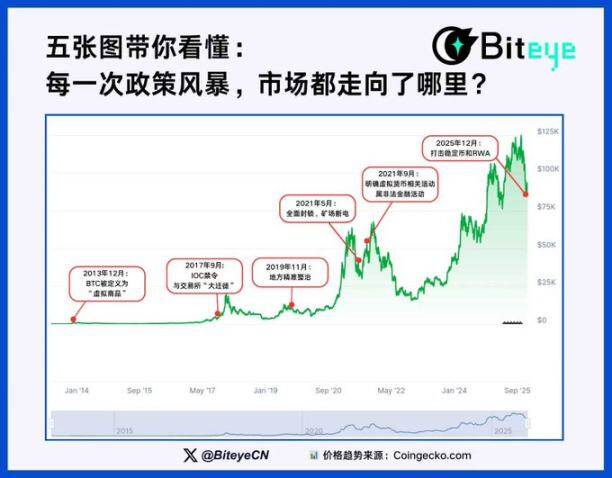
Five charts to help you understand: Where does the market go after every policy storm?


- 核心观点:中国监管趋严,但加密市场已全球化。
- 关键要素:
- 2025年底七大协会发布风险提示,点名稳定币、RWA等。
- 回顾历史,监管多在市场过热时出手,短期冲击市场。
- 长期看,政策未改比特币上行趋势,市场主导权已外移。
- 市场影响:或加速资金与项目出海,短期情绪承压。
- 时效性标注:短期影响。
Original authors: Viee, Amelia, Denise, Biteye Content Team
Recently, seven major financial associations in mainland China issued new risk warnings, specifically naming various virtual assets such as stablecoins, RWA, and worthless cryptocurrencies. While Bitcoin has not shown any significant fluctuations, the recent cooling of market sentiment, shrinking account balances, and USDT's off-exchange discount have brought to mind past rounds of policy tightening.
Since 2013, mainland China has been regulating the crypto sector for twelve years. Policies have been introduced time and again, and the market has responded accordingly. This article aims to review the market reactions at these key junctures, and also to clarify one question: After regulations were implemented, did the crypto market enter a period of dormancy, or will it gather strength for a renewed surge?
2013: Bitcoin was defined as a "virtual commodity".
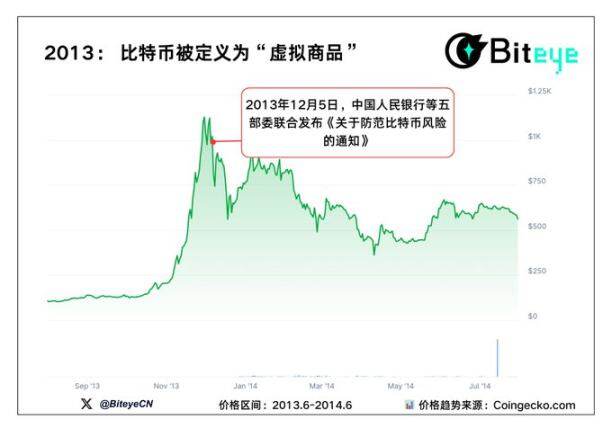
On December 5, 2013, the People's Bank of China and four other ministries jointly issued the "Notice on Preventing Bitcoin Risks," which for the first time explicitly defined Bitcoin as a "specific virtual commodity," lacking legal tender status and not belonging to the category of currency. At the same time, it prohibited banks and payment institutions from providing services for Bitcoin transactions.
The timing of this announcement was also delicate, coming just after Bitcoin hit an all-time high of around $1,130 at the end of November. In early December, Bitcoin's price was still fluctuating between $900 and $1,000, but the market cooled rapidly a few days after the policy was implemented. Throughout December, Bitcoin closed at around $755, a monthly drop of nearly 30%.
In the following months, Bitcoin entered a prolonged period of downward fluctuation, with prices generally ranging between $400 and $600. This pullback from the peak essentially signaled the end of the 2013 bull market. Bitcoin's price remained below $400 until the end of 2015.
The first round of regulation extinguished the early frenzy and also kicked off the game between "policy and market".
2017: The ICO Ban and the "Great Migration" of Exchanges
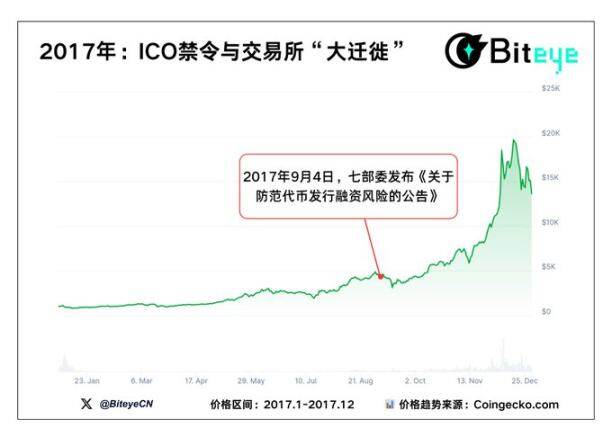
2017 was an extremely tumultuous year for the cryptocurrency market, and also a year of the most decisive regulatory action. On September 4th, seven ministries jointly issued the "Announcement on Preventing Risks of Token Issuance Financing," defining ICOs as illegal fundraising and requiring all domestic exchanges to shut down. Bitcoin closed at around $4,300 that day. However, in the week following the policy announcement, BTC briefly fell to as low as $3,000.
While this round of regulation temporarily severed the dominance of mainland exchanges, it failed to shake the foundation of the global bull market. As trading activity rapidly shifted to Singapore, Japan, South Korea, and other locations, Bitcoin experienced an accelerated rebound after completing a phase of consolidation. Starting in October, it rose steadily, and three months later, in December 2017, the closing price of Bitcoin had soared to $19,665.
The second round of regulation brought about a short-term shock, but it also inadvertently promoted the spread of globalization.
2019: Targeted Local Rectification
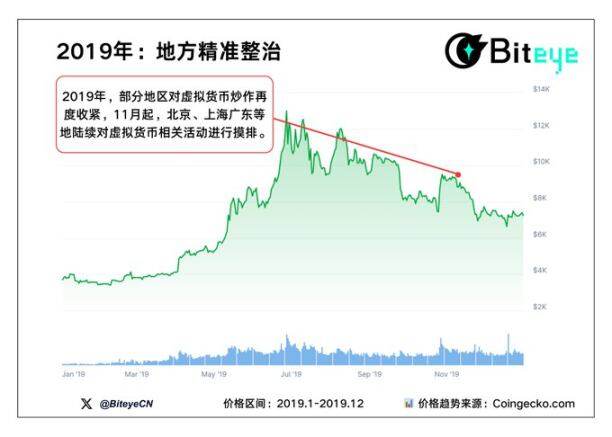
Starting in November 2019, Beijing, Shanghai, Guangdong, and other regions successively investigated virtual currency-related activities, shifting the regulatory approach to "targeted local rectification," without relaxing the intensity. That month, Bitcoin fell from over $9,000 at the beginning of the month to around $7,700, and market sentiment was depressed.
The real turning point occurred the following year. In 2020, driven by halving expectations and global monetary easing, Bitcoin embarked on a bull market warm-up from $7,000 to over $20,000, successfully connecting to the epic bull market of 2020-2021.
The third round of regulation, in a sense, cleared the path for the next phase of upward movement.
2021: Complete lockdown, power outage at mines
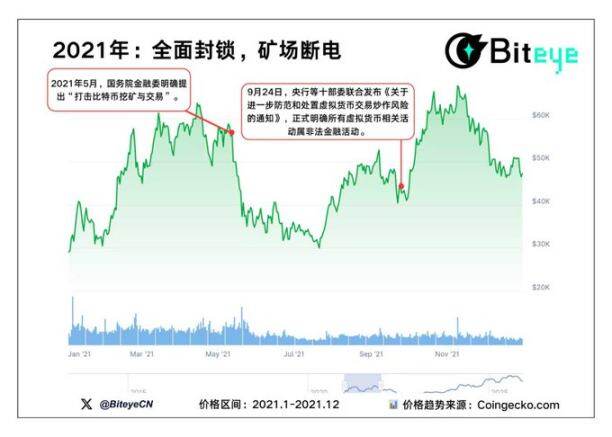
In 2021, regulatory intensity reached its peak. Two landmark events occurred that year, completely reshaping the global cryptocurrency market. In mid-May, the State Council Financial Stability and Development Committee explicitly proposed "cracking down on Bitcoin mining and trading." Subsequently, major mining provinces such as Inner Mongolia, Xinjiang, and Sichuan successively introduced policies to shut down mining operations, resulting in a nationwide "power outage wave for mining machines." On September 24, the People's Bank of China and ten other ministries jointly issued the "Notice on Further Preventing and Handling Risks of Virtual Currency Trading and Speculation," formally clarifying that all virtual currency-related activities are illegal financial activities.
In May, Bitcoin fell from $50,000 to $35,000. Entering June and July, BTC traded sideways in the $30,000-$40,000 range, with market sentiment at its lowest point. Bitcoin then bottomed out and rebounded in August, continuing its upward trend driven by optimistic expectations for global liquidity, ultimately reaching a new all-time high near $68,000 in November.
The fourth round of regulation can set boundaries, but it cannot stop the global redistribution of computing power and capital.
2025: The Expected Reversal - From "Innovation Exploration" to "Comprehensive Tightening"
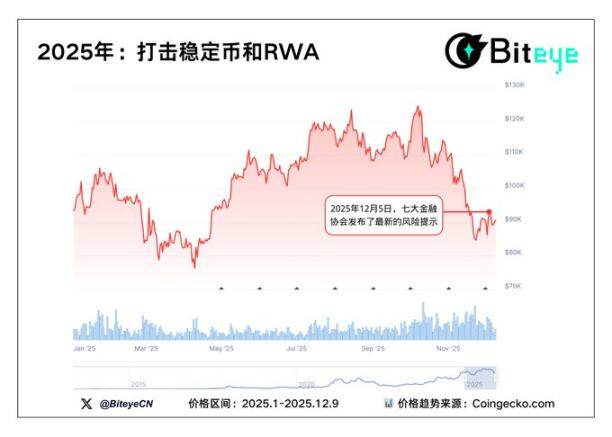
The regulatory narrative for 2025 is full of dramatic twists and turns. In the first half of the year, a series of signals gave the market a sense of "thawing ice," and a cautiously optimistic mood permeated the industry: from the discussions in Hong Kong about the framework for issuing stablecoins to the "Malu Grape" blockchain project in the suburbs of Shanghai, the market began to discuss the possibilities of "compliance paths" and "Chinese models."
The winds shifted abruptly at the end of the year. On December 5th, seven major financial associations jointly issued a risk warning, the core message of which was very clear:
- It is clear that cryptocurrencies are not legal tender.
- The report specifically targets and cracks down on popular concepts such as "air coins," stablecoins, and RWA.
- Not only are domestic transactions prohibited, but advertising and referral programs are also banned, indicating that regulations are becoming more detailed.
The core upgrade of this risk warning lies in the fact that it not only reiterates the illegality of virtual currency transactions, but also extends to the most popular sub-sectors (stablecoins, RWA) and promotional activities for the first time.
So, how will the market move this time? Unlike in the past, Chinese funds are no longer the dominant force in the market; Wall Street ETFs and institutional holdings have become the new main drivers. We can see that USDT is trading at a negative premium, indicating that many people are rushing to convert their USDT back to fiat currency and exit the market.
Market Voices: A Summary of KOL Opinions
Renowned media personality Wu Shuo (@colinwu) advises everyone to pay attention to the movements of CEXs (Consumer Exchanges) from an operational perspective. The real direction will depend on whether the platforms restrict domestic IP addresses, KYC registration, and C2C functionality.
XHunt founder @defiteddy2020 compared the crypto policies in mainland China and Hong Kong, believing that the stark contrast reflects different market positioning and regulatory philosophies.
Solv Protocol co-founder @myanTokenGeek believes this round of regulation may have two consequences: first, users and projects will accelerate their overseas expansion; second, underground gray channels will make a comeback.
Liu Honglin, founder of Mankiw Law Firm in Shanghai (@Honglin_lawyer), added from a legal perspective that many RWA-type projects are indeed non-compliant, using compliance as a pretext for fundraising and pump-and-dump schemes, which is essentially no different from fraud. For teams that are genuinely committed to doing real work, going global is the only solution.
Crypto OG @Bitwux believes this is simply official confirmation of something the industry already knew, and the impact will be limited. The regulators are merely reiterating old news, with the main focus likely on preventing the leakage of gray-market channels.
Independent trader @xtony1314 stated that this is being led by the police, and it's no longer just talk. If enforcement actions and restrictions on trading platforms follow, it could trigger a wave of "voluntary exodus + market panic."
Independent trader @Meta8Mate believes that every time a concept becomes overheated, there will be risk warnings. 2017 was ICOs, 2021 was mining, and this time it's stablecoins and RWA's turn.
In conclusion: Storms never stop the tide from going in the right direction; they only change the course of the journey.
Looking back over these twelve years, we can clearly see a continuously evolving and goal-oriented logical thread:
Regulatory policies have remained consistent, necessary, and reasonable. A grain of sand in the grand scheme of things can become a mountain on an individual's shoulders. The impact of regulatory policies on the industry is undeniable, but we must acknowledge that regulation aims to protect investors from uncontrollable financial risks and maintain the stability of the domestic financial system.
Regulatory interventions are characterized by a clear "timing." Policies are often introduced when market enthusiasm reaches its peak or a local climax, aiming to cool down the risks of overheating. This has been the case from the tail end of the bull market in 2013, the ICO frenzy in 2017, to the mining boom in 2021, and now to the rising hype surrounding stablecoins and RWA concepts.
The long-term effects of policies are waning. Apart from the first round of regulation in 2013, which directly ended the bull market cycle at the time, subsequent strong interventions (shutting down exchanges in 2017 and cracking down on mining in 2021) have not changed the long-term upward trend of Bitcoin.
Bitcoin has become a "global game." Wall Street ETFs, Middle Eastern sovereign wealth funds, European institutional custody, and even the consensus of global retail investors collectively form the main support for the current price.
A key conclusion is that the binary structure of "strict defense by the East" and "pricing dominated by the West" may become the new normal in the crypto world.


