






比特币生态新贵:B²土壤孕育的下个DeFi Summer


Original - Odaily
Author-husband how
The last bull market was the first shot fired by the DeFi sector. As for which sector will be the core driving force of the upcoming new bull market, everyone has recently formed a certain consensus - the Bitcoin ecosystem will take the lead.
The most important criterion in ecology is the degree of ecological prosperity. In other words, the degree of prosperity represents the wealth effect in a certain sense. The place where the wealth effect in the ecosystem gathers the most is in the DeFi sector, as Paul Veradettakit, a partner at Pantera Capital, released one of the six major predictions in the crypto field in 2024: the resurgence of Bitcoin and DeFi Summer 2.0.
However, if the Bitcoin ecosystem wants to undertake the development of the DeFi sector, it cannot be achieved by relying solely on the performance of the Bitcoin network.
Due to the particularity of Bitcoin, the external smart contract function is very simple and cannot handle a large number of complex applications. Is it possible to follow the example of the Ethereum second-layer network and use Bitcoin as the settlement layer to open up a new second-layer network for the Bitcoin network to help it undertake the operation of applications?
However, looking at the second-layer protocols of the Bitcoin ecosystem, most projects have short introductions, and most of them focus on the new narrative to create excitement. Too many projects have no possibility of implementation. Odaily recently paid attention to B² Network’s release of the pledge mining activity B² Buzz. By the way, it conducted research on B² Network and found that the network structure model and related details introduced in the white paper of the project are relatively complete and eye-catching.
In the following, we will introduce the basic overview of B² and elaborate on the technical implementation and ecological status.
Based on tradition and supplemented by ZK technology, build a ready-to-use layer 2 network
B² Network uses the Bitcoin network as the settlement layer, uses the Taproot block space to record and verify the transaction proof of the second-layer network, and builds a zk-proof second-layer network that is compatible with EVM. B² Network’s move combines the advantages of the Bitcoin network and Ethereum’s two-layer structure.
The technical architecture of B² Network is generally divided into two aspects, namely the Rollup layer and the data availability layer.
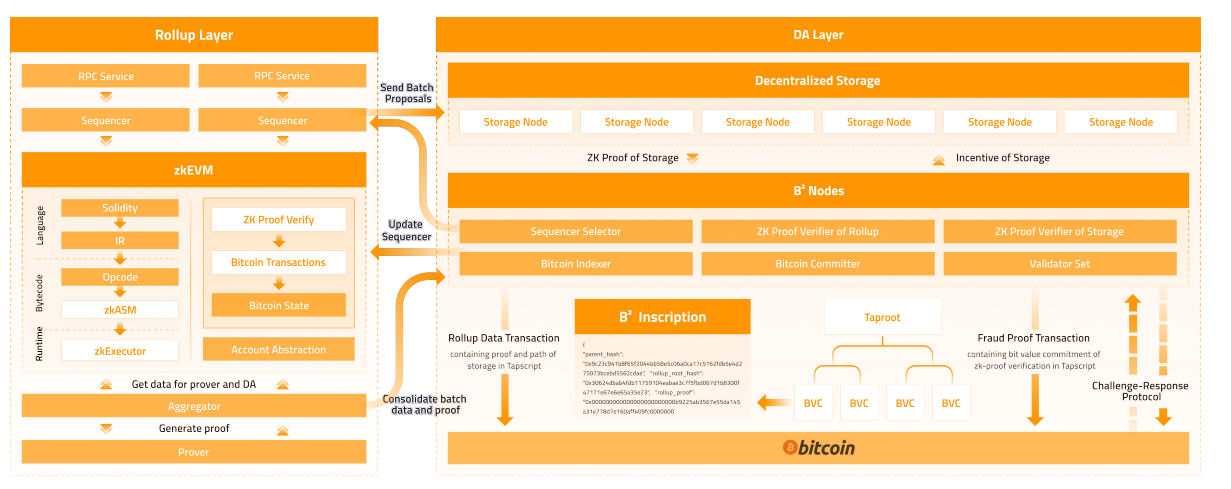
According to the above figure, the two structures verify and cooperate with each other to maintain the stable operation of the entire network. However, it involves the cross-fitting of multiple components. We will introduce different components of different structures separately.
Rollup layer: clear structure and complete functions
The Rollup layer is the execution layer of B² Network and uses ZK-Rollup as the underlying technical architecture. This layer consists of multiple components, including the Account Abstraction Module, RPC Service, Memory Pool, Sequencer, zkEVM, Aggregator, Synchronizer, and Prover Account Abstraction Module.
The Account Abstraction Module allows users to use contract accounts controlled by Bitcoin private keys, Ethereum private keys, or email. Users can use contract accounts to generate sub-accounts for different devices or DApps, and perform default operations or checks based on settings, such as account initialization, email account DKIM verification, transaction verification, account recovery, permission management, and asset locking. The account abstraction module also provides a transaction packager service to help users pay Gas.
The RPC service allows users to initiate transactions or send signed messages through wallets or DApps. After initial verification by the B² RPC service, the transaction or signature details are sent to the mempool service or account abstraction processing. The transaction packager service verifies the message signature and generates corresponding transaction information based on the message content to implement the function of using other digital currencies to pay Gas or pay Gas on behalf of others.
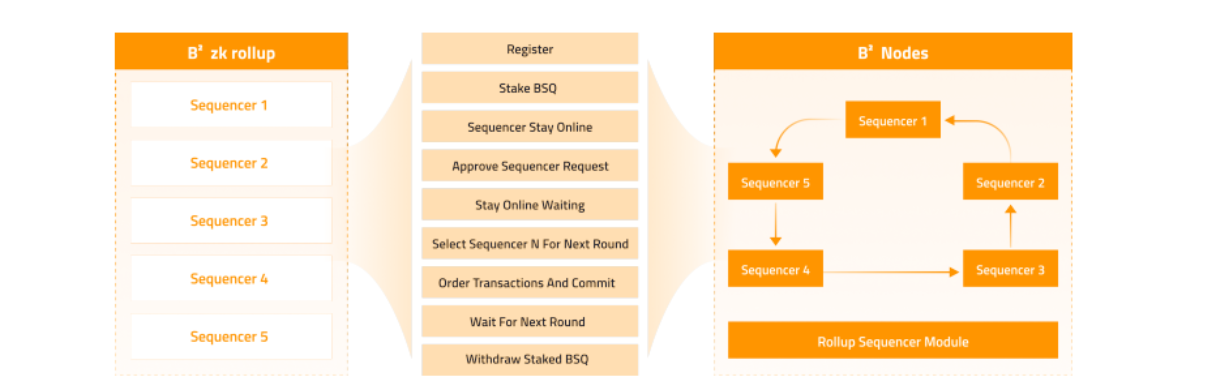
The memory pool is used to store pending transactions. The sequencer is responsible for sorting and packaging user-submitted transactions and then passing them to zkEVM for specific transaction execution. B² Network implements decentralized sequence services through B² nodes and updates the sequencer set through a DPoS-like mechanism.
zkEVM is compatible with the Ethereum Virtual Machine (EVM), helping developers build secure DeFi, NFT and other DApps. It also supports migrating DApps from other EVM compatible chains to B² Network. zkEVM is integrated with B² Network’s Bitcoin Index module to store Bitcoin’s state data, enabling developers to integrate the Bitcoin network into DApp development.
The aggregator obtains transaction information and status information sorted by the sequencer from zkEVM. They can generate zero-knowledge proofs, or aggregate transactions and collate proof details into transaction batch hash trees. This tree is sent to the data availability layer for backup, ensuring the availability of Rollup transaction data.
The role of the prover is to generate validity proofs for a batch of transactions submitted by the sequencer. From the transaction batch and state information obtained from the aggregator, the prover creates multiple ZK-STARK proofs and binds them together via STARK recursion to produce a single broad ZK-STARK. This ZK-STARK is transmitted to the SNARK builder through the CIRCOM component to generate a ZK-SNARK validity certificate, reducing Gas costs. The generated proof is returned to the aggregator.
The synchronizer ensures that information from the B² Network is synchronized to the Rollup layer, including sequencer information and Bitcoin transaction data.
To sum up, the Rollup layer obtains user transactions through the RPC service and stores them in the memory pool. After the sequencer sorts the transactions, zkEVM executes the transaction batching. The prover generates a zero-knowledge proof of the authenticity of the transaction. Through the aggregator, transaction and proof details are summarized and synchronized to the data availability layer, ensuring transaction authenticity, data security and availability.
DA layer: rigorous logic, multi-party verification
The data availability layer is the storage and verification layer of B² Network and consists of decentralized storage, B² nodes and the Bitcoin network.
The storage node receives the Rollup data sent from the sequencer of the Rollup layer and stores it in decentralized storage. The storage node runs B² Networks ds-prover program, regularly generates zero-knowledge proofs based on stored Rollup data, and sends the generated storage zk proof to the B² node. After passing the verification, the storage node will receive certain storage rewards. Storage nodes in distributed storage redundantly store copies of Rollup data, ensuring the data availability of B² Network.
B² nodes are off-chain validators and assume several unique functions. It consists of six main modules:
ZK proof validator for the Rollup module: Gets Rollup transaction data from decentralized storage, and gets the merkle tree root hash and zk proof data of the Rollup transaction from the aggregator of the Rollup layer. Internally, merkle tree root hashes are used for integrity checks on stored Rollup transactions, and zk proof data is used to verify the correctness and validity of transactions.
Storage modules ZK proof validator: Verifies storage zk proofs submitted by storage nodes of decentralized storage. After the verification is passed, the B² node distributes rewards to storage nodes, incentivizing them to persistently store copies of Rollup data.
Sequencer selector module: Implements a DPoS-like mechanism to select a group of sequencers to provide transaction sorting and packaging services for a specific period. Individuals or organizations competing to become a sequencer must stake a certain amount of tokens BSQ and prepare the necessary hardware resources. Users can delegate their tokens BSQ to candidates competing for sequencer positions. Candidates who operate a sequencer service can be rewarded with a percentage of transaction fees and additional tokens BSQ.
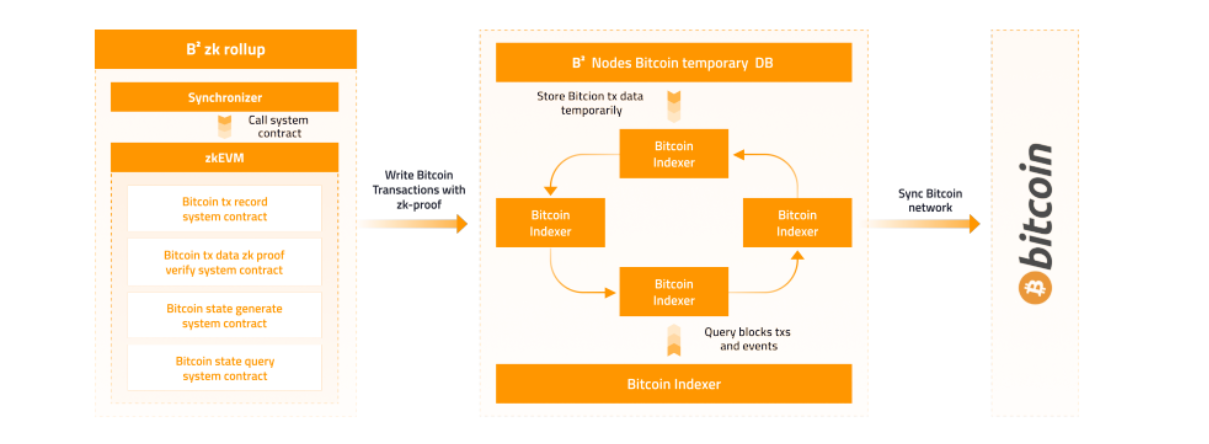
Bitcoin Index Module: Monitors blocks and transactions on the Bitcoin network. After obtaining the latest block and transaction, generate a zero-knowledge proof to ensure the accuracy of the transaction information, and send the transaction and corresponding zk proof to the Rollup layer. After zkEVM receives the Bitcoin transaction and the zk proof, it verifies it and generates the Bitcoin state.
Bitcoin Committer Module: Bitcoin Committer sends two types of transactions to Bitcoin: one writes Rollup data to Bitcoin, and the other writes zk proof verification commitment to Bitcoin.
Validator Set Module: The validator set module maintains Schnorr signature members on Bitcoin Layer 1.
Bitcoin Network: As part of the data availability layer, B² Network performs final confirmations through the Bitcoin network. The Bitcoin network allows users to recover all B² Rollup transactions via Bitcoin and verify their authenticity using zk proofs recorded on Bitcoin. B² Network validates commitments and challenge-response mechanisms via zk-proofs for final confirmation on the Bitcoin network. Bitcoin’s powerful Proof-of-Work (PoW) algorithm ensures the security of B² Rollup.
To sum up, the data availability layer stores, verifies and confirms the authenticity, integrity and availability of Rollup data through decentralized storage, B² nodes and the Bitcoin network. The design of this layer ensures the high security and reliability of B² Network.
Core strategy, innovation
The above mainly explains the core architecture of B² Network, but the more detailed solution is what really attracts the attention of B² Network. B² Network adopts the following four steps to use the Bitcoin network as the settlement layer to ensure the security of the second-layer network.
Convert the verification program of zero-knowledge proof into Bitcoin script: Convert the verification program of zero-knowledge proof into a logic gate circuit based on NAND gate, and implement NAND gate, addition gate and multiplication gate through Bitcoin script, and finally construct zero Verification procedures for knowledge proofs.
Circuit Taproot as B² Rollup promises: assemble Bit Value Commitment into logic gates to form a circuit binary tree, and use Circuit Taproot as the root node of the binary tree. Circuit Taproot reduces release size as a B² Rollup commit on Bitcoin.
Verification and response protocol: B² Network uses the UTXO transaction that releases the locked reward as the unlocking script and utilizes the Taproot script for unlocking. Prover generates each branch of the Circuit Taproot Tree in advance, given the hash of the input. Challenger uses preimage to execute the script and verify whether the output is consistent with Provers submission. If not, MAST can be leveraged to unlock the entire Taproot and receive locked bonuses.
Challenge Mechanism: B² Network uses a challenge mechanism, similar to Arbitrum Rollup’s “interactive verification game.” Observers can initiate a challenge and execute the gated Bitcoin script through a binary search to find the wrong branch. The challenger who finds the wrong branch the fastest can unlock the UTXO locking the reward and receive the reward. If the challenge is unsuccessful, Prover will unlock the UTXO through the time lock script after the challenge period ends and retrieve the reward.
Through the above technical principles, B² Network realizes consensus on Rollup data on Bitcoin, and uses the challenge mechanism and Taproot script to ensure the availability and security of the data.
But B² Network is not limited to the status quo. It recently launched B² Hub, which integrates the Bitcoin DA layer of the state transition proof system. B² Hub will use its self-developed ZK proof verification commitment technology to help other Bitcoin ZK-Rollups to be verified on the Bitcoin main network, thereby ensuring that the security level of the ZK-Rollup connected to B² Hub is consistent with the Bitcoin main network, which greatly Improve security.
How B² Hub works:
Any Bitcoin Rollup can leverage B² Hub to be verified on the Bitcoin network, saving time and reducing costs. B² Hub compiles the aggregated batch and attestation data into Tapscript and submits the zk-attested verification commitment in the form of Taproot. The modular DA layer has proven its success and effectiveness in various ecosystems.
Bitcoin’s second layer has become a new trend in the industry, and B² needs to stand out
When it comes to Bitcoin’s second-layer network, the first one to bear the brunt is the Lightning Network, which improves Bitcoin’s transaction speed and privacy by establishing payment channels between transaction parties. However, the Lightning Network is more of a channel to support Bitcoin P2P transactions, and it is unable to build and run applications.
The second-layer Bitcoin project currently running better on the market is none other than Stacks. Stacks is a Bitcoin smart contract layer that uses the Clarity language for smart contract involvement and supports BTC for asset atomic exchange and other functions.
To a certain extent, both B² and Stacks projects use the Bitcoin network as a data verification layer, but B² Network uses Taproot to record and verify the correctness of its own network operation, relying more on Bitcoin for its own security. coin network. On the contrary, Stacks relies more on regular recording on the Bitcoin main network and an independent consensus algorithm to ensure its own network security. The timeliness and security of the two are different.
However, the development of applications in the Stacks ecosystem is worth learning from B² Network. Currently, there are more than 80 projects in the Stacks ecosystem, with a relatively high degree of ecological richness, such as ALEX, BlockSurvey, Console, and Gamma, etc.
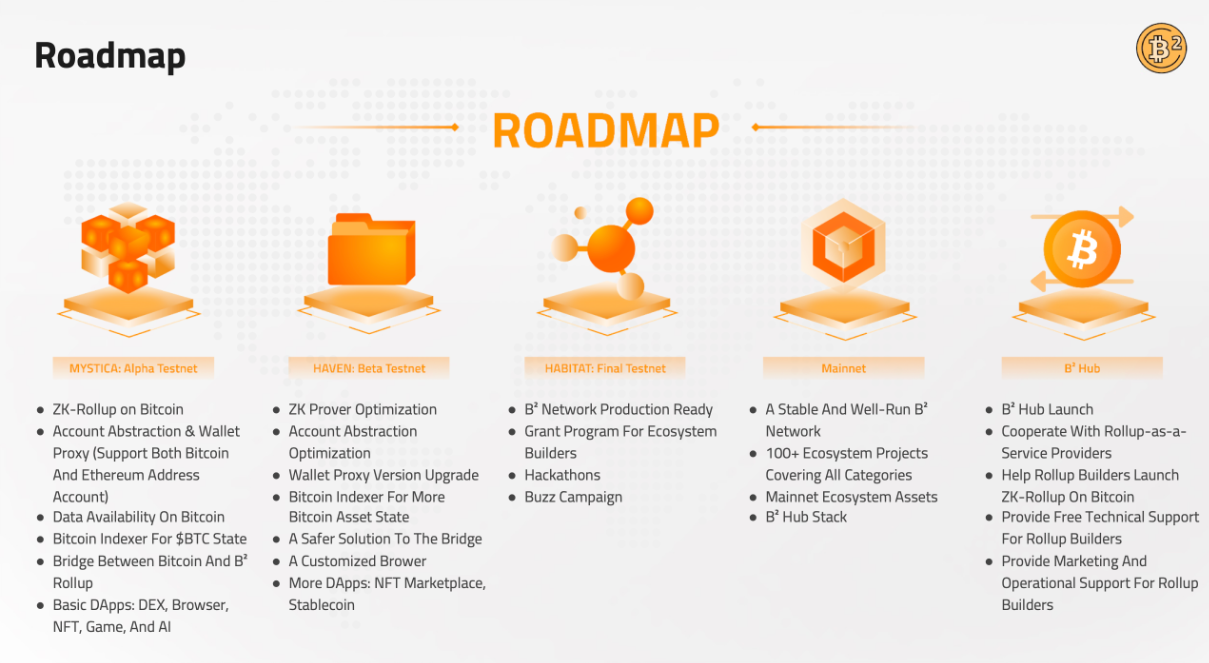
B² Network will go through three testnet stages, with different testnet stages testing operations based on different technical requirements. The Alpha version test network Mystica was officially launched for C-end users on December 25 last year. Users can experience Mystica by participating in the official Odyssey. It is reported that B² Network has opened the beta test network Haven. This version of the test network will support more third-party DApps and be open to the user side. Users can experience more DApps in Odyssey.
B² Network is not limited to the second layer of Bitcoin. Although the current second layer solution of Bitcoin has many rollups, B² Network truly realizes the verification of rollup commitment on the Bitcoin main network, which ensures that the security of rollup is consistent with that of Bitcoin. In order to solve the pain points in the industry, B² Network launched B² Hub, which provides DA layer services for other Bitcoin rollups, so that other rollups can focus on multi-faceted innovation without reinventing the wheel in terms of security verification. This will greatly accelerate the development of the entire Bitcoin ecosystem.
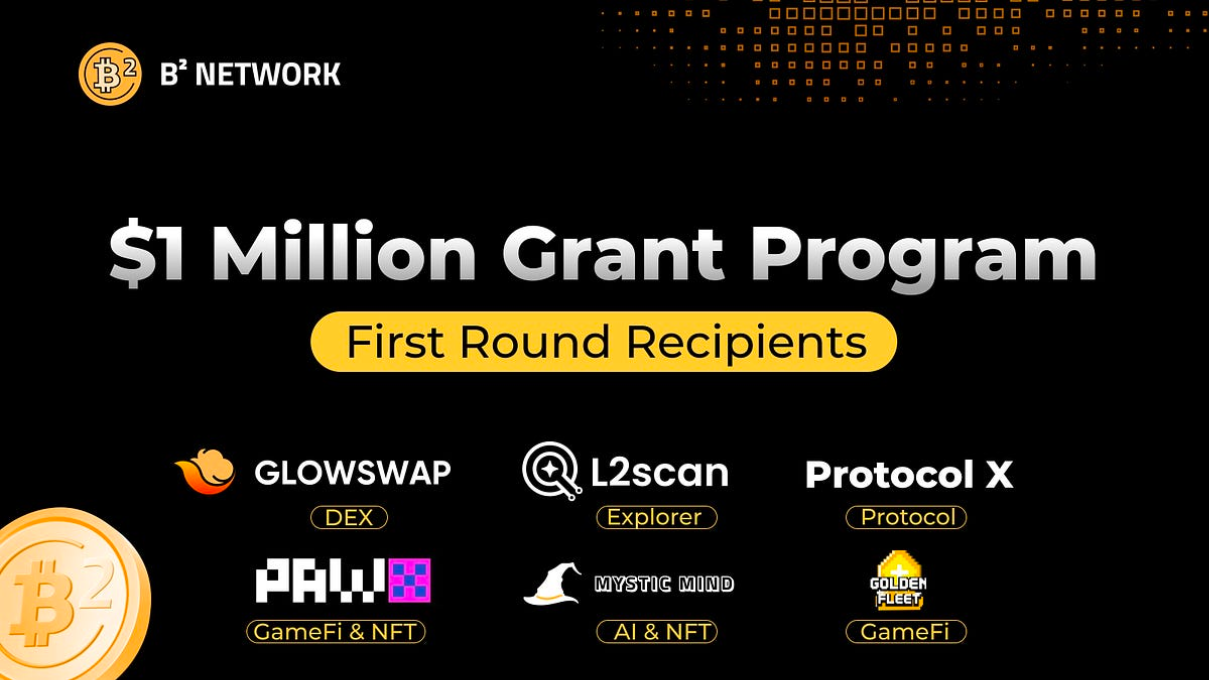
In addition, B² Network is also committed to building a healthy ecosystem. B² Network has previously released a million-dollar Grant plan, and last week announced the first batch of six projects funded by the Grant plan, namely GlowSwap, L2S can, Protocol X, PawX, Mystic Mind and Golden Fleet, and stated that Grant applications Open to developers long-term.
B² Network has also recently launched a staking mining activity, which will enhance the ecological gameplay. The Stake-to-Earn competition in the Ethereum ecosystem is fierce, while the BTC ecosystem has not yet started competition in this area due to its early stage of technological development. As a representative of high-quality Bitcoin second-layer projects, B² Network took the lead in firing this shot.
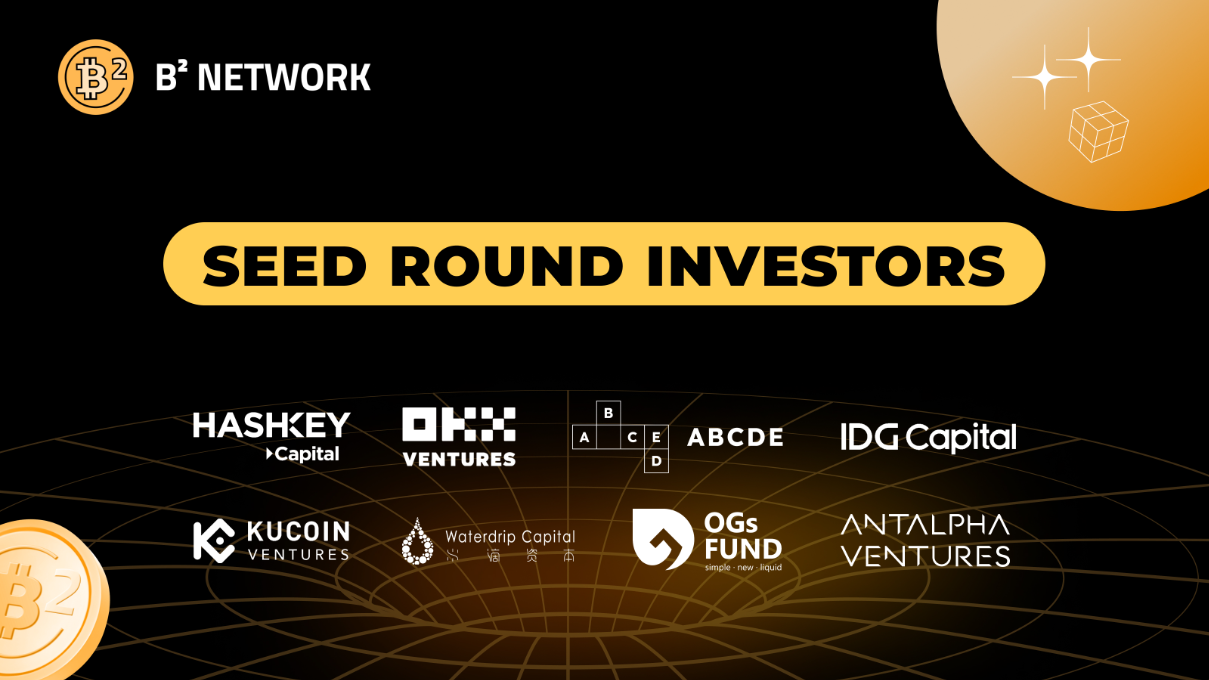
At the same time, B² Network also announced that it has recently received seed round financing from Hashkey Capital, OKX Ventures, ABCDE, IDG Capital, Kucoin Ventures, Waterdrip Capital, OGs Fund and Antalpha Ventures.
In general, with the support of many parties, it is worth paying attention to whether B² Network can win this battle for Bitcoin’s second-layer TVL.


